
Executive Overview
The 2026 Bayreuth Festival will long be remembered as a watershed moment for operatic production—a crucible where high-art tradition violently collided with the algorithmic frontier. Billed officially as “Ring 10010110 – From Myth to Code,” this experimental staging of Richard Wagner’s monumental Der Ring des Nibelungen sought to map the unconscious, cross-temporal architecture of human mythology onto a procedurally generated, AI-driven visual canvas. Curated by Marcus Lobbes and conducted with characteristic gravity by Maestro Christian Thielemann, the production eschewed traditional theatrical naturalism and hyper-political Regietheater in favor of something far more radical: a meditation on the unseen, mediated entirely through machine intelligence.
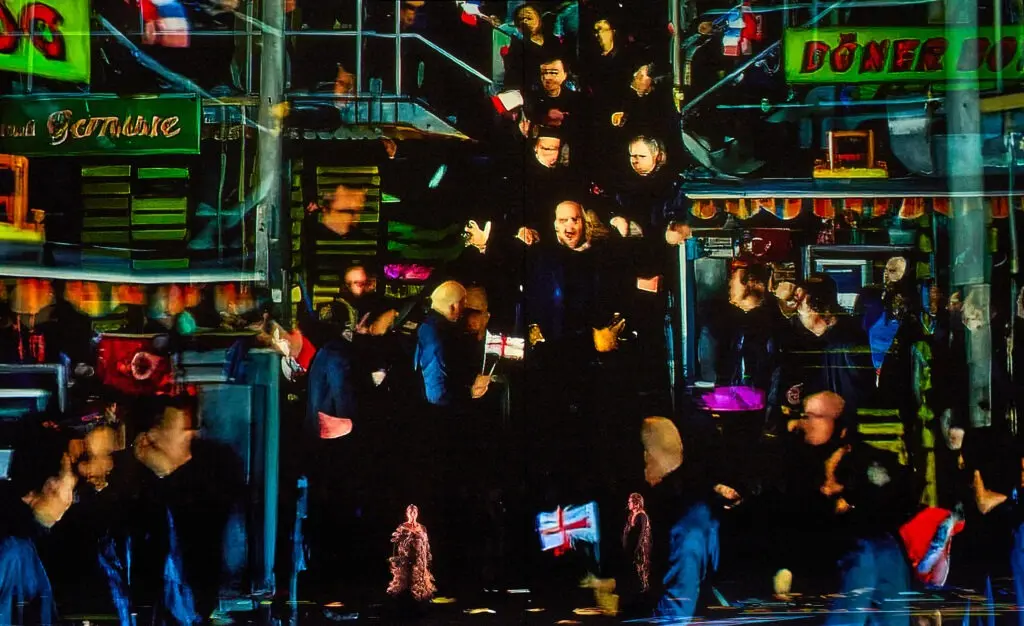
Yet, from the moment the Norns first drew their fateful threads in the Prologue of Götterdämmerung, the production ignited an immediate, often vitriolic firestorm among critics and traditionalists alike. Audiences accustomed to tangible stagecraft, narrative clarity, and psychological realism found themselves confronted by an unyielding barrage of shifting, hallucinatory imagery. Characters were swallowed whole by data-driven projections reminiscent of Carl Gustav Jung’s Red Book; performers were anchored to static, infrared-tracked positions behind gauze scrims; and historical visual citations spanning 150 years of Occidental culture flickered past like data packets on a fiber-optic cable.
Despite the near-unanimous outcry from mainstream critics who dismissed the staging as a cold, disorienting exercise in technological alienation, the production demands a more sophisticated reckoning. Far from being a mere gimmick, Bayreuth’s AI Ring was an audacious exploration of humanity’s psychological and technological trajectory. It forced spectators to confront the existential vertigo of the 21st century—globalization, climate collapse, and the Orwellian shadow of artificial intelligence—using Wagner’s timeless myth as a mirror. Beneath the storm of controversy lay a profound musical triumph, anchored by Christian Thielemann’s magisterial orchestral reading and a vocal ensemble of peerless distinction.
Detailed Chronology & Production Anatomy
To understand the spatial and psychological ecosystem of the 2026 Bayreuth Ring, one must examine how the tetralogy unfolded across its four evenings, moving from primordial creation to final cataclysmic dissolution.
The Prologue and the Norns: Weaving the Code
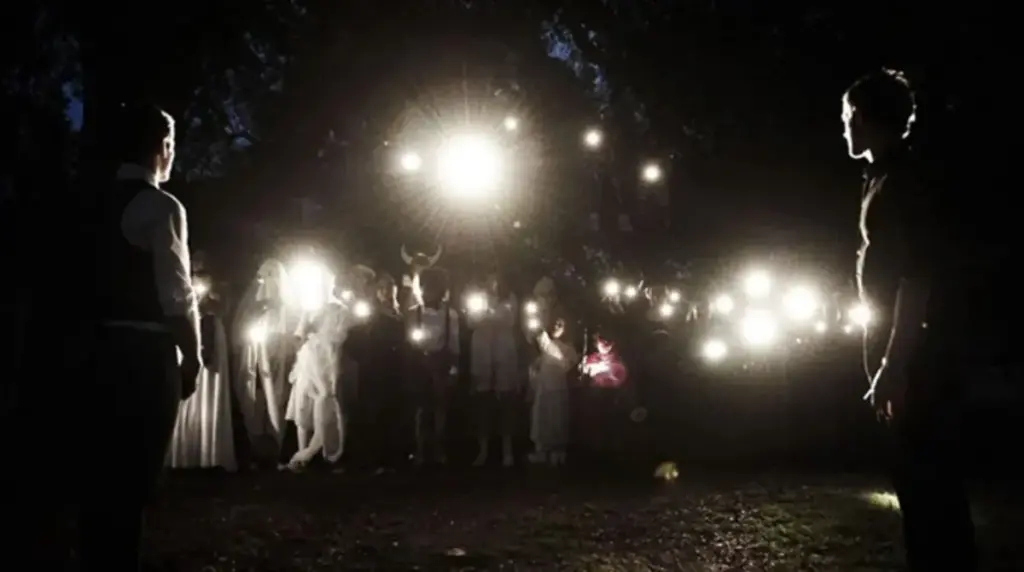
The experiment announced its intentions immediately in the opening scenes of Götterdämmerung. Heinrich Porges’s historical accounts of Wagner rehearsing the Norns note that the composer demanded they be “of sublime calm,” their knowledge derived entirely from the rope of destiny they gaze upon. In Lobbes’s AI staging, this concept was taken to its literal and metaphysical extreme. Clothed in Pia Maria Mackert’s austere, grey-toned garments—blending pagan druidism, classical togas, and Victorian silhouettes—the Norns stood virtually motionless.
They were framed by towering, flashing projections driven by algorithmic research engines that cross-referenced world mythology with modern data streams. It was here that the production sparked its most vehement inter-mission debates: the sudden, unexplained appearance of an AI-generated squirrel scurrying across the screen.
Unlike the consciously inserted red fox of Bayreuth’s 2023 Augmented Reality Parsifal—which served as a clear environmentalist mascot for "uncontaminated Nature"—the squirrel was an algorithmic free association. The AI engine had cross-referenced a 17th-century Icelandic design depicting Ratatoskr, the legendary squirrel running up the bark of Yggdrasil between the eagle and the corpse-eating dragon Nidhogg. This was history and myth synthesized by machine logic, operating independently of standard directorial intention.
Siegfried and the Slowing Tides
As the cycle progressed through Das Rheingold, Die Walküre, and Siegfried, spectators noted a distinct shift in the pacing of the visual apparatus. By the time Klaus Florian Vogt’s radiant, effortless Siegfried took the stage, the algorithmic imagery appeared to slow down, offering a dubious yet welcome concession to an overwhelmed audience.
The stage actors wore infrared trackers, transmitting their exact physical coordinates to the central computer terminal. Far from acting as traditional theatrical agents, the performers served as human anchors within a holographic cybernetic space. They were transformed into archetypal figurines, floating between multiple layers of translucent scrims. While critics decried the absence of traditional blocking, this static immobility allowed the monumental weight of Wagner’s libretto and harmonic structures to assume absolute dominance.
The Cataclysm: Götterdämmerung and the Funeral March
The climax of the experiment arrived with Götterdämmerung and the execution of Siegfried’s Funeral March. Musically, Christian Thielemann’s reading clocked in at 7:12 minutes, placing it firmly in line with his historical interpretations (7:54 in Bayreuth 2010; 7:20 in Vienna 2011) and safely navigating the historical spectrum between Rudolf Moralt’s brisk 1949 reading (6:41) and Herbert von Karajan’s expansive 1966 pacing (8:29).
Yet, visually, the scene was entirely divorced from traditional naturalism. As the Gibichung clan—Mika Kares’s terrifyingly power-bent Hagen, Magdalena Hinterdobler’s tragic, Ophelia-like Gutrune, and Michael Kupfer-Radecky’s repentant-too-late Gunther—enacted their Shakespearean treachery, they were engulfed by a visual timeline of 150 years of Western civilization. Fake news, climate disasters, and the horrors of late-stage globalization flickered across the backdrop. The effect was polarizing: it shattered theatrical immediacy for many, while for others, it successfully forged a bridge between ancient Norse myth and modern existential dread.
Supporting Context & Metrics
Historical Precedents of Bayreuth Innovation
Bayreuth has always been a laboratory for technical disruption, frequently meeting new innovations with institutional hostility before later embracing them as canon.
- 1927: Commercial electrical microphone recordings were introduced into the Festspielhaus, and painted backdrop flats were partially replaced with electric stage lighting and color projections.
- 1950: Wieland Wagner introduced minimalist scenography inspired by Adolphe Appia, stripping the stage of traditional naturalism.
- 1976: The legendary Jahrhundertring (Centenary Ring) directed by Patrice Chéreau and conducted by Pierre Boulez introduced political, anti-bourgeois iconography that was initially booed off the stage before being celebrated as a masterpiece.
- 1988: Harry Kupfer’s "laser Ring" utilized cutting-edge projection technology to simulate digital and spatial dimensions, meeting similar institutional resistance.
The 2026 AI Ring is simply the latest chapter in this evolutionary lineage—a step away from physical realism and toward a digital ontology of opera.
Comparative Timings of Siegfried’s Funeral March
| Conductor / Year | Orchestral Ensemble | Duration | Characteristic Interpretation |
|---|---|---|---|
| Rudolf Moralt (1949) | Vienna Philharmonic | 6:41 | Suppressed, anguished brass sneers; lean and swift. |
| Karl Böhm (1967) | Bayreuth Festival Orchestra | 6:48 | Compact, driving, and structurally merciless. |
| Herbert von Karajan (1966) | Berlin Philharmonic | 8:29 | Expansive, highly balanced, wide emotional gamut. |
| Georg Solti (1958) | Vienna Philharmonic | 7:35 | Hard-hitting, explosive brass outbursts of raw tragedy. |
| Marek Janowski (1983) | Staatskapelle Dresden | 6:29 | Brisk, classical symmetry and transparency. |
| Christian Thielemann (2010) | Bayreuth Festival Orchestra | 7:54 | Monumental, heavy with late-Romantic pathos. |
| Christian Thielemann (2026) | Bayreuth Festival Orchestra | 7:12 | Dynamic, flexible architecture balancing modern despair and lyricism. |
Official Statements & Creative Intent
The conceptual foundation of "Ring 10010110" relied heavily on the premise that the production team were not traditional stage directors, but curators of an algorithmic process. Marcus Lobbes and his technical collaborators repeatedly emphasized that the AI was not deployed to tell a linear story, but to act as a psycholinguistic mirror for the audience’s own cognitive processing of myth.
"The AI-generated imagery was never intended to be a guessing game of historical identification," noted production documentation released prior to the premiere. "It was designed to capture the essence of a theater’s storied treatment of a monumental work, cross-referencing historic productions from 1876 onward with contemporary socio-political data. The spectator is asked to seek sanctuary not in a familiar stage picture, but in the architecture of their own historical recollections."
Despite these clear programmatic notes, the critical establishment largely rejected the premise. Commentators from major European cultural periodicals argued that the relentless visual bombardment severed the crucial connection between the physical actor and the live spectator. The tension between the production’s stated theoretical framework and the audience’s expectation of affective theatricality created an unbridgeable chasm.
Future Outlook: The Road to the Digital Opera House
As the dust settles on the 2026 Bayreuth Festival, the legacy of "Ring 10010110" will likely be viewed through a dual lens: as a frustrating missed opportunity for narrative cohesion, and as an indispensable pioneer voyage into the digital unknown.
We are living through a transitional epoch of human history. Just as our grandparents could scarcely have imagined instant global telecommunications, modern audiences struggle to conceptualize the ultimate ramifications of artificial intelligence. The AI Ring served as a cultural canary in the coal mine—an Orwellian mirror recalling HAL 9000 from 2001: A Space Odyssey, challenging humanity to overcome the limitations of temporal reality and algorithmic determinism.
For opera houses worldwide, the questions raised by Lobbes’s experiment will reverberate for decades. How far can digital mediation go before live performance loses its unique ontological status? Can algorithmic generation evolve from a disorienting collage into a true collaborator in artistic creation?
Whatever answers future productions provide, Bayreuth has proven once again that Wagner’s Ring is an infinite universe. As long as we keep our third eyes open—even in the darkening twilight of Valhalla—the myth will continue to be discovered anew, bridging the ancient roots of the World Ash Tree with the cold, luminous strands of tomorrow’s code.