
Executive Overview
In the rapidly evolving landscape of artificial intelligence and digital music discovery, a compelling new project has emerged from Central Europe that challenges conventional approaches to data collection and event aggregation. ClassicalBot, developed independently by Slovakian software engineer Róbert Druska, represents a significant leap forward in automated web scraping and data processing.
Originally conceived as a localized, hyper-targeted experiment to map classical music concerts across Slovakia, ClassicalBot has quietly expanded its digital footprint into a worldwide concert-tracking directory. What sets this platform apart from traditional aggregators—which rely heavily on manual data entry, rigid application programming interfaces (interfaces), or human curation teams—is its near-total reliance on autonomous artificial intelligence. From discovering obscure local orchestra websites to extracting complex program details and analyzing performance repertoires, ClassicalBot operates as a self-sustaining digital organism.
The platform relies on an innovative architecture featuring an automated "crawler factory" and dynamic AI agents. These systems work in tandem to navigate the notoriously fragmented and non-standardized digital ecosystem of classical music venues, opera houses, and philharmonic societies. First brought to wider industry attention by the Bliss Music Library Management Blog, ClassicalBot serves as both a functional utility for classical music enthusiasts and a striking proof-of-concept for solo developers pushing the boundaries of what is possible with modern automation tools.
While ClassicalBot’s current incarnation focuses on the niche world of symphonies, concertos, and recitals, its underlying infrastructure hints at far broader commercial applications. Druska’s modular "crawler factory" concept could theoretically be repurposed to index everything from shifting e-commerce pricing to local restaurant menus, corporate data, and global job markets. As the tech industry debates the sustainability and scalability of agentic workflows, ClassicalBot offers a real-world window into how autonomous AI agents can conquer unstructured web data at scale.
Detailed Chronology: From Local Experiment to Global Index
The Genesis: Mapping Slovakia’s Classical Underground
Every innovative software project often begins as a personal frustration. For Róbert Druska, that frustration stemmed from the sheer difficulty of keeping track of live classical music performances in his home country of Slovakia. Unlike mainstream pop, rock, or electronic music tours—which are typically consolidated on major ticketing platforms like Ticketmaster, Resident Advisor, or Bandsintown—classical music performances are heavily decentralized. They are hosted by regional cultural centers, historic churches, state-funded philharmonics, independent ensemble websites, and university auditoriums.
Initially, Druska set out simply to build a reliable aggregator for Slovakia. However, he quickly realized that traditional web scraping methods were insufficient. Classical music websites are notoriously heterogeneous: they lack uniform metadata standards, frequently use outdated content management systems, embed event details inside unstructured PDF brochures, or list programs in multiple languages without clear tags.
Faced with the prohibitive manual labor required to write custom scrapers for hundreds of distinct venue websites, Druska turned to emerging generative AI and automation frameworks. Instead of hardcoding rules for each target site, he sought to build a system that could look at an arbitrary web page, understand its context, and extract the necessary event data autonomously.
Expanding the Horizon: Going Global
Buoyed by the initial success of the Slovakian prototype, Druska scaled the architecture. By removing geographic constraints and empowering his AI agents to scour the open web for performance venues, the project rapidly morphed from a national directory into a global mapping initiative.
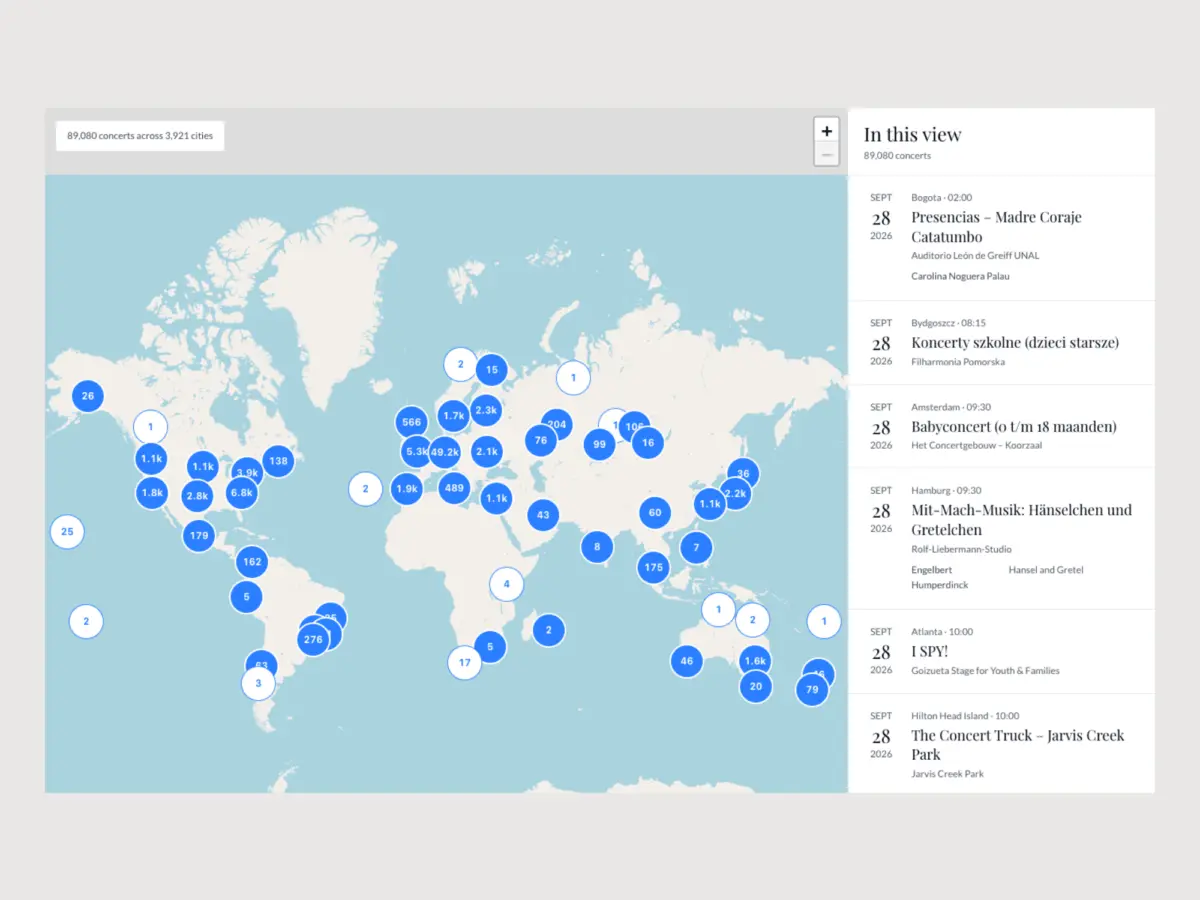
Today, ClassicalBot’s interactive interface features a world map punctuated by glowing coordinate points, marking cities where classical concerts are actively being indexed. This expansion was not achieved by scaling a human operations team, but by scaling the autonomy of the software itself. The system learned to identify foreign-language terminology related to classical music—such as koncert, Orchester, recital, Sinfonie, or filarmónica—allowing it to traverse international domains with minimal human supervision.
Architectural Innovations: The "Crawler Factory" and the "Magic Box"
To understand how ClassicalBot achieves this global scale, one must examine Druska’s technical documentation, specifically outlined in his developer blog post, "Scaling Classical Music Concert Crawlers with AI Agents."
The backbone of the platform is built around two primary conceptual pillars:
- The Magic Box: A centralized reasoning engine powered by large language models (LLMs) that acts as the analytical brain of the operation. When raw, unstructured text or HTML is pulled from a target website, it is fed into the Magic Box. Here, the AI parses the data, distinguishes between a venue’s box office hours and an actual performance date, identifies the featured composers and soloists, and structures the output into a standardized JSON format.
- The Crawler Factory: Rather than deploying static scripts, Druska engineered a self-generating pipeline. When the system encounters a new domain or an unrecognized website layout, the crawler factory dynamically generates, tests, and refines specialized scraping routines tailored to that specific site. If a venue redesigns its website and breaks an existing scraper, the factory detects the failure, analyzes the new DOM (Document Object Model) structure, and automatically patches or rewrites the extraction logic.
This closed-loop system minimizes human intervention, transforming web scraping from a tedious, maintenance-heavy chore into a self-healing, automated pipeline.
Supporting Context & Metrics: The State of AI Agents and Data Extraction
The Rise of Agentic Workflows
ClassicalBot arrives at a pivotal moment in the tech industry. For much of the early 2020s, generative AI was defined by conversational interfaces (chatbots) and static content generation (text, image, and code creation). However, the technological zeitgeist has rapidly shifted toward AI agents—systems designed to execute multi-step workflows, interact with external tools, browse the web, and make autonomous decisions to achieve a defined goal.
Druska’s project is a textbook example of an agentic workflow applied to data engineering. According to recent industry surveys, unstructured data extraction remains one of the highest friction points for enterprises across finance, logistics, real estate, and retail. Traditional enterprise software relies on rigid Optical Character Recognition (OCR) templates and fragile regex parsing. When a document format changes by even a few pixels, the pipeline breaks.
By leveraging LLMs to handle semantic ambiguity, projects like ClassicalBot demonstrate how AI agents can bridge the gap between unstructured human communication (such as concert descriptions written in poetic prose) and structured machine-readable databases.
The Classical Music Discovery Dilemma
To fully appreciate the utility of ClassicalBot, one must examine the state of music discovery tech. Over the past two decades, billions of dollars have been poured into recommendation algorithms for streaming services like Spotify, Apple Music, and YouTube Music. Yet, these systems are overwhelmingly optimized for recorded music, studio albums, and mainstream genres.

Live performance discovery, particularly in niche genres like classical, opera, and contemporary orchestral music, has largely lagged behind. Major ticketing conglomerates often overlook smaller philharmonic societies, chamber music groups, and conservatory recitals because the transaction volumes do not justify the onboarding costs.
Consequently, classical music fans have historically relied on word-of-mouth, physical brochures, or scattered local bookmarks. ClassicalBot fills a crucial gap by aggregating long-tail cultural data that commercial aggregators routinely ignore. By democratizing access to this information, the platform helps sustain regional arts organizations that lack the marketing budgets of major touring acts.
Official Statements and Developer Insights
In his documentation and public communications regarding ClassicalBot, Róbert Druska has remained remarkably transparent about both the capabilities and the experimental nature of his creation.
Reflecting on the core philosophy driving the project, Druska noted on the official site:
"From the start, this project was meant to be an experiment into how far AI automation can go, and almost every part you see—source discovery, concerts extraction, program analysis—is done by AI in some form."
This candid admission highlights a broader trend among indie developers who are leveraging foundational AI APIs and open-source models to build enterprise-grade automation capabilities single-handedly. What once required a dedicated engineering team of data scientists, backend developers, and scraping specialists can now be conceptualized, prototyped, and deployed by a solo developer over a matter of weeks or months.
Looking beyond the realm of symphonies and concertos, Druska has also addressed the expansive commercial potential of his underlying architecture. In his technical blog post, he elaborated on the adaptability of his crawler factory model:
"This idea of an automated crawler factory could be extended to any use case. We could create a loop to cover all restaurant menus in a city, e-shop prices, job offers, all kinds of events, company data."
This perspective reframes ClassicalBot not merely as a niche music project, but as a proof-of-concept for a universal data-ingestion engine. In an economy where real-time data is the lifeblood of competitive intelligence, supply chain management, and market research, the ability to spawn self-healing, AI-driven web scrapers on demand holds immense market value.
Future Outlook: Commercial Viability and Industry Implications
Is ClassicalBot a Viable Business?
As industry observers and music tech analysts continue to evaluate ClassicalBot, the primary question facing the platform is one of commercial sustainability.
At present, ClassicalBot operates primarily as a labor of love—a technical showcase and a community resource. It is free to use, lacks aggressive monetization, and does not charge venues to list their events. However, the underlying technology possesses clear commercial pathways:
- B2B Data Licensing: Cultural tourism boards, travel agencies, and global event platforms could license ClassicalBot’s aggregated feeds to provide their users with comprehensive local arts calendars.
- Ticketing Partnerships: By integrating affiliate booking links or direct box office checkout integrations, the platform could monetize the transactional intent of classical music lovers searching for tickets.
- Enterprise Scraping-as-a-Service (SaaS): Druska’s "crawler factory" concept could be productized into an enterprise tool, allowing businesses to spin up autonomous AI scrapers for dynamic pricing intelligence, lead generation, and competitive monitoring.
Broader Implications for the Software Development Landscape
Beyond its commercial prospects, ClassicalBot offers a glimpse into the future of software development itself. The project illustrates the empowerment of the "solopreneur." Armed with modern LLMs, vector databases, cloud infrastructure, and autonomous agent frameworks, single developers can now construct complex, multi-layered data pipelines that rival systems built by mid-sized tech companies.
However, scaling agentic systems also introduces distinct challenges. Autonomous scrapers operating at a global scale must contend with rate-limiting, anti-bot protections, CAPTCHAs, and shifting website terms of service. Furthermore, relying entirely on AI for data extraction introduces the risk of "hallucinations"—where an LLM might misinterpret a venue’s date format or invent non-existent program details. Ensuring data integrity and accuracy without heavy human oversight remains an ongoing engineering hurdle for projects like ClassicalBot.
Conclusion
ClassicalBot stands as a fascinating intersection of classical arts preservation and cutting-edge artificial intelligence. What began as a localized solution to a frustrating personal problem in Slovakia has blossomed into a global cartography of live orchestral music, powered entirely by autonomous digital agents.
Whether Róbert Druska chooses to commercialize his "crawler factory" or keeps ClassicalBot as an open-ended technical experiment, the project has already succeeded in turning heads across the music tech and developer communities. It proves that the most exciting innovations in AI are not always born in Silicon Valley boardrooms, but are frequently forged by independent developers pushing the limits of imagination, code, and autonomy.