
Executive Overview
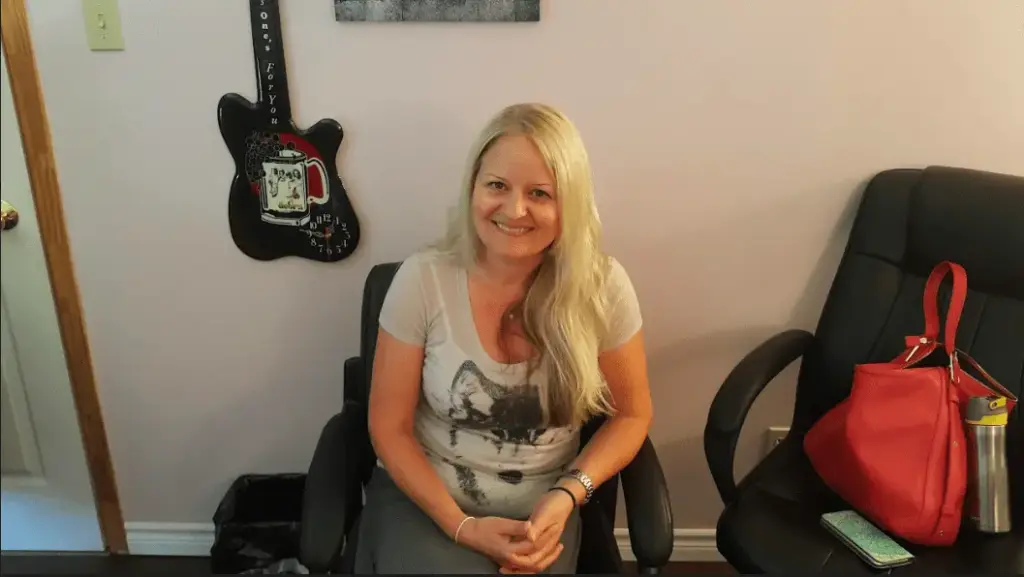
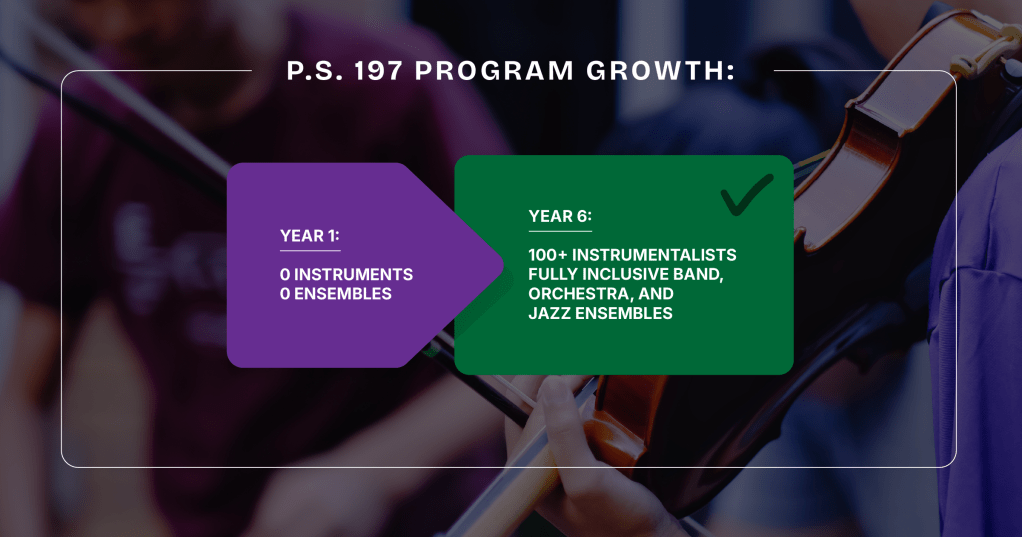
When Kimberly Rosenbaum stepped through the doors of P.S. 197, The King’s Highway Academy, in central Brooklyn six years ago, she was greeted by an ambitious mandate and a stark reality. School administrators laid out a clear vision: build a comprehensive instrumental music program entirely from scratch. At the time, the school possessed no bands, no orchestras, and—most critically—no instrumental inventory.
Today, that silence has been replaced by a vibrant, multi-layered musical ecosystem. P.S. 197 now boasts a thriving fourth-grade band, a fifth-grade band, an after-school string orchestra, and a dynamic jazz ensemble. Furthermore, the program features full inclusion for students receiving special education services who wish to participate in music-making.
Managing a sprawling school population that has grown to approximately 1,200 students across grades 3K through fifth is an extraordinary operational feat. Rosenbaum handles roughly 15 general music sections while carving out time to pull small groups for compressed 20-minute lunch and recess lessons. To survive and scale this high-demand schedule, she needed a scalable solution—finding an invaluable ally in digital practice software that acts as an automated virtual conductor.
Detailed Chronology: The Journey from Zero to 100+ Instrumentalists
Year One: Establishing the Foundation
The initial phase of P.S. 197’s musical renaissance required foundational groundwork. With zero instruments in the building, Rosenbaum’s first challenge was securing equipment, generating student interest, and carving out physical and temporal space in a crowded elementary school schedule.
Without an established tradition of instrumental music at the academy, recruitment relied entirely on enthusiasm, demonstrations, and community outreach. Rosenbaum introduced baseline general music concepts while identifying students showing early aptitude and passion for specific brass, woodwind, and string instruments.

Scaling Up and Navigating Logistical Growth
As the student body expanded and word of the nascent program spread, the operational hurdles multiplied. Teaching small groups of 10 beginner alto saxophone or brass players during tight, 20-minute lunch periods presented severe logistical bottlenecks.
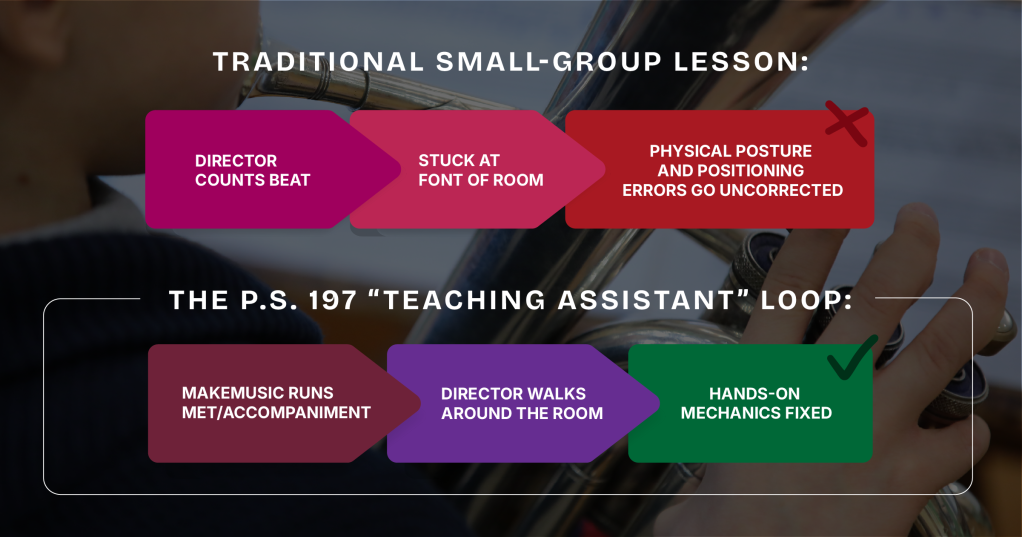
In a traditional classroom setting, an educator directing a beginner group is trapped at the front of the room. Waving a baton, counting off starts aloud, and keeping time consumes the entirety of the instructor’s focus. This leaves little to no bandwidth to address individual physical mechanics, such as faulty embouchures, awkward hand positions, or incorrect posture.
To overcome this hurdle, Rosenbaum integrated MakeMusic into her daily classroom routine, transforming software into an automated teaching assistant.
“MakeMusic allows me to take a step away from being a conductor and lets me really focus on just being a teacher,” Rosenbaum explains. “They know the count-off is coming, the program takes them through, and I can go student-by-student down the line to fix hand position, embouchures, and instrumental positions while they play.”
Supporting Context & Metrics: Overcoming Urban Education Barriers
Navigating NYCDOE Procurement Complexity
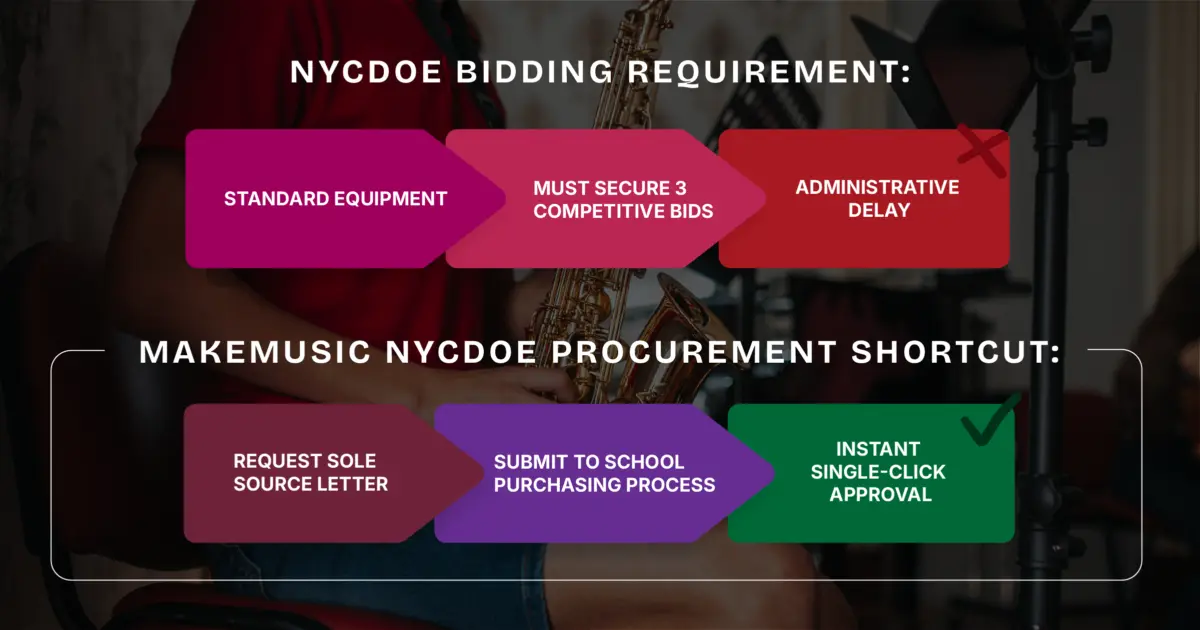
For public school educators operating within the New York City Department of Education (NYCDOE), securing instructional technology often means wading through complex procurement portals like FAMIS and ShopDOE. Standard purchasing rules frequently require educators to secure three competitive bids from distinct vendors—a bureaucratic roadblock that can stall software rollouts for months.
Rosenbaum circumvented this administrative friction by utilizing a strategic procurement shortcut available to many public school educators: the Sole Source Vendor Letter.
“MakeMusic provides a sole-source letter stating you can’t buy this tool anywhere else,” Rosenbaum notes. “You give that letter to your purchasing secretary, and they don’t have to ask for three bids because there’s only one source. It’s one of my easiest purchases of the entire year.”
Fostering Universal Access in a Diverse Urban Setting
P.S. 197 serves a remarkably vibrant, multicultural Brooklyn community, which includes a significant population of multilingual students and English Language Learners (ELL). Ensuring that language barriers never translate into musical exclusion became a core tenet of Rosenbaum’s instructional philosophy.
To bridge these gaps, Rosenbaum pairs core method book roadmaps with supplemental digital materials within the platform. When instructing non-English-speaking string or wind students, she utilizes Spanish-translated editions of Alfred Music’s Sound Innovations directly inside the software ecosystem.
Compounding this accessibility is the platform’s visual red-and-green note feedback engine. This automated system offers young, developing musicians an intuitive, non-verbal practice partner at home. Students receive immediate, visual reinforcement of their pitch and rhythm accuracy, fostering independent learning habits outside of school hours.
Official Perspectives and Expert Advice
The rapid expansion of P.S. 197’s music program offers a blueprint for educators operating in high-density, under-resourced urban environments. Rosenbaum’s methodology challenges the assumption that robust instrumental ensembles require affluent districts or massive startup grants. Instead, success hinges on resourcefulness, modern pedagogical tools, and an unwavering commitment to student equity.
For educators hesitant to integrate digital practice platforms into elementary or urban ensembles, Rosenbaum’s advice is rooted in empowerment:
“MakeMusic isn’t a rigid curriculum; it’s a flexible tool,” she reflects. “You’re giving students access to resources they wouldn’t otherwise have. When you give a kid an instrument and the right tools to practice, they just take off with it. Why wouldn’t you give them that opportunity?”
Future Outlook: The Blueprint for Modern Music Education
The transformation of P.S. 197 highlights a broader paradigm shift in music education. As school districts nationwide grapple with compressed instructional time, large class sizes, and diverse student populations, the integration of intelligent practice software is moving from a luxury to an operational necessity.
By leveraging automated accompaniment and real-time visual feedback, educators can reclaim precious minutes of instructional time, turning chaotic group rehearsals into focused, individualized coaching sessions.
For music educators looking to replicate Rosenbaum’s success—streamlining small-group lessons, navigating cumbersome district purchasing portals, and expanding access to every student regardless of background—the roadmap has been drawn in Brooklyn. Tools are readily available to transform school hallways from quiet corridors into corridors echoing with the sounds of thriving, confident young instrumentalists.