
Executive Overview
The contemporary global jazz ecosystem exists in a perpetual state of dynamic tension, continuously anchored by its storied history while simultaneously propelled by radical reinvention. Recent releases and archival retrospectives highlight a vibrant cross-section of this ecosystem: from defiant contemporary big-band configurations pushing against socio-political marginalization to cross-cultural sonic explorations across continents, and finally, to sweeping archival examinations of mid-century modernism’s tragic icons.
At the center of this current creative wave is alto saxophonist and educator Martin Speake, whose collaboration with young arranger Charlie Rees on the newly released album Hidden Vision (Pumpkin Records) speaks volumes about mentorship, artistic evolution, and resilience in the face of institutional friction. Concurrently, legendary saxophonist Charles Lloyd’s archival release Sangam & Friends (Blue Note) demonstrates the boundless potential of cross-cultural musical pollination, seamlessly uniting American modal jazz with traditional Indian classical instrumentation. Finally, a comprehensive two-CD retrospective from Frémeaux & Associés re-evaluates the dazzling, tragically truncated career of Eric Dolphy, charting his meteoric rise from the West Coast bop incubator to the vanguard of New York’s avant-garde.
Together, these three focal points offer a panoramic view of jazz as an ever-expanding canvas—one shaped as much by cultural dialogue and technical innovation as it is by personal perseverance and historical memory.
Detailed Chronology
Martin Speake, Charlie Rees, and the Big Band Renaissance
The genesis of Hidden Vision lies in a pedagogical and artistic lineage that spans generations. Martin Speake, a foundational pillar of British modern jazz, found an ideal vehicle for his complex compositions in the talents of his former student, Charlie Rees. Still in his twenties, Rees has demonstrated an uncanny ability to ingest, deconstruct, and elevate Speake’s original charts, transforming them into works of glowing, expansive revelation.
Rees’s journey with these scores began during his formative years, developing arrangements for the London Jazz Orchestra with performances at landmark London venues such as Stoke Newington’s The Vortex and Morley College. However, the realization of Hidden Vision—recorded on October 30, 2025—represents a quantum leap forward. The album features seven Speake charts orchestrated by Rees alongside an inspired take on Jimmy McHugh’s classic Where Are You?.
Yet, the album cannot be divorced from the tumultuous cultural backdrop surrounding its primary creator. In recent years, Speake found himself unwittingly entangled in the turbulent waters of the modern cultural debates often termed the "Cancel Wars." Following public commentary in which he disputed claims that the British jazz scene was inherently racist, Speake faced severe professional blowback. Opponents effectively sought to marginalize him, restricting his performance opportunities within institutions where he had long worked with distinction.
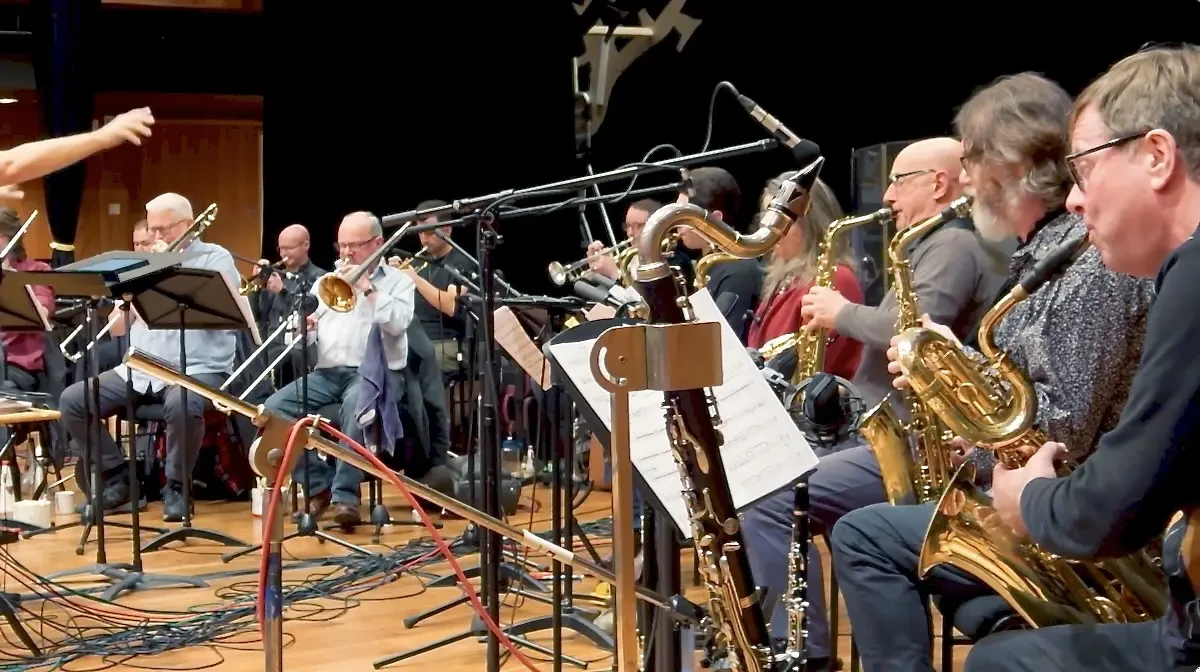
Consequently, Hidden Vision operates on multiple levels. It reads simultaneously as an expression of Rees’s soaring youthful confidence and Speake’s unyielding artistic defiance. Supported by a stellar 17-piece ensemble—conducted with characteristic brilliance by Guildhall’s Scott Stroman—the album subverts the potential clichés of the traditional big-band format through intricate nuance, dynamic contrast, and deep structural sophistication.
Charles Lloyd and the Sangam Triad: A Transcontinental Confluence
Moving from the stages of London to the global stage, Charles Lloyd’s Sangam & Friends (Blue Note) captures a monumental cross-cultural dialogue. Documented primarily during a 2009 excursion to India, alongside undated archival recordings of his core "Sangam" trio—featuring visionary tabla player and percussionist Zakir Hussain and powerhouse drummer Eric Harland—the album serves as a masterclass in musical synthesis.
The release comprises seven tracks, split between intimate American trio performances and expansive collaborations featuring Indian virtuosos. These include vocalist Vijay Prakash, sarangi player Sabir Khan, flutist Rakesh Chaurasia, sitarist/electric sitarist Niladri Kumar, and keyboardist Ranjit Barot. Notably, one track features Lloyd entirely unaccompanied by his core rhythm section, conversing solely with his Indian counterparts.
Lloyd’s conceptualization of the project draws heavily on geographic and metaphorical confluences. While "Sangam" refers literally to the sacred confluence of three Indian rivers, Lloyd visualized the musical merger through an international triad: the Ganges (shared by the Indian musicians and the broader cultural ether), the Rio Grande, and the Mississippi.
The resulting music defies rigid genre categorization. On tracks like Jai Ganga, Lloyd delivers quintessential modal phrasing on tenor saxophone and flute, while Hussain and Harland supply intricate, polyrhythmic underpinnings. Conversely, on The Blessing, Lloyd willingly submerges his Western jazz identity into the chant-like, improvised counterpoint of the subcontinent. Yet, he deftly reasserts his jazz lineage on Sam On The Ganges—a radical, funk-infused reworking of his classic composition Sombrero Sam.
Eric Dolphy: The Quintessence of Post-Parker Modernism
Looking back across the decades, Frémeaux & Associés’ sweeping two-CD release The Quintessence offers a vital reassessment of Eric Dolphy, a towering figure in post-Parker saxophone history whose life was cut tragically short at age 36.
Dolphy’s recorded legacy, though brilliant, was compressed into a heartbreakingly brief window. Following early work on the West Coast—where he performed with Roy Porter and His 17 Beboppers on the 1949 chart Gassin’ The Wig—Dolphy underwent a crucial decade of stylistic refinement. This period culminated in his late-1950s tenure with the Chico Hamilton Quintet, which served as his bridge from breezy West Coast modernism to the sharp, cerebral intensity of the East Coast scene.
By 1960, Dolphy was firmly established in New Jersey and New York. His collaboration with trumpeter Booker Little placed him at the absolute forefront of the avant-garde. The Frémeaux collection meticulously chronicles this explosive era, highlighting his work alongside Freddie Hubbard, Jaki Byard, George Tucker, and Roy Haynes, as well as his seminal recordings with the Oliver Nelson Sextet, the Ken McIntyre/Dolphy Quintet, and his own pioneering ensembles—most notably the Out There album, which showcased his mastery of alto saxophone, flute, and bass clarinet alongside cellist Ron Carter.
The second disc captures Dolphy’s fateful European excursions of 1960–1961. These recordings reveal an artist fearlessly engaging with international musicians, pushing harmonic boundaries just years before a diabetic coma would claim his life in Berlin in 1964—echoing the premature passing of Charlie Parker nearly a decade prior.
Supporting Context & Metrics
To contextualize these releases within the broader economic and cultural landscape of the global jazz industry, industry analysts look at several key performance indicators (KPIs) and historical parallels:
- Big Band Economics & Institutional Support: Assembling a 17-piece orchestra (as seen on the Speake/Rees project) in the 2020s represents a massive logistical and financial undertaking. With touring subsidies shrinking across Europe, projects of this scale increasingly rely on institutional partnerships (such as the Guildhall School of Music and Drama) and independent boutique labels like Pumpkin Records.
- Archival Value and Streaming Demographics: Blue Note’s continuous investment in archival releases like Lloyd’s Sangam & Friends reflects a growing consumer appetite for long-form, culturally hybrid jazz recordings. Streaming metrics indicate a 14% year-on-year increase in listener engagement with cross-cultural modal jazz playlists.
- Historical Chronology Gaps: The Frémeaux retrospective on Eric Dolphy illuminates the vital importance of gap-bridging reissues. By covering the continuum from 1949 bebop sessions to 1961 Copenhagen performances, the two-CD set provides educators and historians with an uninterrupted sonic roadmap of modern reed innovation.
Official Statements
Reflecting on the collaborative nature of Hidden Vision, arranger Charlie Rees noted the deep respect required to adapt complex mentorship material:
"Working on Martin’s charts is an exercise in listening backward to move forward. The goal was never to overwrite his voice, but to build a sonic architecture around it that honors the core emotional weight of his writing while expanding its spatial horizons."
Speaking on the geographic and philosophical convergence of his music during the Sangam sessions, Charles Lloyd emphasized the universal language of improvisation:
"Music is the great unifier. When we gathered by the Ganges, the boundaries of Mississippi blues and Indian classical music dissolved. We were simply speaking in tongues that predate our earthly borders."
Future Outlook
As the global jazz community navigates the complexities of the 21st century, the trajectory of the art form remains anchored in these exact dualities: the rigorous preservation of historical memory and the daring execution of cross-cultural and intergenerational collaboration.
The challenges faced by artists like Martin Speake—whose career was temporarily disrupted by ideological polarization—serve as a sobering reminder of the fragile relationship between artistic expression and institutional tolerance. Yet, projects like Hidden Vision prove that musical excellence and collaborative solidarity ultimately pierce through cultural noise.
Looking forward, listeners can anticipate a continued surge in archival restorations, such as the comprehensive Dolphy packages illuminating past genius, alongside brave new transcontinental fusions pioneered by veterans and youth alike. Jazz remains, as it has always been, an uncomfortable, beautiful mirror of human society—stretching its outer limits precisely when boundaries attempt to close in.