
By Ian DeNolfo, Executive Director, The Voice Foundation
Executive Overview
We stand at a profound inflection point in the history of voice science. Artificial intelligence (AI) is no longer a futuristic novelty or an abstract computational concept relegated to computer science laboratories; it is actively, rapidly reshaping how researchers conduct investigations, how clinicians analyze complex biometric data, and how medical professionals care for patients.
For decades, the human voice has been recognized as an intimate, deeply personal medium of art, communication, and identity. Today, propelled by breakthroughs in machine learning (ML), deep neural networks (DNNs), and large language models (LLMs), the voice is being unlocked as a high-resolution, non-invasive digital biomarker. It offers diagnostic windows into systemic health conditions ranging from neurodegenerative disorders and respiratory diseases to mental health crises.
At the epicenter of this paradigm shift is The Journal of Voice and its parent organization, The Voice Foundation. Far from being late adopters of digital innovation, the Foundation has tracked, published, and fostered artificial intelligence research in acoustic science for over three decades. This comprehensive report examines the exponential trajectory of AI in voice science, explores foundational and emerging research, analyzes real-world impact metrics, highlights expert perspectives on the ethical integration of computation into medicine, and maps out the path forward for a global research community standing on the brink of unprecedented discovery.
Detailed Chronology: Over Thirty Years of AI Research in Voice Science
While the broader public consciousness only recently engaged with conversational artificial intelligence and generative platforms, the academic foundation of AI in voice science was poured over thirty years ago.
The Early Pioneers (1994–2015)
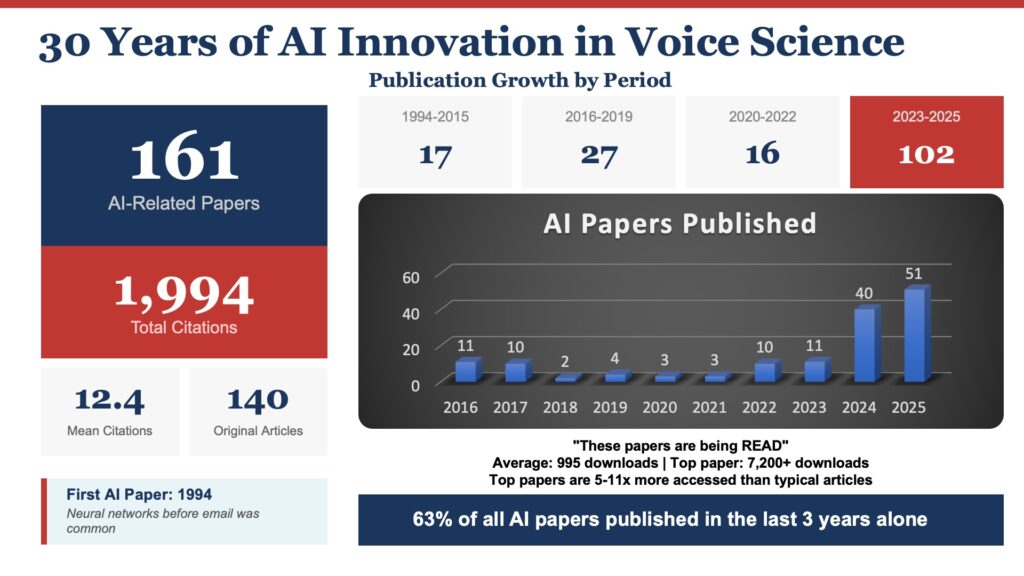
In 1994—the same year the World Wide Web was first breaking into public awareness, and years before the widespread use of commercial email—The Journal of Voice published a paper by Rihkanen and colleagues titled "Spectral Pattern Recognition of Improved Voice Quality." This pioneering study utilized early neural networks to analyze acoustic signals. At a time when computational power was a fraction of what it is today, visionary researchers were already recognizing that human auditory perception, while remarkable, could be augmented by machine pattern recognition.
However, growth during the first two decades was measured. Between 1994 and 2015, the journal published just 17 AI-related papers. The methodology of the era primarily focused on basic artificial neural networks applied to limited spectral and cepstral features.
The Acceleration Phase (2016–2022)
As computing hardware matured, deep learning frameworks emerged, and digitized datasets expanded, the pace of publication quickened.
- 2016–2019: 27 AI papers were published, marked by a transition from shallow neural networks to deep learning architectures capable of parsing complex acoustic vectors.
- 2020–2022: 16 papers were published during a period heavily disrupted by global health crises, which paradoxically catalyzed remote health technologies and digital biomarker research.
The Exponential Explosion (2023–Present)
The most striking story in modern academic publishing is the sheer verticality of recent growth. Of the 161 total AI-related papers published in the history of The Journal of Voice, 102 papers—an astonishing 63 percent—were published in just the last three years (2023 to early 2025).
In the single year of 2025, the journal published 51 AI-related papers. This output surpasses the cumulative total of AI papers published during the entire first twenty years of the field’s formal tracking. This is not gradual academic progress; it is an exponential transformation of an entire scientific discipline.
Supporting Context & Metrics: Real-World Impact and Global Reach
Academic output alone does not measure scientific value. The true test of a research paper’s worth lies in its real-world utility—how frequently it is read, downloaded, and cited by clinicians, speech-language pathologists (SLPs), and interdisciplinary researchers seeking actionable tools.
Readership and Download Metrics
Usage statistics for The Journal of Voice demonstrate extraordinary global engagement:
- The average AI-related paper published in the journal has been downloaded nearly 1,000 times.
- The single most-accessed AI paper—a landmark study examining machine learning applications for COVID-19 detection—has amassed over 7,200 downloads, outperforming the median article in its issue by a factor of eleven.
- The two most-cited papers in the journal’s AI catalog—Fang and colleagues’ deep learning study (193 citations) and Hegde’s machine learning survey (147 citations)—have each been downloaded nearly 5,000 times.
These figures represent more than sterile academic metrics; they reflect a global community of clinicians and therapists actively seeking practical, technologically advanced solutions to improve patient outcomes.
Landmark Research Reshaping the Field
The body of literature housed within The Journal of Voice maps a clear trajectory from theoretical acoustic classification to sophisticated clinical deployment.
Deep Learning for Voice Pathology Detection
In 2019, Fang and colleagues published "Detection of Pathological Voice Using Cepstral Vectors: A Deep Learning Approach," which has since become the most-cited AI paper in the journal’s history with 193 citations. This research proved that deep neural networks could identify vocal pathologies with exceptional accuracy—often utilizing acoustic features far too subtle for the human ear to consciously perceive.
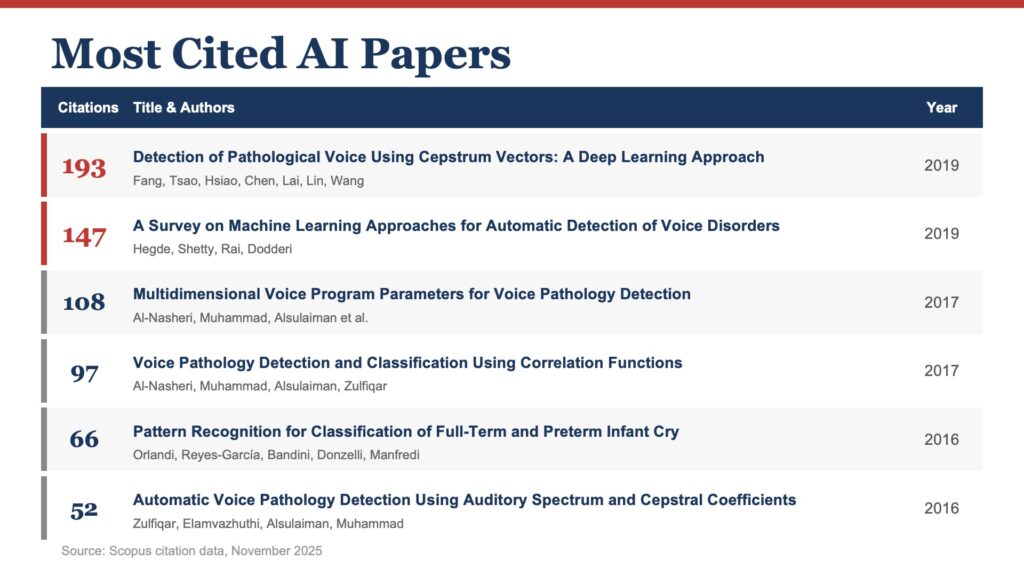
Concurrently, comprehensive overview studies, such as Hegde and colleagues’ "Survey on Machine Learning Approaches for Automatic Detection of Voice Disorders" (147 citations), established foundational frameworks for newcomers to the field. Other heavily cited contributions, such as Al-Nasheri’s 2017 papers on Multidimensional Voice Program parameters and correlation functions, cemented computational acoustic analysis as a legitimate, highly accurate diagnostic auxiliary.
As research evolved through the 2020s, investigators transitioned to advanced architectures: Chen and Chen applied deep neural networks for granular voice classification, Fujimura pioneered one-dimensional convolutional neural networks (CNNs), and Cho and Choi compared CNN models for the automated evaluation of laryngoscopic images.
The Voice as a Digital Biomarker
Perhaps the most transformative conceptual leap in recent years is the framing of the human voice as a digital biomarker—a non-invasive window into systemic, whole-body health.
Groundbreaking studies published in the journal have demonstrated the efficacy of voice analysis in detecting and tracking neurological decline. For example, Hemmerling and Wójcik-Pędziwiatr’s 2022 paper on predicting the severity of Parkinson’s disease from voice signals accumulated 29 citations within just three years, accelerating the timeline toward clinical bedside applications.
Beyond neurology, systematic reviews have begun exploring voice quality as a digital biomarker for affective disorders, including depression and bipolar disorder. The clinical implications are immense: routine vocal screening could allow for the early detection of mental health fluctuations, enabling proactive interventions and alleviating the burden on overburdened healthcare systems. Furthermore, machine learning models analyzing respiratory sounds and voice characteristics have proven effective as sentinels for pulmonary health, as evidenced by pandemic-era diagnostic tools.

AI Chatbots in Clinical Decision-Making
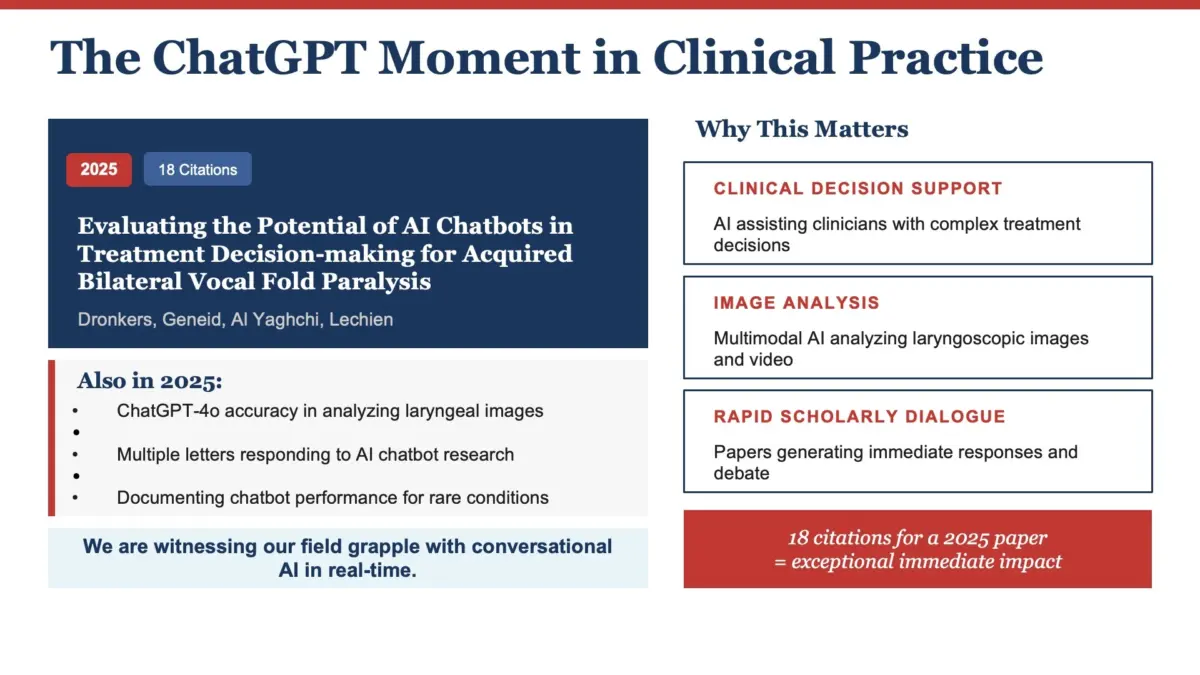
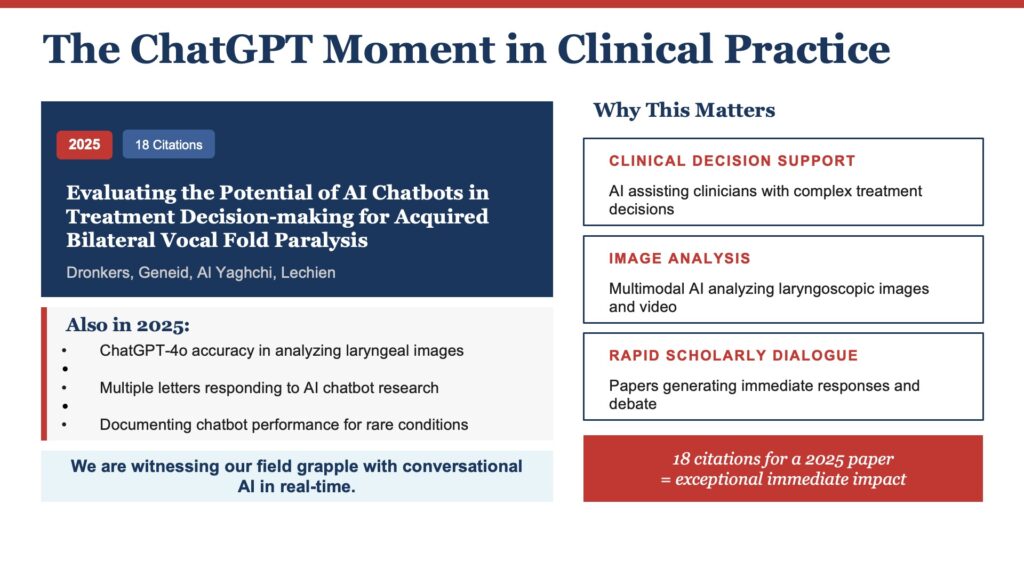
Reflecting the cutting edge of contemporary technology, 2025 saw the publication of pivotal papers examining the utility of conversational AI and large language models in clinical workflows. A standout study by Dronkers and colleagues, "Evaluating the Potential of AI Chatbots in Treatment Decision-making for Acquired Bilateral Vocal Fold Paralysis," captured immediate scholarly attention, securing 18 citations shortly after release. This work sparked robust academic discourse, including letters to the editor and investigative responses regarding ChatGPT-4o’s precision in analyzing complex laryngeal imagery. The medical community is actively navigating the promises and pitfalls of conversational AI in real-time.
Official Statements & Expert Perspectives
To understand the human element behind this technological wave, it is essential to examine the insights of leaders who bridge computational science, clinical practice, and academic administration.
Dr. Mark Berardi: Managing Neurobiological Complexity
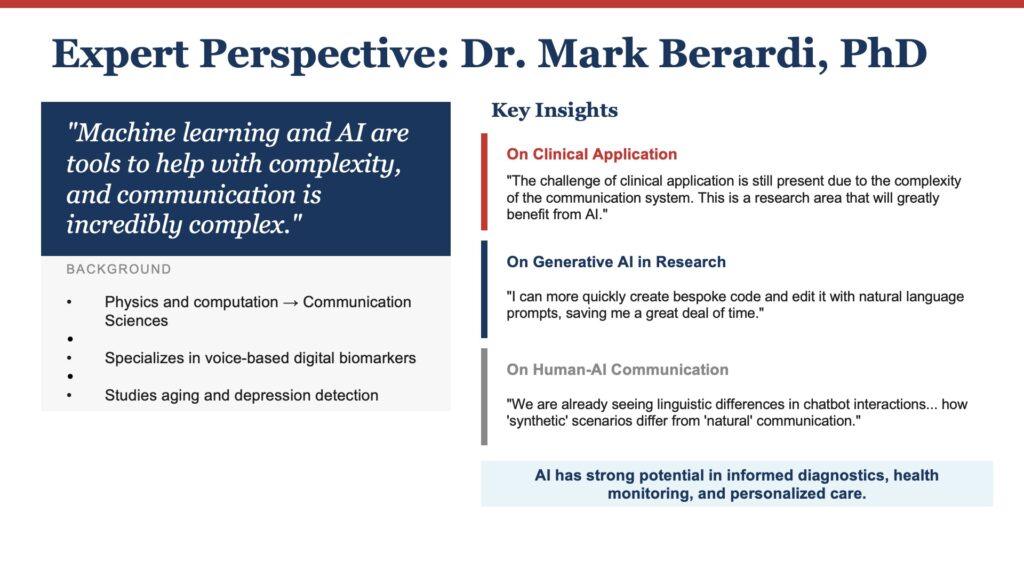
Dr. Mark Berardi brings a unique interdisciplinary lens to voice science, having transitioned from physics and computation into the medical study of communication. He views artificial intelligence not as a replacement for human intuition, but as an indispensable tool for managing complexity.
"Machine learning and AI are tools to help with complexity, and communication is incredibly complex in its neurobiological and physiological processes. So I think the application is warranted," Dr. Berardi explains.
His current research investigates voice-based digital biomarkers for aging and depression. While noting that acquiring acoustic data has become remarkably straightforward, he emphasizes that the true scientific frontier lies in decoding the intricate mechanics of the human communication system itself.
On generative AI, Dr. Berardi offers a pragmatic assessment. While it has not yet overhauled foundational research paradigms overnight, it successfully obliterates traditional workflow bottlenecks—particularly in coding and data processing. Researchers can now write, test, and refine bespoke analytical code using natural language prompts.
Intriguingly, Dr. Berardi is also studying human-AI interaction dynamics: how human speech patterns adapt when conversing with synthetic agents versus living interlocutors, and how virtual communication environments (such as Zoom calls) alter linguistic output. As synthetic communication becomes ubiquitous, voice science must expand to analyze not just the solo human voice, but human speech modulated by machine interaction.
Dr. Eric Hunter: Embracing Change with Ethical Clarity
Dr. Eric Hunter focuses heavily on the institutional and academic implications of AI integration within scholarly publishing and university settings.
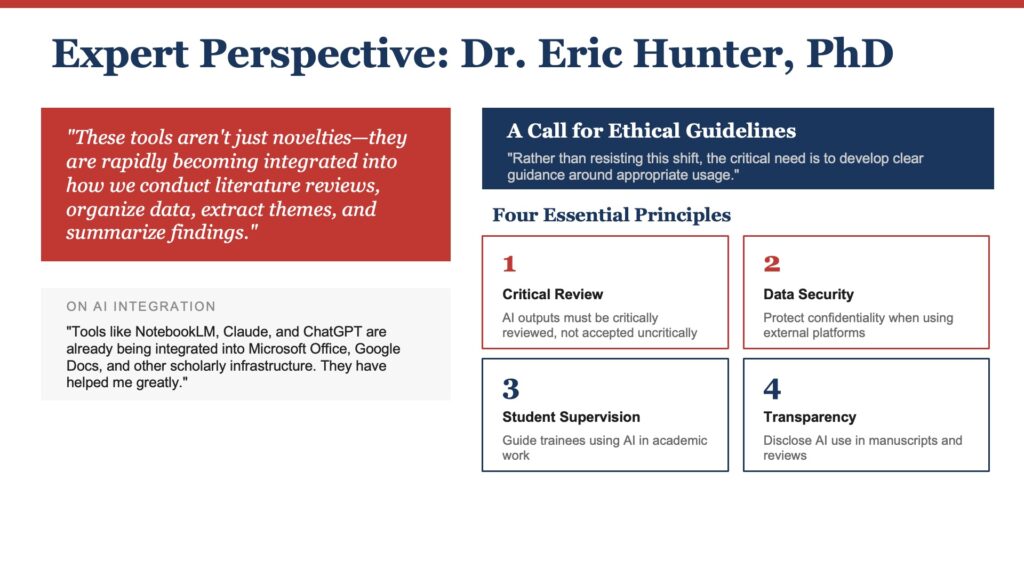
"These tools aren’t just novelties," Dr. Hunter observes. "They are rapidly becoming integrated into how we conduct literature reviews, organize data, extract themes from large bodies of text, and even summarize findings."
Dr. Hunter stresses that large language models and AI-driven platforms are permanently embedded into modern academic infrastructure—appearing in manuscript preparation tools, peer-review assistance platforms, and collaborative writing suites embedded within standard office software. Consequently, he issues an urgent call to action for the scientific community: rather than resisting these technologies, academics must proactively establish clear, transparent usage guidelines.
Dr. Hunter outlines four essential governance principles for academic AI integration:
- Absolute Transparency: Authors must clearly disclose if and how generative tools were utilized in drafting, coding, or data synthesis.
- Human Accountability: Researchers retain absolute responsibility for the factual accuracy, intellectual integrity, and ethical soundness of published work.
- Data Privacy and Security: Clinical voice data and patient biometric inputs must be protected against unauthorized harvesting or privacy breaches.
- Equitable Access: The benefits of AI-driven diagnostic tools must be distributed equitably across global healthcare systems, preventing technological disparities.
"Our field will benefit most," Dr. Hunter concludes, "if we embrace the productivity these tools offer while also building a shared ethical framework for their responsible use."
A Global Research Community
The rapid advancement of artificial intelligence in voice science is not the isolated achievement of a single laboratory or institution. It is the product of a vibrant, interconnected global community.
Leading contributors to The Journal of Voice span continents and disciplines. Prolific authors such as Jérôme René Lechien, Dimitar Deliyski, Stephanie Zacharias, and Ahmed Yousef—alongside esteemed researchers like Paavo Alku, Leonardo Wanderley Lopes, and Maryam Naghibolhosseini—have spearheaded dozens of foundational studies. Working alongside international colleagues across Europe, the Americas, Asia, and beyond, these scientists are unified by a shared commitment to decoding the human voice through the powerful lens of machine learning.
The Path Forward
As The Journal of Voice looks toward the coming decades, its core mission remains unchanged: publishing rigorous, boundary-pushing research while upholding the highest standards of scientific integrity and peer review. However, navigating this new era requires decisive, collective action across three key pillars:
- Thoughtful Engagement with Technology: Researchers and clinicians must learn what AI tools can reliably execute, understand their algorithmic limitations, and utilize them to amplify human clinical expertise rather than abdicate professional judgment.
- Commitment to Ethical Frameworks: The establishment of shared ethical guidelines—answering Dr. Hunter’s call for institutional clarity—demands a concerted, collaborative effort across medical associations, academic journals, and regulatory bodies.
- Continuous Knowledge Sharing: The 161 AI papers published to date represent merely the opening chapter. Every clinician, speech therapist, and biomedical engineer possesses unique insights that can enrich our collective understanding of human vocal physiology.
An Extraordinary Moment in Voice History
For hundreds of thousands of years, the human voice has served as our primary instrument of connection, emotional expression, and personal identity. It carries the subtle nuances of our moods, the hidden signatures of our physical health, and the distinct resonance of our individuality in ways that no other biological signal can match.
Today, for the first time in human history, we possess computational tools sophisticated enough to genuinely comprehend that complexity. We have at our disposal technologies capable of decoding what the voice reveals about our brains and bodies, extending the reach of expert clinicians, catching degenerative pathologies before symptoms manifest, and democratizing access to high-quality voice care on a global scale.
We are living through an extraordinary moment in the timeline of science. As the flagship publication at the center of this revolution, The Journal of Voice and The Voice Foundation remain committed to leading the charge. The next decade promises discoveries we are only just beginning to imagine—and we look forward to sharing every breakthrough with the global community.
About the Author
Ian DeNolfo is Executive Director of The Voice Foundation, the organization that publishes The Journal of Voice. A graduate of The Juilliard School and The Curtis Institute of Music, he formerly performed as a leading tenor at major opera houses worldwide before transitioning his career toward arts administration, medical science, and the advancement of vocal health.