
Executive Overview
The live entertainment and ticketing landscape is undergoing a radical shift as major technology platforms pivot toward data-driven B2B solutions. Ticketing-tech heavyweight SeatGeek has officially unveiled its latest innovation: TourIQ, a sophisticated predictive-intelligence tool engineered specifically for concert promoters, festival organizers, and venue operators. Rather than focusing on the end-consumer experience, TourIQ targets the complex, high-stakes preparatory phases of event planning, offering unprecedented foresight into valuation, ticket scaling, and dynamic pricing long before a single ticket goes on public sale.
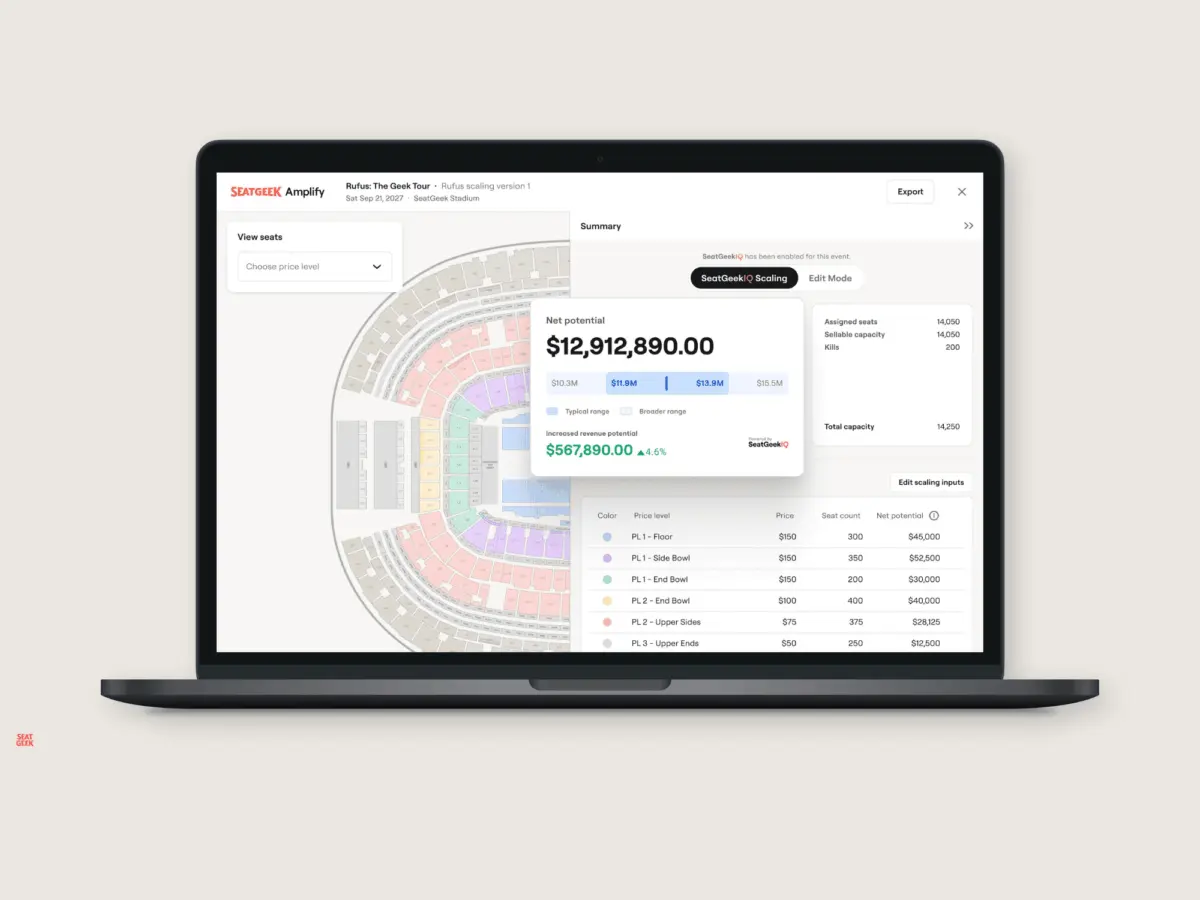
For decades, the live events industry has relied on a mix of historical precedent, institutional gut feeling, and reactive post-sale adjustments to price tours and events. SeatGeek’s new offering aims to completely replace this foundational guesswork. According to company specifications, TourIQ is designed to calculate the precise market value of a concert or third-party event for any building, featuring any artist, on any given date—all before marketing campaigns launch. Integrated directly into SeatGeekIQ, the platform’s comprehensive suite of analytics and management tools for live-show bookers, TourIQ promises to optimize revenue while reshaping how risk is managed in the multi-billion-dollar touring ecosystem.
Despite being a recent addition to the market, TourIQ is already operating at scale. SeatGeek reports that the technology has been quietly deployed across major stadium tours managed by three of the largest promoters in the United States. Furthermore, early case studies from high-profile sporting and entertainment events validate the tool’s core premise: optimizing ticket accessibility while simultaneously maximizing gross revenues through advanced predictive scaling.
Detailed Chronology: From Concept to Market Launch
The genesis of TourIQ stems from years of escalating complexity within the live touring sector. Post-pandemic recovery brought unprecedented volatility to ticket sales, consumer spending habits, and tour production costs. Promoters faced narrowing profit margins, skyrocketing insurance and logistics fees, and unpredictable demand curves. Traditional methods of tour routing and pricing—often based on previous tour performances in specific markets—became increasingly unreliable.
Recognizing an existential need for precision within the industry, SeatGeek’s data science and product development teams began conceptualizing a predictive engine capable of synthesizing disparate data points into actionable financial foresight. The goal was to build an algorithm sophisticated enough to account for market saturation, local economic indicators, competing local events, artist trajectory, and venue-specific acoustics and sightline desirability.
The Development and Testing Phase
Throughout late 2024 and 2025, SeatGeek refined TourIQ through closed-beta testing with select industry partners. During this developmental window, the software was integrated into major live entertainment workflows to test its algorithmic resilience across various genres, venue capacities, and geographical markets.
Rather than deploying the tool indiscriminately, SeatGeek targeted high-capacity stadium tours and high-visibility marquee events. This high-pressure testing environment allowed the company to calibrate TourIQ’s predictive models against real-world volatility, ensuring that its seat-by-seat pricing recommendations could withstand the intense demand fluctuations typical of modern blockbuster tours.
The Official Public Unveiling
In October 2026, SeatGeek officially lifted the veil on TourIQ, detailing its core capabilities via corporate announcements and platform updates. Positioned as the ultimate antidote to tour-promoter uncertainty, the software immediately became a flagship component of the SeatGeekIQ ecosystem. The launch signaled a strategic evolution for the ticketing firm, cementing its identity not merely as a transactional marketplace for consumers, but as an indispensable enterprise software provider for the architects of live entertainment.
Supporting Context & Metrics: Proving the Predictive Model
The live entertainment industry is inherently skeptical of unproven software promises, particularly when millions of dollars in artist guarantees and venue overhead are on the line. To overcome this skepticism, SeatGeek backed the launch of TourIQ with concrete empirical data derived from early real-world implementations.
The Nissan Stadium Case Study
The most compelling quantitative evidence of TourIQ’s efficacy comes from a rigorous field test conducted during a major college football match at Nissan Stadium in Nashville, Tennessee. Historically, sporting events and third-party stadium rentals suffer from rigid, flat-rate pricing models that fail to capture the nuanced willingness-to-pay of different consumer segments.
When SeatGeek applied TourIQ’s predictive scaling algorithms to the Nissan Stadium event, the results defied conventional ticketing wisdom. According to performance data released by the company, the deployment yielded three striking outcomes:
- Volume Surge: The event sold 29% more tickets than initially projected under traditional forecasting models.
- Revenue Maximization: Gross revenue exceeded projections by 13%, demonstrating that higher volume did not come at the expense of top-line financial health.
- Consumer-Friendly Pricing: Remarkably, these revenue gains were achieved while maintaining an average ticket price that was 13% lower than historical baselines for comparable events.
This counter-intuitive success—simultaneously increasing volume, lifting gross revenue, and lowering average ticket prices—highlights the core power of predictive intelligence. By precisely identifying the market-clearing price for every single seat in the house, TourIQ eliminates the deadweight loss associated with mispriced inventory. Empty seats that would have gone unsold at inflated flat rates are priced to move, while high-demand sections capture their true economic value without alienating the broader fanbase.
Industry Adoption at Scale
Beyond isolated case studies, TourIQ has already cleared the highest hurdle in the live entertainment business: enterprise adoption. SeatGeek confirmed that the predictive-intelligence tool is actively being utilized on stadium-level tours orchestrated by three of the largest concert promoters in the United States.
In an industry where promoters fiercely guard their proprietary methodologies and operational edges, the willingness of major market players to integrate TourIQ into their tour-planning workflows underscores the tool’s immediate utility and competitive advantage.
Official Statements and Industry Implications
The introduction of TourIQ has sparked widespread discussion among industry analysts, venue directors, and artist management teams regarding the future of event economics.
Industry observers note that pricing a tour has traditionally been an art form heavily reliant on institutional memory. Veteran bookers often relied on gut feelings, regional promoter feedback, and historical box-office reports from past decades. However, as the economics of touring have tightened—burdened by rising fuel costs, crew wages, and artist guarantees—the margin for error has evaporated.
SeatGeek’s executive team emphasizes that TourIQ is designed to empower human decision-makers rather than replace them. By removing the exhausting cognitive load of manual seat-scaling and initial pricing matrices, the software frees promoters to focus on creative marketing, artist relations, and experiential enhancement.
"The pitch is simple: we replace the guesswork with a hard number, before anything goes on sale," representatives for SeatGeek noted during the platform’s rollout. By shifting the timeline of intelligence gathering to the pre-sale phase, bookers gain the agility to adjust marketing spends, alter capacities, or restructure routing long before financial commitments become locked in.
Furthermore, venue operators stand to benefit immensely from this technology. Venues often operate on thin percentage splits of ticket sales and ancillary revenues (such as food, beverage, and merchandise). By ensuring that every seat is filled at an optimal price point, TourIQ directly drives higher attendance figures, which in turn boosts on-site per-capita spending—a critical revenue stream for modern arena and stadium operators.
Future Outlook: The Next Frontier of Tour Intelligence
As TourIQ transitions from its initial launch phase into broader commercial availability across the entire SeatGeekIQ ecosystem, the long-term implications for the live entertainment sector are profound.
Data-Driven Tour Routing
Looking ahead, predictive intelligence tools like TourIQ have the potential to revolutionize how tours are routed in the first place. By simulating demand across hundreds of potential secondary and tertiary markets simultaneously, management teams could eventually use predictive models to design mathematically optimized tour itineraries that minimize logistical overhead while maximizing regional yield.
The Evolution of Dynamic Pricing
While consumer-facing dynamic pricing has frequently drawn the ire of fans when implemented reactively during high-demand on-sales (often associated with algorithmic surge pricing), TourIQ represents a more proactive, foundational approach. By establishing intelligent, data-backed scaling from day one, the industry may see a reduction in chaotic secondary-market scalping, as primary ticket prices more accurately reflect true consumer demand from the outset.
Competitive Pressures in Ticketing Tech
The launch of TourIQ also intensifies the technological arms race among major ticketing and enterprise software providers. As platforms like SeatGeek, Ticketmaster, and AXS vie for exclusive venue partnerships and promoter contracts, the differentiator is increasingly shifting away from consumer-facing marketplaces and toward proprietary B2B intelligence tools. Promoters and venues will naturally gravitate toward platforms that offer superior financial forecasting and risk-mitigation capabilities.
In summary, SeatGeek’s TourIQ marks a significant maturity milestone for the live entertainment business. By marrying vast datasets with advanced predictive modeling, the tool bridges the gap between artistic ambition and commercial reality, ensuring that the multi-billion-dollar touring machine operates with unprecedented precision, transparency, and profitability.