By Ian DeNolfo, Executive Director, The Voice Foundation
Executive Overview
Voice science stands at a historic inflection point. Today, artificial intelligence (AI) and machine learning (ML) are fundamentally reshaping how researchers conduct investigations, how data scientists analyze complex acoustic metrics, and how clinicians diagnose and care for patients. This rapid technological evolution bridges the gap between raw acoustic signals and systemic human health, transforming a traditionally subjective clinical art into a data-driven, highly quantifiable medical discipline.
For over half a century, The Voice Foundation and its premier publication, the Journal of Voice, have served as the intellectual anchor for this multidisciplinary field. Far from being a recent bandwagon, the integration of artificial intelligence into voice science boasts a surprisingly deep history. Decades before generative AI captured the public consciousness, pioneering researchers were already training early neural networks on acoustic datasets.
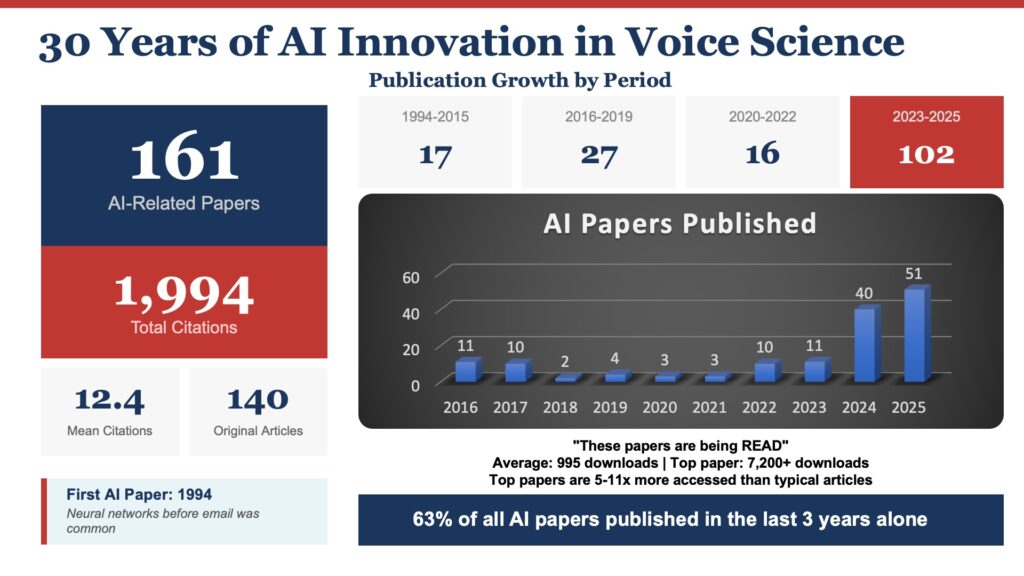
Today, that trickle of early computational research has exploded into an exponential wave. More than 60 percent of all AI-related papers published in the Journal of Voice over the past three decades have appeared in just the last three years. This shift reflects a profound modernization of clinical workflows. From identifying subtle vocal pathologies imperceptible to the human ear to deploying voice as a non-invasive digital biomarker for neurological, psychological, and respiratory conditions, AI is redefining the boundaries of what medicine can glean from the human voice.
The Voice Foundation: A Legacy of Innovation
To understand the magnitude of today’s technological transformation, one must look back at the institution that laid its foundation. In 1969, Dr. Wilbur James Gould founded The Voice Foundation in New York City. At a time when the interdisciplinary care of the human voice was virtually nonexistent, Dr. Gould possessed the groundbreaking foresight to bring together distinct professional silos: physicians, scientists, speech-language pathologists, performing artists, and vocal pedagogues. His goal was simple yet revolutionary—to foster a collaborative environment dedicated to understanding and caring for the professional voice user.
The Foundation hosted its inaugural Annual Symposium—Care of the Professional Voice—in 1972, followed by its first Gala (later christened Voices of Summer) in 1973. For over five decades, the Foundation has successfully built bridges between art and science, and between the sterile environment of the clinic and the demanding stage of the performing artist.
Since 1989, The Voice Foundation has been steered by Dr. Robert Thayer Sataloff, an internationally renowned otolaryngologist who is simultaneously a professional singer and conductor. Dr. Sataloff’s staggering academic output includes more than 1,200 publications and 79 textbooks. Under his visionary leadership, the Foundation relocated to Philadelphia, expanding its global footprint. Today, the annual Philadelphia symposium draws hundreds of medical, scientific, academic, and speech-language professionals alongside performing artists from every corner of the globe. Alongside this gathering, the Foundation proudly publishes the Journal of Voice, the premier peer-reviewed periodical dedicated entirely to voice science and medicine.
Detailed Chronology: Thirty Years of AI Research in Voice Science
While many academic disciplines are currently scrambling to understand the implications of machine learning, the Journal of Voice has been quietly publishing AI research for over thirty years.
The journey began in 1994 with a landmark paper by Rihkanen and colleagues entitled "Spectral Pattern Recognition of Improved Voice Quality." Published the same year the World Wide Web was emerging into public consciousness—at a time when sending an email was still a novelty for many—this study utilized primitive neural networks to analyze voice metrics. It proved that artificial intelligence could parse acoustic data with a precision that predates the modern big-data era.
For the next two decades, computational voice research grew steadily, though methodically:
1994–2015: 17 foundational papers explored the basic applications of neural networks and pattern recognition.
2016–2019: 27 papers marked the dawn of modern machine learning and deep learning applications.
2020–2022: 28 papers navigated the complexities of remote diagnostics and early neural classification models, particularly accentuated by global health crises.
2023–2025: An astonishing 102 papers flooded the journal, accounting for 63 percent of all AI-related research published in its history.
The year 2025 alone witnessed the publication of 51 AI-related papers—surpassing the total output of the journal’s first twenty years combined. This is not gradual academic growth; it is an exponential transformation that mirrors the blistering pace of technological advancement in Silicon Valley and research labs worldwide.
Supporting Context & Metrics: Beyond Citations to Real-World Impact
Academic output is frequently measured in citation counts, but the true measure of a medical journal’s value lies in its real-world utility. Usage statistics for the Journal of Voice reveal an extraordinary level of global engagement.
The average AI-related paper published in the journal has been downloaded nearly 1,000 times—a remarkable metric for specialized scientific literature. Furthermore, the publication’s most-accessed AI paper—a pioneering study examining machine learning applications for COVID-19 detection via voice—has amassed over 7,200 downloads, eclipsing the median download rate for its issue by a factor of eleven.
The top-cited papers demonstrate a similar hunger for practical, clinically relevant tools:
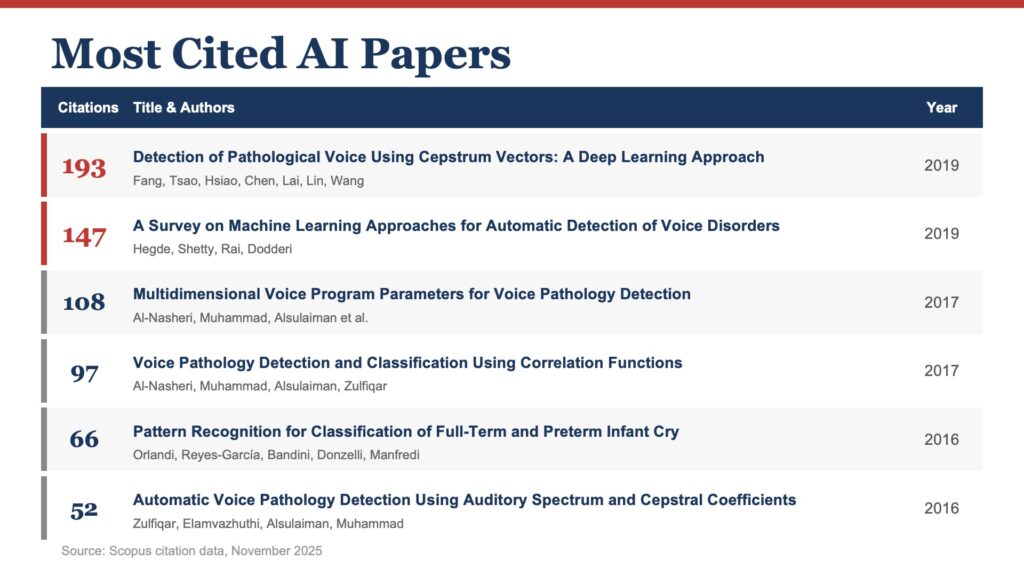
Fang and colleagues (2019): A deep learning study on pathological voice detection utilizing cepstrum vectors, capturing 193 citations.
Hegde and colleagues: A comprehensive survey on machine learning approaches for the automatic detection of voice disorders, garnering 147 citations.
Both papers were downloaded nearly 5,000 times each, ranking consistently among the most-accessed articles in their respective issues. These figures illustrate that the readers are not merely academic theorists; they are frontline clinicians, researchers, and speech-language pathologists actively seeking deployable digital tools to elevate patient care.
Landmark Research Reshaping the Field
The progression of machine learning within the Journal of Voice reflects a steady march toward greater diagnostic precision. Fang’s 2019 milestone proved that deep neural networks could identify vocal pathology through acoustic features completely imperceptible to the unassisted human ear. Subsequent work by researchers like Al-Nasheri (2017) on Multidimensional Voice Program parameters, Chen and Chen (2022) on advanced voice classification, and Cho and Choi on convolutional neural network (CNN) models for laryngoscopic images have continuously expanded the frontier of computational otolaryngology.
Voice as a Digital Biomarker
Perhaps the most exciting conceptual leap in recent years is the classification of the human voice as a digital biomarker—a non-invasive, continuous window into systemic human health.
Breakthrough research published in the journal details the use of advanced voice analysis to detect and monitor neurodegenerative conditions like Parkinson’s disease. A 2022 paper by Hemmerling and Wójcik-Pędziwiatr on predicting Parkinson’s severity from voice signals has secured 29 citations in a mere three years, accelerating the transition from bench science to bedside application.
Beyond neurology, systematic reviews have begun exploring voice quality as a digital biomarker for mental health disorders, including clinical depression and bipolar disorder. The societal implications are profound: routine, automated voice screening could flag mental health fluctuations long before traditional clinical manifestation, dramatically reducing the burden on overstretched healthcare systems and enabling early, life-saving interventions.
AI Chatbots in Clinical Practice
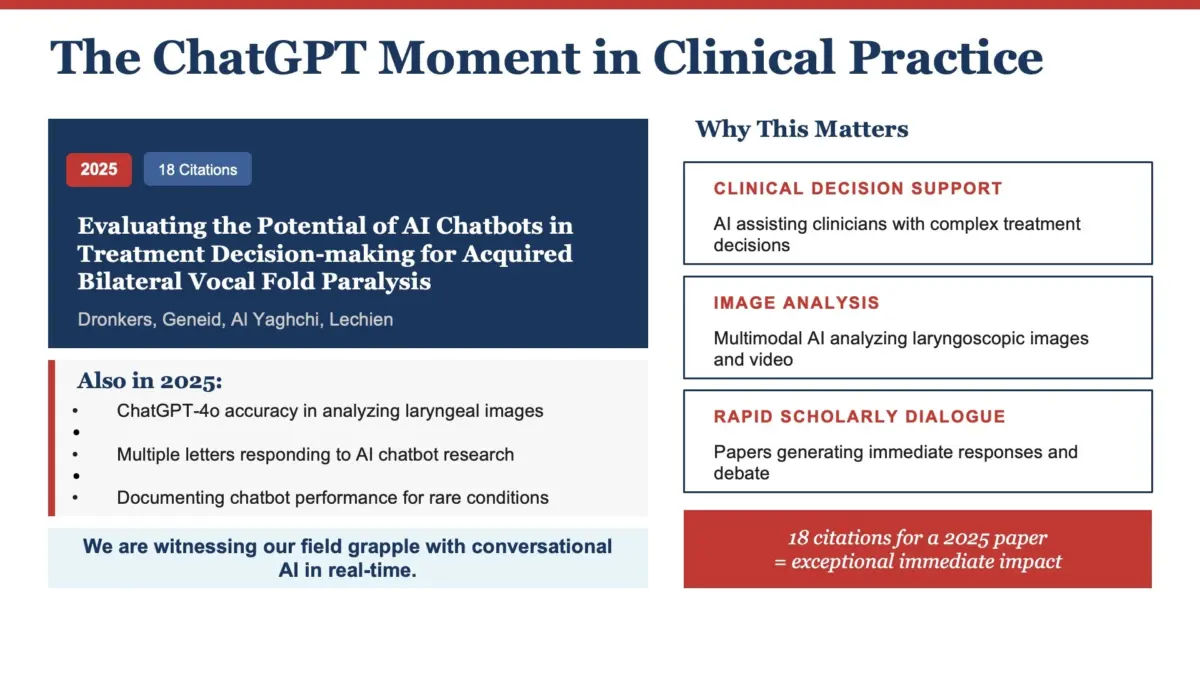
The integration of conversational artificial intelligence has also forced the medical community to look inward. In 2025, the journal published groundbreaking work by Dronkers and colleagues examining the potential of AI chatbots in treatment decision-making for acquired bilateral vocal fold paralysis. This single paper accumulated 18 citations almost immediately, triggering a flurry of response papers and letters to the editor regarding the diagnostic accuracy of platforms like ChatGPT-4o when analyzing complex laryngeal images.
Official Statements & Expert Perspectives
To navigate this seismic shift, the scientific community relies on the guidance of visionary researchers who understand both the computational architecture and the clinical stakes.
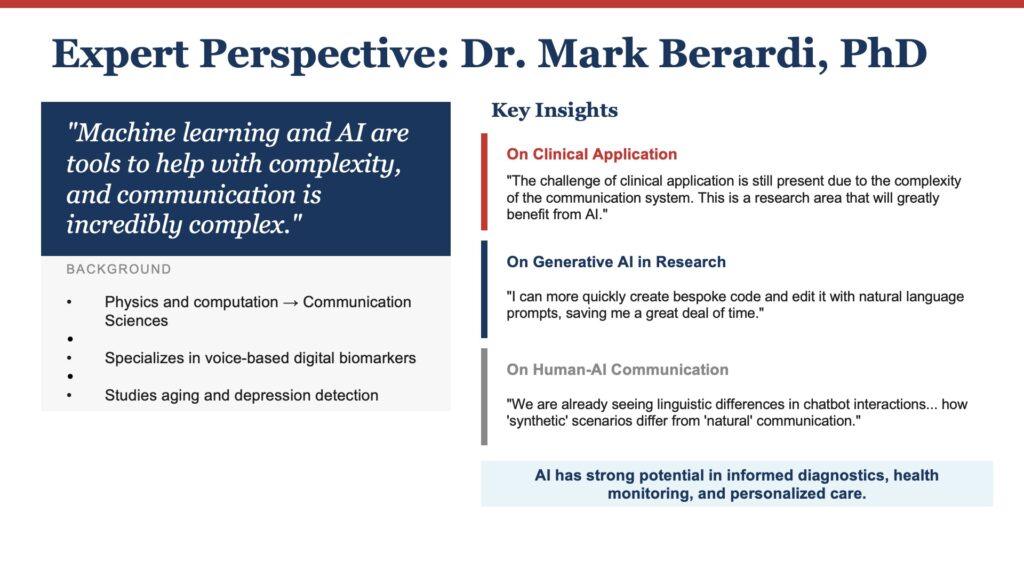
Dr. Mark Berardi: AI as a Tool for Complexity
Coming from a rigorous background in physics and computation, Dr. Mark Berardi views artificial intelligence through an analytical lens. He argues that AI is fundamentally an instrument designed to manage complexity:
"Machine learning and AI are tools to help with complexity, and communication is incredibly complex in its neurobiological and physiological processes. So I think the application is warranted."
Dr. Berardi’s current research focuses on extracting voice-based digital biomarkers for aging and depression. While acquiring clean speech signals has become frictionless, he notes that the true bottleneck lies within the intricate web of human neurobiology—precisely the domain where machine learning excels.
On generative AI, Dr. Berardi offers a pragmatic appraisal. While it hasn’t completely rewritten the theoretical rules of research overnight, it has eliminated mechanical bottlenecks. Researchers can now rapidly prototype bespoke code and refine data-processing pipelines using natural language prompts. Furthermore, Dr. Berardi is pioneering studies into human-AI communication—analyzing how human speech patterns adapt when conversing with machines versus other humans, and how "synthetic" environments like Zoom alter linguistic delivery.
"We are already seeing linguistic differences in chatbot interactions," he notes, suggesting that voice science must soon encompass human-machine communicative dynamics.
Dr. Eric Hunter: Embracing Change with Ethical Clarity
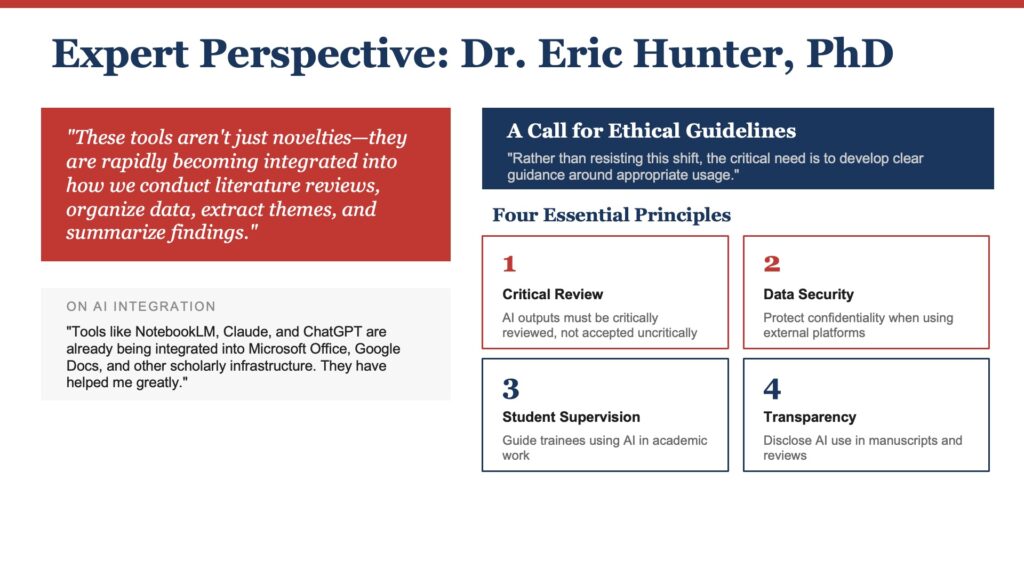
Dr. Eric Hunter focuses heavily on the institutional and academic ramifications of widespread AI adoption. He issues a clear warning to traditionalists: these platforms are not temporary novelties.
"These tools aren’t just novelties. They are rapidly becoming integrated into how we conduct literature reviews, organize data, extract themes from large bodies of text, and even summarize findings. Large language models and AI-driven platforms are not going away. In fact, we should expect them to become increasingly embedded within common academic workflows."
With AI tools seamlessly integrated into standard office suites and scholarly research infrastructures (such as NotebookLM, Claude, and ChatGPT), Dr. Hunter stresses that resistance is futile. Instead, the academic community must proactively establish clear boundaries. He outlines four essential principles for responsible integration:
Transparency: Full disclosure of AI assistance in literature synthesis, coding, and manuscript preparation.
Accountability: Absolute human ownership of final research conclusions, interpretations, and clinical assertions.
Data Integrity: Rigorous vetting of training datasets to prevent algorithmic bias and hallucinations in clinical diagnostics.
Ethical Review: Establishing standardized peer-review protocols to evaluate AI-generated methodologies.
"Our field will benefit most," Dr. Hunter concludes, "if we embrace the productivity these tools offer while also building a shared ethical framework for their responsible use."
A Global Research Community
The renaissance of voice science is fueled by an interconnected, international collective. Key contributors to the Journal of Voice span continents, including prolific authors such as Jérôme René Lechien, Dimitar Deliyski, Stephanie Zacharias, Ahmed Yousef, Paavo Alku, Leonardo Wanderley Lopes, and Maryam Naghibolhosseini. This global network proves that computational voice science is not the domain of a few isolated computer science labs, but a unified worldwide commitment to decoding human vocal physiology.
Future Outlook
The path forward for the Journal of Voice and the broader scientific community requires a delicate balance of enthusiasm and rigorous skepticism. As we look toward the next decade, three imperatives stand out:
Thoughtful Engagement: Researchers must treat AI as a powerful amplifier of human expertise rather than a replacement for clinical judgment. Understanding the inherent limitations of algorithms is just as vital as celebrating their predictive successes.
Collective Ethical Frameworks: The call for ethical governance voiced by leaders like Dr. Hunter must be answered collectively. Journals, universities, and medical boards must draft standardized guidelines that protect patient privacy and uphold scientific integrity.
Open Collaboration: With 161 AI papers and counting, the scientific community must continue to share data, datasets, and clinical insights openly to accelerate innovation.
The human voice has served as our fundamental instrument of connection, emotional expression, and personal identity for hundreds of millennia. It carries our deepest emotions, our physiological vulnerabilities, and our very essence in ways no other biological signal can replicate.
For the first time in human history, we possess computational tools sophisticated enough to truly decode that complexity—tools that extend the reach of expert clinicians, catch subtle pathologies before they escalate, and democratize access to elite voice care across the globe.
We are living through an extraordinary moment, and the Journal of Voice proudly stands at its epicenter. The next decade promises discoveries we are only just beginning to imagine, and we look forward to charting that uncharted territory together.