
Executive Overview
In the modern landscape of religious and community gatherings, architectural grandeur, sophisticated musical arrangements, and passionate spoken-word delivery form the backbone of a successful worship service. However, for a significant and often overlooked segment of the congregation—individuals experiencing hearing loss—these carefully crafted experiences can frequently become isolating. Traditional acoustic environments in large sanctuaries, community halls, and historic chapels present profound challenges, including reverberation, background noise, and distance from the sound source. To bridge this gap, houses of worship are increasingly turning to advanced Assistive Listening Systems (ALS).
Implementing an assistive listening infrastructure is far more than a mere compliance measure or technical upgrade; it represents a profound theological and cultural commitment to radical inclusion. When a house of worship ensures that every congregant can clearly hear the spoken message, the musical cadence, and the intimate whispers of prayer, it removes invisible barriers to spiritual engagement.
However, deploying an effective ALS requires strategic foresight, careful budgeting, comprehensive staff training, and targeted communication. Drawing from industry best practices and specialized resources—such as the Listen Technologies Church Assistive Listening Toolkit—this report provides a rigorous, step-by-step framework for religious organizations seeking to evaluate, procure, and successfully deploy assistive listening technology. By moving through a structured process of needs assessment, financial planning, operational training, and community awareness, leadership teams can transform their acoustic environments into spaces of universal access.
Detailed Chronology: A Four-Phase Implementation Framework
Successfully integrating an Assistive Listening System into an existing or newly constructed worship facility requires a methodical, multi-phase approach. Risc-free deployment depends on meticulous planning, stakeholder engagement, and continuous operational evaluation. The implementation lifecycle can be broken down into four distinct, highly collaborative phases.
Phase 1: Understanding Congregation Needs and Acoustic Realities
The foundational step in any technological integration is a thorough, empirical assessment of the target audience. Too often, facility managers attempt to diagnose acoustic needs from the sound booth, overlooking the lived experiences of congregants seated throughout the sanctuary.
- Deploying Congregational Surveys: The most effective method for quantifying hearing accessibility needs is the direct surveying of the congregation. Surveys should not merely ask if someone has trouble hearing, but should delve deeply into the nuances of their weekly experience. Key metrics to capture include:
- Self-reported difficulty understanding speech during various parts of the service (e.g., sermons versus musical interludes).
- Current utilization of hearing aids or cochlear implants.
- Specific technical capabilities of personal devices, notably whether hearing aids are equipped with telecoils (t-coils).
- Analyzing Sanctuary Acoustics: Alongside demographic and personal surveys, audio technicians must evaluate the physical space. Reverberation times, dead zones, and sound pressure level (SPL) distributions across different seating sections must be mapped. Understanding how sound behaves in the room allows technical teams to select the appropriate ALS technology—whether infrared (IR), radio frequency (RF), or audio induction loop systems.
Phase 2: Financial Planning, Budgeting, and Procurement
Once the congregation’s specific needs and the room’s acoustic profile are clearly defined, leadership must evaluate available technological options against organizational budgetary constraints.
- Cost-Benefit Analysis of Equipment Tiers: Assistive listening solutions vary widely in price and complexity, ranging from basic pocket-receiver systems to robust, venue-wide hearing loop infrastructures that interface directly with personal t-coil hearing aids. Decision-makers must calculate the total cost of ownership (TCO), factoring in hardware longevity, maintenance, battery replacements, and potential future expandability.
- Leveraging Expert Consultations and Funding: Specialized audio-visual integrators, such as CCI Solutions, provide invaluable assistance during this phase, frequently offering free consultations to help organizations align their technical ambitions with realistic fiscal parameters. Furthermore, because capital expenditures for accessibility upgrades can occasionally strain standard operational budgets, leadership should proactively explore targeted fundraising campaigns, dedicated donor gifts, or accessibility-focused grants designed to underwrite inclusion initiatives.
Phase 3: Operational Readiness and Staff Training
The most sophisticated assistive listening hardware will inevitably fail if the human element of deployment is neglected. Ushers, greeters, sound engineers, and welcome desk volunteers form the front line of accessibility.
- Empowering "Assistive Listening Ambassadors": Staff and volunteers must be thoroughly trained not only on the mechanics of charging, storing, and distributing receivers, but also on the empathetic delivery of these tools. They must view themselves as accessibility ambassadors whose role is to warmly facilitate connection rather than merely hand out electronics.
- Establishing Clear Operating Procedures: Operational friction must be minimized. Stations where devices are checked out should maintain a standardized workflow. To assist volunteers during high-traffic moments before a service begins, facilities should keep a laminated, highly visible "Frequently Asked Questions" (FAQ) sheet at the distribution desk, providing instant answers regarding device pairing, volume adjustments, and sanitary protocols.
Phase 4: Community Awareness and Technological Adoption
Purchasing and installing an ALS is only half the battle; ensuring that the technology is actively utilized requires an aggressive, multi-channel awareness campaign.
- Strategic Signage and Wayfinding: Clear, internationally recognized accessibility signage must be placed at all primary entrances, welcome kiosks, and seating areas. Congregants should instantly know that assistive devices are available and precisely where to acquire them.
- Multi-Channel Marketing: Reminders regarding the availability of assistive listening devices should be systematically integrated into weekly printed bulletins, digital slide presentations before services, and announcements from the stage.
- Live Training and Community Outreach: To alleviate any intimidation surrounding new technology, houses of worship should consider hosting dedicated live training sessions or workshops. Here, congregants can test the equipment in a relaxed, low-pressure environment. Beyond the internal congregation, advertising these accessibility upgrades to the broader local community can yield profound results; many individuals who have drifted away from active worship due to hearing degradation will return when they realize a facility has made intentional accommodations for their needs.
Supporting Context & Metrics: The Imperative of Hearing Accessibility
To fully appreciate the urgency of deploying Assistive Listening Systems, one must examine the broader demographic and sociological realities surrounding hearing loss, particularly within aging populations and community-focused institutions.
The Demographics of Hearing Impairment
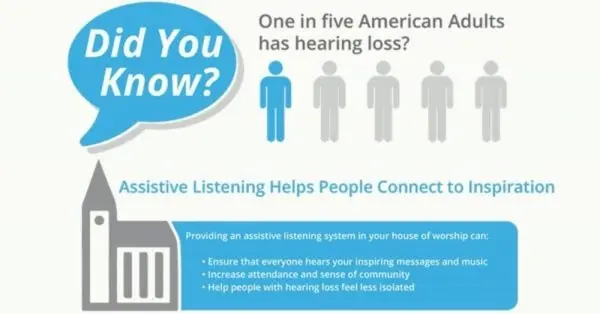
According to public health data from organizations such as the World Health Organization (WHO) and the Centers for Disease Control and Prevention (CDC), hearing loss is one of the most prevalent chronic conditions affecting adults globally. In many religious communities, the demographic curve skews toward older adults—a population segment where age-related hearing loss (presbycusis) is statistically most pronounced.
- The Isolation Factor: Unaddressed hearing loss is rarely just a physical ailment; it is deeply intertwined with social isolation, depression, and cognitive decline. When an individual struggles to understand spoken word in a crowded, reverberant worship space, they often choose to withdraw entirely rather than experience the exhaustion of straining to listen.
- The Limitations of Amplification Alone: A common misconception among church leadership is that simply turning up the main loudspeaker system solves the problem. In acoustic environments with high reverberation (common in traditional sanctuaries with hard plaster walls, stained glass, and high ceilings), merely increasing volume often degrades speech intelligibility. Amplifying sound in a boomy room only makes the reflections louder, turning distinct syllables into an unintelligible wash of noise. Assistive Listening Systems bypass this acoustic hurdle by delivering a clean, direct audio feed straight to the listener’s ear or hearing aid.
Technological Ecosystems: Understanding the Options
When selecting an ALS, administrators must navigate several distinct technological topologies, each with specific advantages:

- Audio Induction Loops (Hearing Loops): Widely considered the gold standard for accessibility by users, hearing loops transmit an audio signal via a copper wire loop installed around the perimeter of a room. This magnetic field is picked up directly by the telecoil (t-coil) inside a user’s hearing aid or cochlear implant. Advantages: No extra receivers to check out; discreet; zero latency. Disadvantages: Higher initial installation costs; susceptibility to electrical interference.
- Radio Frequency (RF) Systems: RF systems transmit audio via radio waves from a central transmitter to individual pocket receivers worn by the user, who then plugs in standard headphones or earbud sets. Advantages: Wide coverage area; reliable signal propagation through walls; cost-effective. Disadvantages: Requires management, distribution, sanitation, and collection of physical receivers.
- Infrared (IR) Systems: IR systems utilize invisible light waves to transmit high-quality audio within a localized line-of-sight space. Advantages: Secure transmission (signals cannot escape through walls, making them ideal for confidential spaces); immune to radio interference. Disadvantages: Requires direct line-of-sight between transmitter and receiver; ineffective in sunlit outdoor or heavily glassed spaces.
Official Statements and Industry Insights
Industry experts, accessibility advocates, and technical solution providers emphasize that integrating an ALS is a transformative cultural milestone for any religious community.
Renowned audio integration specialists note that the primary barrier to assistive listening adoption is rarely financial; rather, it is a lack of awareness regarding how modern technology interacts with personal medical devices. As highlighted in expert materials from organizations specializing in worship technology, bridging the gap between sound ministry and physical accessibility requires a shift in mindset:
"Reaching out to those who feel disconnected from your community due to hearing loss is central to sharing the message of inclusion. Genuinely compassionate service involves being aware of and caring for the needs of everyone, especially those dealing with impairments. Make sure they are able to hear the beauty and emotion of the spoken word in your church by providing them with the equipment they need to stay connected."
Furthermore, manufacturers and advocacy groups stress that compliance with accessibility standards, such as the Americans with Disabilities Act (ADA) in the United States, represents only the minimum legal threshold. True pastoral care and community leadership transcend compliance, aiming for an environment where every single attendee experiences optimal engagement, unhindered by physiological limitations.
To streamline this educational and procurement process, industry resources such as the Listen Technologies Church Assistive Listening Toolkit have been developed. These comprehensive guides provide downloadable sample surveys, standardized signage templates, bulletin announcement copy, and technical configuration workflows designed specifically to empower administrative and pastoral teams.
Future Outlook: The Horizon of Inclusive Worship
As audio-visual technology continues to evolve at a rapid pace, the future of assistive listening in houses of worship points toward greater integration, personalization, and seamless connectivity.
The Shift Toward Personalization and BYOD (Bring Your Own Device)
While traditional dedicated RF receivers and hardwired hearing loops will remain foundational, the next generation of assistive listening is increasingly leaning toward smartphone integration and "Bring Your Own Device" (BYOD) ecosystems. Modern Wi-Fi-based assistive listening platforms allow congregants to stream pristine, zero-latency sanctuary audio directly to their personal smartphones using standard earbuds or Bluetooth-enabled hearing aids.
This technological evolution offers several profound benefits:
- Reduced Stigma: Many congregants—particularly younger individuals or those newly experiencing hearing degradation—hesitate to request a specialized device at a welcome desk due to social stigma. Utilizing their own smartphone removes this psychological barrier entirely.
- Customized Audio Profiles: Future software iterations will allow users to fine-tune frequency responses, compression, and equalization directly through an app tailored to their specific audiogram and hearing profile.
Architectural and Cultural Integration
Looking ahead, accessibility will no longer be treated as an auxiliary or retrofitted feature added to a completed building project. Forward-thinking architects, acousticians, and religious leaders are now baking acoustic design and hearing loop infrastructure into the master-planning phase of new sanctuaries and campus expansions.
Ultimately, the future of worship spaces will be defined by an uncompromising commitment to universal design. By recognizing that physical spaces must accommodate the full spectrum of human sensory experience, houses of worship can ensure that their doors—and their messages—truly remain open to all. The deployment of an Assistive Listening System is a powerful, tangible testament to this mission, ensuring that the spoken word, the shared prayer, and the transformative power of community resonate clearly in every heart and mind.