
Executive Overview
In an era where houses of worship increasingly leverage cutting-edge audio-visual technology to amplify their message, a critical demographic is frequently overlooked: individuals experiencing hearing loss. For many congregants, the Sunday service—meant to be a time of spiritual connection, community engagement, and auditory inspiration—becomes an exercise in frustration. Reverberant sanctuaries, competing ambient noise, and complex acoustic environments can render spoken sermons and musical performances entirely unintelligible, even for those utilizing standard amplification or hearing aids.
The implementation of an Assistive Listening System (ALS) is no longer merely an accommodation; it is a foundational pillar of radical hospitality and inclusive ministry. However, successfully bridging this acoustic divide requires far more than simply purchasing and plugging in off-the-shelf hardware. It demands a strategic, multi-phased approach that encompasses congregation assessment, rigorous budget forecasting, comprehensive staff and volunteer training, and proactive community-wide marketing.
This comprehensive report examines the strategic imperatives houses of worship must navigate when deploying an ALS. Drawing upon industry best practices, expert consultations from technical integrators such as CCI Solutions, and institutional frameworks like the Listen Technologies Church Assistive Listening Toolkit, this article provides a definitive roadmap for leadership teams committed to ensuring that every voice—and every message—is heard.
Detailed Chronology: A Four-Phase Roadmap to ALS Deployment
Transitioning a worship facility into an acoustically accessible environment requires a methodical, step-by-step approach. Rphasing the deployment prevents common pitfalls, controls capital expenditure, and maximizes user adoption.
Phase 1: Understanding Congregation Needs and Baseline Assessment
The foundational mistake many facility managers make is purchasing hardware based solely on room square footage rather than the specific demographic and clinical realities of their congregation. Assessing needs must precede any procurement conversation.
- Deploying Congregational Surveys: Leadership should initiate a comprehensive survey distributed both digitally (via email and app notifications) and physically (printed inserts in worship bulletins). This survey must go beyond a simple "Do you have trouble hearing?" Instead, it should inquire about specific service experiences, the types of assistive devices currently owned (such as hearing aids or cochlear implants), and crucially, whether those personal devices are equipped with telecoils (t-coils).
- Analyzing Acoustic Environments: Facility teams must evaluate how different spaces within the campus—from the main sanctuary to auxiliary youth chapels and cry rooms—interact with sound. Understanding dead zones and reverberation times ensures that the chosen ALS technology (whether RF, infrared, or audio induction loop) matches the structural realities of the building.
Phase 2: Comprehensive Budgeting and Solution Architecture
Once demographic data and acoustic profiles are compiled, leadership can evaluate technological options against financial realities.
- Cost Estimation and Product Matching: Assistive listening technologies vary widely in price and application. Facilities must evaluate the total cost of ownership, factoring in transmitters, receivers, neckloops, charging stations, and signage.
- Leveraging Expert Consultations: Organizations like CCI Solutions offer specialized assistance, providing free consultations designed to help church administrators navigate complex equipment tiers, expense reports, and long-term budgeting constraints.
- Capital Campaign and Fundraising Integration: For many congregations, retrofitting an older sanctuary or outfitting a new build strains existing operational budgets. Forward-thinking ministries frame the ALS initiative as a dedicated fundraising campaign. Communicating the profound impact of hearing accessibility often inspires generous donor giving, as members recognize a direct line between their contributions and the inclusion of marginalized peers.
Phase 3: Operational Readiness and Staff Training
The finest audio hardware in the world is rendered useless if staff, ushers, and volunteers do not know how to operate it, maintain it, or explain it to potential users.
- Establishing "Assistive Listening Ambassadors": Frontline volunteers—greeters, ushers, and welcome desk attendants—must be thoroughly trained. They should not merely hand out devices; they must act as knowledgeable ambassadors for accessibility.
- Standardized Check-Out Procedures: Training protocols must include hands-on instruction for users at the point of distribution. Volunteers should demonstrate how to adjust volume, wear neckloops correctly, and pair devices with personal hearing aids.
- Operational Documentation: To maintain consistency during staff transitions, facilities should keep a laminated copy of Frequently Asked Questions (FAQs) and troubleshooting steps directly at the distribution desk. Quick-reference guides reduce friction and build confidence among volunteers.
Phase 4: Community Awareness and Marketing Integration
Deploying an ALS is a significant milestone that deserves celebration and widespread communication, both internally and throughout the surrounding civic community.
- Universal Signage Deployment: Compliance and clarity go hand-in-hand. Facilities must install standardized, internationally recognized signage indicating that Assisted Listening Devices are available, along with clear directional indicators pointing to the distribution desk.
- Multi-Channel Promotion: Awareness campaigns should span every communication medium. Weekly bulletin reminders, slide deck announcements before services, and dedicated email blasts ensure that the message reaches all corners of the congregation.
- Hosting Live Technology Demos: To eliminate intimidation associated with new technology, ministries can host interactive training sessions or open-house demonstrations during fellowship hours. Allowing congregants to test receivers in a low-pressure environment significantly drives adoption rates.
- Civic Outreach: The commitment to accessibility is a powerful testimony to the wider community. Local senior centers, retirement communities, and advocacy groups for the hard of hearing should be explicitly notified that the facility is fully accessible, welcoming back individuals who may have previously dropped away due to hearing barriers.
Supporting Context & Metrics: The Hidden Epidemic of Hearing Loss in Worship
To fully grasp the urgency of implementing an Assistive Listening System, one must examine the broader demographic and psychological data surrounding hearing impairment, particularly within aging populations and traditional faith communities.
The Demographics of Hearing Loss
According to data from the National Institutes of Health (NIH) and the Hearing Loss Association of America (HLAA):
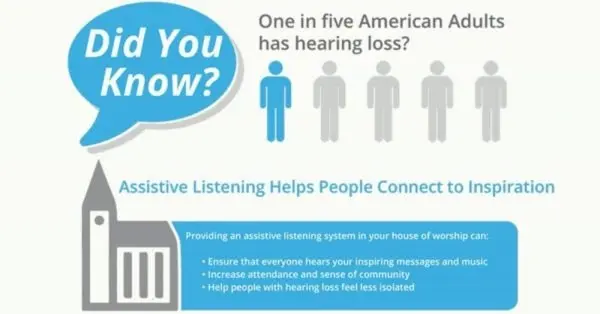
- Approximately 15% of American adults (37.5 million) aged 18 and over report some trouble hearing.
- The prevalence of hearing loss increases sharply with age: roughly 25% of those aged 65 to 74 and 50% of those aged 75 and older experience disabling hearing loss.
- Given that many church congregations skew older than the general population, the concentration of individuals struggling with auditory comprehension during services is often disproportionately high—frequently exceeding 30% to 40% in traditional liturgical and mainline Protestant settings.
The Psychological Toll of Acoustic Isolation
Hearing loss is rarely just a physical limitation; it is deeply psychological and social. When congregants cannot understand the spoken word, scripture readings, or pastoral prayers, they experience a profound sense of isolation.
- Disconnection from Community: Unable to participate fully in shared worship, individuals often quietly drift away from active church life, missing out on the pastoral care and fellowship that faith communities are designed to provide.
- Cognitive Fatigue: Straining to hear in a reverberant room for an hour causes extreme cognitive exhaustion, often referred to as "listening fatigue." Many attendees simply stop trying, choosing instead to stay home.
By installing an ALS, a house of worship directly counteracts this isolation. Providing assistive technology is a tangible manifestation of empathy, signaling to every attendee that their presence is valued, their struggles are recognized, and their ability to engage spiritually is a priority for the ministry.

Official Statements and Industry Insights
Industry leaders, accessibility advocates, and audio-visual integrators emphasize that assistive listening is no longer an optional accessory, but an integral component of modern architectural and acoustic design.
"Reaching out to those who feel disconnected from your community due to hearing loss is central to sharing the message of inclusion. Genuinely compassionate service involves being aware of and caring for the needs of everyone, especially those dealing with impairments. Make sure they are able to hear the beauty and emotion of the spoken word in your church by providing them with the equipment they need to stay connected."
— Technical Integration Advisory, CCI Solutions
Experts point out that compliance with accessibility legislation, such as the Americans with Disabilities Act (ADA) in the United States, sets a legal baseline, but true ministry extends far beyond minimum legal requirements. While the ADA mandates specific percentages of assistive listening receivers based on room capacity, the pastoral imperative is to achieve 100% functional inclusion.
Furthermore, manufacturers of assistive listening technologies have streamlined integration protocols. Modern systems seamlessly interface with existing digital sound mixing consoles, allowing audio engineers to route clean, direct feeds—untouched by room reverberation—straight to transmitters. This ensures that a congregant with an ALS receiver experiences superior vocal clarity compared to someone sitting unassisted in the optimal acoustic center of the sanctuary.
Future Outlook: The Horizon of Inclusive Worship Technology
As we look toward the future of worship production and facility management, the landscape of assistive listening is evolving rapidly. Several key trends are poised to redefine how houses of worship approach auditory accessibility over the next decade:
1. The Rise of Personal Smartphone Integration
Traditional ALS setups rely heavily on dedicated hardware receivers managed, cleaned, and distributed by volunteers. However, the future increasingly points toward Bring Your Own Device (BYOD) architectures. Wi-Fi-based assistive listening systems allow congregants to stream pristine audio directly to their personal smartphones via proprietary apps. Users can then listen using their own wired or Bluetooth-enabled headphones, hearing aids, or cochlear implants, dramatically reducing the administrative burden on church staff while offering a discreet, personalized listening experience.
2. Advanced Telecoil and Bluetooth LE Audio Integration
The widespread adoption of Bluetooth Low Energy (LE) Audio and Auracast broadcast technology promises to revolutionize public space audio. Auracast will allow audio sources—such as a church sound system—to broadcast high-quality audio directly to an unlimited number of compatible personal audio devices simultaneously. Houses of worship that invest in robust IP-enabled audio infrastructure today will be uniquely positioned to adopt these emerging broadcast standards seamlessly.
3. Artificial Intelligence and Dynamic Acoustic Compensation
As artificial intelligence permeates professional audio mixing, future ALS deployments will likely incorporate real-time AI processing that dynamically adapts to individual hearing profiles. Future receivers may feature cloud-synced hearing prescriptions that automatically boost specific frequency ranges tailored to a user’s exact audiogram, compensating for complex sensorineural hearing loss on the fly.
Conclusion
The mandate of the modern house of worship is to proclaim a message of radical grace, universal welcome, and deep community. Yet, that message remains incomplete if physical and acoustic barriers prevent a significant portion of the congregation from receiving it.
By following a disciplined framework—understanding congregation needs through rigorous surveys, budgeting wisely with expert partners like CCI Solutions, preparing staff to be passionate ambassadors, and creating vibrant community awareness—ministries can dismantle these invisible barriers. Utilizing comprehensive resources such as the Listen Technologies Church Assistive Listening Toolkit, facility leaders have access to the sample surveys, signage templates, and promotional materials required to turn accessibility goals into operational realities.
Ultimately, investing in an Assistive Listening System is an investment in human connection. It ensures that when the spoken word echoes through the sanctuary, every heart and mind can engage fully with its beauty, emotion, and transforming power.