
Executive Overview
In an era defined by rapid technological advancement and an increasing cultural emphasis on accessibility, houses of worship face a critical mandate: ensuring that every member of the congregation can fully participate in communal services. For millions of individuals experiencing hearing loss, the Sunday morning experience can often be an isolating ordeal. Despite powerful architectural acoustics, traditional sound reinforcement systems frequently fail to overcome the barriers posed by background noise, reverberation, and distance.
Enter the Assistive Listening System (ALS)—a transformative technology designed to bridge the acoustic gap between the pulpit and the pew. However, the deployment of such systems within a worship environment requires far more than a simple equipment purchase. It demands a strategic, highly intentional approach that encompasses congregational assessment, budgetary forecasting, comprehensive staff training, and aggressive community outreach.
This comprehensive report examines the four-step framework necessary for successfully integrating an Assistive Listening System into any house of worship. Drawing on industry insights from AV integration experts and specialized manufacturers like Listen Technologies, this analysis provides church leadership teams, AV directors, and administrative boards with the authoritative roadmap required to foster a truly inclusive worship environment. By systematically addressing congregation needs, evaluating financial options, empowering volunteer ambassadors, and raising public awareness, faith communities can ensure that the spoken word—and the emotional resonance of the service—reaches every single attendee without exception.
Detailed Chronology: The Four-Phase Implementation Roadmap
Successfully deploying an Assistive Listening System is a multi-stage initiative. To maximize return on investment and ensure high user adoption rates, churches must follow a disciplined, chronological methodology.
Phase 1: Understanding Congregation Needs and Baseline Assessment
The foundational misstep in many audio upgrade projects is purchasing hardware based solely on guesswork rather than empirical data. Before evaluating specific technologies, leadership must quantify the actual hearing-assistance requirements of their flock.
The most effective vehicle for this discovery phase is a targeted congregational survey. Church administrators should distribute questionnaires designed to capture nuanced data regarding parishioners’ listening experiences. Key inquiries must address:
- Current Acoustic Challenges: Do attendees struggle to comprehend the sermon due to ambient noise, echo, or low-volume speech?
- Hearing Aid Utilization: What percentage of the congregation wears hearing aids?
- Technology Compatibility: Are these hearing aids equipped with telecoils (t-coils), which allow direct audio streaming from loop systems or neck loops?
By gathering this data, AV teams can avoid purchasing obsolete or mismatched equipment. For instance, if a high percentage of elderly parishioners utilize t-coil equipped hearing aids, a hearing loop system may offer the most seamless, accessory-free experience. Conversely, if needs vary widely, a multi-channel radio frequency (RF) or infrared (IR) system paired with dedicated receivers and lightweight headphones may prove more versatile.
Phase 2: Comprehensive Options Analysis and Financial Forecasting
Once demographic and acoustic needs are clearly established, the leadership team must transition to evaluating equipment options and aligning them with fiscal realities. Estimating the total cost of ownership involves looking beyond the initial hardware price tag to include installation, cabling, signage, and maintenance accessories.
Houses of worship operate under strict budgetary constraints, making financial forecasting critical. Specialized AV providers, such as CCI Solutions, offer invaluable assistance during this phase by providing free consultations specifically tailored to expense mapping and budget alignment.
Furthermore, churches should look beyond general operational funds to finance these inclusivity initiatives. Creative fundraising campaigns—such as designated memorial gifts, specialized capital campaigns, or community grant applications—frequently yield the capital necessary to offset the cost of high-end assistive listening solutions. Engaging the congregation in the funding process also builds a sense of shared ownership in the mission of accessibility.
Phase 3: Operational Readiness and Staff Training
The acquisition of state-of-the-art technology guarantees nothing if the human element of deployment is neglected. The success of an Assisted Listening System ultimately hinges on the competency and enthusiasm of the staff and volunteers tasked with its daily operation.
Church receptionists, ushers, audio engineers, and welcome-team volunteers must undergo rigorous training on how to operate, maintain, and distribute the listening devices. Think of these frontline personnel not merely as ushers, but as Assisted Listening Ambassadors. Their demeanor and technical fluency will dictate whether a hesitant parishioner feels comfortable requesting and utilizing a device.
Best practices for operational readiness include:
- Guided User Instruction: When checking out a device to an attendee, volunteers must take a moment to patiently explain its operation, adjust volume controls, and demonstrate proper placement.
- Visual Aid Integration: Maintain a laminated, highly legible copy of Frequently Asked Questions (FAQs) at the welcome desk or distribution counter. This ensures volunteers can quickly troubleshoot minor issues or answer common questions without fumbling through manuals.
- Maintenance Protocols: Establish a strict routine for sanitizing, charging, and inventorying receivers after every service to guarantee peak performance week after week.
Phase 4: Strategic Awareness and Community Outreach
An invisible technology is an underutilized technology. Even the most sophisticated listening system will fail to impact the community if congregants do not know it exists. Phase four centers on aggressive internal marketing and external community outreach.
First, houses of worship must implement clear, universally recognized signage indicating that Assisted Listening Devices are available, along with directional indicators pointing to the pickup location. Second, perpetual reminders should be woven into weekly church bulletins, digital projection slides before services, and announcements from the stage.
To drive rapid adoption, churches should consider hosting a dedicated live training session or "Accessibility Sunday." This gives congregants an opportunity to test the technology in a low-stakes environment, demystifying the equipment for those who might feel intimidated by modern electronics.

Finally, do not limit marketing efforts to the existing membership. Surrounding neighborhoods harbor countless individuals who have stopped attending church simply because they could no longer hear the services. Aggressively advertising the church’s commitment to universal accessibility can serve as a powerful beacon, drawing new visitors and welcoming back those who felt alienated by their sensory impairments.
Supporting Context & Metrics: The Imperative of Accessibility
To fully appreciate the urgency of deploying Assistive Listening Systems, one must examine the broader socio-demographic and architectural context governing modern houses of worship.
The Demographic Reality of Hearing Loss
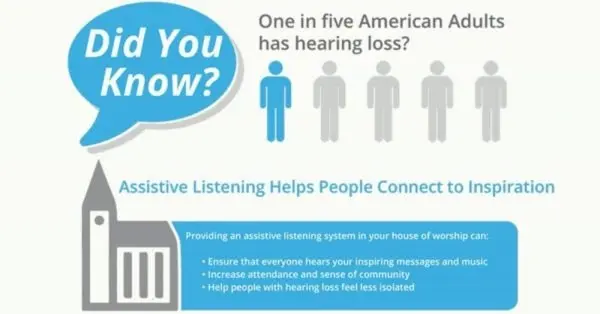
According to data compiled by public health agencies and audiological associations, hearing loss is one of the most prevalent chronic conditions affecting adults globally. In aging populations, the incidence rate climbs precipitously. Within a typical church demographic—which often skews older—a significant percentage of the congregation experiences some degree of sensorineural or conductive hearing loss.
When left unaddressed, hearing loss does more than impede communication; it drives social isolation. Individuals who struggle to follow a sermon often withdraw from fellowship coffee hours, Bible studies, and worship services altogether. By investing in an ALS, a church directly combats this isolation, upholding a theological commitment to radical hospitality.
Acoustic Challenges in Traditional Architecture
Paradoxically, many traditional church buildings feature architectural aesthetics that actively sabotage speech intelligibility. Vaulted ceilings, hard stone pillars, stained glass windows, and expansive hardwood or tile flooring create long reverberation times (echoes). While these structural elements enhance pipe organs and choral performances, they smear the transient sounds of human speech, making it extraordinarily difficult for the human brain to parse words cleanly—even for individuals with normal hearing, let alone those utilizing hearing aids.
Assistive Listening Systems bypass these room acoustics entirely. By transmitting the audio signal directly from the soundboard—via infrared, radio frequency, or induction loops—straight to the listener’s ear or hearing aid, these systems eliminate room reverberation and background noise from the listening equation.
Official Statements & Industry Insights
Industry leaders emphasize that accessibility is no longer an optional "add-on" for progressive organizations, but a core component of holistic ministry.
Advocacy groups and audio manufacturers, including the resource teams at Listen Technologies, consistently highlight that true hospitality requires removing unseen barriers. In their comprehensive House of Worship Assistive Listening Toolkit, industry specialists note:
"Reaching out to those who feel disconnected from your community due to hearing loss is central to sharing the message of inclusion. Genuinely compassionate service involves being aware of and caring for the needs of everyone, especially those dealing with impairments. Make sure they are able to hear the beauty and emotion of the spoken word in your church by providing them with the equipment they need to stay connected."
AV integration specialists echo this sentiment, stressing that the integration of assistive technologies elevates the overall production and communication standard of the entire worship service. When the spoken word is pristine and accessible, engagement spikes across all demographics, reinforcing the impact of the pastoral message.
Future Outlook: The Evolution of Inclusive Worship Technology
As we look toward the future of worship facility design, the convergence of audio engineering and personal medical technology promises even greater integration and ease of use.
The Rise of Bluetooth LE Audio and Auracast
The horizon of assistive listening is being reshaped by emerging standards such as Bluetooth Low Energy (LE) Audio and broadcast audio technologies like Auracast. These innovations point toward a future where houses of worship may no longer need to manage physical inventories of dedicated receivers and headphones. Instead, venues can broadcast high-quality, multi-channel audio directly to compatible smartphones, tablets, and next-generation Bluetooth-enabled hearing aids or earbuds already in the pockets and ears of attendees.
Proactive Design in Facility Master Planning
Forward-thinking churches are moving away from retrofitting accessibility solutions as an afterthought. Modern architectural planning increasingly incorporates acoustic modeling and pre-wired induction loop perimeters directly into initial capital construction blueprints. This holistic mindset ensures that future generations of worshippers will encounter spaces designed from the ground up for universal participation.
Conclusion and Next Steps
The integration of an Assistive Listening System is both a technical upgrade and a profound pastoral ministry. By systematically understanding congregational needs, navigating financial options with expert guidance, training staff to act as compassionate ambassadors, and raising comprehensive community awareness, houses of worship can dismantle the invisible barriers of hearing loss.
For leaders seeking actionable tools to begin this journey—including sample congregation surveys, standardized signage templates, and bulletin announcement drafts—comprehensive resources such as the Listen Technologies Church Assistive Listening Toolkit offer invaluable assistance.
Is your worship facility prepared to take the next step toward universal inclusion? Evaluate your acoustic footprint today, engage your congregation, and ensure that every voice in your community is heard loud and clear.