By Ian DeNolfo, Executive Director, The Voice Foundation
Executive Overview
We stand at a profound inflection point in the history of voice science—a moment when artificial intelligence (AI) and advanced machine learning are fundamentally reshaping how researchers conduct investigations, how clinicians analyze complex biological data, and how medical professionals care for patients.
For more than half a century, The Voice Foundation and its premier peer-reviewed publication, the Journal of Voice, have served as the intellectual nexus bridging art and science, the clinic and the stage. Today, that bridge is carrying an unprecedented volume of computational innovation.
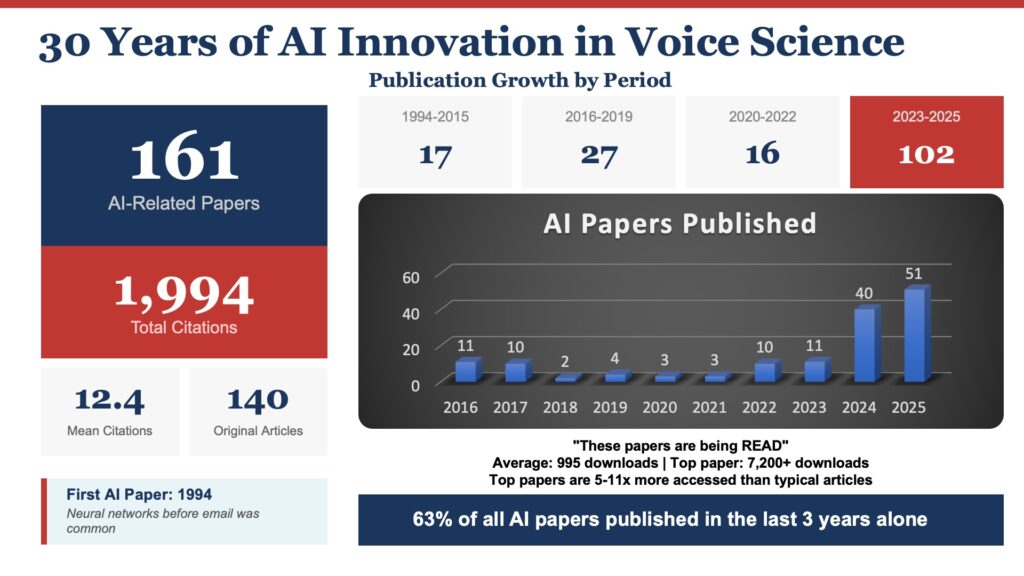
Far from being a sudden or fleeting trend, the integration of artificial intelligence into voice science spans more than three decades. Yet, the velocity of this transformation has reached an exponential curve. Of the hundreds of AI-focused studies published within the pages of the Journal of Voice over its history, an astonishing 63 percent have appeared within the last three years alone. In 2025 alone, the journal published 51 AI-related papers—surpassing the output of the field’s entire first two decades combined.
This explosive growth is not merely a quantitative milestone; it represents a qualitative paradigm shift. From deep neural networks capable of detecting vocal pathologies imperceptible to the human ear, to pioneering research framing the human voice as a non-invasive digital biomarker for systemic health conditions like Parkinson’s disease, depression, and respiratory illness, AI is unlocking the hidden architecture of human vocalization. As the medical and scientific communities grapple with these breakthroughs—alongside the ethical integration of generative AI and clinical chatbots—the imperative for a shared framework of responsible usage has never been more urgent.
A Legacy of Interdisciplinary Innovation
To understand the magnitude of today’s technological leap, one must examine the foundational bedrock upon which it rests. In 1969, Dr. Wilbur James Gould founded The Voice Foundation in New York City during an era when systematic, interdisciplinary care for the human voice was virtually nonexistent. Dr. Gould possessed the visionary foresight to bring together groups that historically operated in silos: physicians, scientists, speech-language pathologists, vocal performers, and master pedagogues. Together, they forged a collaborative ecosystem dedicated to understanding and preserving the professional voice.
The Foundation’s momentum rapidly materialized into institutional traditions. In 1972, it convened its first Annual Symposium—Care of the Professional Voice—followed a year later by its inaugural Gala, later celebrated as the Voices of Summer. For over five decades, these platforms have successfully bridged the gap between the expressive artistry of the stage and the rigorous objectivity of the medical laboratory.
Since 1989, The Voice Foundation has flourished under the leadership of Dr. Robert Thayer Sataloff. An internationally renowned otolaryngologist, Dr. Sataloff is also a professional singer and conductor whose staggering academic output includes more than 1,200 publications and 79 textbooks. Under his stewardship, the Foundation relocated its headquarters to Philadelphia and cemented its status as the global epicenter of voice education and interdisciplinary research, anchored by the Journal of Voice.
A Three-Decade Chronology: Tracing the Roots of AI in Voice Science
While contemporary public discourse often treats artificial intelligence as an overnight phenomenon born of recent generative models, the voice science community has been pioneering computational analytics for over thirty years.
The historical timeline of AI within the Journal of Voice stretches back to 1994—the very same year the World Wide Web first emerged into public consciousness, and long before electronic mail became a ubiquitous workplace tool. In that seminal year, the journal published a paper by Rihkanen and colleagues titled "Spectral Pattern Recognition of Improved Voice Quality," which utilized early neural networks to analyze acoustic patterns.
For many years, this intersection of computer science and otolaryngology advanced at a steady, deliberate pace. A retrospective analysis of the publication timeline reveals distinct eras of growth:
The Pioneeering Era (1994–2015): 17 foundational papers exploring basic neural networks, pattern recognition, and early digital signal processing.
The Acceleration Era (2016–2019): 27 papers marking the early adoption of advanced machine learning algorithms and deeper algorithmic architectures.
The Stabilization & Refinement Era (2020–2022): 16 papers navigating global research shifts during the pandemic while quietly refining pattern classification.
The Exponential Explosion (2023–2025): 102 papers—accounting for 63 percent of all historical AI publications in the journal—highlighted by an unprecedented 51 papers published in 2025 alone.
This trajectory underscores a profound truth: the voice science community did not merely react to the modern AI boom; it anticipated and built the analytical foundations upon which today’s medical breakthroughs stand.
Academic metrics are frequently criticized for existing in an ivory-tower vacuum, but the digital footprint of AI research within the Journal of Voice tells a vastly different story. These studies are not merely cited in bibliographies; they are actively downloaded, scrutinized, and deployed by clinicians, speech-language pathologists, and biomedical engineers across the globe.
The average AI-focused paper published in the journal commands nearly 1,000 downloads—an extraordinary metric for specialized academic literature. More remarkably, specific landmark studies have achieved viral distribution within the scientific community:
The COVID-19 Sentinel Study: A machine learning investigation into acoustic markers for COVID-19 detection has been downloaded over 7,200 times—representing eleven times the median download rate for articles in its respective issue.
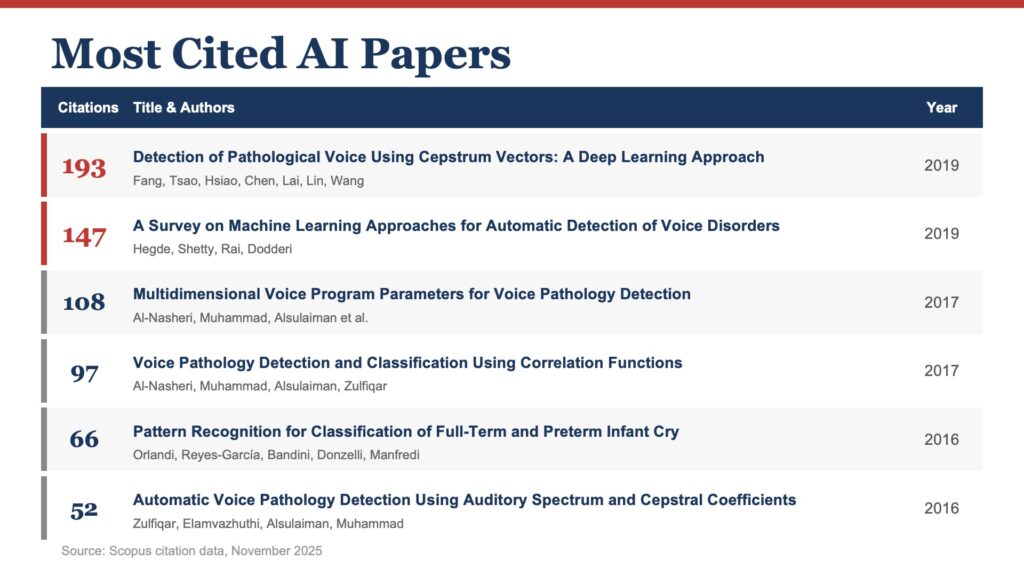
Deep Learning Benchmarks: Fang and colleagues’ deep learning study on pathology detection (193 citations) and Hegde’s comprehensive machine learning survey (147 citations) have each been downloaded nearly 5,000 times, frequently ranking as the most-accessed articles in their issues.
These numbers reflect a global hunger among frontline medical professionals for practical, data-driven tools that can enhance diagnostic accuracy and elevate patient outcomes.
Landmark Research Reshaping Clinical Practice
Deep Learning for Voice Pathology Detection
The cornerstone of modern computational voice analysis lies in its ability to detect subtle physiological anomalies long before they manifest perceptibly to human senses.
In 2019, Fang and colleagues published "Detection of Pathological Voice Using Cepstrum Vectors: A Deep Learning Approach," which currently stands as the most-cited AI paper in the journal’s history with 193 citations. By utilizing deep neural networks to evaluate acoustic features hidden within cepstrum vectors, the study proved that algorithms could identify voice pathologies with unprecedented sensitivity.
This work built upon earlier milestones, such as Hegde and colleagues’ definitive survey on machine learning for voice disorder detection (147 citations) and Al-Nasheri’s dual 2017 contributions regarding Multidimensional Voice Program parameters and correlation functions. Over time, the methodology has evolved exponentially, incorporating Chen and Chen’s deep neural network classifications, Fujimura’s one-dimensional convolutional neural networks (CNNs), and Cho and Choi’s comparative analyses of CNN models applied to complex laryngoscopic imagery.
Voice as a Digital Biomarker for Systemic Health
Perhaps the most paradigm-shifting development in modern medicine is the conceptualization of the human voice as a digital biomarker—a non-invasive, continuous window into systemic neurological, psychological, and respiratory health.
Neurological investigations have yielded extraordinary results. Hemmerling and Wójcik-Pędziwiatr’s 2022 research on predicting the severity of Parkinson’s disease directly from acoustic voice signals has amassed 29 citations in just three years, accelerating the transition toward wearable or tele-health diagnostic monitors.
Concurrently, systematic reviews exploring voice quality as a digital biomarker for affective disorders—such as clinical depression and bipolar disorder—reveal immense promise. The clinical implications are staggering: routine acoustic screening during standard telehealth check-ins could flag early markers of mental health decline, allowing for proactive clinical intervention and alleviating the burden on overstretched psychiatric healthcare systems. Furthermore, machine learning models analyzing vocal characteristics during respiratory illnesses have demonstrated the viability of the voice as an early-warning sentinel for pulmonary distress.
AI Chatbots and Clinical Decision-Making
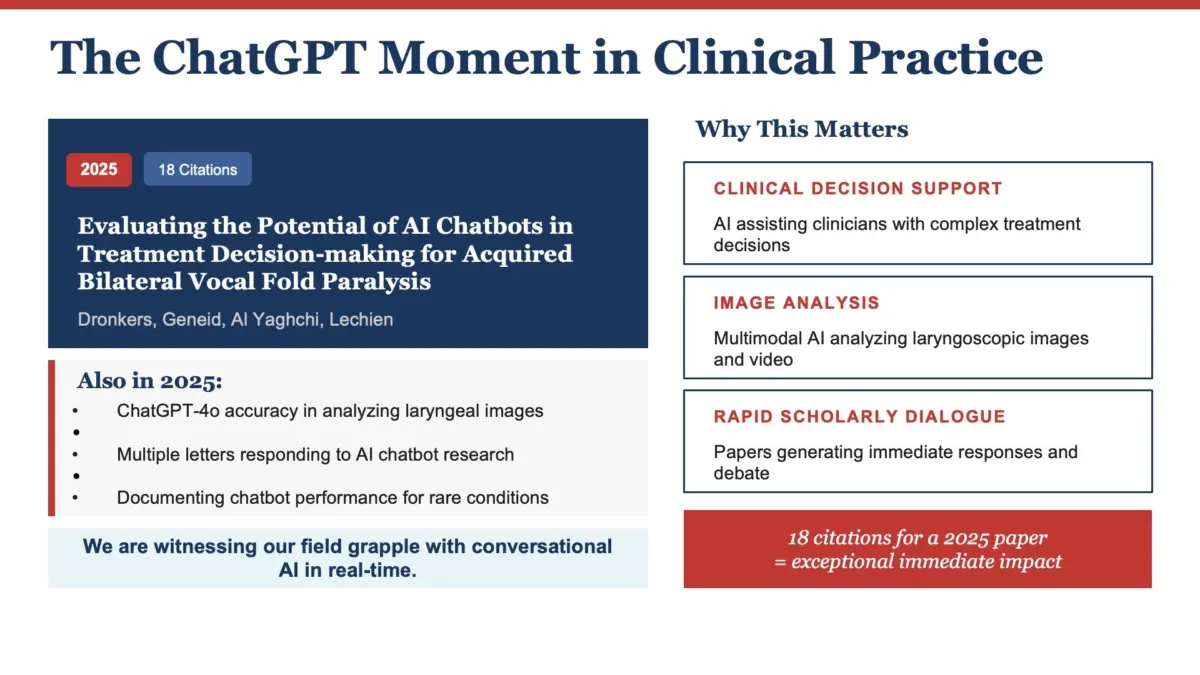
The year 2025 marked a new frontier with the publication of seminal research examining the role of conversational AI and large language models (LLMs) in direct clinical decision-making.
A prime example is Dronkers and colleagues’ study, "Evaluating the Potential of AI Chatbots in Treatment Decision-making for Acquired Bilateral Vocal Fold Paralysis," which rapidly accumulated 18 citations within its debut year—a testament to its immediate relevance. Generating robust letters to the editor, follow-up debates, and parallel studies assessing platforms like ChatGPT-4o in analyzing complex laryngeal imagery, these inquiries demonstrate a medical field actively grappling in real time with the integration of conversational intelligence into patient care workflows.
Official Perspectives: Expert Insights on the AI Horizon
Navigating this technological revolution requires visionary leadership. Two prominent voices within The Foundation community offer vital perspectives on managing complexity and establishing ethical clarity.
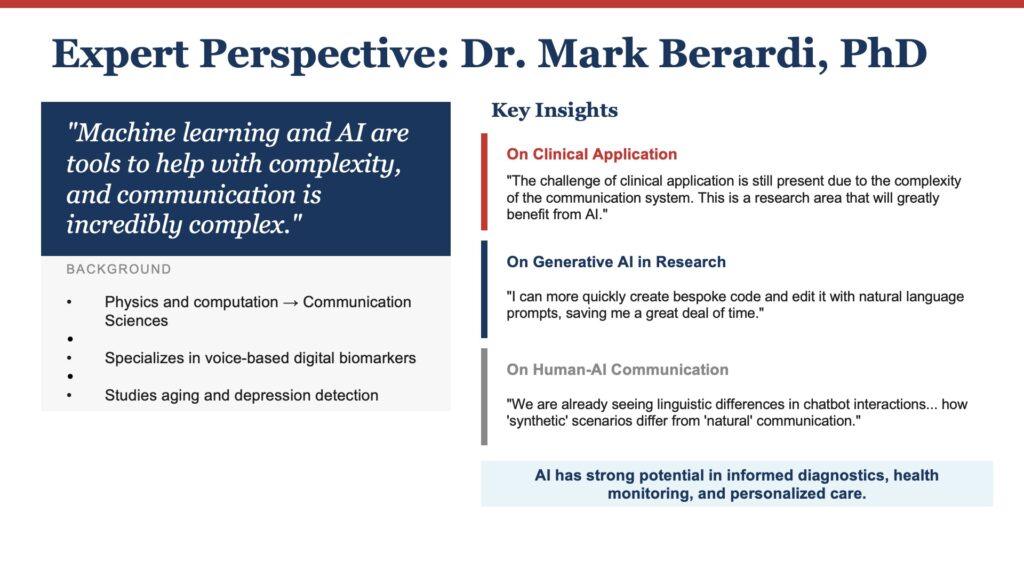
Dr. Mark Berardi: Managing Biological Complexity
Drawing from a background in physics and computational science, Dr. Mark Berardi views artificial intelligence not as a replacement for human intellect, but as an indispensable engine for managing biological complexity.
"Machine learning and AI are tools to help with complexity, and communication is incredibly complex in its neurobiological and physiological processes. So I think the application is warranted," Dr. Berardi notes.
His current research targets voice-based digital biomarkers for aging and depressive states. While acquiring vocal signals has become frictionless, the true hurdle remains the intricate nature of human neurophysiology—a domain where machine learning excels. Regarding generative AI, Dr. Berardi highlights its immediate utility in eliminating research bottlenecks, particularly through natural language programming that allows scientists to generate and refine bespoke code instantly.
Intriguingly, Dr. Berardi’s work also extends to human-AI communication dynamics—investigating how human speech patterns adapt when interacting with conversational agents or virtual interfaces like Zoom compared to traditional face-to-face dialogue. As synthetic communication becomes normalized, voice science must expand its scope to analyze the human voice in constant conversation with machines.
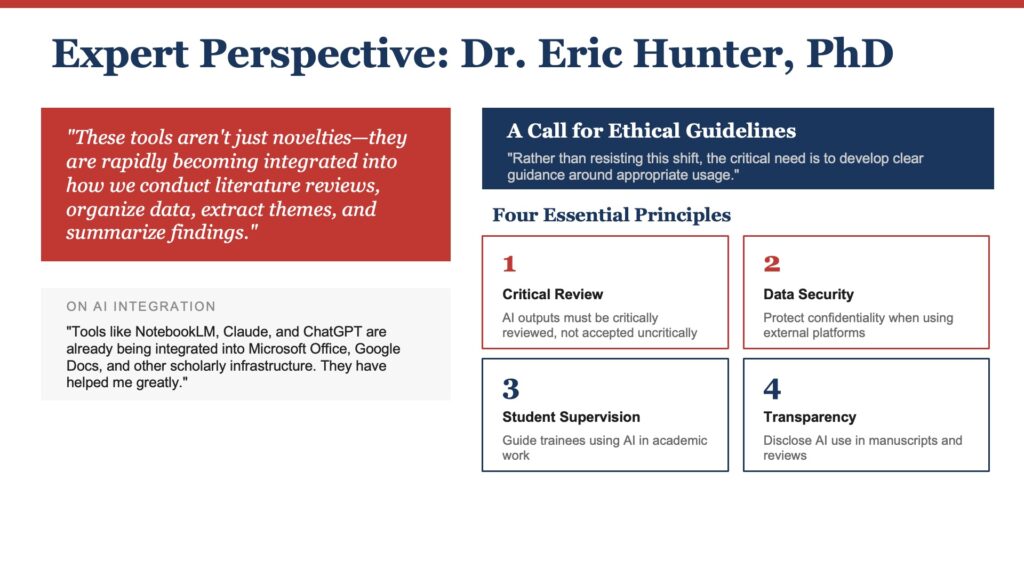
Dr. Eric Hunter: Embracing Change with Ethical Clarity
Dr. Eric Hunter focuses heavily on the institutional and academic realities of the AI revolution, urging the scientific community to move past mere novelty and confront deep structural integration.
"These tools aren’t just novelties," Dr. Hunter observes. "They are rapidly becoming integrated into how we conduct literature reviews, organize data, extract themes from large bodies of text, and even summarize findings."
Large language models are swiftly embedding themselves into standard academic software infrastructure, including Microsoft Office, Google Docs, and scholarly publishing platforms. Rather than resisting this tide, Dr. Hunter issues a definitive call to action: the immediate establishment of clear, transparent guidelines governing appropriate AI usage for both authors and peer reviewers.
To safeguard the integrity of scientific publishing, Dr. Hunter outlines four foundational pillars for AI integration:
Absolute Transparency: Full disclosure of any generative or computational tools utilized in manuscript preparation or data synthesis.
Human Accountability: The absolute retention of authorial responsibility for all analytical conclusions, interpretations, and factual claims.
Intellectual Rigor: Utilizing AI strictly to enhance productivity, eliminate logistical bottlenecks, and organize data—never to fabricate or substitute deep critical thought.
Equitable Access: Ensuring that computational advancements benefit the broader global scientific community without introducing systemic biases.
"Our field will benefit most," Dr. Hunter concludes, "if we embrace the productivity these tools offer while also building a shared ethical framework for their responsible use."
A Global Research Community
The rapid evolution of AI-driven voice science is powered by a robust, interconnected global network of researchers spanning every continent. The pages of the Journal of Voice reflect this international collaboration, featuring prolific contributions from leading scholars such as Jérôme René Lechien (6 papers), Dimitar Deliyski (5 papers), Stephanie Zacharias (5 papers), and Ahmed Yousef (4 papers as first author), alongside foundational experts like Paavo Alku, Leonardo Wanderley Lopes, and Maryam Naghibolhosseini.
This dynamic ecosystem proves that computational voice science is not the domain of isolated laboratories, but a synchronized global crusade dedicated to decoding human vocal physiology through advanced computation.
The Path Forward: Future Outlook
As we look toward the next decade, the Journal of Voice remains firmly committed to serving as the premier platform for rigorous, boundary-pushing research while preserving the highest standards of scientific integrity.
To successfully navigate this uncharted territory, the voice science community must embrace three strategic imperatives:
First, Thoughtful Engagement: Practitioners must master AI as an instrument for managing complexity, understanding its algorithmic boundaries to amplify human expertise rather than abdicate clinical judgment.
Second, Collective Ethical Governance: The development of a shared ethical framework—as advocated by Dr. Hunter—requires proactive, cross-institutional collaboration to establish transparent publishing and diagnostic standards.
Third, Unwavering Openness: Researchers, clinicians, and educators must continue sharing data and discoveries. The 161 AI papers published to date represent merely the dawn of a much larger scientific renaissance.
The human voice has served as our primary instrument of connection, emotional expression, and identity for hundreds of thousands of years. It carries our health, our history, and our humanity in ways no other biological signal can replicate.
Now, for the first time in human history, we possess analytical tools sophisticated enough to genuinely decode that complexity—extending the reach of expert clinicians, detecting pathology before clinical presentation, and democratizing access to specialized voice care worldwide. We stand at an extraordinary moment in time, and the Journal of Voice is proud to stand at its vibrant center. The next decade promises discoveries beyond imagination; we look forward to sharing them with you.