
Executive Overview
Voice science stands at a monumental technological and clinical crossroads. For decades, the human voice has been studied primarily through the lenses of acoustic physics, otolaryngology, and speech-language pathology. Today, however, the integration of artificial intelligence (AI) and machine learning (ML) is fundamentally reshaping how researchers conduct investigations, how clinicians analyze physiological and acoustic data, and how patients receive care.
At the center of this transformation is The Voice Foundation and its premier peer-reviewed publication, the Journal of Voice. Far from treating AI as a passing technological trend, the Foundation has tracked, published, and fostered computational innovations in vocal analysis for over three decades.
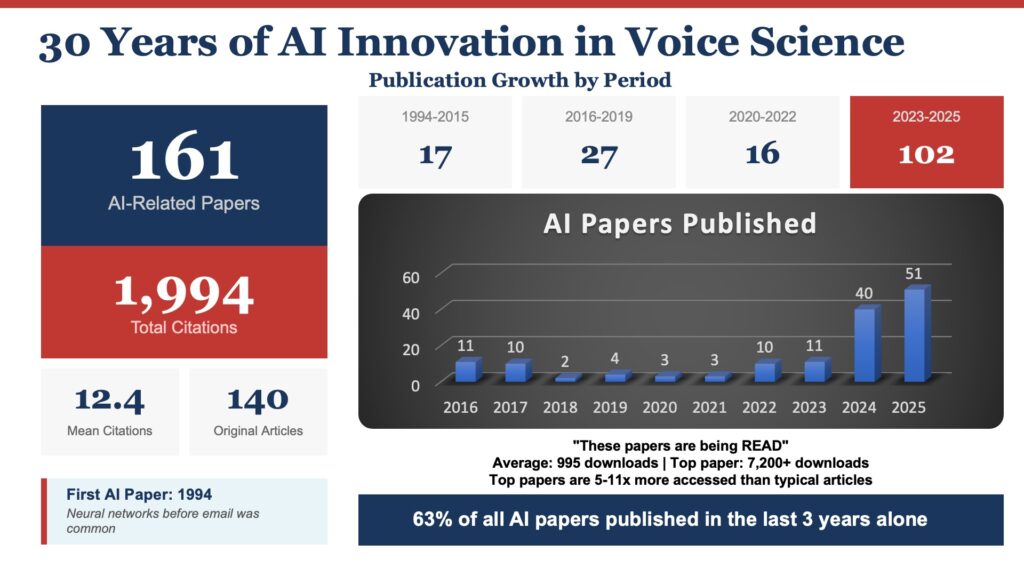
An analysis of publishing milestones reveals an explosive upward curve: out of 161 AI-focused papers published in the journal’s history, an astonishing 63 percent (102 papers) have appeared in just the last three years (2023–2025). In 2025 alone, the journal published 51 AI-related papers—surpassing the total output of the field’s first two decades combined.

This article explores the historical foundations of voice science, traces the chronological evolution of AI within the discipline, highlights breakthrough real-world applications, features expert perspectives from leading researchers, and maps out the ethical and structural path forward for the global medical community.
The Voice Foundation: A Legacy of Interdisciplinary Innovation
To understand the current AI revolution in voice science, one must appreciate the historical framework that made it possible. In 1969, Dr. Wilbur James Gould founded The Voice Foundation in New York City. At a time when interdisciplinary care for the human voice was virtually non-existent, Dr. Gould possessed the visionary foresight to break down silos. He brought together physicians, vocal scientists, speech-language pathologists, performing artists, and singing teachers to pool their expertise in the care and preservation of the professional voice.
The Foundation established its enduring footprint by launching the Annual Symposium: Care of the Professional Voice in 1972, followed by its inaugural Gala (later christened Voices of Summer) in 1973. For over five decades, the organization has continuously bridged the gap between art and science, and between the clinical laboratory and the theatrical stage.
Since 1989, the Foundation has been guided by Dr. Robert Thayer Sataloff, an internationally renowned otolaryngologist, author of more than 1,200 publications (including 79 textbooks), and a professional singer and conductor. Under Dr. Sataloff’s leadership, the Foundation relocated its headquarters to Philadelphia and expanded its academic reach. Today, the annual Philadelphia Symposium draws hundreds of medical, scientific, academic, and performing arts professionals from around the globe, while the Journal of Voice maintains its standing as the foremost authority in voice science and medicine.
Detailed Chronology: Thirty Years of AI Research in Voice Science
The inclusion of artificial intelligence in the Journal of Voice predates the widespread public awareness of digital technology. While society at large was just beginning to grasp the utility of the World Wide Web, the journal published a landmark paper in 1994 by Rihkanen and colleagues titled "Spectral Pattern Recognition of Improved Voice Quality." Utilizing primitive neural networks to analyze voice signatures, this paper proved that machine computation could parse acoustic data well before electronic mail became an everyday utility.
The subsequent publication timeline illustrates a measured evolution transitioning into an exponential surge:
- 1994–2015 (The Foundation Era): 17 papers. Research during this period established the baseline capabilities of neural networks and early algorithms in identifying basic acoustic patterns and vocal tract configurations.
- 2016–2019 (The Deep Learning Inflection): 27 papers. As processing power scaled, researchers began applying deep neural networks (DNNs) and complex cepstrum vectors to detect pathologies hidden deep within acoustic signals.
- 2020–2022 (The Diagnostic Expansion): 16 papers. Amid global disruptions, researchers pivoted machine learning frameworks toward remote health monitoring, including early explorations into respiratory and neurological markers.
- 2023–2025 (The Exponential Surge): 102 papers. Propelled by the advent of advanced deep learning architectures, large language models (LLMs), and automated diagnostic pipelines, the field experienced hyper-growth. Publishing 51 AI papers in 2025 alone cemented a paradigm shift from theoretical computing to clinical integration.
Supporting Context & Metrics: Beyond Citations to Real-World Impact
Academic output is often measured by citation counts, but the true metric of success for medical and scientific literature is functional adoption. The AI research published in the Journal of Voice is heavily utilized by clinicians, biomedical engineers, and speech-language pathologists worldwide.
- Download Metrics: The average AI-related paper in the journal has been downloaded nearly 1,000 times.
- The COVID-19 Benchmark: The single most-accessed AI paper—a study evaluating machine learning models for COVID-19 detection via voice biomarkers—has amassed over 7,200 downloads, eclipsing the median download rate for its issue by elevenfold.
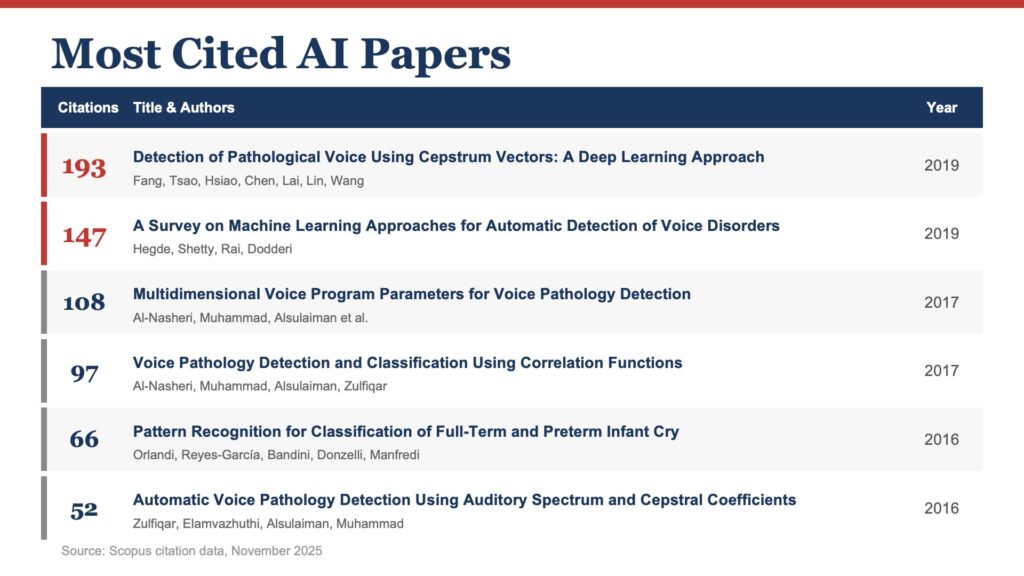
- Most-Cited Pillars: Fang and colleagues’ 2019 deep learning study on voice pathology detection stands as the most-cited paper in the journal’s history with 193 citations, closely followed by Hegde’s comprehensive machine learning survey with 147 citations. Both papers have been downloaded nearly 5,000 times each, underlining their role as foundational texts for practitioners seeking practical diagnostic frameworks.
Landmark Research Shaping the Field
Deep Learning for Voice Pathology Detection
Fang et al. proved that deep neural networks could identify pathological conditions using acoustic features imperceptible to the human ear. This paved the way for works like Hegde’s systematic survey, Al-Nasheri’s multidimensional parameter studies, and subsequent implementations of one-dimensional convolutional neural networks (1D-CNNs) by Fujimura and colleagues for automated voice classification.
Voice as a Digital Biomarker
Perhaps the most profound philosophical and practical shift in modern medicine is viewing the voice not merely as a vehicle for speech, but as a continuous, non-invasive digital biomarker of systemic health.

- Neurological Monitoring: Research spearheaded by authors like Hemmerling and Wójcik-Pędziwiatr has successfully demonstrated the predictive modeling of Parkinson’s disease severity from routine voice signals, garnering significant citations in short timeframes.
- Mental Health and Systemic Illness: Systematic reviews published in the journal have begun charting voice quality degradation as an early indicator of clinical depression, bipolar disorder, and respiratory compromise. This raises the enticing possibility of routine vocal screenings acting as early-warning sentinels for psychiatric and somatic illnesses.
AI Chatbots in Clinical Decision-Making
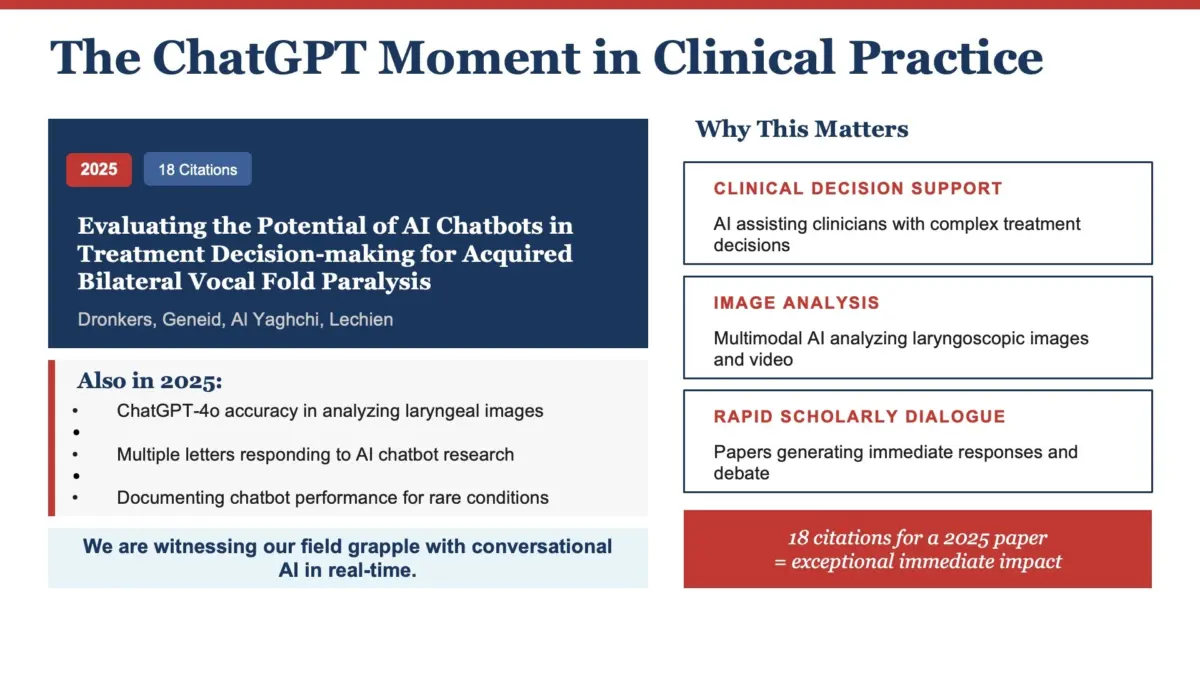
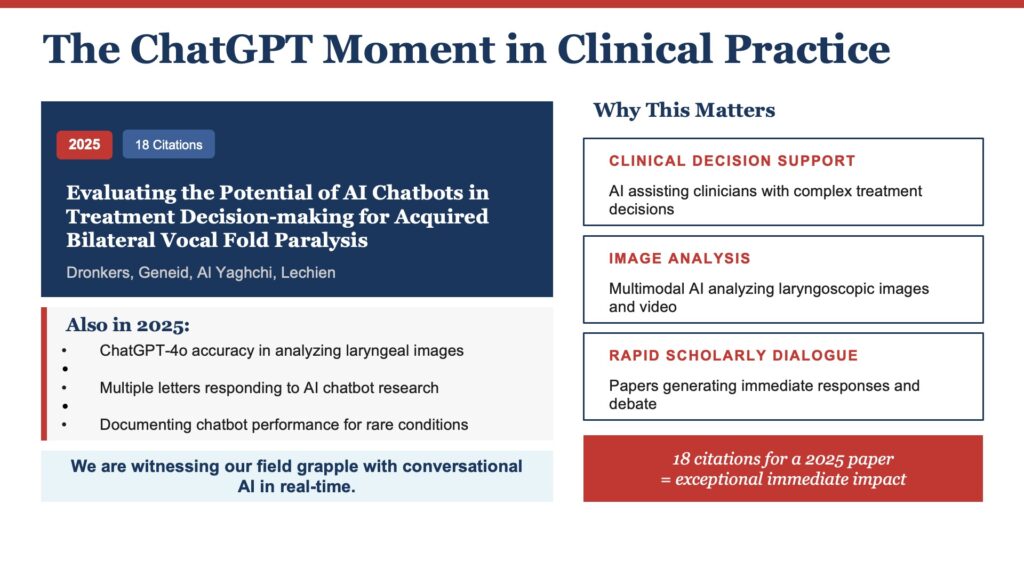
Entering uncharted territory, recent issues of the journal have featured studies evaluating generative conversational AI. Papers examining AI chatbots in treatment decision-making for complex conditions—such as acquired bilateral vocal fold paralysis—have generated immediate scholarly debate, letters to the editor, and analyses regarding the diagnostic accuracy of tools like ChatGPT-4o when analyzing laryngeal images.
Official Statements and Expert Perspectives
To navigate this technological frontier, the voice science community relies on multidisciplinary leaders who understand both the immense potential and the inherent risks of computational medicine.
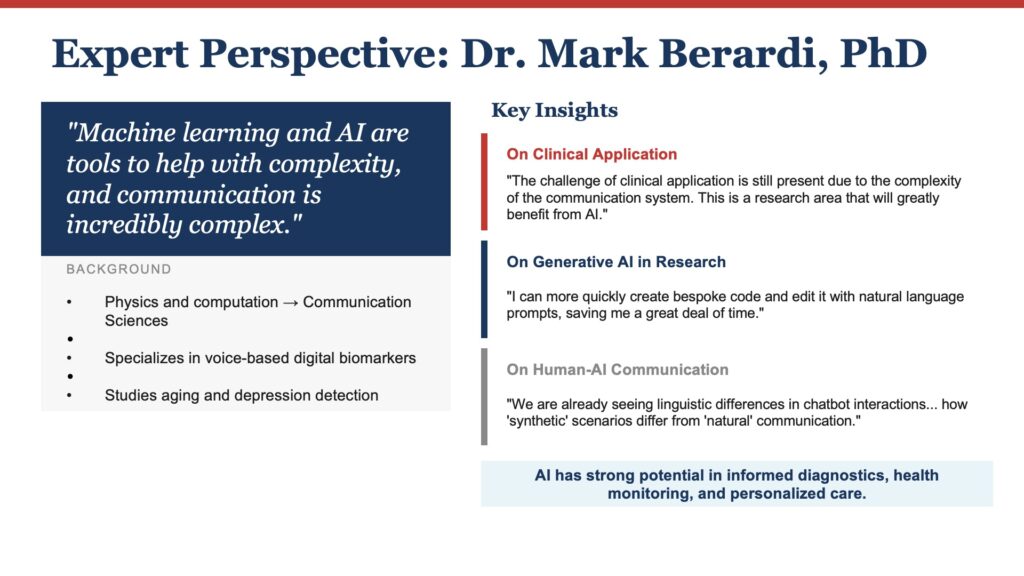
Dr. Mark Berardi: AI as a Tool for Complexity
Coming from a background in physics and computation, Dr. Mark Berardi views artificial intelligence through the lens of data management and complexity reduction.
"Machine learning and AI are tools to help with complexity, and communication is incredibly complex in its neurobiological and physiological processes. So I think the application is warranted."
Dr. Berardi highlights that while acquiring vocal and speech signals has become remarkably simple, interpreting them remains difficult due to the multi-layered nature of human communication. He notes that generative AI has transformed daily research workflows by removing traditional bottlenecks, allowing researchers to rapidly draft bespoke code and manipulate datasets using natural language prompts.
Furthermore, Dr. Berardi’s lab is exploring human-AI interaction dynamics: how human speech patterns adapt when conversing with chatbots versus real people, and how synthetic environments like video conferencing modify linguistic output. Understanding these shifts is becoming vital as patients increasingly interact with synthetic health interfaces.
Dr. Eric Hunter: Embracing Change with Ethical Clarity
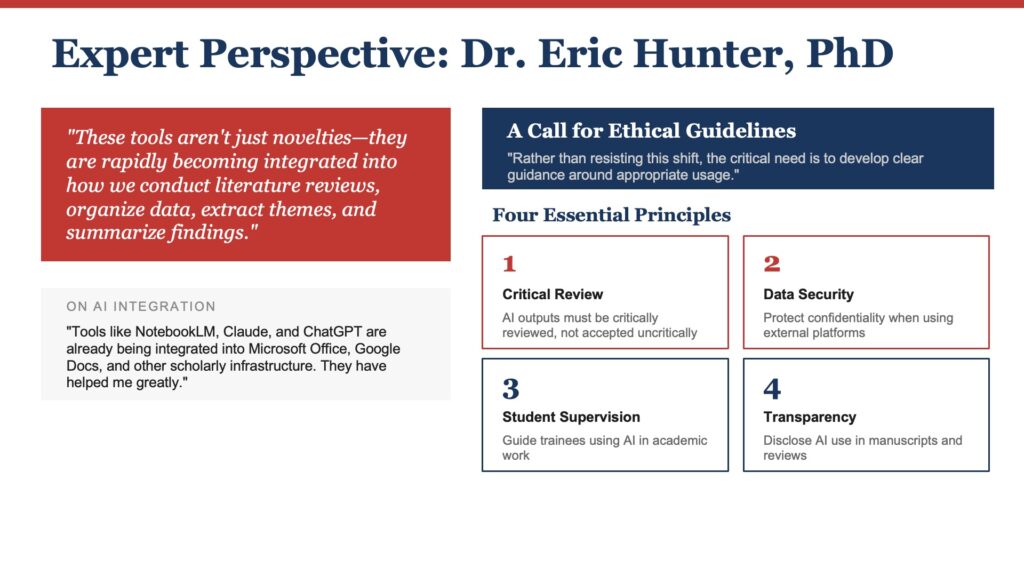
Dr. Eric Hunter emphasizes that computational tools are rapidly embedding themselves into academic and clinical infrastructures, from literature reviews and data coding to thematic extraction and manuscript preparation.
"These tools aren’t just novelties. They are rapidly becoming integrated into how we conduct literature reviews, organize data, extract themes from large bodies of text, and even summarize findings… Rather than resisting this shift, the critical need is to develop clear guidance around appropriate usage—for both authors and reviewers."
Dr. Hunter advocates for a balanced approach that leverages computational productivity while preserving rigorous scientific accountability. He outlines four essential principles for academic integrity in the age of AI: transparency in tool utilization, verification of generated data, maintenance of editorial oversight, and adherence to patient privacy standards.
A Global Research Network
The transformation of voice science is fueled by an international coalition of researchers. Leading contributors to the Journal of Voice—including Jérôme René Lechien, Dimitar Deliyski, Stephanie Zacharias, Ahmed Yousef, Paavo Alku, Leonardo Wanderley Lopes, and Maryam Naghibolhosseini—represent laboratories spanning multiple continents. Their collaborative efforts demonstrate that AI-driven voice science is a globally unified endeavor.
Future Outlook: The Path Forward
As the Journal of Voice continues to chart the course of computational medicine, the scientific community must navigate three critical imperatives:
- Thoughtful Engagement with Technology: Researchers and clinicians must view AI not as a replacement for human clinical judgment, but as an advanced amplifier of expertise. Understanding the boundaries, failure modes, and algorithmic biases of these tools is mandatory.
- Establishment of Shared Ethical Frameworks: As Dr. Hunter notes, individual institutional policies are insufficient. The global voice community must collaborate to construct uniform ethical standards for authorship, data handling, and AI-assisted clinical diagnosis.
- Continuous Open Discourse: Publishing rigorous findings must remain an ongoing priority. The 161 AI papers recorded to date represent only the opening chapter of a much larger scientific narrative.
Conclusion
The human voice has served as our fundamental instrument of identity, emotion, and connection for millennia. It carries the nuances of our psychological state and the physiological markers of our physical health in ways no other biomedical signal can replicate.

For the first time in human history, we possess computational tools sophisticated enough to decode this immense complexity. By expanding our understanding of the voice as a digital biomarker, extending the reach of clinicians, and democratizing access to preventative voice care, we stand at the precipice of a golden age in medicine. Supported by the enduring mission of The Voice Foundation, the Journal of Voice remains steadfast at the epicentre of these extraordinary discoveries.
About the Author
Ian DeNolfo is Executive Director of The Voice Foundation, which publishes the Journal of Voice. A graduate of The Juilliard School and The Curtis Institute of Music, he formerly performed as a leading tenor at opera houses worldwide before transitioning to arts and science administration.