
Executive Overview
The intersection of opera and cinema represents one of the most fruitful yet critically underexplored territories in the history of multimedia art. From the earliest days of silent film, visionary directors have mined the dramatic, hyper-emotional landscapes of grand opera for cinematic inspiration. While iconic works like Georges Bizet’s Carmen—starting with Ernst Lubitsch’s 1920 silent adaptation Gypsy Blood—have long saturated the silver screen, many other masterworks enjoy a more complex, mercurial relationship with the medium of film.
Leoncavallo’s I Pagliacci found cinematic footing as early as 1915, followed by Offenbach’s The Tales of Hoffmann in 1923 and Verdi’s perennial darling La Traviata (adapted via George Cukor’s Camille in 1936). Yet, while certain operas achieved immediate and recurring cinematic immortality, others slipped into obscurity. Works like Lukas Foss’s English-language opera Griffelkin (1955), Manuel Moreno’s Spanish-language El gato montés (1916), and Bedřich Smetana’s Czech masterpiece Dalibor (1868) were relegated to a solitary cinematic appearance. Even giants of the canon, such as George Gershwin’s Porgy and Bess (1935) and Mozart’s Così fan tutte (1790), have historically struggled to secure a sustained presence in cinema houses.
This comprehensive investigation explores the winding, often unpredictable path of operatic adaptations, focusing heavily on the cinematic incarnations of Giuseppe Verdi’s tragic masterpiece, Rigoletto. While Verdi’s works dominated early 20th-century cinema and enjoyed a robust resurgence in post-World War II European melodramas, contemporary cinematic adaptations have grown scarce. By examining the shifting landscape from silent film to modern independent projects, we uncover how Rigoletto has been reimagined, sanitized, localized, and revered across more than a century of filmmaking.
Detailed Chronology: Verdi on the Silver Screen
To understand the cinematic footprint of Rigoletto, one must first trace the broader historical trajectory of Giuseppe Verdi’s works in early cinema. Verdi holds a unique distinction among master composers: his scores were among the earliest chosen by pioneers of the 20th-century film industry, deeply embedded in the cultural fabric of early narrative filmmaking.
The Silent Era and the Birth of the "Talkie"
The cinematic life of Verdi began in Italy with the silent film Otello (1906). This was quickly followed by an American silent adaptation of Aida in 1911, and Hungarian silent treatments of A Masked Ball (1917) and Rigoletto (1918). These foundational projects laid the groundwork for a burgeoning marriage between operatic melodrama and visual storytelling.
As the industry transitioned from silent "moving pictures" to sound-equipped "talkies," adaptations evolved. The watershed moment arrived in 1936 with George Cukor’s Camille, a sound-film adaptation rooted in La Traviata. This commercial and artistic success blew the doors open for a wave of Verdi adaptations that blurred the lines between direct opera recordings, filmed stage productions, and free-form narrative adaptations.
The Golden Age of Post-War Melodrama
Following the devastation of World War II, Italian cinema experienced a massive surge in opera-based musicals and melodramas. Scholars Carlo Celli and Marga Cottino-Jones have extensively documented this post-war cultural push, noting that Italian studios were desperate to export domestic artistic triumphs.
Director Carmine Gallone emerged as a central figure in this movement, helming the lauded biopic Giuseppe Verdi (1938) and The Young Caruso (1951). The year 1953 marked an absolute zenith for the bel canto film tradition, yielding three massive commercial hits: Verdi: King of Melody, Puccini, and Aida—all of which starred legendary opera singers of the day. Verdi’s music also echoed through international projects, such as Hollywood’s Seven Hills of Rome (1958) starring American tenor Mario Lanza, and Bernardo Bertolucci’s historical epic 1900 (1976), where Verdi’s themes were inextricably linked to motifs of fate and mortality.
Supporting Context & Metrics: The Many Faces of Rigoletto
While staged productions of Rigoletto remain staples of the global opera house repertoire, its non-opera film adaptations span an astonishing array of cultural contexts, geopolitical borders, and creative interpretations.
The Italian Trilogy of Non-Opera Adaptations
The narrative trajectory of Rigoletto on film outside the opera house is anchored by three major Italian features:
- The King’s Jester (Il re si diverte) (1941) – Directed by Mario Bonnard, this marked the first major non-operatic cinematic adaptation of the Rigoletto story, translating Victor Hugo’s original play and Verdi’s narrative framework into heightened cinematic melodrama.
- Rigoletto (1946) – Directed by Carmine Gallone, this adaptation integrated titans of the Italian vocal scene, including Tito Gobbi, Mario Filippeschi, Lina Pagliughi, and Anna Canali. Pagliughi, notably, was a celebrated collaborator of Maria Callas.
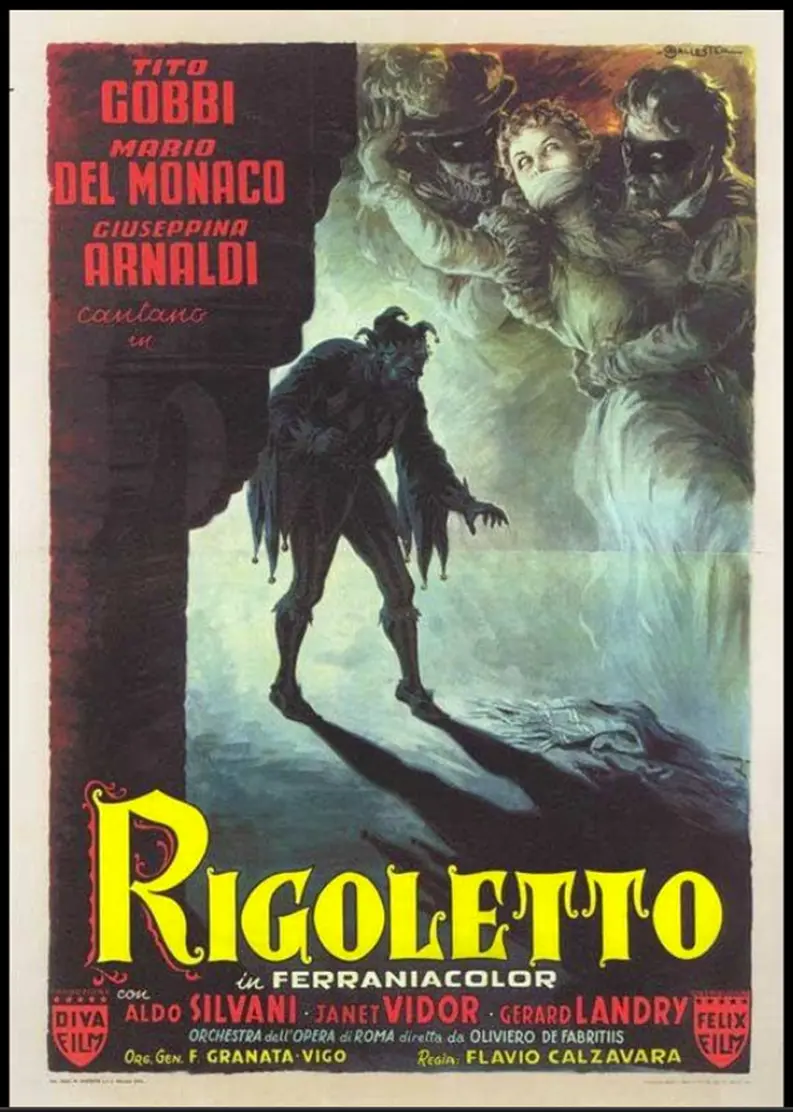
- Rigoletto and his Tragedy (Rigoletto e la sua tragedia) (1956) – Directed by Flavio Calzavara, this film continued the mid-century Italian tradition of deepening the fictional psychological drama while respecting Francesco Maria Piave’s original libretto.
Interestingly, the 1941 and 1956 films shared two cast members: Aldo Silvani and Renato Chiantoni. While Silvani graduated from a minor role in the 1941 film to the title character in 1956, Chiantoni maintained supporting character actor status across both projects.
The Revival and International Diversification
After a quiet period during the turbulent cinematic movements of the 1970s, Verdi returned to the cultural zeitgeist. Jean-Pierre Ponnelle’s internationally acclaimed 1982 filmed production of Rigoletto reinvigorated interest, coinciding with visionary director Franco Zeffirelli’s lavish operatic films (La Traviata in 1982, Otello in 1986).
Simultaneously, mainstream cinema frequently borrowed Verdi’s musical cues. Bernardo Bertolucci utilized his music in The Spider’s Stratagem (1970), Oliver Stone integrated Rigoletto melodies into the financial thriller Wall Street (1987), and Woody Allen tapped into Verdi’s sonic well in Match Point (2005).
However, direct narrative adaptations took wildly divergent paths as the 20th century closed:
- Leo D. Paur’s Rigoletto (1993): A family-friendly, radically sanitized North American adaptation that altered the tragic elements of the narrative into a tale of personal, triumphant redemption. Many purists argue this strayed too far from the source material to be considered a true adaptation.
- Curtiss Clayton’s Rick (2003): An American modernization featuring high-profile talent such as Sandra Oh, which unfortunately suffered from a lack of distribution and went largely unnoticed by critics and audiences alike.
- Rob Swales’s Rigoletto… in Bluegrass (2006): An independent Canadian feature that boldly re-imagined the tragic jester narrative through the cultural lens of a bluegrass folk musician. Though charming in its DIY aesthetic, its unpolished execution limited its reach.
Official Statements & Critical Perspectives
Industry veterans and cultural historians have long debated the viability of translating grand opera into standard cinema. The structural friction between the operatic requirement for suspension of disbelief—where emotional peaks are expressed through soaring, unamplified human voices—and the cinematic demand for psychological realism has historically divided critics.
In their seminal analysis of Italian cinema, film historians Celli and Cottino-Jones noted:
"The post-WWII Italian cinematic apparatus viewed national musical heritage not merely as art, but as political and cultural currency. Melodrama was the language through which a recovering nation expressed its collective trauma and its enduring passion. To adapt Verdi was to reaffirm Italian identity on the global stage."
Yet, contemporary directors have found the literal translation of opera into film increasingly daunting. While theater directors like the late William Friedkin tackled Rigoletto on stage—such as his acclaimed 2015 production for the Maggio Musicale Fiorentino—direct film adaptations of Verdi have ground to a near-halt.
Cultural commentators frequently contrast this stagnation with the frequent cinematic deployment of Richard Wagner’s music in contemporary blockbusters (such as the 2024 body-horror feature The Substance), or modern cinematic explorations of classical and operatic themes, seen in recent biographical and fictional releases like Todd Field’s Tár, Tom Ford’s developmental considerations of Cry to Heaven, and Pablo Larraín’s polarizing biographical drama Maria.
Future Outlook: Will Verdi Return to the Silver Screen?
As the entertainment industry navigates an era defined by intellectual property mining and high-concept cinematic experiments, the absence of major Verdi adaptations on contemporary movie slates is conspicuous.
The 20th century proved that cinematic iterations of Rigoletto, La Traviata, and Aida could capture the public imagination through sweeping melodrama and powerhouse vocal performances. Yet, 21st-century filmmakers have largely relegated Verdi to soundtrack contributions rather than narrative source material.
Is the market ready for a new, high-budget cinematic retelling of Rigoletto? The commercial and critical successes of recent musically driven cinematic projects suggest an underlying appetite for high-drama narrative spectacles. However, bridging the gap between operatic grandeur and modern cinematic sensibilities requires a rare breed of auteur—directors willing to shoulder the monumental weight left behind by cinematic giants like Zeffirelli and Rosi.
Until a visionary filmmaker steps forward to revitalize Verdi for a new generation of cinemagoers, the legacy of Rigoletto on film will remain a fascinating mosaic of mid-century Italian melodramas, experimental indie pivots, and timeless musical hauntings—waiting patiently for the next great cinematic awakening.