
Executive Overview
In an era where modern houses of worship strive to foster environments of radical inclusion, the acoustic experience remains a foundational yet frequently overlooked pillar of community engagement. For millions of congregants globally, hearing loss represents an invisible barrier to spiritual participation. Traditional sound reinforcement systems—while capable of projecting music and spoken word across sprawling sanctuaries—frequently fall short for individuals with auditory impairments. Reverberation, background noise, and distance from the sound source can transform an uplifting sermon into an unintelligible blur.
To bridge this profound communication gap, forward-thinking religious organizations are increasingly turning to dedicated Assistive Listening Systems (ALS). However, the successful integration of these technologies requires far more than a simple equipment purchase; it demands a strategic, highly intentional approach to assessment, budgeting, staff training, and community outreach.
This comprehensive report examines the four critical phases required to successfully implement an assistive listening infrastructure within a faith-based setting. Drawing upon industry expertise from auditory solution providers such as CCI Solutions and Listen Technologies, this analysis outlines a definitive roadmap for leadership teams, audio-visual (AV) technicians, and pastoral staff dedicated to ensuring that every member of their congregation can fully experience the spoken word.
Detailed Chronology: The Four-Step Implementation Framework
Implementing an effective assistive listening strategy is a deliberate process that requires careful planning, stakeholder engagement, and meticulous execution. To maximize return on investment and ensure high adoption rates among congregants, facility managers should adhere to a structured, chronological implementation framework.
[Phase 1: Needs Assessment]
       │
       ▼
[Phase 2: Financial & Technical Evaluation]
       │
       ▼
[Phase 3: Operational Preparation & Training]
       │
       ▼
[Phase 4: Community Awareness & Promotion]
Phase 1: Understanding Your Congregation’s Unique Needs
The foundational misstep in acoustic upgrades is purchasing technology before diagnosing the specific demographic and clinical requirements of the community. Before evaluating hardware specifications or soliciting vendor bids, leadership must conduct a thorough internal audit of their congregation’s auditory landscape.
The most effective vehicle for this discovery phase is a targeted, anonymous congregation survey. This instrument should be carefully crafted to capture qualitative and quantitative data regarding the worship experience. Key inquiries should focus on:
- Current Service Experience: Do congregants frequently miss words during the sermon or scripture readings? Does background music drown out spoken announcements?
- Hearing Aid Utilization: What percentage of attendees regularly wear hearing aids or cochlear implants?
- Technological Compatibility: Are these devices equipped with telecoils (t-coils)—the small copper wire loops inside hearing aids that allow them to receive electromagnetic signals directly from sound systems?
By gathering this data, AV committees can bypass generic solutions and target the exact technologies—whether radio frequency (RF), infrared (IR), or Wi-Fi-based streaming systems—that will serve their specific demographic.
Phase 2: Fully Understanding Your Options and Budgetary Realities
Once the congregation’s profile has been established, leadership must evaluate the technical and financial landscape. Estimating the cost of an assistive listening ecosystem involves balancing hardware requirements, transmitter ranges, receiver quantities, and architectural constraints.
Navigating this phase independently can be overwhelming for volunteer-led AV teams. Consequently, partnering with specialized integrators is vital. Organizations such as CCI Solutions offer expert assistance and complimentary initial consultations designed to help church leadership navigate expense forecasting and capital budgeting.
Furthermore, facility boards should view the acquisition of accessibility technology not merely as an operational expense, but as a ministry investment. Funding these initiatives can be achieved through several pathways:
- Dedicated Capital Campaigns: Highlighting accessibility as a primary goal of a building or ministry fund often inspires donors who have personal connections to hearing loss.
- Targeted Fundraising Events: Community-driven events focused specifically on inclusion initiatives.
- Grants and Foundations: Exploring philanthropic grants dedicated to disability advocacy and senior inclusion in public spaces.
Phase 3: Preparing for Operational Success
The finest audio equipment on the market will fail to achieve its purpose if the human infrastructure supporting it is unprepared. The success of an Assisted Listening System depends heavily on how seamlessly staff, ushers, and volunteers can manage, distribute, and maintain the devices.
Frontline volunteers should be designated as "Assisted Listening Ambassadors." These individuals carry the responsibility of normalizing the use of assistive technology and ensuring that visitors feel entirely comfortable requesting a receiver. Preparation must include comprehensive operational training covering:
- Device Handling: How to power, sanitize, and test receivers before services begin.
- User Instruction: Taking the time to guide first-time users through the basic functions of the device, such as volume adjustment and earphone placement.
- Troubleshooting: Quick diagnostic steps for resolving common user issues, such as poor signal lock or low battery warnings.
To maintain consistency during high-traffic Sunday mornings, facilities should place a laminated copy of Frequently Asked Questions (FAQs) directly at the welcome desk or distribution counter. This quick-reference guide ensures that even rotating volunteers can answer technical questions with confidence and poise.

Phase 4: Creating Awareness and Driving Adoption
Even a flawlessly installed and operated system will see low utilization if the congregation remains unaware of its existence. Launching an ALS requires an intentional, multi-channel marketing and communication campaign.
- Visual Signage: Prominent, universally recognized international symbols for accessibility should be displayed at all primary entrances, outlining precisely where Assisted Listening Devices (ALDs) can be acquired.
- Print and Digital Reminders: Weekly bulletins, slide presentations before the service, and digital app notifications should regularly remind attendees that devices are available upon request.
- Live Educational Demonstrations: Consider hosting a brief, dedicated training session or workshop following a service. Allowing congregants to test the technology in a relaxed environment demystifies the equipment and encourages adoption.
- Community Outreach: Extend the message beyond the physical walls of the church. Informing local senior centers, audiologists, and community health organizations about your accessibility upgrades positions the church as an inclusive, welcoming destination for families navigating age-related or congenital hearing loss.
Supporting Context & Metrics: The Imperative of Auditory Accessibility
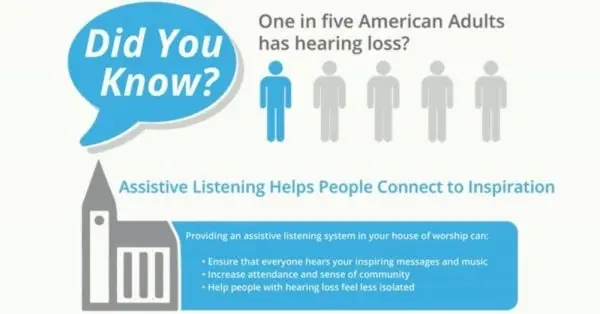
To understand why investments in assistive listening are critical, one must examine the broader socioeconomic and physiological context of hearing loss in modern society. According to data from the World Health Organization (WHO) and the Hearing Loss Association of America (HLAA), over 48 million Americans experience some degree of hearing loss. As global populations age, this demographic segment continues to expand exponentially.
| Metric Indicator | Statistical Data / Insight |
|---|---|
| Prevalence | Approximately 1 in 8 people in the U.S. (13%) aged 12 years or older has hearing loss in both ears. |
| Age Correlation | Affects roughly 25% of individuals aged 65 to 74, and 50% of those aged 85 and older. |
| Psychological Impact | Untreated hearing loss is directly linked to social isolation, depression, cognitive decline, and anxiety. |
| The "Sunday Morning" Challenge | Reverberant architecture in traditional sanctuaries creates high acoustic noise floors, severely compounding speech intelligibility issues. |
When individuals with hearing impairments encounter spaces where speech is unintelligible, they frequently make the painful decision to withdraw from communal worship altogether. This dynamic creates a paradox: individuals who need spiritual community and emotional support the most are often structurally disenfranchised by acoustic design barriers. Implementing an ALS is therefore a direct countermeasure to isolation, transforming the sanctuary into a genuinely accessible spiritual home.
Official Statements and Industry Insights
Industry leaders and accessibility advocates have long emphasized that inclusion is not merely an operational checkbox, but a theological imperative.
“Reaching out to those who feel disconnected from your community due to hearing loss is central to sharing the message of inclusion,” notes corporate advocacy literature from Listen Technologies. “Genuinely compassionate service involves being aware of and caring for the needs of everyone, especially those dealing with impairments.”
Acoustical engineers point out that sound reinforcement is only half the battle. While loudspeakers amplify sound waves within a room, they do not combat the destructive acoustic reflections bouncing off stone walls, stained glass, and vaulted ceilings.
“You can have the most expensive line-array speaker system in the world, but physics dictates that acoustic reflections will degrade speech clarity for hard-of-hearing listeners,” explains an independent AV integration consultant specializing in houses of worship. “An assistive listening system bypasses the room entirely, delivering a pristine, direct-to-ear audio feed that restores the emotional nuance, whispered passages, and distinct resonance of the spoken word.”
Future Outlook: The Evolution of Inclusive Worship Environments
Looking toward the future, the landscape of assistive listening technology is undergoing rapid transformation. While traditional analog RF (Radio Frequency) systems have served houses of worship admirably for decades, the industry is rapidly pivoting toward advanced digital architectures and personal device integration.
The Rise of Wi-Fi Streaming and BYOD (Bring Your Own Device)
Modern technological advancements allow churches to stream high-definition, low-latency audio directly to congregants’ smartphones via local Wi-Fi networks. This "Bring Your Own Device" (BYOD) model eliminates the logistical friction of managing physical receiver inventories, sanitizing earbuds, and replacing proprietary battery packs. Congregants simply download an app, plug in their personal headphones, earbuds, or stream directly to their Bluetooth-enabled hearing aids, and experience customized audio clarity tailored to their specific auditory profile.
Regulatory Landscape and Compliance Standards
Beyond moral and spiritual motivations, legal frameworks such as the Americans with Disabilities Act (ADA) set strict guidelines regarding public accommodations, including houses of worship. While historic religious structures have historically enjoyed certain exemptions, the cultural and legal expectation for universal accessibility continues to tighten. Proactive integration of advanced listening systems shields organizations from future regulatory friction while positioning them as progressive leaders in community welfare.
Conclusion and Next Steps
The measure of a vibrant faith community is found in its capacity to embrace the marginalized and ensure that no voice—and no listener—is left behind. By understanding congregation needs, leveraging expert consultations, training dedicated volunteers, and promoting technological resources, religious facilities can eliminate the barriers imposed by hearing loss.
For ministry leaders seeking deeper guidance, comprehensive toolkits—including sample surveys, signage templates, and worship bulletin announcements—are readily available through resources such as the Listen Technologies Church Assistive Listening Toolkit.
Take the first step today: evaluate your sanctuary’s acoustic ecosystem, consult with qualified integration partners, and ensure that every member of your community can fully experience the beauty, depth, and emotion of the spoken word.