
Special Report | By the Editorial Board
Executive Overview
In an era defined by rapid technological advancements in architectural acoustics, multi-media projection, and line-array sound reinforcement, houses of worship are investing heavily in immersive audio experiences. Yet, despite the pristine clarity delivered by modern mixing consoles and digital signal processors, a significant demographic within congregations continues to experience profound isolation: individuals with hearing loss. For these members, soaring musical arrangements and deeply moving sermons frequently dissolve into a cacophony of unintelligible reverberation and acoustic muddying.
The implementation of an Assistive Listening System (ALS) is no longer merely an ADA compliance afterthought or a secondary ministry metric; it is a foundational pillar of radical inclusivity and pastoral care. Recent industry insights, supported by resources such as the Listen Technologies Church Assistive Listening Toolkit and specialized audiovisual consultation firms like CCI Solutions, emphasize that bridging the auditory divide requires a deliberate, four-phase strategic approach.
This special report provides an exhaustive, authoritative examination of how religious institutions can successfully assess, procure, deploy, and promote assistive listening technology. By transforming technical integration into a pastoral mission, leadership teams can ensure that every congregant—regardless of auditory capability—fully experiences the spoken word, fellowship, and worship experience.
Detailed Chronology: The Four-Step Implementation Framework
Successfully introducing an assistive listening infrastructure requires methodical planning and cross-departmental execution. Industry best practices categorize the journey into four distinct operational phases, moving from preliminary data collection to community-wide engagement.
[Phase 1: Needs Assessment] ──> [Phase 2: Technical Sourcing] ──> [Phase 3: Staff Training] ──> [Phase 4: Community Awareness]Phase 1: Understanding Your Congregation’s Unique Needs
The primary misstep in technology procurement is purchasing solutions based on generalized assumptions rather than empirical data. Before engaging vendors or reviewing hardware catalogs, church leadership must conduct a comprehensive audit of their congregation’s specific auditory profiles.
The most effective vehicle for this discovery is a targeted survey distributed physically in bulletins, digitally via email newsletters, and verbally from the stage. Key metrics to capture during this phase include:
- Direct Service Feedback: How do members rate their ability to understand the spoken word and musical lyrics during standard worship services?
- Hearing Aid Adoption Rates: What percentage of the congregation utilizes hearing aids or cochlear implants?
- Telecoil (T-Coil) Integration: Crucially, do these hearing assistance devices feature active t-coils? A t-coil is a tiny copper wire coil found inside many hearing aids that acts as an antenna, picking up electromagnetic signals from loop systems or personal receivers and translating them directly into crystal-clear sound within the user’s ear.
By quantifying these variables, worship leaders avoid over-allocating capital toward redundant technologies while ensuring that the chosen system directly addresses the specific auditory challenges present in the pews.
Phase 2: Evaluating Options and Budgeting for Long-Term Value
Once demographic data has been collected and analyzed, the focus shifts to hardware evaluation and financial forecasting. Estimating the true cost of an assistive listening ecosystem involves balancing equipment expenses, installation labor, ongoing maintenance, and accessory costs such as lightweight earphones, neckloops for t-coil users, and hygienic storage solutions.
Navigating this procurement landscape can be daunting for facility managers and volunteer audio engineers. To streamline this process, specialized integration partners like CCI Solutions offer expert assistance, including complimentary consultations tailored to expense and budgeting parameters. Furthermore, houses of worship should explore creative funding mechanisms to offset capital expenditures, such as:
- Dedicated Capital Campaigns: Highlighting the ministry impact of hearing accessibility to inspire donor contributions.
- Memorial Gifts and Bequests: Allowing families to fund assistive tech suites in honor of loved ones who struggled with hearing loss.
- Denominational Grants: Accessing regional or national organizational funds earmarked for accessibility upgrades and inclusive ministry initiatives.
Phase 3: Preparing Staff and Volunteers for Operational Success
The finest audio hardware on the market is rendered ineffective if church staff, ushers, and welcome team volunteers do not know how to operate, troubleshoot, and distribute the devices efficiently. Seamless execution during Sunday mornings or mid-week gatherings depends entirely on front-line personnel functioning as "Assisted Listening Ambassadors."
Training protocols must move beyond a passive memo and include hands-on walkthroughs. Ambassadors should be thoroughly versed in:
- Device Distribution and Pairing: How to quickly verify battery levels, sanitize units between services, and sync receivers with specific listening channels or neckloops.
- Personalized Instruction: Taking the critical extra minute during the check-out process to explain device functions, volume controls, and proper placement to first-time users.
- Visual Troubleshooting Guides: Maintaining a laminated, highly visible "Frequently Asked Questions" (FAQ) sheet at the reception desk or distribution counter to provide instant answers to common technical queries.
Phase 4: Creating Awareness and Driving Adoption
Even the most transformative technology remains underutilized if the community remains unaware of its existence. Launching an ALS demands a multi-channel marketing and educational campaign designed to remove the social stigma historically associated with hearing assistance.
+-------------------------------------------------------------------------+
|                  MULTI-CHANNEL AWARENESS STRATEGY                       |
+--------------------------+----------------------------------------------+
| Channel                  | Implementation Action                        |
+--------------------------+----------------------------------------------+
| Physical Signage         | Display ADA-compliant ISA symbols at all     |
|                          | entrances and the device pickup desk.        |
+--------------------------+----------------------------------------------+
| Print & Digital Media    | Embed weekly reminders in printed bulletins, |
|                          | slide decks, and church apps.                |
+--------------------------+----------------------------------------------+
| Live Congregational Demo | Host a dedicated training moment during      |
|                          | announcements to demystify the tech.         |
+--------------------------+----------------------------------------------+
| Local Community Outreach | Advertise accessibility features to nearby   |
|                          | senior centers and care facilities.          |
+--------------------------+----------------------------------------------+- Prominent Signage: Display the International Symbol of Access for Hearing Loss (the blue sign with the ear and slash symbol, or the newer International Symbol of Access variations) at all primary building entrances, directing visitors precisely to where Assisted Listening Devices (ALDs) are housed.
- Collateral Integration: Embed consistent, warm reminders within every weekly bulletin, digital slide deck, and mobile app notification.
- Live Demonstrations: Consider hosting a brief, live orientation or demonstration during a gathering, allowing congregants to familiarize themselves with the technology in a low-pressure environment.
- Community-Wide Outreach: Expand marketing beyond current members. Outreach to local retirement communities, senior living centers, and rehabilitation facilities alerting them to the church’s new accessibility measures often yields an influx of visitors seeking an inclusive spiritual home.
Supporting Context & Metrics: The Hidden Epidemic of Hearing Loss
To fully appreciate the urgency of deploying assistive listening infrastructure, church leaders must examine the broader sociological and medical data surrounding hearing impairments.

The Demographic Reality
According to public health data from organizations such as the World Health Organization (WHO) and the Hearing Loss Association of America (HLAA), hearing loss is one of the most common chronic physical conditions affecting adults. In standard congregation demographics—skewing heavily toward older adults—the prevalence rate rises dramatically.
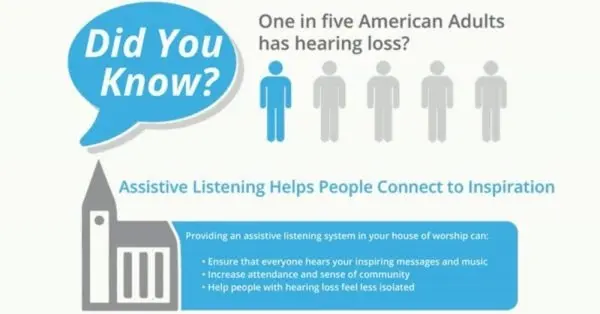
- Prevalence: Approximately one in three individuals over the age of 65 experiences disabling hearing loss, a figure that climbs to nearly one in two for those over 75.
- The Psychological Toll: Unaddressed hearing loss is directly correlated with social isolation, anxiety, depression, and accelerated cognitive decline. When individuals struggle to comprehend conversations or worship services in large, reverberant spaces, their natural defense mechanism is withdrawal.
- The Church Attendance Factor: Many elderly or hearing-impaired individuals quietly drop out of active church life not because of a waning faith, but due to sheer exhaustion caused by straining to hear in acoustically hostile environments.
The Acoustic Challenge of Worship Architecture
Traditional and contemporary church architecture inherently works against the hearing-impaired. Cathedrals, modern multi-purpose auditoriums, and traditional sanctuaries are typically designed for acoustic resonance, long reverberation times, and aesthetic beauty. While this creates a lush environment for pipe organs and choir stalls, it destroys speech intelligibility.
Speech sounds (consonants in particular, such as s, f, t, p) carry high frequencies that are easily masked by low-frequency reverberation and background noise (HVAC systems, projector fans, shuffling feet). Without an assistive listening system that delivers a direct audio feed straight to the ear or hearing aid, an amplified sound system alone often amplifies the reverberation rather than clarity.
Official Statements and Industry Insights
Industry pioneers and accessibility advocates underscore that technological integration must be driven by empathy rather than obligation.
"Reaching out to those who feel disconnected from your community due to hearing loss is central to sharing the message of inclusion. Genuinely compassionate service involves being aware of and caring for the needs of everyone, especially those dealing with impairments. Make sure they are able to hear the beauty and emotion of the spoken word in your church by providing them with the equipment they need to stay connected."
— Accessibility Advocacy Working Group, Listen Technologies & CCI Solutions
Experts note that the modern church often pours thousands of dollars into front-of-house mixing consoles, wireless microphones, and line-array speakers to impress visitors, yet routinely neglects the final three feet of the audio chain: the transmission of sound directly to the ears of those with auditory deficits.
By treating accessibility as an essential ministry component rather than an ADA checkbox, leadership shifts the cultural paradigm of the church from passive accommodation to proactive hospitality.
Future Outlook: The Next Generation of Inclusive Worship
Looking ahead, the landscape of assistive listening technology is shifting rapidly, promising even greater integration and discretion for users.
Technological Horizons
- Wi-Fi Audio Streaming: Modern systems increasingly leverage local Wi-Fi networks to stream ultra-low-latency audio directly to congregants’ personal smartphones. Users simply download an app, plug in their standard earbuds or Bluetooth-enabled hearing aids, and stream the service directly. This dramatically reduces hardware overhead, sanitation burdens, and the self-consciousness associated with wearing bulky, facility-issued receivers.
- Auracast™ Broadcast Audio: Representing the bleeding edge of Bluetooth Low Energy (LE) audio, Auracast technology allows public venues to broadcast crystal-clear audio streams simultaneously to an unlimited number of compatible audio receivers, earbuds, and hearing aids. As smartphone and hearing aid manufacturers universally adopt Auracast over the coming years, houses of worship equipped with these transmitters will offer frictionless, universally accessible audio without requiring specialized proprietary receivers.
- Advanced Artificial Intelligence (AI) Noise Suppression: Integration between church soundboards and smart listening systems will soon utilize AI algorithms to isolate speech in real-time, stripping out ambient room noise, HVAC hums, and coughs before the audio signal ever reaches the listener’s ear.
Conclusion and Actionable Next Steps
The true measure of a vibrant, welcoming faith community lies in its relentless pursuit of the marginalized, the overlooked, and the disconnected. Hearing loss creates an invisible barrier that can make church members feel like strangers in their own spiritual homes.
By following the four-step blueprint—Understanding Needs, Evaluating Options, Preparing Staff, and Creating Awareness—churches can systematically dismantle these auditory barriers.
For leadership teams ready to take the next step, extensive resources are readily available. Organizations like Listen Technologies provide robust assets, such as the House of Worship Assistive Listening Toolkit, which includes sample surveys, printable signage templates, and worship bulletin announcements.
Worship facility directors, technical coordinators, and pastoral staff are strongly encouraged to evaluate their current auditory environment today. By investing in assistive listening infrastructure, your ministry ensures that every single soul can hear the beauty, power, and emotion of the spoken word, remaining vibrantly connected to the life of the church.