
Executive Overview
In an era defined by rapid technological innovation, houses of worship strive to create welcoming, immersive environments where every congregant can experience the full emotional and spiritual resonance of a service. Yet, for millions of individuals navigating hearing loss, the modern sanctuary can often feel isolating rather than inclusive. Acoustic challenges—ranging from high vaulted ceilings and reverberant architecture to the complex dynamics of modern live sound production—frequently conspire to obscure the spoken word and musical performances.
The implementation of an advanced Assistive Listening System (ALS) is no longer merely a supplementary accommodation; it is a foundational pillar of modern pastoral care and radical hospitality. By bridging the acoustic gap between the pulpit and the pew, these systems ensure that no member of the community is left disconnected from the message.
However, successfully integrating an ALS into a house of worship requires a strategic, deliberate, and highly structured approach. Moving beyond a simple hardware purchase, a successful rollout demands a deep understanding of congregational demographics, careful financial planning, comprehensive staff and volunteer training, and sustained communication campaigns. This comprehensive report explores the essential four-step framework for deploying an Assistive Listening System, examines the broader socioeconomic and pastoral implications of hearing accessibility, and offers an authoritative roadmap for worship leaders, technical directors, and facility managers committed to fostering truly inclusive communities.
Detailed Chronology: The Four-Step Implementation Roadmap
Deploying an Assistive Listening System involves a multi-phase lifecycle. To ensure seamless adoption and maximum return on investment—both spiritually and financially—leadership teams must navigate four distinct, highly collaborative stages.
Phase 1: Understanding Your Needs and Assessing the Congregation
The genesis of any successful infrastructure project lies in empirical data rather than assumptions. Before evaluating hardware specifications or soliciting vendor bids, leadership must conduct a thorough audit of the congregation’s actual hearing accessibility needs.
- The Congregational Survey: The most effective initial step is the deployment of a comprehensive survey designed to quantify the prevalence and nature of hearing loss within the community. This instrument should gently and directly inquire about members’ personal experiences during standard worship services.
- Mapping Technological Adoption: Crucially, the survey must assess whether congregants utilize hearing aids, and if so, whether those devices are equipped with telecoils (t-coils). Understanding the prevalence of t-coil compatibility dictates whether the facility should invest heavily in hearing loop systems (induction loops) or complementary technologies like FM and Wi-Fi streaming solutions.
- Evaluating Spatial Demographics: Beyond direct surveys, pastoral teams should analyze demographic trends within their local community and existing membership rolls. As populations age, the percentage of individuals experiencing age-related hearing loss (presbycusis) naturally rises, making proactive accessibility planning a long-term institutional necessity.
Phase 2: Evaluating Options and Financial Planning
Once the congregation’s unique profile is established, the focus shifts to hardware evaluation and budgetary alignment. The marketplace offers a diverse array of assistive listening technologies, each with distinct advantages.
- Technology Categories: Facilities typically choose among FM systems (which broadcast audio via radio frequencies to portable receivers), Infrared (IR) systems (ideal for secure environments requiring line-of-sight transmission), Wi-Fi-based systems (leveraging personal smartphones via dedicated apps), and Hearing Induction Loops (which transmit audio directly to t-coil equipped hearing aids).
- Budgeting and Cost Estimation: Estimating the total cost of ownership involves accounting for transmitters, receivers, neckloops, charging stations, and signage. Specialized audio integration partners, such as CCI Solutions, offer invaluable expertise during this phase, frequently providing free consultations to help organizations navigate expense forecasts and capital expenditure budgeting.
- Capital Acquisition and Fundraising: Because accessibility upgrades directly impact community equity, many houses of worship successfully offset implementation costs through targeted fundraising campaigns, memorial gifts, special benevolence offerings, or regional grant programs designed to promote disability access and civic inclusion.
Phase 3: Preparing for Operational Success
Hardware alone does not guarantee accessibility; human infrastructure is equally vital. The long-term viability of an ALS hinges on how effectively staff and volunteers manage the day-to-day distribution and maintenance of the technology.
- Establishing "Listening Ambassadors": Staff members and hospitality volunteers should be reframed as foundational "Assistive Listening Ambassadors." Their role extends far beyond handing out hardware; they are frontline advocates for inclusion.
- Rigorous Staff Training: Every usher, welcome team member, and audio-visual technician must receive hands-on training regarding the operation, troubleshooting, and sanitization of the listening devices. When a device is checked out to a congregant, the volunteer should take a moment to walk the user through its basic functions, ensuring a frustration-free experience.
- Creating Operational Collateral: To streamline operations at the welcome desk or distribution counter, facilities should maintain laminated quick-reference guides featuring answers to frequently asked questions (FAQs). This ensures consistency and reduces anxiety among volunteers managing technical equipment under Sunday morning time pressures.
Phase 4: Creating Awareness and Driving Adoption
The finest technology yields zero impact if the target audience remains unaware of its existence. Launching an ALS requires a robust internal and external marketing and communication strategy.
- Prominent Visual Signage: Facilities must install clear, internationally recognized signage indicating that Assisted Listening Devices are available, alongside directional markers pointing to the precise location where they can be obtained.
- Multi-Channel Announcements: Information regarding the new system should be integrated into every available communication channel. This includes printed worship bulletins, digital presentation slides before services, e-newsletter blasts, and announcements from the stage.
- Live Educational Demonstrations: To demystify the technology, consider hosting a dedicated live training session or open house prior to a weekend service. Allowing congregants to test the receivers in the actual sanctuary environment builds familiarity and confidence.
- Community Outreach: Word travels fast. Informing the broader local community—including retirement communities, local senior centers, and advocacy groups for the hard of hearing—that your facility is fully equipped with assistive listening technology serves as a powerful beacon of radical hospitality, drawing new visitors through your doors.
Supporting Context & Metrics: The Societal and Economic Imperative
To fully appreciate the urgency of implementing assistive listening systems, one must examine the broader epidemiological landscape of hearing loss and its profound psychological toll.
The Scale of the Challenge
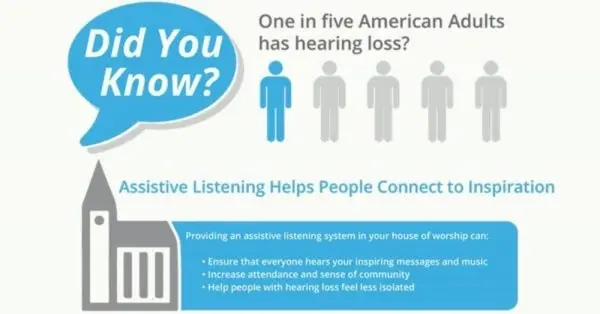
According to data compiled by public health organizations and audiological associations, hearing loss ranks among the most prevalent chronic physical conditions affecting adults globally. In the United States alone, tens of millions of individuals experience clinically significant hearing impairment.
- The Aging Demographics: The demographic shift known as the "Silver Tsunami"—driven by the aging Baby Boomer generation—means that the percentage of churchgoers experiencing age-related hearing decline is accelerating rapidly. Without intentional acoustic accommodations, a significant and growing segment of the core demographic within traditional houses of worship faces systemic exclusion.
- The Invisible Disability: Hearing loss is frequently characterized as an "invisible disability." Unlike mobility impairments that necessitate ramps or elevators, hearing loss carries no outward physical markers. Consequently, individuals frequently mask their struggles, nodding politely during conversations while missing crucial elements of liturgical readings, pastoral sermons, and corporate singing.
The Psychosocial Toll of Isolation
The consequences of unaddressed hearing loss extend far beyond mere inconvenience; they strike at the heart of human connection and mental well-being.

- Social Withdrawal: Studies consistently link unmanaged hearing loss to social isolation, loneliness, anxiety, and depression. When individuals find it exhausting or impossible to follow corporate discourse, they gradually withdraw from communal gatherings.
- Cognitive Load: Straining to decipher muffled speech in reverberant architectural spaces demands immense cognitive energy, leaving listeners fatigued and diminishing their capacity for spiritual engagement and reflection.
- The Pastoral Imperative: For a house of worship, the mission is fundamentally relational. When a congregant sits through a weekly service unable to hear the spoken word, the institution fails in its core pastoral duty. Implementing an Assistive Listening System directly combats this isolation, transforming a barrier to entry into an invitation to profound participation.
Official Statements and Industry Insights
Leading voices in audio engineering, pastoral administration, and audiological accessibility emphasize that modern houses of worship must view acoustic inclusion as an essential component of modern ministry.
"Reaching out to those who feel disconnected from your community due to hearing loss is central to sharing the message of inclusion. Genuinely compassionate service involves being aware of and caring for the needs of everyone, especially those dealing with impairments. Make sure they are able to hear the beauty and emotion of the spoken word in your church by providing them with the equipment they need to stay connected."
— Industry Consensus Statement, House of Worship Assistive Listening Guidelines
Audio system integrators and accessibility advocates further stress that the integration of assistive technologies elevates the overall standard of production within a facility. When technical teams design systems with accessibility in mind, gain structure, microphone placement, and acoustic treatment naturally improve, yielding a superior auditory experience for the entire congregation—not just those utilizing dedicated receivers.
Future Outlook: The Next Horizon in Sanctuary Accessibility
As audio engineering and digital connectivity continue to evolve, the future of assistive listening within houses of worship promises even greater levels of integration, personalization, and seamless user experience.
The Rise of Bring-Your-Own-Device (BYOD) Solutions
While traditional dedicated RF and infrared receivers remain a staple of church accessibility ministries, the proliferation of smartphone technology has paved the way for Bring-Your-Own-Device (BYOD) audio streaming.
- App-Based Listening: Modern Wi-Fi listening systems allow congregants to stream pristine, low-latency sanctuary audio directly to their own smartphones or tablets via a dedicated app. Users can then route the audio straight into their wireless earbuds, headphones, or Bluetooth-enabled hearing aids.
- Dignity and Discretion: BYOD solutions eliminate the potential stigma associated with checking out a specialized institutional receiver at a welcome desk. Congregants can access assistive audio with the same discreet familiarity with which they check their text messages or digital hymnals.
Integration with Advanced Hearing Aid Ecosystems
The boundary line between assistive listening hardware and personal hearing aids continues to blur. As Bluetooth Low Energy (BLE) audio and Auracast broadcast technologies enter the consumer electronics mainstream, future houses of worship will be able to broadcast multi-channel audio directly to thousands of compatible personal hearing devices simultaneously, without requiring intermediate neckloops or dedicated receivers.
The Ongoing Mission of Radical Inclusion
Technology alone, however advanced, remains merely a tool in the hands of communities dedicated to human flourishing. The ultimate trajectory of sanctuary accessibility points toward a future where universal design principles are embedded into the architectural, acoustic, and operational DNA of every house of worship from the ground up.
By embracing structured implementation frameworks—such as assessing congregational needs, budgeting thoughtfully, training compassionate volunteer ambassadors, and marketing accessibility provisions proactively—religious organizations can dismantle physical barriers and fulfill their highest calling: ensuring that every single person who crosses their threshold can hear, engage with, and be transformed by the message of hope.
Conclusion and Additional Resources
For facilities seeking to deepen their commitment to accessibility, comprehensive toolkits and educational resources are readily available. Organizations are encouraged to download comprehensive reference guides, such as the Listen Technologies Church Assistive Listening Toolkit, which offers in-depth technical specifications, sample congregational surveys, standardized signage templates, and bulletin announcement drafts.
If your worship facility is ready to take the next step toward comprehensive acoustic inclusion, consult with qualified audio integration specialists to evaluate your space and discover how an advanced Assistive Listening System can transform your community.