
Executive Overview
In an era where modern houses of worship heavily invest in immersive architectural acoustics, state-of-the-art line array speaker systems, and multi-media projection walls, a critical demographic is frequently overlooked: congregants experiencing hearing loss. For millions of individuals, Sunday morning services, mid-week Bible studies, and community gatherings do not sound like inspiring messages of hope; instead, they sound like an unintelligible wash of reverberation, background noise, and distant speech.
The implementation of an Assistive Listening System (ALS) is no longer a peripheral accommodation or an afterthought—it is a central pillar of true accessibility, radical hospitality, and inclusive ministry. When a church fails to address the acoustic barriers faced by the hard of hearing, it inadvertently builds a wall of exclusion, preventing a significant portion of its community from fully engaging with the spoken word, the emotional resonance of music, and the communal fellowship that defines the worship experience.
Successfully deploying an ALS requires far more than merely purchasing hardware off the shelf and plugging it into a soundboard. It demands a strategic, multi-phased approach that encompasses congregation-wide assessment, careful financial budgeting, comprehensive staff and volunteer training, and deliberate, ongoing community awareness campaigns.
This report provides an in-depth, authoritative framework for church leadership teams, audio-visual (AV) technicians, and ministry directors. By examining the essential steps of assessment, hardware evaluation, operational execution, and promotion—while drawing upon industry insights from audio innovators like Listen Technologies and integration specialists like CCI Solutions—this guide serves as an operational roadmap for transforming any sanctuary into an acoustically inclusive environment.
Detailed Chronology: The Four-Step Implementation Framework
Integrating an assistive listening infrastructure into an existing or newly constructed worship facility requires a methodical timeline. Rushing the process often results in mismatched technology, frustrated users, and low adoption rates. To ensure maximum impact and stewardship of church resources, leadership should follow a disciplined, four-phase implementation framework.
[Phase 1: Needs Assessment] ──> [Phase 2: Technical & Financial Evaluation] ──> [Phase 3: Operational Preparation] ──> [Phase 4: Awareness & Promotion]Phase 1: Understand Your Congregation’s Unique Needs
The foundational error many church leadership teams make is purchasing listening technology based solely on square footage, seating capacity, or budget constraints, without ever consulting the people who will actually use the devices. Every congregation has a unique demographic footprint, and the nature of hearing impairment varies wildly among individuals.
The most effective, data-driven way to initiate this process is by conducting a comprehensive congregation-wide survey. This survey should be distributed broadly—through digital weekly newsletters, physical bulletins, and verbal announcements—to capture responses from seniors, adults, and even younger demographic groups who may struggle with auditory processing or mild-to-moderate hearing loss.
Key metrics and questions to include in the assessment phase:
- Current Experience: How would you rate your ability to clearly understand the spoken word and musical lyrics during standard worship services?
- Acoustic Challenges: Do you experience issues primarily with volume, background noise, echo/reverberation, or music overpowering the sermon?
- Hearing Aid Utilization: Do you currently wear hearing aids or cochlear implants?
- T-Coil Compatibility: If you wear hearing aids, are they equipped with a telecoil (t-coil) receiver? (This is a vital data point when deciding between FM, Infrared, Wi-Fi, or Induction Loop systems).
- Usage History: Have you ever used an assistive listening device at a theater, conference center, or another house of worship? What was your experience?
By aggregating this data, the AV team and pastoral staff can move past guesswork and build a precise profile of the congregation’s auditory needs. This ensures that the capital invested directly targets the specific barriers keeping members disconnected.
Phase 2: Fully Understand Your Technical and Financial Options
Once the congregation’s needs have been clearly defined, the next phase involves navigating the complex landscape of assistive listening technologies. Choosing the wrong system can render the equipment useless to a large portion of the target audience.
Broadly speaking, modern houses of worship have access to several primary transmission formats:
- Radio Frequency (RF/FM) Systems: These systems transmit audio via radio waves from a base transmitter to portable belt-pack receivers worn by the user. They offer broad coverage areas and can pass through walls, making them ideal for large sanctuaries.
- Wi-Fi-Based Audio Systems: Utilizing the church’s local wireless network, these systems stream ultra-low-latency audio directly to congregants’ personal smartphones or smart devices via a dedicated app. This drastically reduces the need to purchase, sanitize, and manage dedicated physical receivers.
- Infrared (IR) Systems: Utilizing invisible light spectrums, IR systems transmit audio securely within a direct line of sight. While immune to radio interference, they are typically limited to indoor spaces and cannot pass through physical barriers.
- Audio Induction Loops (Hearing Loops): A copper wire loop installed around the perimeter of the sanctuary generates an electromagnetic field that transmits sound directly into a hearing aid or cochlear implant equipped with a t-coil, eliminating the need for any external headset or receiver.
Budgeting and Financial Planning
Estimating the total cost of ownership—including transmitters, receivers, neck loops, charging stations, signage, and installation labor—requires expert guidance. Organizations like CCI Solutions provide invaluable, free consultations designed to help church finance committees navigate expense projections and integrate these costs into operational or capital expenditure budgets.
Furthermore, churches should not shy away from targeted fundraising campaigns. Many church members without hearing loss are eager to contribute financially when they understand that their gifts directly enable elderly parents, lifelong friends, or struggling peers to hear the Gospel message clearly for the first time in years.
Phase 3: Prepare for Success Through Training and Infrastructure
Procuring and installing state-of-the-art hardware is only half the battle; the long-term success of an ALS hinges entirely on the human element. If church staff, ushers, and welcome-team volunteers are unfamiliar with how the technology operates, the devices will sit gathering dust in a drawer.
Staff and volunteers must be thoroughly trained, transforming them into dedicated "Assisted Listening Ambassadors." These individuals are the frontline touchpoints for users. When a visitor or member approaches the welcome desk to check out a device, the interaction must be seamless, welcoming, and deeply knowledgeable.
Best practices for operational preparation include:
- Hands-On Demos: Train volunteers not just to hand over a device, but to walk users through its basic functions—powering on, adjusting volume, connecting headphones or neck loops, and verifying signal clarity.
- Laminated Reference Guides: Place clear, laminated instruction sheets and answers to Frequently Asked Questions (FAQs) directly at the distribution counter or reception desk. Volunteers should never have to guess how to troubleshoot a dead battery or pair a receiver.
- Hygiene and Maintenance Protocols: Establish a strict post-service routine for sanitizing earpieces, recharging battery packs, and logging device inventories to prevent loss or damage.
Phase 4: Create Comprehensive Awareness and Community Promotion
Even the most advanced, perfectly maintained listening system is a failure if nobody knows it exists. Once the system is operational, the church must launch a multi-channel awareness campaign to ensure that both the existing congregation and the surrounding geographic community are fully informed.

+-----------------------------------------------------------------+
               MULTI-CHANNEL AWARENESS STRATEGY
+-----------------------------------------------------------------+
  [Visual Signage] ──> Proper ADA-compliant symbols at entrances
  [Print Media]    ──> Weekly bulletin notices & slide graphics
  [Live Training]  ──> Dedicated demo sessions for congregants
  [Community Outreach] ──> Inviting local seniors and care facilities
+-----------------------------------------------------------------+
Key promotional vectors include:
- Strategic Signage: Display internationally recognized, ADA-compliant assistive listening symbols at all main entrances, the welcome desk, and inside the sanctuary itself, clearly indicating where devices can be acquired.
- Print and Digital Reminders: Incorporate a permanent, recurring blurb in every weekly printed bulletin and digital newsletter. Utilize pre-service multi-media slide presentations to display brief, welcoming reminders.
- Live Educational Training Sessions: Host a brief, post-service workshop or demonstration day where curious congregants can try out the technology firsthand, demystifying the equipment and removing any social stigma associated with wearing a listening device.
- Community-Wide Outreach: Market the new accessibility features to surrounding retirement communities, assisted living facilities, and local senior centers. Letting the broader community know that your church has invested in total auditory inclusion is one of the most powerful evangelistic tools available.
Supporting Context & Metrics: The Scale of Auditory Need
To fully appreciate the urgency of implementing an Assistive Listening System, leadership teams must examine the broader socio-demographic and medical data surrounding hearing loss.
According to data compiled by organizations such as the Hearing Loss Association of America (HLAA) and the World Health Organization (WHO):
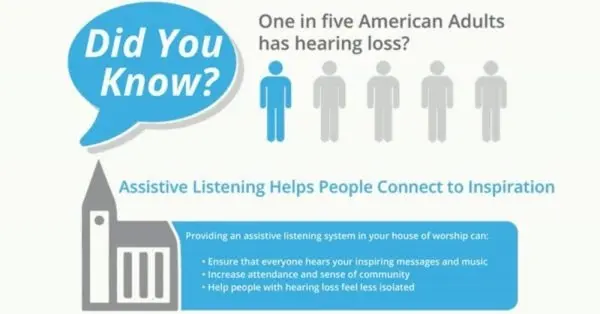
- Prevalence: Over 48 million Americans (approximately 1 in 5 individuals) experience some degree of hearing loss.
- Age Correlation: While hearing loss affects people of all ages, its prevalence increases sharply with age. More than 50% of adults over the age of 75 experience disabling hearing loss, making seniors—often the most faithful, long-standing members of a church congregation—the primary victims of sanctuary acoustic barriers.
- The Social Toll: Untreated hearing loss is directly linked to social isolation, depression, cognitive decline, and anxiety. When individuals can no longer follow conversations in large, reverberant spaces like traditional church sanctuaries, they simply stop attending, leading to a painful sense of spiritual disconnection.
- Legal and Ethical Mandates: Beyond the moral imperative of radical hospitality, houses of worship are increasingly recognizing their ethical obligations under human rights frameworks to ensure public accommodations are truly accessible to all citizens, regardless of physical impairment.
When churches integrate systems validated by industry leaders like Listen Technologies, they actively combat the isolation caused by hearing loss, transforming passive listeners into fully engaged participants.
Official Statements and Industry Insights
Industry experts and accessibility advocates emphasize that auditory inclusion must be treated as a core component of facility design and ministry execution.
"Reaching out to those who feel disconnected from your community due to hearing loss is central to sharing the message of inclusion. Genuinely compassionate service involves being aware of and caring for the needs of everyone, especially those dealing with impairments. Make sure they are able to hear the beauty and emotion of the spoken word in your church by providing them with the equipment they need to stay connected."
— Accessibility Advocacy & Technical Integration Guidelines
Audio engineering specialists emphasize that modern architectural acoustics—while visually stunning and musically optimized—often create a hostile environment for the hard of hearing. Hard reflective surfaces, high ceilings, and powerful sound reinforcement systems create high levels of reverberation (echo).
Technical consultants note that traditional amplification simply turns up the volume, which exacerbates acoustic reflection and worsens speech intelligibility. An Assistive Listening System bypasses the room’s acoustic flaws entirely, delivering a clean, direct-to-ear audio feed that restores clarity, warmth, and emotional nuance to the spoken sermon and musical performance alike.
Future Outlook: The Next Generation of Sanctuary Accessibility
As audio technology continues to evolve at a breakneck pace, the future of church accessibility points toward seamless integration between institutional broadcast systems and personal consumer electronics.
The convergence of Bluetooth Low Energy (BLE) audio, Auracast™ broadcast audio technology, and cloud-managed Wi-Fi streaming platforms suggests a future where congregants will no longer need to check out specialized, bulky receivers from a welcome desk. Instead, future-proofed houses of worship will broadcast secure, high-definition audio streams directly to personal smartphones, hearing aids, and earbud systems already owned by the user.
However, regardless of whether a church utilizes traditional FM packs, cutting-edge Wi-Fi streaming, or copper induction loops, the underlying philosophy remains unchanged. Technology is merely the tool; the ultimate mission is relational and spiritual.
By taking proactive steps today—assessing congregational needs, budgeting thoughtfully, training enthusiastic volunteers, and promoting accessibility openly—churches can eliminate physical barriers and ensure that every single soul in attendance can fully absorb, experience, and celebrate the message of grace.
Additional Resources and Actionable Tools
For church leadership teams, AV directors, and facility managers seeking to dive deeper into the technical specifications and operational logistics of sanctuary accessibility, comprehensive resources are readily available.
To access sample congregation surveys, signage templates, step-by-step implementation checklists, and audio engineering whitepapers, download the official Listen Technologies Church Assistive Listening Toolkit.
Does your worship facility currently meet the needs of every member of your community? Evaluate your acoustic landscape today and ensure that no voice—and no listener—is left behind.