
Executive Overview
In an era where houses of worship strive to cultivate environments of radical hospitality, inclusivity, and community engagement, one foundational barrier often remains unaddressed: acoustic accessibility. For millions of congregants worldwide, the modern worship experience—characterized by dynamic sound systems, contemporary musical arrangements, and spoken-word delivery—can be an isolating ordeal rather than a spiritually uplifting one. Age-related hearing loss, medically diagnosed auditory impairments, and the progressive degradation of natural hearing create an invisible wall between the pulpit and the pew.
To dismantle this barrier, progressive religious organizations are increasingly turning to advanced Assistive Listening Systems (ALS). However, deploying these technologies requires far more than a simple equipment purchase; it demands a strategic, culturally sensitive, and meticulously executed integration plan.
This report provides an authoritative examination of how houses of worship can effectively assess, procure, implement, and promote assistive listening technology. Drawing upon industry best practices, expert methodologies provided by leaders such as CCI Solutions and Listen Technologies, and a foundational four-step implementation framework, this article serves as a definitive guide for faith-based leadership teams seeking to ensure that every message is heard, every lyric is felt, and every member of the congregation remains fully connected to the life of the community.
Detailed Chronology: The Four-Step Implementation Framework
Successfully deploying an Assistive Listening System in a worship facility is a journey that requires careful sequencing. Moving from initial concept to a fully operational, congregation-wide accessibility program involves a structured, chronological methodology.
Phase 1: Understand Your Needs through Data-Driven Assessment
The foundational misstep many organizations make when upgrading their audio infrastructure is assuming they know what their congregation requires without asking. Technology acquisition should never begin with a sales catalog; it must begin with the congregation itself.
The first critical step in the implementation timeline is conducting a comprehensive, congregation-wide needs assessment. Religious leaders must deploy surveys designed to capture both qualitative and quantitative data regarding the listening experiences of their attendees. These instruments should specifically inquire about:
- The overall clarity and intelligibility of services from various seating zones within the sanctuary.
- The frequency with which individuals struggle to comprehend spoken elements, such as sermons, scripture readings, and announcements.
- The prevalence of hearing aid adoption among the membership.
- Crucially, whether those hearing aids are equipped with telecoils (t-coils), which directly interface with loop systems and neck loops.
By gathering this data, facility committees can move past generalized assumptions and ground their project in verifiable realities. If survey results indicate that a significant percentage of aging attendees utilize t-coil-enabled devices, the technical team can tailor their solution—such as prioritizing an induction loop system or ensuring the provided receivers are universally compatible with existing personal hearing hardware.
Phase 2: Evaluate Options, Costs, and Fiscal Strategy
Once the specific acoustic needs of the community are mapped, the administrative leadership must explore the technical and financial landscape. Understanding the available options requires balancing performance capabilities against budgetary constraints.
Assistive Listening Systems generally fall into a few primary technological categories:
- Radio Frequency (RF) Systems: Transmit audio via radio waves to belt-pack receivers worn by users. These offer robust coverage and are ideal for large, wide-open spaces.
- Infrared (IR) Systems: Utilize invisible light beams to transmit sound. Highly secure and immune to radio interference, though they require a direct line of sight between the transmitter and receiver.
- Audio Induction Loops (Hearing Loops): Transmit an electromagnetic field directly to the telecoils built into most modern hearing aids and cochlear implants, offering the most seamless user experience possible because listeners use their own customized hearing devices.
Estimating the cost of these systems can be complex, involving hardware, wiring, installation labor, and peripheral accessories like headphones and neck loops. To navigate this phase successfully, institutions can leverage expert consultations. Organizations like CCI Solutions offer specialized assistance, including free consultations designed to help church boards navigate expense forecasting and budgeting.
Furthermore, because capital improvement projects often compete with other ministry priorities, forward-thinking churches frequently implement dedicated fundraising campaigns. Communicating the missional value of the project to the broader congregation often inspires generous, targeted giving, successfully offsetting the financial investment required for top-tier assistive technology.
Phase 3: Prepare for Operational Success and Staff Training
The finest audio technology in the world will fail if the human element of distribution and support is neglected. Phase 3 of the implementation timeline shifts the focus from hardware to operational readiness.
It is vital to the long-term success of any new Assisted Listening System that staff members and volunteers receive comprehensive training on how to operate, maintain, and distribute the devices. These individuals should be viewed as your "Assisted Listening Ambassadors"—the frontline representatives of your church’s commitment to accessibility.
Training protocols should cover:
- Proper sanitization and battery management of receivers and headphones.
- Step-by-step instructions on pairing or setting up devices for first-time users.
- Empathetic communication techniques when assisting individuals with sensory impairments.
Operational friction is the primary reason users abandon new technology. To mitigate this, facilities should establish a permanent, well-marked distribution station—such as an information desk or welcome counter. At this station, staff should maintain a laminated, quick-reference guide containing answers to frequently asked questions (FAQs). When a device is checked out, the attendant should take a moment to provide a friendly, hands-on demonstration of its basic functions, ensuring the user feels confident before entering the sanctuary.
Phase 4: Cultivate Awareness and Community Outreach
The final phase of the rollout focuses on visibility and adoption. An Assistive Listening System provides zero value if the people who need it do not know it exists.
Creating awareness requires a multi-channel communication strategy:
- Signage: Prominently display the universal international symbols for accessibility, clearly informing attendees that Assisted Listening Devices are available and directing them to the exact location where they can be acquired.
- Print and Digital Media: Insert regular reminders into the weekly worship bulletin, digital presentation slides during pre-service loops, and website announcements.
- Live Demonstrations: Host a dedicated training session or workshop during a fellowship hour, allowing congregants to test the technology firsthand and familiarize themselves with its operation without the pressure of an impending service.
- Community-Wide Advertising: Extend your outreach beyond the existing membership. Local senior centers, retirement communities, and regional healthcare networks should be informed of your church’s new accessibility features. Many individuals stop attending religious services simply because they assume older facilities cannot accommodate their changing sensory needs; broadcasting your proactive inclusion efforts can draw new visitors and welcome back those who felt previously disconnected.
Supporting Context & Metrics: The Scale of Hearing Loss and Inclusion
To fully appreciate the urgency of deploying Assistive Listening Systems, one must examine the broader public health context and the psychological impact of hearing impairment within religious communities.

The Demographic Imperative
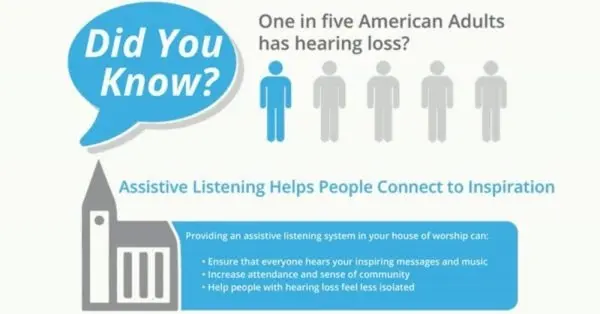
According to data compiled by organizations such as the World Health Organization (WHO) and the Hearing Loss Association of America (HLAA), hearing loss is one of the most prevalent chronic conditions affecting adults globally. In the United States alone, approximately 48 million people experience some degree of hearing loss. As global populations age, this number is projected to climb steadily.
Within the context of houses of worship, demographic trends skew even higher. Traditional church, synagogue, and mosque congregations often have a higher median age than the general population. Consequently, the incidence of age-related hearing loss (presbycusis) within a typical Sunday morning gathering is frequently higher than national averages.
The Psychological Cost of Isolation
When individuals begin to lose their hearing, the impact extends far beyond physical acoustics; it strikes at the core of human connection and spiritual well-being. Academic research consistently links untreated hearing loss to:
- Social isolation and withdrawal from community activities.
- Increased rates of anxiety, depression, and cognitive fatigue.
- A gradual distancing from religious and spiritual institutions due to the frustration of being unable to comprehend spoken sermons, liturgy, and pastoral counseling.
When a house of worship invests in an Assistive Listening System, it is not merely purchasing electronic components; it is actively restoring social agency and psychological comfort to members who might otherwise silently slip away from the community. Reaching out to those who feel disconnected due to hearing loss is central to sharing a message of genuine inclusion. Compassionate service requires an active awareness of—and care for—the physical and sensory needs of every individual.
Official Guidelines and Resource Frameworks
The implementation of accessibility measures in public and religious facilities is supported by a wealth of professional resources designed to eliminate guesswork for facility managers and ministry teams.
Industry Frameworks and Toolkits
Navigating the technical and administrative requirements of installing an ALS is significantly streamlined through industry-standard toolkits. For instance, the Listen Technologies Church Assistive Listening Toolkit provides a comprehensive suite of resources tailored specifically to houses of worship. These materials include:
- Sample congregation surveys that can be easily customized for local use.
- Standardized signage templates compliant with accessibility visual standards.
- Pre-written bulletin announcements and promotional copy to drive awareness.
- Technical whitepapers detailing the differences between RF, IR, and Loop technologies.
Facilities seeking to utilize these resources can access detailed documentation and download implementation toolkits directly through manufacturer and distributor platforms (such as the official Listen Technologies Church Assistive Listening Toolkit).
The Role of Specialized Integration Partners
Integrating modern audio-visual technology into historic or architecturally sensitive worship spaces requires specialized expertise. Organizations like CCI Solutions bridge the gap between acoustic engineering and ministry objectives. By offering tailored consultations, these partners help administrative teams evaluate their current sound reinforcement infrastructure, project accurate budgeting figures, and select hardware that integrates seamlessly with existing mixing consoles and speaker arrays.
Official guidelines emphasize that an acoustic audit should evaluate:
- Room reverberation times and acoustic reflections.
- The placement of microphones and speaker zoning.
- Integration capabilities with broadcast and streaming mixes, ensuring that in-person assistive listening feeds maintain the same high fidelity as online audio streams.
Future Outlook: The Evolution of Acoustic Accessibility in Worship
As audio technology continues to advance at a rapid pace, the future of assistive listening within houses of worship points toward even greater integration, personalization, and seamless connectivity.
The Shift Toward Personal Device Integration
Historically, assistive listening relied entirely on dedicated hardware: a church-owned receiver handed to a user, paired with standard over-the-ear headphones. While these systems remain vital for users who do not wear hearing aids, the future belongs to direct-to-device streaming architectures.
Emerging standards in wireless communication—such as Bluetooth Low Energy (BLE) Audio and advanced Wi-Fi-based streaming protocols—are revolutionizing how audio is delivered in public spaces. Soon, congregants will be able to download a dedicated app on their own smartphones, connect their wireless earbuds or hearing aids directly to the church’s audio network, and adjust volume, EQ, and clarity settings tailored precisely to their personal auditory profile, all in real-time.
Architectural Integration as a Standard Practice
Looking ahead, acoustic accessibility is transitioning from an afterthought or a retrofitted accommodation to an integral design phase of new church construction and major renovation projects. Architects, acousticians, and AV integrators are increasingly designing spaces with universal access built into the structural blueprints. Induction loops are being laid into concrete foundations before flooring is installed, and multi-channel zoning is being mapped out during initial system design.
Furthermore, cultural expectations within faith communities are shifting. Accessibility is no longer viewed through the narrow lens of legal compliance (such as adherence to the Americans with Disabilities Act, which often provides exemptions for religious entities); rather, it is embraced as a core moral and ethical imperative. A truly welcoming house of worship is one where technical barriers are systematically identified and eliminated.
Conclusion
The spoken word holds immense power within religious traditions—it is the vehicle for sacred texts, theological instruction, pastoral comfort, and communal prayer. Ensuring that every attendee can experience the beauty and emotion of the spoken word without impediment is a profound act of pastoral care.
By systematically understanding congregation needs, evaluating technical and financial options with expert partners like CCI Solutions, training dedicated staff to act as accessibility ambassadors, and aggressively promoting the new technology using toolkits provided by leaders like Listen Technologies, houses of worship can transform their acoustic environments.
The future of inclusive worship relies on proactive, compassionate leadership. By investing in Assistive Listening Systems today, religious organizations ensure that no voice is lost, no member is left behind, and the timeless message of the community is heard clearly by all who enter its doors.