
Executive Overview
In an era where modern houses of worship invest heavily in immersive audio-visual architectures—ranging from line-array loudspeaker systems to high-definition LED walls—a fundamental demographic is frequently overlooked: individuals experiencing hearing loss. For millions of congregants globally, Sunday services, midweek gatherings, and milestone celebrations are marred by acoustic challenges. Reverberation, background noise, and architectural anomalies in traditional sanctuary spaces can transform inspiring sermons and musical arrangements into unintelligible noise.
The integration of an Assistive Listening System (ALS) is no longer merely an ADA (Americans with Disabilities Act) compliance checkbox; it is a profound pastoral imperative. By bridging the acoustic gap, houses of worship can restore full participation, dignity, and spiritual connection to members of their community who might otherwise feel alienated.
However, deploying an effective ALS requires strategic foresight. Purchasing hardware off the shelf and placing it on a welcome desk is a recipe for low adoption and wasted resources. True accessibility demands a holistic framework encompassing congregational data collection, financial forecasting, rigorous staff and volunteer training, and sustained communication campaigns. This report outlines a comprehensive four-step blueprint—derived from industry best practices and technical frameworks provided by audio integration leaders such as CCI Solutions and Listen Technologies—designed to help religious organizations successfully evaluate, procure, and launch an inclusive listening infrastructure.
Detailed Chronology: The Four-Phase Implementation Roadmap
Successfully introducing an Assistive Listening System into a worship facility requires a methodical, step-by-step approach. Rushing the deployment often results in mismatched technologies, untrained personnel, and a lack of awareness among the congregation. Below is the chronological framework that facilities must follow to ensure maximum impact and seamless integration.
Phase 1: Needs Assessment and Congregational Data Collection
The foundational mistake many church leadership teams make is guessing what kind of audio support their congregation needs. Assumptions are frequently made based on visible demographics, but hearing loss is an invisible condition that spans all age groups.
- Executing the Needs Survey: The first critical step is deploying a comprehensive survey to the congregation. This instrument must directly target listening experiences during corporate worship. Questions should explore whether respondents struggle to understand the spoken word, how often they miss specific elements of a service (such as scripture readings, prayer, or announcements), and whether they currently use personal hearing aids.
- Targeting Hearing Aid Compatibility (T-Coils): A crucial metric to capture during this phase is the prevalence of telecoil (t-coil) technology within the congregation’s existing hearing aids. Understanding whether members possess t-coil equipped devices dictates whether an organization should prioritize an inductive loop system (which broadcasts directly to t-coils) or an FM/Wi-Fi streaming architecture (which requires receivers and lightweight ear-speakers or neck loops).
- Analyzing the Data: Once survey responses are aggregated, facility teams can map out the scale of the need. If twenty percent of respondents report moderate-to-severe hearing challenges, and a significant portion utilize t-coil aids, the technical procurement strategy changes drastically compared to a congregation with different demographic markers.
Phase 2: Technical Evaluation and Financial Forecasting
With concrete data in hand, the leadership team must transition from identifying the problem to evaluating technological and financial solutions.
- Sizing the Investment: Estimating the cost of an ALS involves more than just purchasing a transmitter and a handful of receivers. Facilities must evaluate the square footage of the sanctuary, structural impediments (such as steel-reinforced concrete that can block RF signals), and the total number of devices required to meet peak capacity. Industry guidelines typically suggest providing receivers for approximately one to two percent of total seating capacity, though this number should be adjusted upward based on the Phase 1 survey results.
- Leveraging Professional Consultations: Navigating audio specs—such as bandwidth, latency, and signal-to-noise ratios—can overwhelm volunteer AV teams. Organizations like CCI Solutions offer specialized assistance and complimentary consultations to help administrative boards build accurate expense projections and integrate these line items into broader fiscal budgets.
- Capital Campaigns and Fundraising: For many non-profit houses of worship, capital allocation is a delicate balancing act. Leadership can offset the financial burden of an ALS upgrade by launching targeted fundraising campaigns, applying for disability-access grants, or partnering with philanthropic donors who have a personal connection to hearing advocacy.
Phase 3: Operational Readiness and Staff Training
The best technology in the world is useless if the people operating it do not know how it works. Phase 3 focuses on transforming the church staff and volunteer corps into knowledgeable advocates.
- Designating "Assistive Listening Ambassadors": Ushers, greeters, and AV booth operators are the frontline of accessibility. They must receive hands-on training regarding the operation, charging, sanitization, and distribution of the assistive listening devices. Treat these key personnel not merely as equipment handlers, but as "Assistive Listening Ambassadors" charged with proactively identifying individuals who might benefit from the technology.
- Personalized User Instruction: When a congregant checks out a receiver, the ambassador should never simply hand over the device in silence. A brief, courteous demonstration on how to adjust the volume, secure the ear-piece, or sync with a neck loop sets the user up for success and eliminates technological intimidation.
- Operational Cheat Sheets: To maintain consistency across multiple services and rotating volunteer teams, facilities should place laminated Frequently Asked Questions (FAQs) and quick-troubleshooting guides directly at the distribution desk. Clear instructions on battery management, channel locking, and sanitization protocols ensure a professional user experience every single week.
Phase 4: Community Awareness and Marketing
Building an ALS and keeping it a secret serves no one. The final phase of the rollout focuses on internal marketing and community outreach to ensure maximum utilization.
- Visual Signage and Wayfinding: Proper ADA-compliant signage must be prominently displayed throughout the facility. Visitors need to know immediately upon entering the building that Assisted Listening Devices are available, exactly where they can be obtained, and how to request them.
- Multi-Channel Promotion: Awareness must be reinforced continuously. Announcements should be integrated into printed weekly bulletins, projected on pre-service multi-media screens, and highlighted during spoken announcements from the stage.
- Hosting Live Training Sessions: To break down the psychological barriers associated with using assistive tech, churches can host dedicated live training or demonstration events. Allowing congregants to test the system in a low-pressure environment removes the stigma and familiarizes them with the clarity the technology provides.
- Local Community Outreach: Advertising the availability of an inclusive acoustic environment to the broader geographical community can yield unexpected fruit. Many individuals with hearing impairments have dropped out of active participation in corporate worship simply because they felt isolated by poor acoustics. Broadcasting that your facility is equipped for complete accessibility can draw new visitors who have been searching for a welcoming, accommodating spiritual home.
Supporting Context & Metrics: The Human and Acoustic Reality
To fully grasp the necessity of an Assistive Listening System, one must examine the intersection of audiology, architecture, and modern worship dynamics.
The Acoustic Challenge in Modern Sanctuaries
Contemporary worship environments present unique acoustic hurdles. Modern architectural trends favor hard, reflective surfaces—concrete floors, exposed steel beams, glass walls, and minimalist aesthetics—which create high reverberation times (RT60). When sound bounces endlessly around a room, speech intelligibility plummets. Even individuals with normal hearing can struggle to parse words under these conditions; for those with sensorineural hearing loss or age-related presbycusis, high reverberation turns speech into an unintelligible wash of sound.
Furthermore, dynamic musical elements—such as modern worship bands utilizing drums, electric guitars, and synthesizers—often overpower the spoken word. Sound engineers struggle to balance the dynamic range required for high-energy music with the crystal-clear articulation required for spoken teaching. An ALS bypasses room acoustics entirely, capturing the pristine audio feed directly from the mixing console (or dedicated ambient microphones) and transmitting it straight to the listener’s ear or hearing aid.

Demographic Realities and Hearing Health Metrics
According to data compiled by organizations such as the Hearing Loss Association of America (HLAA) and the World Health Organization (WHO):
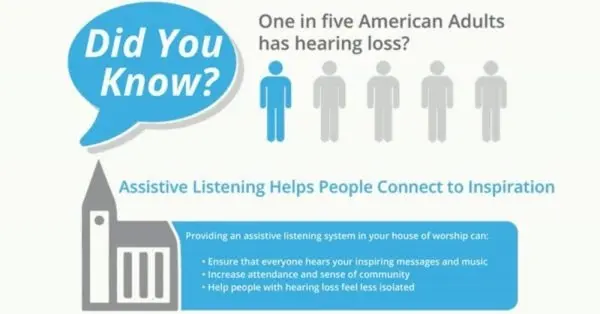
- Over 48 million Americans (approximately 15% of the population) experience some degree of hearing loss.
- Hearing loss is the third most common physical condition in the United States, outpacing diabetes and cancer in terms of prevalence.
- While hearing loss affects all age groups, its incidence rises sharply with age: roughly one in three people older than 65, and half of those older than 75, experience disabling hearing loss.
In the context of a typical church congregation—which often skews toward older demographics—the percentage of attendees experiencing acoustic barriers is frequently higher than the national average. When a house of worship fails to provide an ALS, it risks unintentionally alienating its most seasoned, faithful, and wisdom-rich members.
Official Statements and Industry Insights
Industry experts and accessibility advocates emphasize that technology is merely the vehicle; the ultimate destination is radical inclusion and relational ministry.
"Reaching out to those who feel disconnected from your community due to hearing loss is central to sharing the message of inclusion. Genuinely compassionate service involves being aware of and caring for the needs of everyone, especially those dealing with impairments. Make sure they are able to hear the beauty and emotion of the spoken word in your church by providing them with the equipment they need to stay connected."
— Audio Integration & Accessibility Specialists, CCI Solutions
Experts also stress that accessibility initiatives act as a litmus test for a church’s broader cultural health. When a facility invests time and resources into accommodating invisible disabilities, it signals to the entire community that every individual is valued, seen, and heard.
To assist facility managers, audio technicians, and pastoral staff in executing these principles, comprehensive toolkits have been developed by industry pioneers. For instance, resources such as the Listen Technologies Church Assistive Listening Toolkit provide invaluable, actionable collateral, including sample congregational surveys, standardized ADA signage templates, pre-written bulletin announcements, and technical specification guidelines. Downloading and utilizing such frameworks saves hundreds of administrative hours and guarantees a professional deployment.
Future Outlook: The Evolution of Accessible Worship
Looking ahead, the landscape of assistive listening technology is undergoing rapid transformation, driven by advancements in wireless transmission, digital signal processing (DSP), and personal smart devices.
The Rise of Wi-Fi and Bluetooth LE Audio
Traditional analog FM systems and infrared loops are steadily being complemented—and in some cases replaced—by advanced Wi-Fi streaming solutions and Bluetooth Low Energy (LE) Audio. Wi-Fi systems allow congregants to download an app on their own smartphones, connect to the church’s secure network, and stream pristine, low-latency audio directly to their personal earbuds or hearing aids. This approach significantly reduces the hardware overhead for the church, as the venue no longer needs to manage, sanitize, and recharge dozens of dedicated plastic receivers.
Integration with Personal Smart Devices and Cochlear Implants
As hearing aid technology becomes increasingly sophisticated, future-proof church audio design must account for universal connectivity. Modern cochlear implants and digital hearing aids are increasingly equipped with direct Bluetooth pairing capabilities. Houses of worship that adopt scalable, multi-channel transmission platforms will be uniquely positioned to broadcast customized audio feeds—not only for standard hearing assistance, but potentially for multi-lingual translation and sensory-friendly auxiliary mixes as well.
The Cultural Shift Toward Universal Design
Ultimately, the future of church architecture and audio engineering points toward "Universal Design"—the concept of designing environments and systems that are inherently accessible to all people, to the greatest extent possible, without the need for adaptation or specialized design. While dedicated assistive listening systems will remain a regulatory and practical necessity for the foreseeable future, the mindset they foster is permeating every layer of church administration.
By embracing structured planning, investing in proper training, and actively promoting inclusivity, houses of worship can transcend mere technical compliance. They can create a truly barrier-free sanctuary where every member of the community can experience the full emotional resonance, spoken truth, and spiritual connection of the corporate gathering.