
Executive Overview
In an era where houses of worship strive to cultivate welcoming, universally accessible environments, addressing the acoustic needs of congregants with hearing loss remains one of the most critical yet frequently overlooked imperatives. For millions of individuals, the weekly worship experience is severely diminished—or rendered entirely inaccessible—not by a lack of spiritual warmth, but by architectural acoustics, background noise, and inadequate sound reinforcement. When the spoken word, scripture readings, and musical ministry fail to reach every ear clearly, members of the congregation become unintentionally marginalized.
Implementing an Assistive Listening System (ALS) bridges this gap, transforming the sanctuary into a space of true inclusion. However, purchasing and installing audio hardware is only part of the equation. True accessibility requires a strategic, multi-phased approach that encompasses congregation assessment, financial planning, comprehensive staff and volunteer training, and proactive community outreach.
This report provides a detailed roadmap for church leaders, AV directors, and facility managers looking to implement or upgrade an Assistive Listening System. Drawing from industry standards and expert methodologies provided by auditory technology specialists, this guide explores the essential steps to ensure that every message is heard, every hymn is felt, and every member of the community feels genuinely connected.
Detailed Chronology: A Four-Step Implementation Framework
Successfully deploying an Assistive Listening System requires a deliberate, chronological rollout. Rushing the hardware installation without foundational planning often leads to low adoption rates, wasted budgets, and frustrated congregants. The following four-step framework outlines the lifecycle of an ALS implementation project.
Phase 1: Understand and Assess Community Needs
The foundational error many ministry teams make is purchasing audio equipment based solely on square footage or vendor recommendations without consulting the end-users. The first and most vital step is to conduct a comprehensive assessment of the congregation’s actual hearing-assistance needs.
- Deploying Congregational Surveys: To accurately gauge demand, churches should distribute anonymous surveys—both in print via worship bulletins and digitally through email newsletters and church apps. These surveys should directly address the congregant’s current experience during services. Questions must inquire about whether they struggle to understand the sermon, if they utilize personal hearing aids, and crucially, whether those hearing aids are equipped with telecoils (t-coils).
- Analyzing Demographic and Acoustic Data: Cross-referencing survey data with demographic trends (such as an aging local population) provides a clearer picture of current and future demand. Furthermore, facility managers should evaluate the sanctuary’s acoustic profile. High reverberation times, common in traditional sanctuaries with hard plaster and stained glass, exacerbate hearing difficulties, making an ALS not just a convenience, but an acoustic necessity.
Phase 2: Explore Options and Budgetary Realities
Once the congregation’s needs are quantified, leadership must evaluate the technical and financial parameters of the available options. Navigating the landscape of radio frequency (RF), infrared (IR), and induction loop systems requires expert guidance.
- Cost Estimation and Technical Consultation: Estimating the financial investment involves balancing receiver counts, transmitter types, and integration costs with the existing soundboard. Organizations such as CCI Solutions provide specialized assistance and complimentary consultations to help church boards navigate expense planning and budgeting.
- Funding and Capital Campaigns: Because facility upgrades often compete with other budgetary demands, churches frequently utilize creative funding mechanisms. Dedicated special offerings, targeted capital campaigns, or memorial gifts specifically designated for accessibility enhancements can successfully offset the initial investment, turning the procurement process into a unified community effort.
Phase 3: Prepare for Operational Success
The finest assistive technology will fail if the internal team does not know how to operate, maintain, and distribute it. Operational readiness is the bridge between hardware installation and congregational engagement.
- Training Staff and Volunteers: Ushers, welcome desk personnel, and audio-visual technicians must receive rigorous training on the mechanics of the ALS. These individuals serve as "Assistive Listening Ambassadors." When handing a device to a congregant, ambassadors should take a moment to provide a friendly, clear demonstration of how the receiver works, how to adjust the volume, and how to fit the earphone or neck-loop properly.
- Resource Management: To streamline distribution and reduce friction, ministry teams should maintain a laminated quick-reference sheet containing frequently asked questions (FAQs) and troubleshooting steps at the distribution desk. This ensures that even rotating volunteers can assist users with confidence.
Phase 4: Create Comprehensive Awareness and Outreach
An invisible system is often an unused system. Once the hardware is installed and the team is trained, a robust marketing and communication strategy must be deployed to inform both the existing congregation and the broader community.
- Signage and Visual Cues: Clear, universally understood signage must be placed at all primary entrances, welcome centers, and seating areas, indicating that Assisted Listening Devices are available and directing individuals to where they can acquire them.
- Multi-Channel Announcements: Reminders should be woven into weekly print bulletins, digital slide presentations before services, and verbal announcements from the stage. For major rollouts, hosting a dedicated live demonstration session allows curious congregants to test the technology in a low-pressure environment.
- Community-Wide Advertising: Extending the word beyond the active membership sends a powerful message to the surrounding neighborhood. Publicizing accessibility upgrades via local media, community boards, and social media demonstrates a profound commitment to radical inclusion, often drawing visitors who have previously felt alienated by traditional worship environments.
Supporting Context & Metrics: The Imperative of Auditory Inclusion
To understand the urgency of implementing Assistive Listening Systems, one must examine the broader socio-acoustic context of modern houses of worship.
The Prevalence of Hearing Loss
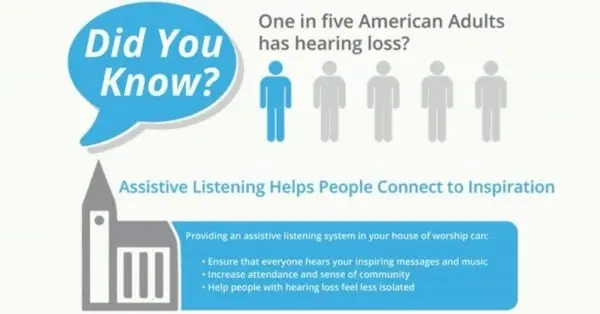
According to public health data, hearing loss is one of the most common chronic physical conditions affecting adults. Approximately one in eight people in the United States (13% or 30 million aged 12 and older) has hearing loss in both ears based on standard hearing examinations. In congregations with aging demographics, this percentage is frequently much higher. Despite these staggering numbers, a significant stigma surrounds hearing loss, causing many individuals to suffer in silence or withdraw entirely from social and spiritual gatherings.
The Acoustic Challenge of Modern Sanctuaries
Worship spaces are uniquely challenging acoustic environments. They often feature:

- High Ceilings and Hard Surfaces: Designed for aesthetic beauty and acoustic musical reverberation, these spaces bounce sound waves repeatedly, creating a muddy acoustic soup where distinct consonants are lost.
- Dynamic Sound Delivery: Modern services often combine spoken-word sermons with high-energy contemporary musical instrumentation. The wide dynamic range between a soft-spoken prayer and a full-band worship set creates extreme listening fatigue for individuals with hearing impairments.
- Distance and Obstructions: Large auditoriums distance the listener from the sound source, compounding the degradation of speech intelligibility caused by ambient room noise (HVAC systems, rustling papers, whispering neighbors).
Economic and Social Return on Investment (ROI)
While the immediate metric of success is the number of devices checked out on a given Sunday, the broader ROI encompasses spiritual retention and community growth. Congregants who can comfortably hear the sermon are more likely to participate in small groups, engage in volunteer ministries, and maintain long-term financial stewardship. Furthermore, accessibility is a powerful evangelistic tool; welcoming individuals with sensory impairments fulfills a foundational moral duty of outreach.
Official Statements and Industry Insights
Industry leaders and accessibility advocates emphasize that providing assistive listening is no longer an optional "extra," but a core component of welcoming pastoral care.
"Reaching out to those who feel disconnected from your community due to hearing loss is central to sharing the message of inclusion. Genuinely compassionate service involves being aware of and caring for the needs of everyone, especially those dealing with impairments. Make sure they are able to hear the beauty and emotion of the spoken word in your church by providing them with the equipment they need to stay connected."
— Industry Accessibility Directive
Experts note that the transition from viewing accessibility as a legal compliance checkbox (such as adherence to the Americans with Disabilities Act) to viewing it as an expression of hospitality transforms church culture. When a church invests in Listen Technologies systems or equivalent infrastructure, it signals to every attendee: You belong here, and your ability to participate matters to us.
To assist ministry leaders in this mission, comprehensive implementation toolkits—such as the Listen Technologies Church Assistive Listening Toolkit—provide invaluable resources, including sample surveys, downloadable signage templates, bulletin announcement copy, and technical setup guides.
Future Outlook: The Next Generation of Sanctuary Accessibility
As audio technology continues to evolve at a rapid pace, the future of assistive listening in houses of worship points toward greater integration, personalization, and seamless connectivity.
The Rise of Wi-Fi and Streaming Audio
Traditional radio frequency (RF) and infrared systems are increasingly being complemented—and in some cases superseded—by Wi-Fi-based audio streaming solutions. These systems allow congregants to stream pristine, low-latency audio directly to their own smartphones or Bluetooth-enabled hearing aids using a dedicated app. This shift reduces the hardware management burden on church volunteers, as users prefer utilizing their personal mobile devices.
Artificial Intelligence and Adaptive Acoustics
Looking ahead over the next decade, the integration of artificial intelligence (AI) into sanctuary sound reinforcement will revolutionize how audio is delivered. Smart DSPs (Digital Signal Processors) will automatically isolate speech from background noise in real time, tailoring mixes dynamically for both house speakers and assistive listening feeds.
Total Universal Design
The ultimate trajectory of church audio design is "Universal Design"—the concept that environments should be inherently accessible to all people, to the greatest extent possible, without the need for adaptation or specialized design. While dedicated assistive listening devices and neck-loops will remain necessary for deep accessibility in the near term, future sanctuary designs will increasingly prioritize acoustic engineering that delivers high speech intelligibility natively to every seat in the house.
Conclusion
Implementing an Assistive Listening System is a profound act of pastoral care. By methodically assessing congregational needs, navigating budgeting options with expert partners, training passionate operational ambassadors, and promoting awareness across all communication channels, houses of worship can dismantle the invisible barriers of hearing loss. Ensuring that every member of the community can experience the full emotional depth and clarity of the spoken and musical word is essential to fulfilling the ultimate mission of any faith community: leaving no one behind.