Voice science stands at a profound inflection point. For decades, the human voice has been studied as a complex acoustic and physiological phenomenon—an intersection of art, anatomy, and neurology. Today, the integration of artificial intelligence (AI) and machine learning (ML) is fundamentally reshaping how researchers conduct studies, how data is analyzed, and how clinicians care for patients.
Far from being a sudden technological wave, this transformation is built on a rich, multi-decade legacy of interdisciplinary pioneering. At the center of this movement is The Voice Foundation and its premier peer-reviewed publication, the Journal of Voice. While mainstream media often portrays AI as an overnight phenomenon born out of recent large language model breakthroughs, the voice science community has been quietly building the architecture of machine-assisted diagnostics for over thirty years.
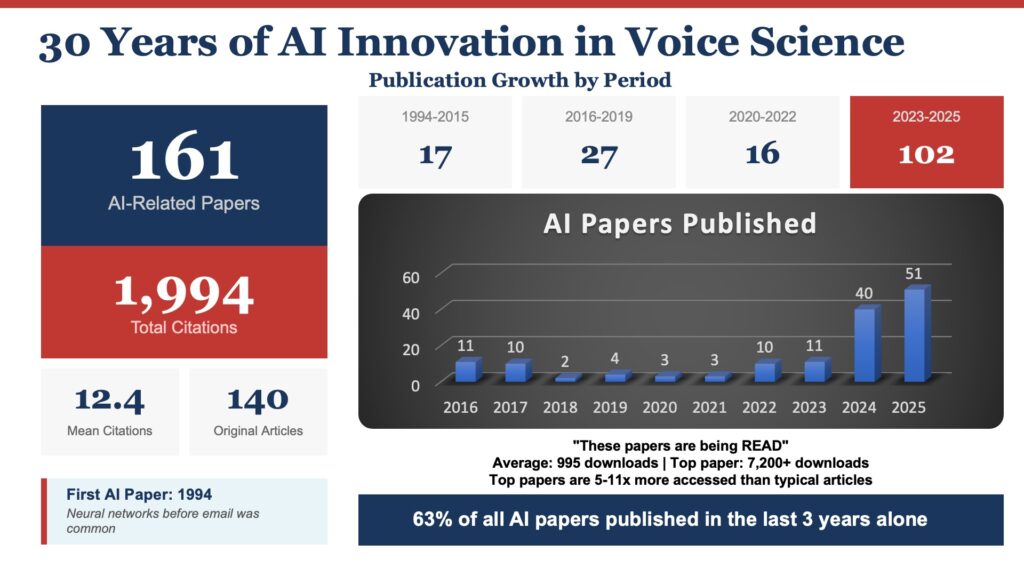
An analysis of publishing trends reveals a staggering acceleration: of the 161 AI-related papers published in the Journal of Voice, 63% have been published in the last three years alone. This white paper explores the historical roots, landmark studies, clinical breakthroughs, and future imperatives of AI in voice science, drawing on insights from institutional leaders and global researchers who are charting the course for the next era of medicine.
Detailed Chronology: Over Three Decades of AI in Voice Science
The trajectory of AI within voice science dispels the myth that machine learning is a recent intruder into medical publishing. Long before the popularization of consumer-facing AI chatbots or cloud-based neural networks, forward-thinking researchers recognized the capability of computational models to process vocal frequencies beyond the limits of human perception.
The Genesis: 1994–2015
The journey began in 1994—the exact same year the World Wide Web entered public consciousness, and when sending an email was still a novelty for many. In that year, the Journal of Voice published a pioneering paper by Rihkanen and colleagues titled "Spectral Pattern Recognition of Improved Voice Quality." Utilizing rudimentary neural networks to analyze voice data, this study proved that computational architecture could categorize and evaluate vocal parameters.
However, progress during the ensuing two decades was deliberate and methodical. Between 1994 and 2015, only 17 AI-focused papers found their way into the journal. Researchers were constrained by processing power, limited datasets, and the nascent state of machine learning algorithms.
The Acceleration: 2016–2022
As computing power expanded and deep learning architectures matured, the pace quickened. From 2016 to 2019, 27 AI papers were published, followed by another 16 papers between 2020 and 2022. During this window, machine learning shifted from a theoretical exercise to a practical diagnostic tool, laying the groundwork for automated pathology detection and early classification models.
The Exponential Explosion: 2023–2025
The current era is characterized by exponential growth. Between 2023 and 2025, 102 AI-related papers were published in the Journal of Voice. In the year 2025 alone, the journal published 51 AI papers—surpassing the total output of the first twenty years combined. This dramatic leap mirrors the broader cultural adoption of AI, but within voice science, it represents something far more functional: the maturation of robust, clinically validated machine learning applications.
Supporting Context & Metrics: Real-World Impact and Global Reach
Academic citations are often treated as insulated metrics of prestige, but in the realm of medical science, high engagement signals a desperate clinical demand for practical tools. The AI research published in the Journal of Voice is not sitting dormant in digital archives; it is being actively consumed, downloaded, and applied by clinicians, speech-language pathologists, and researchers worldwide.
Download and Readership Metrics
High-Volume Access: The average AI paper published in the Journal of Voice has been downloaded nearly 1,000 times.
The Pandemic Sentinel: The single most-accessed AI paper—a study investigating machine learning models for COVID-19 detection—has amassed over 7,200 downloads, outperforming the median article in its issue by a factor of eleven.
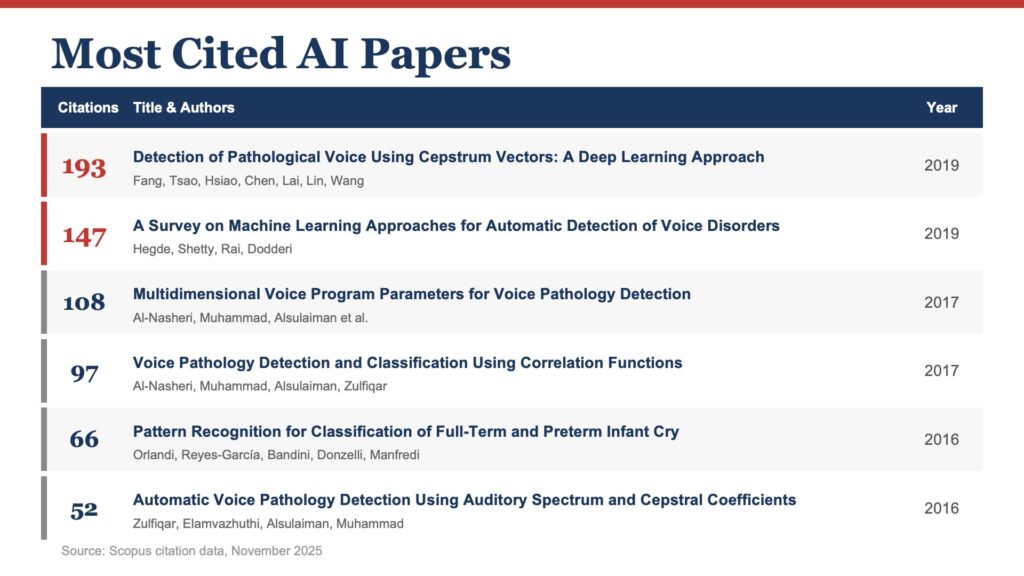
Citations as Clinical Tools: The top-cited papers, including Fang and colleagues’ deep learning study (193 citations) and Hegde’s machine learning survey (147 citations), have each approached nearly 5,000 downloads. These metrics highlight an active global network of medical professionals seeking computational solutions to improve patient outcomes.
Landmark Research Reshaping the Field
1. Deep Learning for Voice Pathology Detection
In 2019, Fang and colleagues published "Detection of Pathological Voice Using Cepstrum Vectors: A Deep Learning Approach," which has since become the most-cited AI paper in the journal’s history. The study demonstrated that deep neural networks could spot voice pathologies with exceptional accuracy by analyzing acoustic features imperceptible to the human ear.
This was complemented by Hegde’s comprehensive survey on machine learning for voice disorder detection (147 citations) and critical contributions from Al-Nasheri and colleagues on multidimensional voice parameters. Subsequent innovations by Chen and Chen (deep neural networks for classification), Fujimura (one-dimensional convolutional neural networks), and Cho and Choi (laryngoscopic image analysis via CNNs) have continuously pushed the boundaries of diagnostic precision.
2. Voice as a Digital Biomarker
Perhaps the most paradigm-shifting development in recent years is the conceptualization of the human voice as a digital biomarker—a non-invasive window into systemic health.
Neurological Monitoring: Groundbreaking work has focused on using vocal analysis to detect and monitor the progression of Parkinson’s disease. Hemmerling and Wójcik-Pędziwiatr’s 2022 paper on predicting Parkinson’s severity from voice signals has garnered significant attention, bridging the gap between acoustic telemetry and neurology.
Mental Health and Psychiatry: Recent systematic reviews explore voice quality as an indicator of depression and bipolar disorder. The clinical implications are profound: routine acoustic screenings could flag mental health shifts early, facilitating timely interventions and easing the burden on overstretched psychiatric healthcare systems.
Respiratory Health: Machine learning applications designed to assess COVID-19 and other pulmonary ailments from vocal resonance continue to validate the voice as an overarching sentinel of bodily wellness.
3. AI Chatbots in Clinical Practice
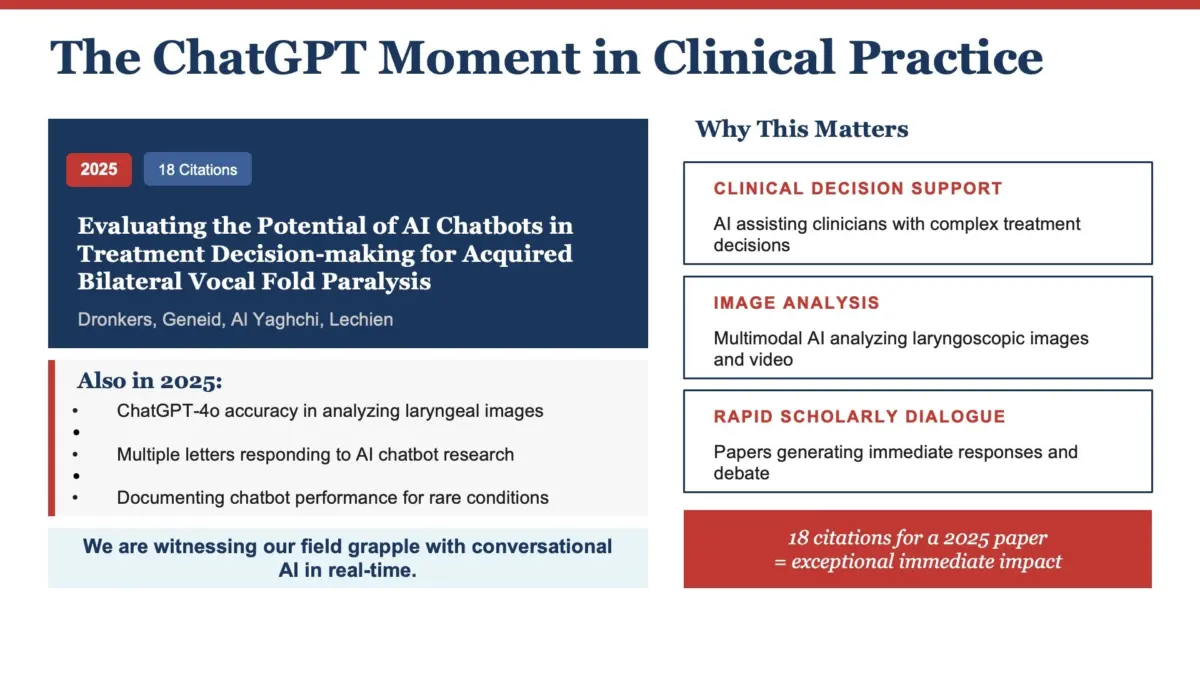
The year 2025 marked another milestone with the publication of research investigating conversational AI and clinical decision-making. Dronkers and colleagues’ paper, "Evaluating the Potential of AI Chatbots in Treatment Decision-making for Acquired Bilateral Vocal Fold Paralysis," accumulated 18 citations within months of publication—an extraordinary velocity for scholarly impact. Coupled with concurrent studies analyzing ChatGPT-4o’s accuracy in evaluating laryngeal images, the medical community is actively navigating the integration of conversational agents into clinical workflows.
Official Statements & Expert Perspectives
To understand the human and institutional dimensions of this technological shift, industry leaders emphasize the need for a balanced approach that pairs technological enthusiasm with ethical clarity.
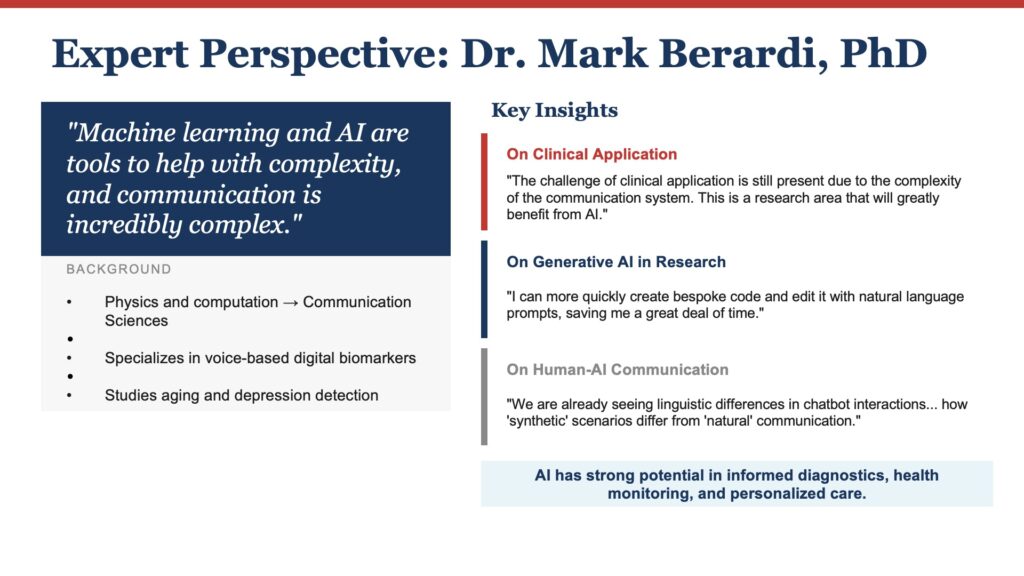
Dr. Mark Berardi: Managing Complexity and Synthetic Communication
Drawing from a background in physics and computation, Dr. Mark Berardi views artificial intelligence primarily as an instrument for mastering complexity.
"Machine learning and AI are tools to help with complexity, and communication is incredibly complex in its neurobiological and physiological processes. So I think the application is warranted."
Dr. Berardi’s research centers on voice-based digital biomarkers for aging and depression. While acquiring vocal signals has become straightforward, he notes that the true obstacle lies within the intricate nature of the human communication apparatus—the exact domain where AI excels.
On the topic of generative AI, Dr. Berardi offers a pragmatic appraisal. While it has not completely rewritten foundational research methodologies overnight, it has effectively dissolved traditional bottlenecks in coding and data processing. Researchers can now author bespoke scripts and refine them via natural language prompts.
Intriguingly, Dr. Berardi’s work also extends to human-AI communication itself. As society transitions toward synthetic interaction modalities—such as Zoom calls and chatbot interfaces—linguistic patterns are shifting. Future voice science must account not only for natural human speech, but for how the human voice adapts when conversing with machines.
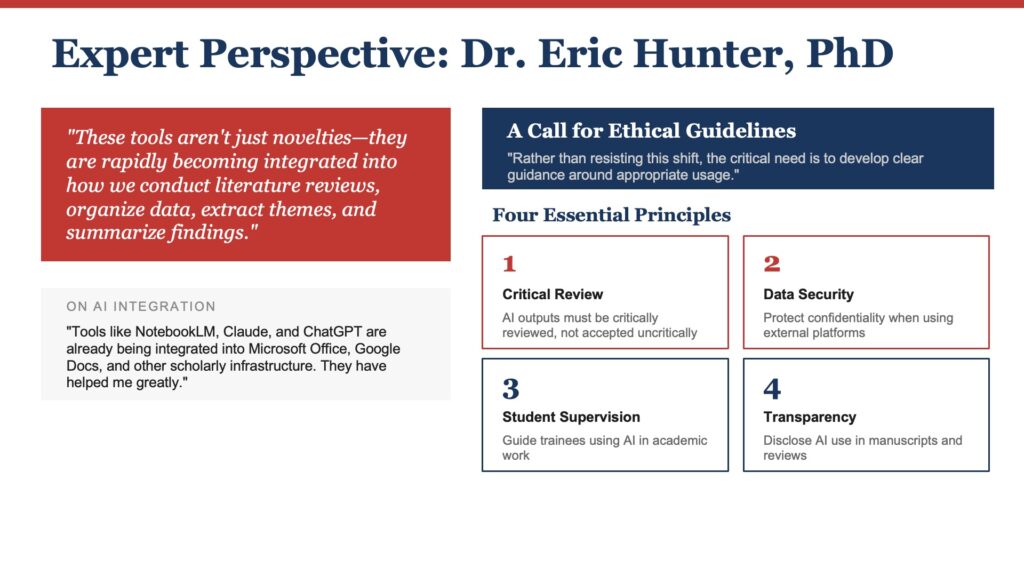
Dr. Eric Hunter: Embracing Change with Ethical Clarity
Dr. Eric Hunter directs attention to the institutional and academic realities of the AI revolution.
"These tools aren’t just novelties. They are rapidly becoming integrated into how we conduct literature reviews, organize data, extract themes from large bodies of text, and even summarize findings."
Dr. Hunter argues that large language models and AI-driven platforms are permanently embedded in modern academic workflows, from manuscript preparation to peer review. Rather than pushing back against an irreversible current, he emphasizes the urgent need to establish transparent guidelines for usage. He outlines four foundational pillars for ethical academic integration:
Transparency in methodology and tool utilization.
Uncompromising human accountability for all published findings.
Rigorous data privacy and ethical stewardship.
Protection against algorithmic bias in diagnostic datasets.
"Our field will benefit most," Dr. Hunter concludes, "if we embrace the productivity these tools offer while also building a shared ethical framework for their responsible use."
A Global Research Community
The momentum behind this scientific renaissance is driven by a decentralized, global coalition. Leading contributors to the Journal of Voice include international authorities such as Jérôme René Lechien, Dimitar Deliyski, Stephanie Zacharias, Ahmed Yousef, Paavo Alku, Leonardo Wanderley Lopes, and Maryam Naghibolhosseini. Spanning multiple continents and disciplines, these researchers underscore that AI voice science is a collaborative, global endeavor.
Future Outlook: The Path Forward for Voice Science
As the Journal of Voice and The Voice Foundation look toward the coming decades, the path forward requires deliberate, collective action across three key pillars:
Mindful Engagement: Researchers and clinicians must view AI as an amplifier of human expertise rather than a replacement for clinical judgment. Understanding the precise capabilities and limitations of machine learning models is essential for safe application.
Harmonized Ethics: The creation of a shared ethical framework—as advocated by institutional leaders—cannot be achieved in isolation. It demands cross-disciplinary cooperation among medical boards, academic publishers, and tech developers.
Continuous Discovery: The 161 AI papers published to date represent only the foundation. As clinical trials expand and datasets grow more sophisticated, the next decade will yield diagnostic breakthroughs previously confined to science fiction.
An Extraordinary Moment in Human History
For hundreds of thousands of years, the human voice has served as our primary instrument of connection, emotion, and identity. It bears the invisible signatures of our health, our psychology, and our humanity in a manner matched by no other physiological output.
Today, for the first time in history, humanity possesses computational tools sophisticated enough to decode that complexity. These systems promise to extend the reach of expert clinicians, catch subtle pathologies before they manifest as critical illnesses, and democratize access to high-quality voice care across the globe.
The Voice Foundation and the Journal of Voice stand proudly at the center of this transformation. As we step across this sonic frontier, the next decade promises discoveries that will forever alter our understanding of the human voice and the medicine that sustains it.
About the Author: Ian DeNolfo is Executive Director of The Voice Foundation, which publishes the Journal of Voice. A graduate of The Juilliard School and The Curtis Institute of Music, he formerly performed as a leading tenor at opera houses worldwide before transitioning to arts administration and scientific leadership at The Voice Foundation.