
Executive Overview
As the winter frost settles and households worldwide begin preparing for the holiday season, music educators and performers alike turn their attention to the timeless melodies that define the festivities. Among the most cherished of these holiday compositions is "The First Noel"—alternatively spelled "The First Nowell"—a traditional Cornish Christmas carol steeped in centuries of musical and cultural heritage.
In a major resource release for pianists of all skill levels, Ben Dunnett LRSM, founder of the Music Theory Academy, composer, and veteran music educator with over two decades of experience, has unveiled a comprehensive suite of learning materials. This release features three distinct piano arrangements of "The First Noel," meticulously graded to cater to novice players, intermediate students, and advanced performers seeking a professional-grade challenge.
Derived in part from Dunnett’s acclaimed holiday piano album, 10 Christmas Carols, this new educational package combines high-definition video demonstrations, downloadable PDF sheet music, and insightful technical guidance. Designed to bridge the gap between amateur enthusiasm and professional execution, the release offers an authoritative yet accessible roadmap for mastering one of Western music’s most enduring traditional carols. This article provides an in-depth review of the arrangements, explores the rich history and lyrical narrative of the carol, and outlines pedagogical strategies for tackling each tier of the newly published sheet music.
Detailed Chronology: From Cornish Tradition to Modern Piano Mastery
To fully appreciate the pedagogical significance of Dunnett’s new arrangements, one must understand the historical trajectory of "The First Noel" and the developmental milestones that led to the creation of this comprehensive learning package.
The Origins and Evolution of the Carol
Dating back to the 16th or 17th century—and potentially rooted even earlier in Cornish oral tradition—"The First Noel" captures the quintessential narrative of the Christian Nativity. First published in William Sandys’ 1833 collection, Christmas Carols Ancient and Modern, the tune possesses a uniquely modal, hypnotic quality characterized by its descending scale passages and repetitive, comforting refrain. Unlike many composed carols of the Victorian era, "The First Noel" belongs to the folk tradition, meaning it was shaped by generations of singers before being transcribed into formal notation.
The Conceptualization of the Three-Tiered Approach
Recognizing the wide disparity in technical abilities among pianists who wish to perform seasonal repertoire during the winter holidays, Ben Dunnett conceptualized a multi-tiered educational framework. Rather than offering a single, one-size-fits-all arrangement—which often alienates beginners or bores advanced players—Dunnett engineered three distinct versions that preserve the core harmonic and melodic integrity of the Cornish tune while scaling the technical demands accordingly.
- The Developmental Phase: The project began with the recording and publication of Dunnett’s professional Christmas album, 10 Christmas Carols, which featured the advanced arrangement.
- The Adaptation Phase: To make the music accessible to a broader audience, Dunnett stripped away dense harmonic colorations and complex countermelodies to create a clean, highly approachable easy piano version complete with explicit fingerings.
- The Bridging Phase: Recognizing the vast chasm between beginner and advanced playing, an intermediate version was introduced. This version enriches the harmonic texture and introduces expressive techniques like spread chords while intentionally omitting printed fingerings to encourage independent problem-solving.
- The Digital Release: The final suite was launched via the Music Theory Academy platform, accompanied by multimedia resources including embedded YouTube performances, high-resolution sheet music previews, and direct PDF downloads.
Supporting Context & Metrics: Analyzing the Arrangements
A close examination of the three piano versions reveals a thoughtful pedagogical progression. Each tier is constructed to target specific technical competencies, ensuring that pianists experience measurable skill development as they learn the piece.
| Arrangement Tier | Primary Target Audience | Key Technical Features | Pedagogical Objective |
|---|---|---|---|
| Easy Version | Novice / Beginner | Single-note right-hand melody, simple bassline, explicit fingering guides. | Master fundamental hand positioning, thumb-tucking in scale passages, and basic rhythm. |
| Intermediate Version | Developing Students | Enriched right-hand harmonies, left-hand spread chords near the cadence. | Cultivate independent fingering problem-solving and manage broader hand spans. |
| Advanced Version | Advanced Pianists | Complex counterpoint, rich chordal voicing, expressive rubato opportunities. | Deliver a concert-ready performance piece suitable for professional recitals or recordings. |
1. The Easy Piano Arrangement: Building Foundational Mechanics
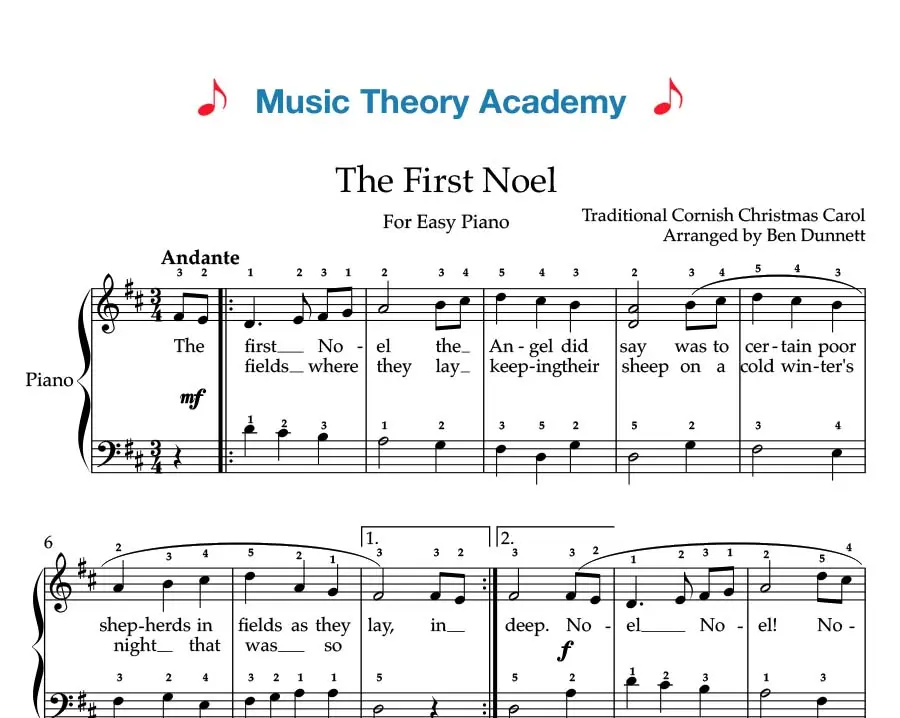
The easy version of "The First Noel" focuses heavily on the primary melody line carried in the right hand, underpinned by a sparse, supportive bassline in the left. Because the carol features extended scalar movements—particularly recalling its traditional Cornish folk roots—Dunnett has embedded precise fingering annotations throughout the score.
For the novice pianist, mastering these fingering cues is essential. Particular attention is drawn to the execution of thumb-tucks during scalic passages, a fundamental piano technique that prevents awkward hand bunching and ensures a smooth, legato phrasing. By keeping the left hand relatively static, the player can concentrate fully on right-hand finger independence and rhythmic consistency.
2. The Intermediate Piano Arrangement: Expanding Harmonic Awareness
Stepping up to the intermediate tier, the arrangement introduces a richer sonic palette. While the core melody remains recognizable, Dunnett weaves additional notes into the right-hand texture to flesh out the underlying harmonies, transforming a simple tune into a full-bodied piano texture.
A notable technical challenge in this version occurs near the conclusion of the piece, where the left hand must execute a spread chord. This requires spatial awareness and wrist flexibility to span the keyboard gracefully without introducing unwanted tension. Significantly, Dunnett has left the fingering blank on this version. This editorial choice serves a vital educational purpose: intermediate players are encouraged to analyze the harmonic structures and physical geography of the keyboard independently, determining the most efficient fingering strategies for their unique hand sizes.
3. The Advanced Piano Arrangement: Concert-Level Artistry
Culminating in the professional arrangement featured on Dunnett’s album 10 Christmas Carols, the advanced version is designed to test the mettle of seasoned pianists. This version exhibits sophisticated voicing, intricate rhythmic interplay between the hands, and a lush harmonic language that elevates the traditional carol into an engaging concert piece.

Pianists tackling this advanced score are strongly encouraged to study the accompanying audio-visual performance—available via YouTube and major streaming platforms like Spotify—while following along with the sheet music. Observing the subtle rubato, dynamic shading, and pedal work demonstrated in the professional recording provides invaluable context that standard notation alone cannot fully convey.
Official Statements and Pedagogical Philosophy
Ben Dunnett LRSM has long advocated for an inclusive, structured approach to music education. Speaking on the philosophy behind the release of these arrangements, Dunnett emphasized the importance of tailoring repertoire to individual learning curves.
"When educators approach seasonal music, the goal should never be to overwhelm the student, nor should it underestimate their potential," Dunnett explains. "‘The First Noel’ is a magnificent piece of traditional music with a melody that resonates deeply with listeners. By breaking it down into easy, intermediate, and advanced iterations, we ensure that every pianist—whether they are playing their very first holiday recital or performing professionally on stage—can engage meaningfully with the material."
Dunnett’s extensive background as a music examiner and teacher heavily informs the design of these scores. By intentionally providing fingerings for the beginner to establish safe biomechanical habits, while withholding them from the intermediate student to foster critical thinking, the resource acts as a virtual masterclass in self-directed learning.
Furthermore, the integration of multimedia elements reflects a modern educational standard. In an era where digital literacy intersects with artistic training, pairing printable PDF sheet music with high-definition video demonstrations accommodates both visual and auditory learners, ensuring a holistic educational experience.
The Narrative Core: Lyrical Context of "The First Noel"
To deliver a truly expressive musical performance, instrumentalists must always understand the story behind the notes. "The First Noel" is fundamentally a narrative song, structured to guide the listener step-by-step through the biblical Nativity story. Reviewing the lyrics reveals the dramatic arc that should inform the dynamic shaping of the piano performance:
The first Noel the angel did say
Was to certain poor shepherds in fields as they lay;
In fields where they lay, keeping their sheep,
On a cold winter’s night that was so deep:

[Refrain]
Nowell, Nowell, Nowell, Nowell,
Born is the King of Israel.

They looked up and saw a star
Shining in the east beyond them far;
And to the earth it gave great light,
And so it continued both day and night.

And by the light of that same star
Three wise men came from country far;
To seek for a king was their intent,
And to follow the star wherever it went.
As the narrative progresses—from the humble shepherds shivering in the dark winter fields, to the sudden illumination of the celestial star, and finally to the arrival of the three wise men bearing gifts of gold, myrrh, and frankincense—the dynamic contour of the piano arrangement must reflect these emotional shifts. An astute pianist will use the structural cues of the music to mirror the storytelling: building tension during the ascent of the star motif, and resolving into a warm, reverent tone as the Magi present their offerings.
The enduring cultural footprint of the carol is further underscored by its widespread adoption across genres. Over the decades, "The First Noel" has been recorded and re-interpreted by an illustrious array of global superstars, including Whitney Houston, Mariah Carey, and the ensemble cast of the hit television series Glee. This modern crossover appeal proves that while the tune is centuries old, its emotional resonance remains entirely contemporary.
Future Outlook: Seasonal Music Education in the Digital Age
The release of these three distinct piano arrangements of "The First Noel" marks a notable contribution to online music pedagogy. As traditional publishing models continue to shift toward hybrid digital platforms, resources that offer immediate access to multi-tiered sheet music, professional audio recordings, and expert video instruction are setting a new benchmark for music students worldwide.
Looking ahead, initiatives like the Music Theory Academy’s holiday sheet music collection point toward a more flexible, personalized future for instrumental education. By removing geographical and financial barriers to high-quality instructional materials, educators can empower students to curate their own learning experiences based on personal interest and technical readiness.
For pianists eager to enrich their holiday repertoire this season, the path forward is clear. Whether starting with the gentle, fingered scales of the easy arrangement, navigating the harmonic shifts of the intermediate version, or mastering the concert-level voicing of the advanced album track, "The First Noel" offers a rewarding challenge for every hand at the keyboard.
To view the video performance, explore additional educational resources, and download the free PDF sheet music for your respective skill level, visit the official Music Theory Academy platform.