
Executive Overview
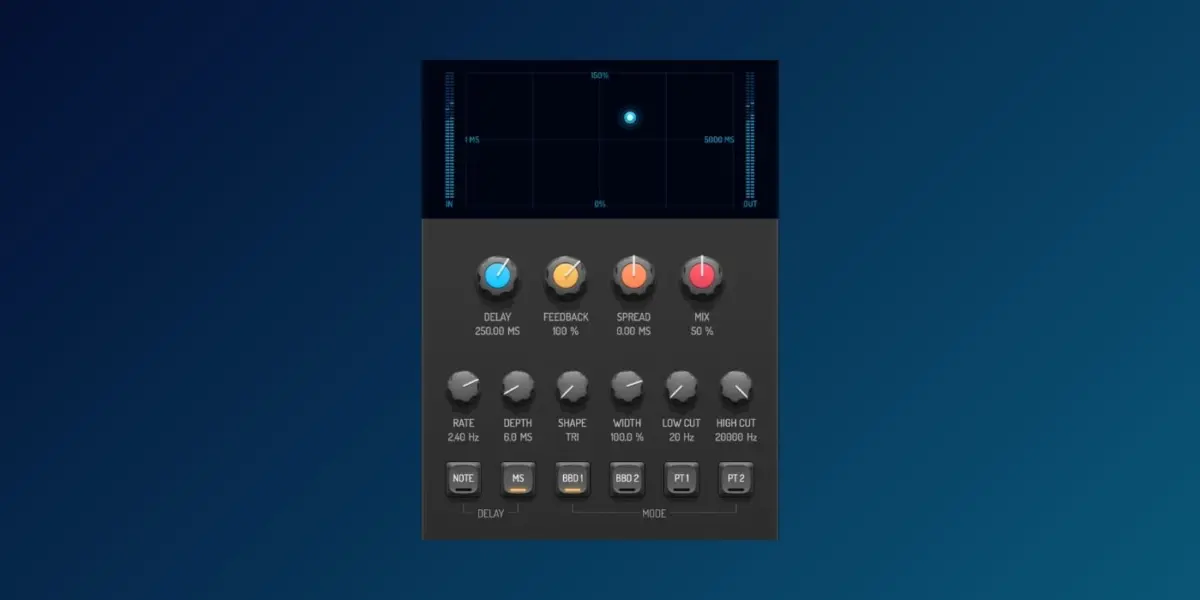
The intersection of nostalgic analog imperfection and modern software design has long been a fertile ground for audio software developers. In this crowded marketplace, developer Bjango has carved out a distinctive niche by prioritizing visual clarity, ergonomic user experience, and privacy-centric software engineering. Following a succession of well-received releases—such as their Robot Vowels plugin—Bjango has officially introduced Buckets And Decay, a versatile time-based and modulation effect processor available for macOS and Windows.
Priced at $49 (plus applicable taxes), Buckets And Decay is not merely another algorithmic delay. Instead, it bridges two distinct eras of hardware signal processing by fusing traditional Analog Bucket Brigade Device (BBD) circuitry with the distinctively gritty, lo-fi characteristics of the PT2399 digital echo processor. Capable of producing lush chorus, sweeping flangers, undulating vibratos, and deep, atmospheric echoes, the plugin is engineered to provide producers and sound designers with an expansive palette of vintage-inspired textures.
To celebrate the launch, Bjango has partnered with Bedroom Producers Blog (BPB) to offer an exclusive giveaway of five full software licenses to the reader community. Beyond the giveaway, the release underscores a broader industry shift: users increasingly demand deeply characterful, hardware-emulated plugins that do not compromise on CPU efficiency, modern multi-platform compatibility, or user privacy—eschewing aggressive telemetry, analytics trackers, and annoying authorization dongles in favor of streamlined, artist-friendly licensing.
Detailed Chronology: From Concept to Release
The Evolution of Bjango’s Audio Software Ecosystem
Bjango’s journey into the audio plug-in market has been characterized by meticulous attention to interface design and sonic utility. Known historically for their work in utility and design systems, the development team brought a high-end graphic design sensibility to audio production tools. Previous releases, including Robot Vowels, established the brand’s reputation for crafting plugins that are both visually striking and immediately intuitive to operate.
The conceptualization of Buckets And Decay began as an exploration into why certain hardware chips retain such a devoted following decades after their commercial prime. Rather than modeling a single, specific legendary stompbox or rackmount unit—a common trope in modern plugin design—Bjango opted for a modular architecture that isolates the core sonic signatures of two distinct technological families: the 1970s/1980s analog BBD chip and the ubiquitous, karaoke-derived PT2399 digital echo chip.
Development and Architectural Design
During the development phase, the engineering team focused on capturing the nonlinearities inherent in these legacy chips. Analog BBD lines, by their very nature, suffer from high-frequency attenuation, clock noise, and progressive signal degradation as the delay time increases. Conversely, the PT2399 chip—originally designed for consumer audio applications like digital voice echoes and home karaoke machines—achieved legendary status among DIY pedal builders and boutique guitar effect manufacturers due to its wide bandwidth limitations, distinct harmonic distortion, and gritty clock artifacts when pushed past its intended parameters.
By combining two distinct BBD models with two distinct PT2399 models under a single hood, Bjango created a hybrid engine. This allows users to sweep through a continuum of sound: from the pristine, warm, organic roll-off of vintage analog delay lines to the industrial, crunchy, and unstable repeats characteristic of circuit-bent digital echoes.
Upon finalization, the plugin was engineered to meet modern platform standards, rolling out simultaneously as an AUv3 plugin for macOS 14 and higher, and as a VST3 plugin supporting macOS 13+ and Windows 10+.
Supporting Context & Metrics: Decoding the Hardware Architecture
To understand the value proposition of Buckets And Decay, one must examine the underlying hardware topologies that inspired its design. The plugin’s architecture relies heavily on two specific technological paradigms that defined decades of recorded music.
1. Analog Bucket Brigade Devices (BBDs)
Introduced in the 1970s, BBD integrated circuits revolutionized analog delay and modulation effects. Before the advent of affordable digital random-access memory (RAM), achieving a time delay in an analog circuit required passing an audio signal through a long series of capacitive storage stages. Driven by an electronic clock, the "bucket brigade" metaphor literalizes how electric charge is passed down the line from one capacitor stage to the next.
- Sonic Characteristics: BBD chips are universally celebrated for their warm, dark repeats. Because each step in the chain introduces minute fidelity losses, high frequencies naturally roll off with every pass through the feedback loop. This prevents delays from cluttering the high-end space of a mix.
- Applications: Famous units like the Electro-Harmonix Memory Man, Boss DM-2, and various vintage chorus units (such as the Roland Dimension D or Boss CE-1) relied on BBD architecture to deliver lush, shimmering choruses, metallic flangers, and moody, atmospheric echoes.
2. The PT2399 Digital Echo Processor
Developed primarily as a single-chip CMOS echo audio processor for consumer entertainment markets (like karaoke systems), the Princeton Technology Corporation PT2399 became an unexpected darling of the modern DIY audio and boutique pedal community.
- Sonic Characteristics: Unlike pure analog circuits, the PT2399 converts the input signal into a digital stream, stores it in internal RAM, and clocks it back out through a digital-to-analog converter. However, its low-cost design introduces distinct quirks: when delay times are pushed to their maximum limits, clock noise, aliasing, and a gritty, lo-fi distortion become prominent features of the sound.
- Applications: The PT2399 powers countless modern indie-rock guitar pedals, tabletop noise boxes, and experimental delay units prized for their gritty, decayed character and capacity for wild self-oscillation.
Comprehensive Feature Matrix of Buckets And Decay
| Feature Category | Specifications & Capabilities |
|---|---|
| Delay Engine | Hybrid architecture featuring 2x BBD models and 2x PT2399 models. |
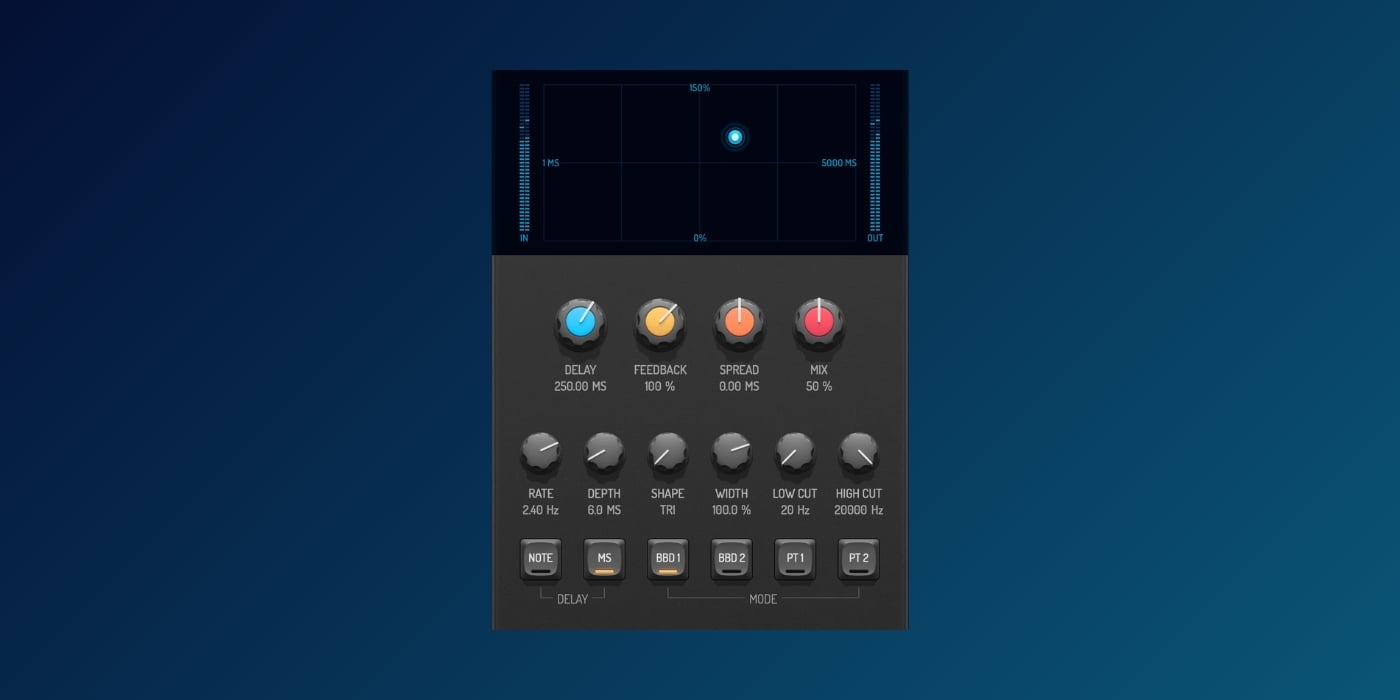
| Time Range | 1 ms to 5 seconds; fully switchable between free-running milliseconds and DAW tempo-sync. |
| Modulation Section | Dedicated Rate, Depth, and Shape controls; LFO waveforms include Triangle, Sine, Square, and Smooth Random. |
| Stereo Processing | Integrated Spread control to offset left and right delay times for expansive stereo imaging. |
| Filtering & Shaping | Onboard Low and High-cut filters for wet signal contouring. |
| Feedback & Dynamics | Continuous Feedback control capable of smooth repeats and chaotic self-oscillation. |
| Mix & Routing | Dry/Wet blend control transitioning seamlessly from subtle doubling/chorusing to full wet vibrato/delay. |
| Plugin Formats | AUv3 (macOS 14+), VST3 (macOS 13+, Windows 10+). |
| Licensing & Pricing | $49 USD (plus tax); includes all 1.x updates; 30-day fully functional free trial available. |
Official Statements and Developer Philosophy
Bjango has consistently championed a user-centric ethos that stands in stark contrast to the modern software industry’s obsession with invasive telemetry, mandatory cloud connection managers, and intrusive copy-protection schemes.
When discussing the release of Buckets And Decay, the company reiterated its steadfast commitment to user privacy and frictionless user experiences:
"When you purchase our plugins, all version 1.x updates are included at no additional cost. Furthermore, Bjango plugins are strictly privacy-focused. There are zero ads, zero analytics, and absolutely no creepy background tracking or telemetry."
This philosophy extends to the software’s operational footprint. By avoiding heavy proprietary authorization managers that require constant internet verification, Bjango ensures that studio engineers, mobile producers, and live performers can rely on their tools without unexpected authorization hurdles.
Industry reception has mirrored this positive sentiment. Tomislav Zlatic of Bedroom Producers Blog noted the unique appeal of the developer’s output:
"We have already run a few Bjango giveaways on BPB, and I really like their software. Their plugins look great, I love the crisp interface design, and they are also fun to use, so I am happy to share this one with BPB readers."
Future Outlook: The Intersection of Vintage Emulation and Modern Workflow
The launch of Buckets And Decay reflects a mature phase in the audio software market. Producers no longer have to choose between the pristine clinical accuracy of digital delay plugins and the maintenance nightmares of fragile, aging vintage hardware. Hybrid processors that synthesize multiple legacy technologies into cohesive, modern interfaces represent the cutting edge of music production tooling.
As software developers look toward the future, several trends illuminated by Bjango’s release are likely to shape the industry:
- Prioritizing Interface Ergonomics: The democratization of digital audio has led to feature bloat, where plugins attempt to do everything and end up overwhelming the user. Bjango’s focus on crisp, legible vector interfaces and immediate parameter accessibility demonstrates that restrained, thoughtful UI design is a major competitive advantage.
- Ethical Software Licensing: As consumer awareness regarding data privacy grows, software companies that reject aggressive tracking and simplify licensing terms are cultivating fiercely loyal user communities. Bjango’s transparent, no-telemetry stance serves as a blueprint for sustainable independent software development.
- Deep Circuit Hybrids: Rather than chasing strict, single-unit emulations, developers are increasingly combining disparate hardware lineages. By marrying the smooth, dark musicality of BBDs with the raw, industrial grit of PT2399 chips, plugins like Buckets And Decay offer hybrid sonic palettes that were physically impossible to achieve within a single vintage hardware box.
The BPB Giveaway Details
For readers looking to secure a copy of Buckets And Decay ($49 value) free of charge, the official partnership giveaway is currently live on Bedroom Producers Blog.
- How to Enter: Participants must leave a comment on the official BPB announcement page answering the question: "Do you have any favorite hardware FX unit (owned or on your wishlist)?"
- Selection Process: Five winners will be chosen at random from the qualifying comments.
- Announcement Date: The winners will be publicly announced on the BPB website on August 20th.
For those not participating in the giveaway—or who wish to test the waters before purchasing—Bjango provides a comprehensive 30-day free trial directly through their official website, allowing producers to evaluate how the plugin’s hybrid BBD and PT2399 delay models integrate into their existing production templates and mixing workflows.