
Executive Overview
In a dramatic illustration of how intensifying climate impacts are increasingly disrupting the performing arts, The Santa Fe Opera was forced to cancel two consecutive mainstage performances—Giacomo Puccini’s Madama Butterfly on August 10 and George Frideric Handel’s Rodelinda on August 11—due to dangerously degraded air quality. The toxic smoke, generated by the nearby Frijoles Fire burning in the mountains north of Santa Fe, blanketed the open-air Crosby Theatre, creating immediate health hazards for patrons, musicians, choristers, principal artists, and backstage production crews.
For an institution internationally renowned for its breathtaking open-air architecture, where the starry New Mexico night sky and sweeping desert vistas form an integral part of the aesthetic experience, the reliance on unconditioned outdoor air is both a signature charm and a distinct operational vulnerability. The sudden closures underscore a growing crisis for open-air amphitheaters across the American West, where lengthening wildfire seasons, fueled by prolonged drought and rising global temperatures, increasingly threaten the summer cultural calendar.
Behind the picturesque twilight performances lies a complex logistical and financial challenge. Canceling major opera productions at the height of the summer festival season triggers a cascade of administrative hurdles, from managing thousands of displaced patrons and processing intricate ticketing resolutions to reassuring artists whose vocal health is directly compromised by fine particulate matter. As smoke settled densely into the Rio Grande basin and surrounding metro areas, triggering prolonged regional Air Quality Alerts, company leadership scrambled to balance public health mandates with the preservation of the remainder of the 2026 festival schedule.
This comprehensive report examines the sequence of events that led to the weekend cancellations, details the meteorological and environmental factors driving the local air quality crisis, reviews the operational and ticketing policies enacted by the opera administration, and analyzes the broader implications of climate change on the future of open-air performing arts in the American Southwest.
Detailed Chronology of the Weekend Closures
The atmospheric conditions that ultimately paralyzed the Santa Fe Opera’s weekend schedule developed rapidly over the second weekend of August, catching regional weather forecasters and arts administrators alike in a high-stakes monitoring loop.
Friday, August 7 to Saturday, August 8: Monitoring and Escalation
As initial reports of the Frijoles Fire emerged from the higher elevations north of Santa Fe, localized winds initially carried the smoke away from the immediate municipal basin. However, by the afternoon of August 8, shifting atmospheric currents began to funnel heavy plumes southward, trapping a thick, acrid haze in the valleys surrounding the opera house, located just north of the city limits.
Company production managers, safety coordinators, and executive leadership convened emergency briefings to assess air quality index (AQI) readings specific to the Crosby Theatre site. While regional air quality standards fluctuate, the primary concern for performing artists—particularly classical singers whose vocal cords require heavy, continuous inhalation of air—is the concentration of fine particulate matter known as $PM_2.5$. These microscopic pollutants penetrate deep into the respiratory tract and can cause acute inflammation, coughing, hoarseness, and long-term vocal damage.
Sunday, August 10: The Madama Butterfly Cancellation
By the morning of August 10, conditions at the opera grounds had deteriorated past acceptable safety thresholds. Visibility across the Sangre de Cristo foothills was severely restricted, and the distinct smell of burning timber and forest duff permeated the open-air seating bowl.
At approximately 1:00 PM local time, following consultations with meteorological advisors and health officials, Santa Fe Opera general directorate and production teams made the difficult decision to scrap the evening’s highly anticipated performance of Puccini’s sweeping tragedy, Madama Butterfly.
Patrons who had traveled from across the United States and abroad for the summer festival were met with urgent email notifications, social media alerts, and front-of-house notices. While many expressed immediate disappointment, widespread understanding prevailed as the dense, yellowish-grey pall hung visibly over the box office and parking terraces.
Monday, August 11: The Rodelina Cancellation
Hopes that overnight weather patterns might scour the basin clean were dashed by Monday morning. National Weather Service and local environmental monitoring stations extended regional Air Quality Alerts, noting that thermal inversions were trapping the Frijoles Fire smoke squarely over the Santa Fe metro area and surrounding locations.
With $PM_2.5$ levels remaining well into the "Unhealthy" or "Very Unhealthy" brackets for sensitive groups—and presenting clear hazards for strenuous physical activity such as operatic singing—leadership recognized that holding a performance would be untenable. At mid-day on August 11, the company announced the cancellation of Handel’s baroque masterwork, Rodelinda.
The back-to-back cancellations marked a rare disruption in the modern history of the summer festival, forcing administrative staff to pivot instantly from artistic presentation to crisis communications, customer service operations, and logistical readjustments for the upcoming week.
Supporting Context & Environmental Metrics
To fully grasp the magnitude of the operational disruption at The Santa Fe Opera, it is essential to examine the environmental data, meteorological mechanics, and architectural context that define the venue.
The Frijoles Fire and Regional Airshed Dynamics
The immediate catalyst for the cancellations was the Frijoles Fire, an active wildfire burning in rugged, heavily wooded terrain in the mountains north of Santa Fe. Driven by dry forest fuels and erratic mountain winds, the fire generated massive columns of smoke that drifted directly downwind into the Santa Fe river valley and the surrounding high-desert plateau.
According to bulletins issued by local news outlets and the National Weather Service, meteorological conditions created a classic atmospheric trapping effect. Cold air drainage overnight caused the heavy wildfire smoke to settle directly into the Santa Fe metro area and adjacent low-lying zones, including the arroyo-carved terrain surrounding the Crosby Theatre.
An official Air Quality Alert was enacted and maintained through 10:00 AM on August 12. During this period, municipal monitoring stations recorded elevated concentrations of $PM_2.5$—inhalable particles with diameters of 2.5 micrometers or smaller. These particles are small enough to bypass the body’s natural nasal and upper respiratory filters, entering the alveoli in the lungs and passing directly into the bloodstream, posing severe risks to individuals with asthma, cardiovascular conditions, and chronic respiratory illnesses, as well as placing heavy physical stress on vocal athletes.
The Architectural Dilemma of the Crosby Theatre
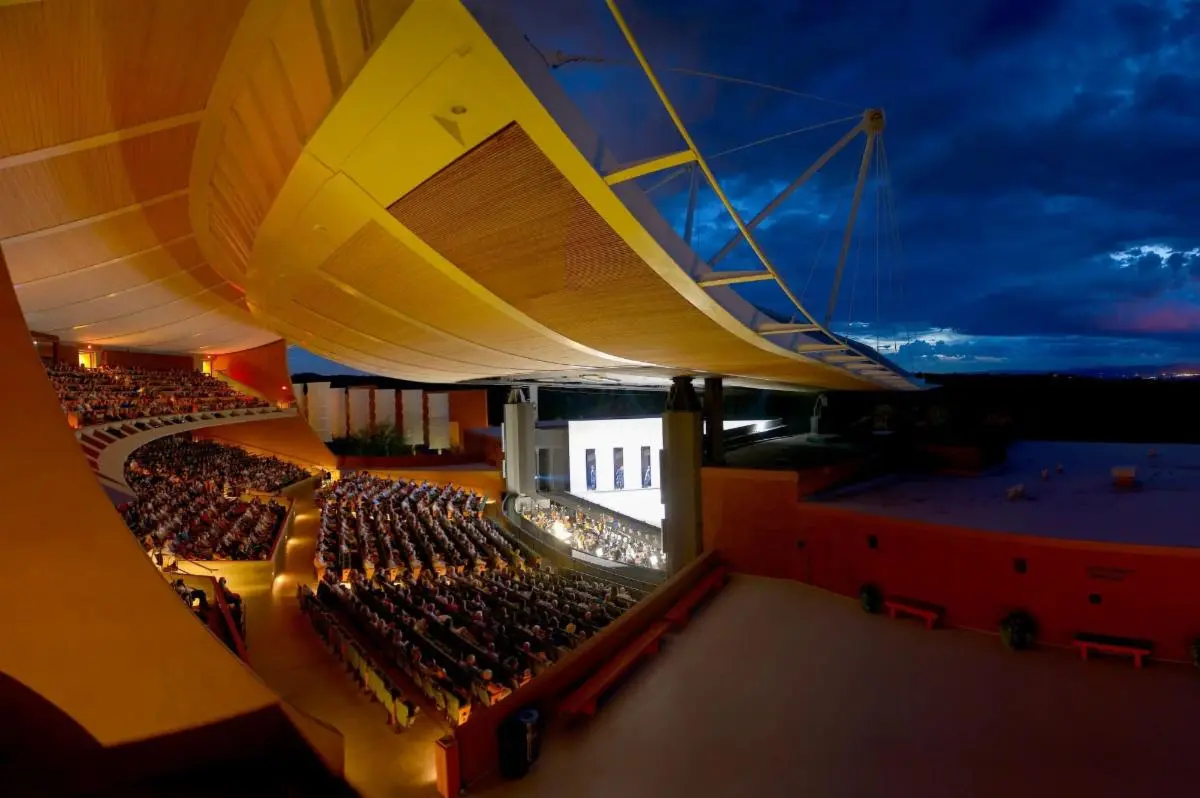
Opened in 1968 and rebuilt in 1998, the Crosby Theatre is an architectural marvel designed specifically to harmonize with its natural environment. Featuring a curving, cantilevered wooden roof that protects audiences and performers from summer rain showers while leaving the sides completely open to the desert air, the venue offers panoramic views of the surrounding mountains.
However, this open-air design, while providing peerless acoustics and a magical connection to the New Mexico landscape, leaves the interior entirely at the mercy of ambient atmospheric conditions. Unlike enclosed opera houses equipped with sophisticated HVAC systems, high-efficiency particulate air (HEPA) filtration, and positive pressure building envelopes, the Crosby Theatre possesses no mechanical barriers against wildfire smoke. When regional air quality degrades, the indoor environment of the theater mirrors the outdoor atmosphere precisely, rendering engineered climate control impossible.
Official Statements and Institutional Response
In the wake of the cancellations, Santa Fe Opera leadership moved swiftly to communicate transparently with artists, staff, and patrons, emphasizing that human health and safety supersede all other operational considerations.
Leadership and Public Statements
In an official statement released via digital channels and social media platforms, including Instagram, the company articulated its core guiding principle:
"The safety of our artists, staff and audience is our highest priority. We appreciate your understanding as we continue to monitor conditions and will share updates as they become available."
The statement reflected an industry-wide shift in how performing arts institutions respond to environmental hazards. In decades past, shows frequently pushed forward despite adverse weather or poor air quality, often to the detriment of performers’ health. Today, driven by heightened awareness of occupational health standards and the increasing frequency of climate-induced disasters, arts organizations are establishing clearer, more conservative thresholds for cancellation.
Comprehensive Ticketing and Patron Relief Options
Recognizing that thousands of patrons invest significant financial resources in travel, lodging, and tickets to attend the Santa Fe Opera’s summer festival, the administrative team established a flexible, multi-tiered remediation policy for ticketholders affected by the August 10 and August 11 cancellations.
Patrons holding tickets for the canceled performances of Madama Butterfly and Rodelinda were given four distinct options:
- Season Exchange: Patrons may exchange their ticket(s) for another evening performance within the current 2026 Season, subject to availability.
- Future Season Exchange: Alternatively, ticketholders can defer their attendance by exchanging tickets for an evening within the upcoming 2027 Season, providing long-term flexibility for out-of-state travelers.
- Charitable Donation: Patrons can choose to donate the total value of their tickets back to the Santa Fe Opera as a tax-deductible charitable contribution, directly supporting the non-profit institution during an economically challenging period.
- Refund or Gift Certificate: Full refunds for the face value of the ticket(s) to the original form of payment are available upon request, or patrons may opt to receive a Gift Certificate equivalent to the full face value for future purchases.
Box office personnel experienced a surge in call volume and digital inquiries following the announcements, but patron relations teams worked around the clock to process exchanges and issue refunds smoothly.
Future Outlook and the Resilience of the Festival
Despite the unprecedented disruption of consecutive cancellations, the operational outlook for the remainder of the summer season remains cautiously optimistic, buoyed by improving weather forecasts and rigorous institutional planning.
Resumption of the Schedule: Eugene Onegin
Following the expiration of the regional Air Quality Alert at 10:00 AM on August 12, meteorological models indicated a favorable shift in wind patterns, allowing smoke to disperse away from the Santa Fe basin. Consequently, The Santa Fe Opera confirmed that it would resume normal operations on the evening of August 12 with a scheduled performance of Pyotr Ilyich Tchaikovsky’s sweeping masterpiece, Eugene Onegin.
Production crews, orchestral musicians, and principal casts returned to the Crosby Theatre stage following morning acoustic checks and health screenings. Management reiterated its commitment to continuous environmental monitoring, ensuring that should smoke conditions flare up again later in the festival run, emergency protocols can be activated with minimal lead time.
The Broader Challenge for Open-Air Arts
The events in Santa Fe serve as a sobering microcosm of a broader, systemic challenge facing the global performing arts community. As climate change increases the frequency, intensity, and duration of wildfire seasons across western North America, southern Europe, and parts of Australia, open-air cultural institutions must adapt their operational models to survive.
Festivals such as the Santa Fe Opera, the Oregon Shakespeare Festival, and various outdoor symphonic and theatrical venues are increasingly forced to invest in advanced meteorological forecasting tools, real-time AQI tracking equipment, and robust financial reserves to absorb the shock of unexpected closures. Furthermore, the crisis highlights the urgent necessity of comprehensive business interruption insurance tailored specifically to environmental hazards—a market that is hardening rapidly as climate risks escalate.
Conclusion
The cancellation of Madama Butterfly and Rodelinda represents a painful chapter in The Santa Fe Opera’s otherwise storied 2026 season, resulting in significant logistical headaches, disappointed audiences, and lost box office revenue. Yet, by prioritizing the immediate health and safety of its artists, workers, and patrons, and by deploying a compassionate, flexible patron support framework, the institution has demonstrated resilience in the face of escalating environmental volatility. As the curtain rises once more on the high-desert stage, the Santa Fe Opera stands as a symbol of both the vulnerability of culture to nature’s fury and the unwavering determination of artists and administrators to keep the music playing against the odds.