
Executive Overview
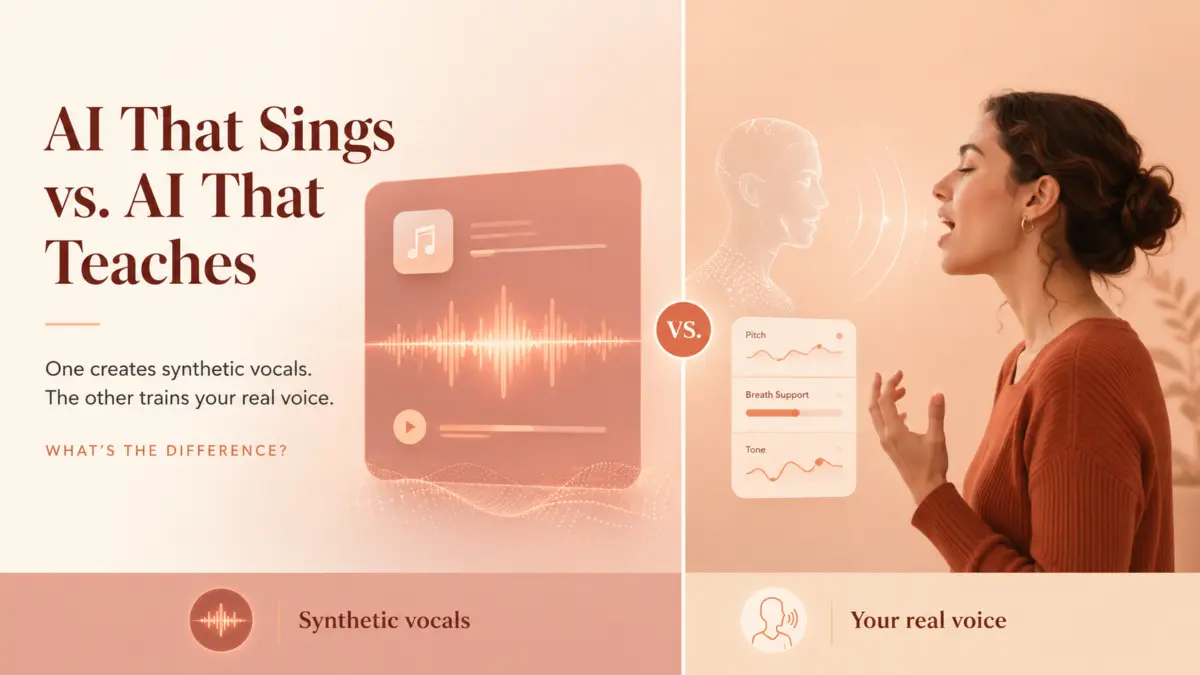
The rapid integration of artificial intelligence into the music industry has generated a profound semantic and functional split. Today, the phrase "AI singing" has come to represent two diametrically opposed technological paradigms. On one side stands generative artificial intelligence—represented by platforms such as Suno, Udio, and various deep-learning voice-cloning technologies—designed to synthesize vocal tracks from text prompts and audio references. On the other side stands analytical and pedagogical AI—exemplified by platforms like Singing Carrots—which acts as a digital vocal coach, analyzing real-time human performance to train and improve the biological voice.
                       ┌─────────────────────────┐
                       │    "AI SINGING" APP     │
                       └────────────┬────────────┘
                                    │
            ┌───────────────────────┴───────────────────────┐
            ▼                                               ▼
┌───────────────────────┐                       ┌───────────────────────┐
│  AI VOICE GENERATORS  │                       │   AI VOCAL COACHES    │
│  (Suno, Udio, etc.)   │                       │  (Singing Carrots)    │
├───────────────────────┤                       ├───────────────────────┤
│ • Replaces human voice│                       │ • Develops human voice│
│ • Output: Audio file  │                       │ • Output: Better user │
│ • Target: Producers   │                       │ • Target: Performers  │
└───────────────────────┘                       └───────────────────────┘
This divide is not merely technical; it is existential. One branch of technology seeks to render human vocal performance obsolete for commercial production, while the other seeks to democratize elite vocal training, making the physical mastery of singing accessible to the masses. For creators, consumers, and software developers, understanding this bifurcation is crucial. Choosing the incorrect class of software leads to wasted capital, frustrated expectations, and a misunderstanding of how artificial intelligence is reshaping human artistic agency.
Detailed Chronology: The Evolution of Voice Tech
The current convergence of these two technologies under a single linguistic umbrella is the result of distinct historical trajectories. To understand how we arrived at this point of confusion, we must trace the development of both analytical and generative audio technologies over the past several decades.
[Pre-2010s] ─────────────────► [Late 2010s] ──────────────► [2023-Present]
Basic Pitch Detection          Algorithmic Pedagogy         Generative AI Explosion
(Auto-Tune, Tuners)            (Real-time DSP, Apps)        (Suno, Udio, Voice Cloning)
Phase 1: The Era of Pitch Detection and Visualizers (Pre-2010s to Mid-2010s)
For years, digital tools for singing were strictly analytical and reactive. The earliest iterations were basic hardware and software pitch detectors used in guitar tuners and early karaoke games like SingStar or Guitar Hero. These systems utilized fundamental frequency ($f_0$) estimation algorithms, such as Autocorrelation or the YIN algorithm, to map a singer’s pitch to a visual interface in real time.
During this era, the concept of an "AI singing app" was synonymous with pitch-tracking software. These tools could tell a user if they were sharp or flat, but they lacked the pedagogical depth to explain why or to structure a curriculum to fix physiological issues.
Phase 2: The Rise of Algorithmic Pedagogy (Late 2010s to Early 2020s)
As machine learning algorithms matured and mobile processing power increased, simple pitch trackers evolved into intelligent training systems. Developers began integrating Digital Signal Processing (DSP) with heuristic models to assess vocal range, identify vocal breaks (passaggi), and track progress over time.
Platforms like Singing Carrots emerged during this period, transforming raw pitch data into actionable educational insights. By analyzing thousands of hours of human vocal exercises, these platforms developed the ability to mimic the diagnostic eye of a human voice teacher—structuring custom vocal workouts, identifying physiological limitations, and offering real-time corrective feedback.
Phase 3: The Generative Explosion (2023 to Present)
The landscape shifted dramatically with the commercialization of generative artificial intelligence. Leveraging diffusion models and transformer architectures originally designed for Large Language Models (LLMs), companies like Suno and Udio introduced systems capable of generating fully realized musical tracks from simple text prompts.
Simultaneously, retrieval-based voice conversion (RVC) and diffusion-based voice cloning allowed users to superimpose the vocal characteristics of any singer—from Drake to Freddie Mercury—onto any audio file.
Suddenly, "AI singing" no longer meant an interactive learning tool; it meant a system that could generate a radio-ready vocal track in seconds, entirely bypassing the human larynx. This rapid technological leap created the current semantic confusion, forcing users and search engines to differentiate between tools designed to replace the singer and those designed to train them.
Supporting Context & Metrics: Synthesizer vs. Coach
To navigate this landscape, it is necessary to examine the technical mechanics, inputs, outputs, and target demographics of both categories.
1. AI Voice Generators (Substitution)
AI voice generators operate on predictive models trained on massive datasets of copyrighted and royalty-free music. These systems do not "sing" in a physiological sense; instead, they convert text and midi data into spectrograms, which are then rendered into playable audio files via neural vocoders.
- Sub-categories:
- Text-to-Song Generators: Platforms like Suno and Udio that generate lyrics, instrumentation, and vocals simultaneously.
- Voice Cloning and Conversion: RVC pipelines that isolate the timber, resonance, and linguistic characteristics of a target voice and apply them to a pre-existing vocal guide track.
- Text-to-Sing Synthesizers: Software that allows composers to type lyrics and enter notes, which are then sung by a synthetic virtual vocalist (e.g., Vocaloid, Synthesizer V).
- Primary Value Proposition: High-speed, low-cost production of vocal assets for demos, video game soundtracks, advertising jingles, and content creation.
2. AI Vocal Coaches (Augmentation)
AI vocal coaches do not generate audio. Instead, they function as analytical mirrors. Using the user’s microphone, the software captures the analog vocal signal, converts it to a digital format, and analyzes its acoustic properties—including pitch accuracy, vibrato rate, spectral centroid (brightness/warmth), and dynamic control.
┌──────────────┐      Analog Audio      ┌──────────────────────┐
│ Human Singer ├───────────────────────►│  Microphone Input    │
└──────────────┘                        └──────────┬───────────┘
                                                   │ Digital Signal
                                                   ▼
┌──────────────┐      Visual Guide      ┌──────────────────────┐
│ User Interface◄───────────────────────┤ Real-Time DSP Engine │
└──────────────┘ └──────────────────────┘- Sub-categories:
- Pitch Trainers: Real-time visual feedback tools that help singers hit precise notes.
- Adaptive Curricular Platforms: Systems that evaluate a user’s vocal range and dynamic limits, adjusting the difficulty of daily exercises based on performance metrics.
- Generative Pedagogical Companions: Advanced platforms that utilize LLMs to explain vocal anatomy, interpret performance data, and offer conversational, customized guidance.
- Primary Value Proposition: Democratic access to vocal technique improvement, confidence building, and physiological development.
Comparative Matrix
| Metric / Feature | AI Voice Generators (e.g., Suno, Udio) | AI Vocal Coaches (e.g., Singing Carrots) |
|---|---|---|
| Core Function | Generates synthetic vocals from text/reference inputs | Analyzes and trains biological human voices |
| User Input Required | Text prompts, lyrics, or guide melodies | Live human vocal performance via microphone |
| Primary Output | A digital audio file (WAV, MP3) | Real-time visual feedback, metrics, and progress tracking |
| Impact on Singer | Bypasses the need for a physical performer | Develops and strengthens the physical performer |
| Key Use Cases | Demos, video soundtracks, advertising, songwriting prototyping | Karaoke prep, professional training, rehabilitation |
| Average Cost Structure | Subscription-based (pay per generation/credit) | Freemium models, subscription-based (pay for training features) |
Performance Metrics: The Efficacy of Algorithmic Pedagogy
The value of generative AI is easily measured in generation speed and rendering quality. However, the efficacy of AI vocal coaches is measured in human behavioral change.
According to published data tracking beginner singers over a seven-month period, structured usage of an AI vocal coach yielded significant, measurable physiological improvements:
PITCH ACCURACY IMPROVEMENT (4-Week Study)
─────────────────────────────────────────────────────────────
Beginner Cohort (No prior training)   │ +16.5% Accuracy Gain
Experienced Cohort                    │  +4.2% Accuracy Gain
─────────────────────────────────────────────────────────────
This data demonstrates that the feedback loop provided by real-time digital signal processing is highly effective for beginners. By providing immediate visual feedback on pitch deviation, the software helps users quickly build the auditory-motor mapping required for accurate singing.

Official Statements and Industry Perspectives
The split between generative and pedagogical AI has sparked intense debate among artists, educators, and legal experts. The two industries face vastly different ethical, legal, and operational realities.
The Generative Controversy: Intellectual Property and Authenticity
Generative AI companies are currently embroiled in high-stakes legal battles. Major record labels, represented by the Recording Industry Association of America (RIAA), have filed lawsuits against Suno and Udio, alleging massive copyright infringement during the training phase of their models.
A prominent intellectual property attorney specializing in music technology recently commented on the situation:
"Generative AI voice platforms are operating in a legal gray area. By training their models on copyrighted vocal tracks without explicit licensing, they have built commercial products that compete directly with the very artists whose work they ingested. This is not just a technological shift; it is an economic conflict over the ownership of vocal identity."
Furthermore, professional session vocalists view generative tools as an existential threat to their livelihoods. When a producer can generate a flawless backing vocal track for pennies using an AI model, the market demand for human session singers inevitably shrinks.
The Pedagogical Defense: Empowering the Human Element
In contrast, vocal pedagogues and academic researchers view AI vocal coaches as valuable allies rather than competitors. Traditional voice lessons are expensive, often costing between $50 and $150 per hour, which prices out many aspiring singers.
A veteran vocal coach and member of the National Association of Teachers of Singing (NATS) shared this perspective:
"An AI vocal coach cannot replace the artistic intuition, emotional guidance, and physiological safety checks of a master human teacher. However, what it can do is democratize daily practice. Most students fail to progress because they practice incorrectly between lessons. An AI tool that monitors their pitch and guides them through structured exercises ensures that their practice hours are productive. It acts as an assistant, not a replacement."
This sentiment is reflected in how users interact with these platforms. Developers at Singing Carrots have noted that users frequently ask their conversational AI guides to simulate training sessions in the style of legendary vocalists. Users do not want the AI to sing for them; they want the AI to teach them how to channel the vocal power of their idols.
Future Outlook: Coexistence or Convergence?
As artificial intelligence continues to evolve, the distinction between generative and pedagogical voice tools will remain a defining feature of the market. Rather than one rendering the other obsolete, we are likely to see a mature ecosystem where both technologies serve distinct human needs.
       FUTURE CONVERGENCE: THE "VOCAL DIGITAL TWIN"
┌─────────────────────────────────────────────────────────┐
│                    AI VOCAL COACH                       │
│  - Analyzes current physical limits                     │
│  - Identifies pitch and resonance flaws                │
└──────────────────────────┬──────────────────────────────┘
                           │
                           ▼
┌─────────────────────────────────────────────────────────┐
│                 GENERATIVE VOICE ENGINE                 │
│  - Clones user's voice                                  │
│  - Generates "Perfect Target Model"                     │
│  - Shows user what they *could* sound like with training│
└─────────────────────────────────────────────────────────┘
1. The Development of "Vocal Digital Twins"
The most promising area of convergence lies in personalized vocal training. Future AI vocal coaches will likely integrate voice-cloning technology to create a "vocal digital twin" of the user.
Instead of training a singer to match an arbitrary pitch or a generic reference file, the AI will clone the user’s voice, process it to remove technical flaws, and generate a personalized "perfect target track." The user will then be trained to match their own optimized synthetic voice. This approach will allow singers to hear their own potential before they have physically developed the muscle memory to achieve it.
2. The Preservation of the Human Experience
Despite the technical perfection of generative music, the human desire to sing remains deeply rooted. Singing is an embodied, physiological act linked to emotional expression, community, and physical well-being. No matter how advanced generative models like Suno or Udio become, they cannot satisfy the internal human drive to perform.
The commercial market for recorded music may continue to integrate synthetic vocals for efficiency and cost reduction. However, live performance, karaoke, community choirs, and personal artistic growth will remain human domains.
Ultimately, generative AI and analytical AI serve two entirely different aspects of the human experience:
- Generative AI satisfies the desire to hear a song.
- Analytical AI satisfies the desire to be the one singing it.
For those who wish to embark on the journey of vocal self-improvement, the digital tools available today are more powerful, precise, and accessible than ever before. The future of voice technology lies not in replacing the human instrument, but in helping us discover its full potential.