
Executive Overview
Music education is universally acknowledged as one of the most creatively fulfilling vocations in the academic sphere, yet it remains intensely demanding. Behind every resonant concert hall performance, flawless marching band drill, and inspired choir recital lies a relentless cycle of administrative tasks, rehearsal management, individual student tracking, and curriculum design. For many educators, the daily reality is a high-speed race against the clock.
Recognizing these systemic pressures, the educational technology platform MakeMusic has rolled out a suite of powerful collaboration and resource-sharing features designed to lighten the load for music teachers worldwide. Whether an educator works within a massive multi-director fine arts department or operates as a lone "department of one" in a rural district, the latest updates to MakeMusic Cloud aim to bridge the gap between isolation and community.
At the forefront of these innovations are two primary developments: a robust Co-Teaching feature that allows multiple instructors to manage a single ensemble seamlessly, and a peer-to-peer Assignment-Sharing protocol that eliminates the redundant creation of quizzes, theory assessments, and instructional materials. By dismantling the administrative silos that have historically plagued music departments, MakeMusic is fostering a more interconnected, sustainable ecosystem for instructors and students alike.
Detailed Chronology: The Evolution of Collaborative Music Tech
The journey toward integrated digital collaboration in music classrooms has accelerated rapidly over the past decade, shifting from isolated software applications to cloud-connected, synchronized ecosystems.
Phase 1: The Era of Digital Isolation (Early 2010s)
In the early days of digital music notation and assessment software, programs operated largely on standalone desktop licenses or basic web architectures. While these tools offered immense value for playback and notation, teachers remained trapped in local silos. If a high school had two band directors, they frequently had to share a single master login or manually reconcile student grades and assignment entries across separate spreadsheets. Collaboration was limited to physical flash drives and printed lesson plans.
Phase 2: The Shift to Cloud-Based Platforms (Mid-to-Late 2010s)
As educational infrastructure migrated to the cloud, platforms like MakeMusic Cloud (formerly SmartMusic) enabled students to submit assignments remotely and receive automated feedback. However, instructor-to-instructor collaboration remained an afterthought. Teachers could view their own rosters, but cross-departmental sharing required convoluted workarounds, such as exporting files and emailing XML scores or PDFs back and forth.
Phase 3: The Introduction of Multiple-Choice Assessments (Earlier This Year)
Earlier this year, MakeMusic introduced Multiple-Choice Assessments, a foundational shift that allowed educators to move beyond performance-only submissions. This feature gave teachers the ability to design structured, rapid-fire checks for understanding covering music theory, aural skills, and listening history. Yet, while these assessments proved popular, each educator was still forced to build their own library from scratch, leading to duplicated effort across school districts.
Phase 4: The Co-Teaching and Org-Sharing Revolution (Current Era)
Today, MakeMusic has closed the loop on workflow efficiency. By introducing native Co-Teaching architecture and Organization-Wide Assignment Sharing, the platform has transformed from a teacher-to-student tool into a comprehensive department-wide collaborative hub. Instructors can now add peers, student teachers, and special education support staff directly into active classes, while seamlessly distributing custom-built quizzes across entire school districts with a single click.
Supporting Context & Metrics: The Reality of Educator Burnout
To understand the significance of these technological updates, one must examine the contemporary landscape of K-12 and collegiate music education. According to recent educational workforce studies, fine arts educators experience high rates of burnout, driven largely by non-instructional administrative burdens.
- The Administrative Time Sink: Studies indicate that modern teachers spend up to 35% of their working hours on non-teaching tasks, including lesson planning, grading, data entry, and curriculum alignment.
- The "Solo" Problem: In many school districts, particularly at the elementary and middle school levels, music educators are the sole fine arts faculty member in their building. Without a departmental peer to bounce ideas off of, these educators face professional isolation.
- The Collaborative Dividend: Research consistently demonstrates that schools utilizing active co-teaching models and shared resource repositories see a measurable reduction in teacher turnover, improved curricular consistency, and enhanced student achievement outcomes.
MakeMusic’s latest features directly target these pain points. By turning administrative friction points into streamlined digital workflows, the platform addresses the root causes of educator fatigue.
Official Statements and Feature Breakdowns
Industry leaders and practicing educators have praised the new updates for their practical, ground-level utility. The system architecture has been meticulously designed to address three distinct collaborative scenarios: large ensemble co-direction, student teacher mentorship, and specialized student support.
Two Conductors, One Vision: The Case for Co-Teaching
The co-teaching feature is engineered to eliminate the communication breakdowns that naturally occur when multiple adults share responsibility for a single ensemble. Whether it is a fall marching band program co-directed by two brass and percussion specialists or a massive concert choir shared by vocal coaches, co-teaching brings transparency to the classroom.
Once an educator invites a colleague via email through the MakeMusic Class Settings, the co-teacher gains synchronized access to the classroom environment. This integration supports several critical educational dynamics:
- Large Ensemble Alignment: Co-directors no longer need to compare notes at the end of a grueling rehearsal day or compromise security by sharing a single login. Both instructors view real-time performance analytics, student submissions, and gradebook entries simultaneously.
- Mentoring Student Teachers: Veteran educators often struggle to integrate student teachers into digital platforms without sacrificing data security or creating administrative chaos. With MakeMusic’s co-teaching setup, a student teacher can step into an active classroom with full, hands-on administrative privileges under the watchful eye of a mentor.
- Special Education and Support Integration: In inclusive classrooms, special education co-teachers and paraprofessionals play a vital role. Providing these specialists with direct access to the MakeMusic platform ensures they can view the exact same musical context, assignment parameters, and grading rubrics as the primary music director, allowing for tailored, equitable student support.
Sharing Is Caring: Cross-Departmental Resource Distribution
The implementation of organization-wide assignment sharing represents a major victory for department chairs and curriculum coordinators. Building comprehensive assessments—ranging from complex rhythm notation quizzes to advanced solfa identification exercises—requires significant intellectual capital.
Under the updated platform architecture:
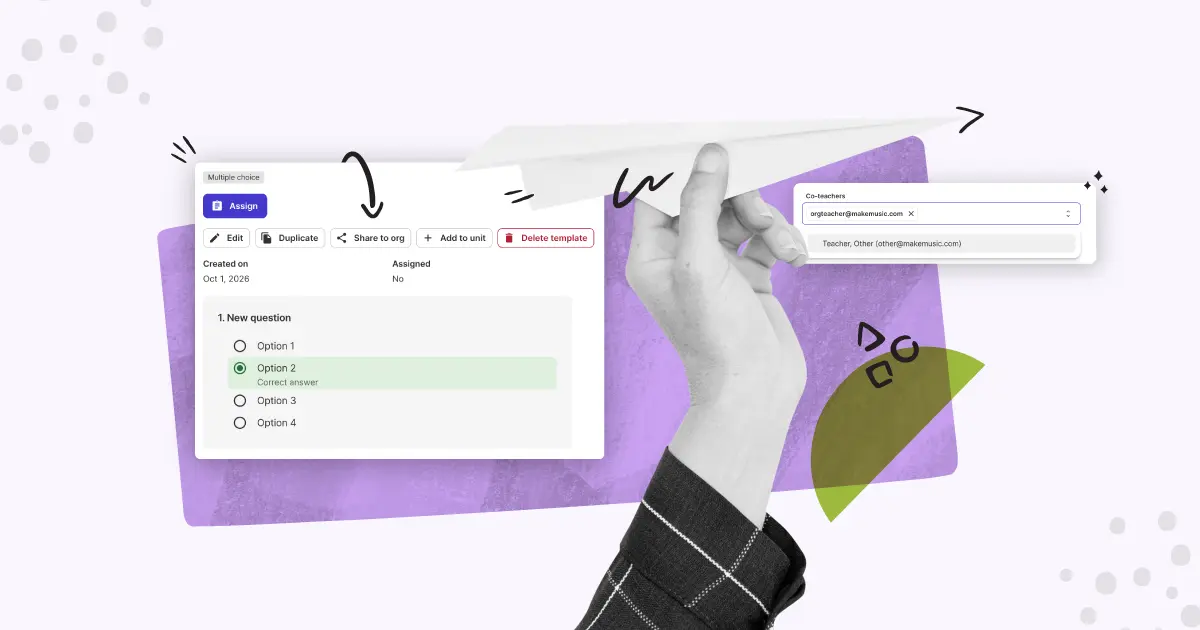
- Educators can navigate to any assignment within their personal library, select the sharing menu, and designate it for organizational distribution.
- Colleagues within the same school or district organization can instantly locate these materials and save direct copies to their own accounts.
- Eliminating Redundancy: Band directors can effortlessly align theory benchmarks across multiple grade levels, choral directors can pool ear-training modules, and incoming educators can inherit an established, high-quality curriculum on day one rather than reinventing the wheel.
Future Outlook: The Connected Music Room of Tomorrow
As educational technology continues to evolve, the boundaries of the traditional music classroom are expanding. The days of the isolated music teacher working late into the night behind a closed office door are rapidly giving way to a more interconnected, collaborative professional culture.
Platforms like MakeMusic are proving that the future of music education lies in community and shared intelligence. By breaking down the barriers between classrooms, schools, and districts, these tools allow educators to focus less on administrative busywork and more on what brought them to the profession in the first place: inspiring the next generation of musicians.
For educators ready to step out of isolation and embrace a more sustainable, connected approach to teaching, the message from the musical community is clear: You don’t have to do this alone, and you shouldn’t have to.
To explore how these collaborative tools can transform your ensemble management and curriculum design, music educators can visit the Teaching with MakeMusic Cloud Facebook group or start a free trial today.