
Executive Overview
For generations, the administrative reality of music education has been weighed down by logistical friction. Band directors, orchestra conductors, choral leaders, and private studio instructors have long spent countless hours navigating fragmented publisher websites, cross-referencing physical catalogs, managing purchase orders across multiple vendors, and waiting weeks for postal deliveries just to secure repertoire for their students.
Enter the MakeMusic Shop—a centralized, digitally integrated storefront designed to fundamentally alter how music educators discover, purchase, and distribute sheet music. Built specifically to eliminate the administrative bottlenecks that pull educators away from actual teaching, the platform consolidates browsing, digital downloading, and physical shipping into a single, cohesive ecosystem.
By bridging catalogs from major industry titans such as Alfred Music, Hal Leonard, Edition Peters, and FJH Music Company into one searchable interface, MakeMusic Shop offers a streamlined procurement process. Educators can now filter thousands of educational titles by grade level, ensemble type, genre, and specific instrumentation within seconds. Furthermore, the platform introduces instantaneous digital delivery models, allowing directors to download complete conductor scores and individual parts as PDFs, print them on demand, and immediately distribute them to their ensembles.
While distinct from the interactive practice environment of MakeMusic Cloud, the Shop operates as a crucial companion tool—complete with exclusive cross-platform discounts for existing subscribers. This comprehensive report explores the architecture of MakeMusic Shop, its implications for music pedagogy, the mechanics of its digital delivery system, and how it reshapes the modern landscape of instructional resource management.
Detailed Chronology: The Evolution of Music Procurement
To understand the significance of the MakeMusic Shop’s launch, one must contextualize the historical hurdles of music retail and digital distribution within educational institutions.
The Era of Physical Catalogs and Mail-Order Repertoire
For decades, music procurement relied heavily on printed seasonal mail-order catalogs. Educators would rifle through massive paper tomes sent out by publishing houses, trying to gauge the difficulty of a piece based on brief textual descriptions or short, low-fidelity audio clips. Once selected, physical scores had to be ordered via institutional purchase orders—a process notorious for bureaucratic delays. If a concert program changed or a sudden influx of students required additional parts, teachers faced weeks of waiting for supplementary shipments, frequently forcing them to improvise or photocopy existing materials (often navigating the complex gray areas of copyright law).
The Digital Shift and Fragmented Web Stores
As the internet matured, publishers began offering digital downloads, yet this solution introduced a new kind of fragmentation. Instead of a unified marketplace, educators found themselves juggling accounts across dozens of separate publisher websites. Each platform featured its own user interface, proprietary digital rights management (DRM) software, viewing restrictions, and printing limitations. Buying music for a mixed ensemble—such as a jazz band that also required vocal arrangements and string accompaniment—meant visiting four or five distinct digital storefronts, generating multiple invoices, and managing disparate login credentials.
The Advent of Interactive Practice Platforms
In recent years, software innovations shifted focus toward student practice tools. Platforms like MakeMusic Cloud revolutionized individual student practice by providing interactive sheet music equipped with background accompaniments, assessment tools, and immediate feedback loops. However, these platforms focused primarily on practice engagement rather than the macro-level acquisition of full ensemble repertoire and physical scores. A distinct gap remained between practicing digital files and the broad, multi-publisher procurement needs of a school music program.
The Birth of MakeMusic Shop
Recognizing the administrative burden still resting on the shoulders of educators, developers engineered the MakeMusic Shop to serve as the missing connective tissue. By uniting major publishing catalogs under a single umbrella equipped with advanced filtering parameters, instant PDF deployment, and seamless physical shipping options, the platform marks the culmination of years of digital refinement. It transitions music acquisition from a fragmented chore into a streamlined, centralized workflow.
Supporting Context & Metrics: Navigating the Catalog and Mechanics
The operational framework of MakeMusic Shop is built around precision, speed, and educational utility. Designed specifically with the demands of modern classrooms in mind, the platform incorporates specific tools to help educators manage tight budgets and diverse student skill levels.
Comprehensive Multi-Publisher Integration
A primary strength of the platform lies in its aggregation of industry-leading publishers. Rather than forcing directors to browse separate sites, MakeMusic Shop houses catalogs from:
- Alfred Music: Renowned for comprehensive band, string orchestra, choral, and piano instructional literature.
- Hal Leonard: The world’s largest print music publisher, covering contemporary pop arrangements, jazz ensembles, marching band charts, and musical theater.
- Edition Peters: A historic publisher bringing classical, contemporary, and niche concert repertoire to the digital storefront.
- FJH Music Company: A staple for progressive string, band, and piano pedagogy.
- Specialized Independent Publishers: Expanding the breadth of global and culturally diverse repertoire available to modern ensembles.
Advanced Filtering and Repertoire Discovery
Navigating thousands of titles requires robust metadata. MakeMusic Shop utilizes an advanced tagging architecture that allows educators to sort compositions by:
- Grade Level: Standardized difficulty ratings ranging from beginner (Grade 0.5–1) to advanced collegiate and professional levels (Grade 5–6), ensuring directors do not over- or under-challenge their students.
- Ensemble Type: Concert band, string orchestra, full orchestra, jazz band, mixed choir, chamber groups, and general music classrooms.
- Instrumentation: Specific breakdowns ensuring teachers can find arrangements that match atypical instrumentation balances within their specific school districts.
- Genre: Classical, jazz, contemporary, holiday, world music, and film scores.
The Mechanics of Digital Downloads and Printing Rights
For digital purchases, the platform removes administrative friction through instant download accessibility.
- PDF Bundles: When purchasing a digital conductor score and parts set, users receive a comprehensive ZIP file or direct PDF downloads containing the full score alongside every individual instrument part.
- Unlimited Part Printing: Once downloaded, educators possess the rights to print individual parts as many times as necessary to accommodate fluctuations in their ensemble size. If a concert band suddenly gains three new clarinet players mid-semester, the director can print the required parts immediately without placing a secondary order.
- Pre-Purchase Transparency: Every product page clearly delineates what is included in the purchase, outlining page counts, specific instrumentations, and whether the asset is a digital download or a physical item designated for mail delivery.
Official Statements and Ecosystem Integration
To fully grasp the positioning of MakeMusic Shop, one must examine its relationship with sister platforms like MakeMusic Cloud and MakeMusic Studio. Company representatives have emphasized that while the tools operate in harmony, they serve distinct pedagogical functions.
Clarifying the Ecosystem: Shop vs. Cloud
A common point of inquiry among educators involves the separation of church and state, so to speak, between the Shop and MakeMusic Cloud.
- MakeMusic Shop functions exclusively as a retail and distribution storefront. It is the marketplace where directors purchase physical scores or download permanent digital PDF files for printing and classroom annotation.
- MakeMusic Cloud operates as a subscription-based interactive practice platform. Students log into Cloud to access interactive notation, receive automated assessment feedback, and play along with generated accompaniments.
"Finding the right piece of music should feel like the fun part of the job," notes the development team behind the platform. "MakeMusic Shop brings browsing, buying, and printing together in one place, so you can spend your time choosing repertoire instead of tracking it down."
Frequently Addressed Distinctions
To eliminate confusion across educational communities, official guidelines clarify several key operational boundaries:
- Separate Libraries: Music purchased in the MakeMusic Shop does not automatically populate within a user’s MakeMusic Cloud library. The licensing agreements, digital rights management, and technical hosting environments of the two platforms remain entirely distinct.
- Understanding Cloud Tagging: When an educator browses the Shop and notices a label reading "Available in MakeMusic Cloud," this simply indicates that the title exists as an interactive practice piece within the Cloud subscription library. Purchasing the physical or PDF score via the Shop does not grant interactive access rights within Cloud.
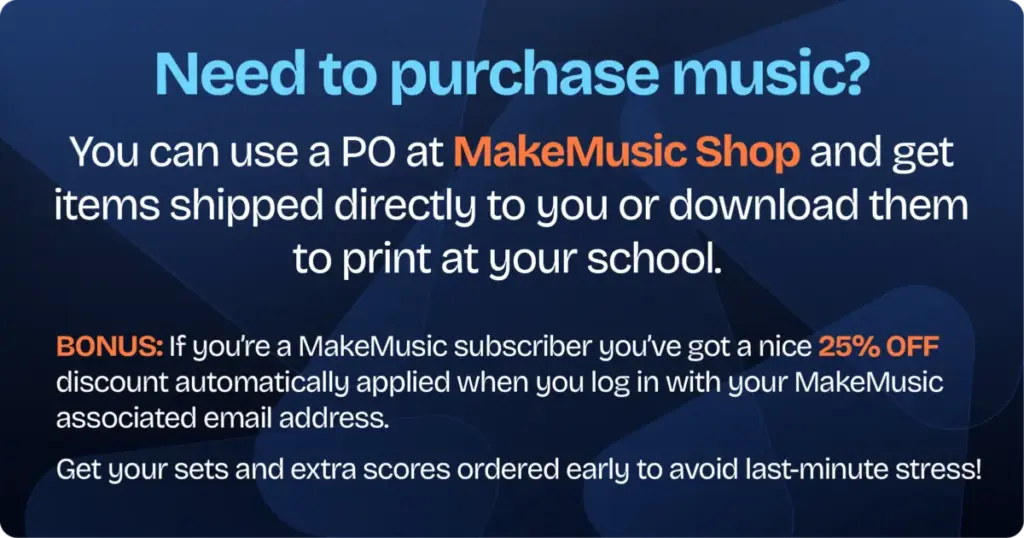
- Subscriber Perks: To reward loyal users of the broader digital ecosystem, active subscribers to MakeMusic Cloud and MakeMusic Studio receive an automatic 25% discount sitewide on all purchases made within the MakeMusic Shop. Crucially, however, a subscription is not mandatory to use the Shop; any educator, community conductor, or private studio teacher can utilize the storefront at standard pricing.
Future Outlook: The Digital Transformation of Music Education
As educational institutions increasingly embrace hybrid and digital-first administrative workflows, platforms like MakeMusic Shop point toward a broader transformation in how the arts are managed, funded, and taught.
Reducing Burnout and Administrative Overhead
Music educators face notoriously high rates of professional burnout, driven largely by non-instructional burdens. Between fundraising, concert staging, instrument maintenance, and bureaucratic paperwork, the actual act of teaching music often gets squeezed into the margins of the workday. By collapsing the multi-step procurement process into a matter of minutes—instant search, instant cart, instant download, and instant print—tools like MakeMusic Shop return valuable hours to the educator. This reduction in administrative friction directly supports teacher retention and classroom focus.
Equitable Access to Diverse Repertoire
The centralization of multi-publisher catalogs democratizes access to high-quality educational literature. Smaller, rural school districts or underfunded community studios often struggle to maintain physical libraries of diverse, contemporary repertoire. By providing a transparent, searchable marketplace tagged by precise pedagogical grade levels, rural and urban educators alike gain equal footing in curating culturally rich, developmentally appropriate concert programs for their students.
The Road Ahead
Future iterations of music education software will likely continue to blur the lines between procurement, practice, and performance. While MakeMusic Shop and MakeMusic Cloud currently maintain structural independence, the integration of user discounts signals a deepening ecosystem approach. As digital rights management technologies evolve and publishing houses grow increasingly comfortable with secure cloud distribution, one can anticipate even tighter integrations that may one day bridge the gap between repertoire acquisition and interactive digital practice.
For now, the immediate impact is clear: the days of flipping through endless paper catalogs and waiting anxiously for postal trucks to deliver missing horn parts are rapidly drawing to a close. By modernizing the storefront of music education, MakeMusic Shop ensures that directors can return their focus to where it belongs—making music.