
Executive Overview
In the vast and intricate architecture of Western classical and contemporary music, the score is more than a static blueprint of notes, rhythms, and dynamics; it is a complex map that demands interpretation, navigation, and an intuitive understanding of a specialized lexicon. Among the most enduring and structurally significant directives found within this lexicon is the Italian term Da Capo, universally abbreviated as D.C.
Translated literally from Italian as "from the head" or "from the beginning," Da Capo instructs the performer to return to the very start of a piece. However, music is rarely as straightforward as a simple loop. To accommodate dynamic compositions, composers throughout history have integrated Da Capo with secondary directional markers, creating a sophisticated system of navigational waypoints. These variations—namely DC al Fine, DC al Segno, and DC al Coda—dictate not just where a musician must return, but precisely where they must halt or jump within the musical landscape.
Beyond its mechanical function as a navigational tool, the concept of Da Capo holds a storied historical pedigree, most notably defining the dramatic and vocal landscape of the Baroque era through the iconic Da Capo Aria. This journalistic inquiry explores the structural mechanics, historical evolution, and interpretive performance practices surrounding Da Capo, shedding light on how these centuries-old Italian directions continue to shape musical performance today.
Detailed Chronology & Historical Evolution: From Baroque Innovation to Modern Score Mechanics
To fully appreciate the weight of the Da Capo directive, one must trace its development through the annals of music history, mapping its transition from a vocal performance practice into a standardized structural device across orchestral, chamber, and solo literature.
The Baroque Genesis and the Rise of Ternary Form
While the literal concept of repeating music from the beginning dates back to the earliest days of Western notation, the systematization of Da Capo as a formal architectural pillar blossomed during the Baroque period (roughly 1600–1750). As opera, oratorio, and sacred cantata formats expanded across Europe, composers sought structural models that could balance dramatic narrative progression with expressive emotional depth.
This search culminated in the invention and explosive popularity of the Da Capo Aria. Structured in ternary form (ABA)—a musical design comprising an opening section (A), a contrasting middle section (B), and a direct return to the opening section (A)—this vocal vehicle became the definitive centerpiece of Baroque opera seria and sacred masterworks.
In a typical Baroque Da Capo Aria, Section A established the primary emotional state or thematic argument, usually introduced by a soloist backed by instrumental accompaniment. Section B introduced a stark contrast—often shifting to a relative key, adopting a different meter, or employing a more agitated or reflective tone. Rather than writing out the entirety of the opening section a second time, composers simply appended the words Da Capo at the conclusion of Section B.
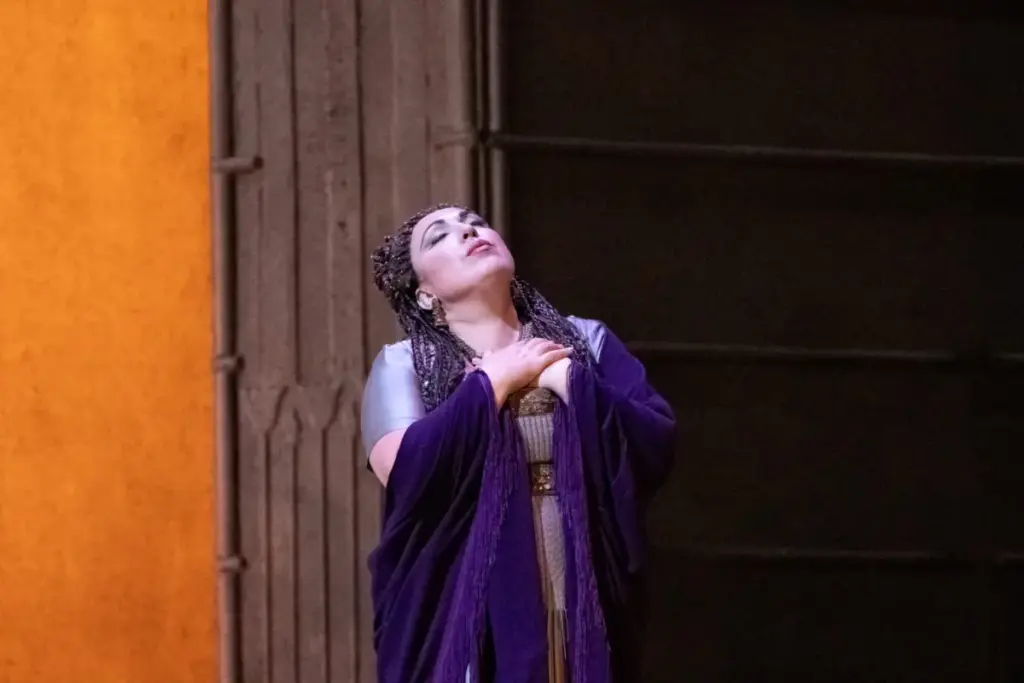
This economical convention saved precious manuscript paper and ink, but it also placed an immense artistic burden on the vocalist. During the performance of the repeated "A" section, singers were expected to spontaneously decorate and embellish the vocal line with intricate ornaments, trills, and cadenzas. This practice transformed a mechanical repeat into a virtuosic display of vocal agility and emotional transformation.
Standardization in the Classical and Romantic Eras
As the Classical era ushered in larger-scale instrumental forms—such as the symphony, string quartet, and sonata—the Da Capo instruction evolved from a vocal ornamentation vehicle into a vital structural signpost for multi-movement works.
Most notably, the Minuet and Trio (and later the Scherzo and Trio) third movements of classical symphonies and chamber works relied heavily on the Da Capo convention. The orchestra would play the Minuet (A), proceed to the contrasting Trio (B), and then encounter the directive Minuet D.C. al Fine (or simply Da Capo). This commanded the ensemble to return to the beginning of the Minuet and play through to the designated end, creating a symmetrical ABA macro-structure without requiring redundant printing.
By the 19th and 20th centuries, as musical notation became increasingly standardized under the influence of Italian publishing houses, the abbreviations D.C., D.S., Coda, and Fine became universal linguistic currency for musicians worldwide, transcending language barriers in international orchestras.
Supporting Context & Mechanics: The Three Primary Variations of Da Capo
While the core instruction of Da Capo remains unwavering—go back to the beginning—the modern musical score utilizes three distinct navigational offshoots to dictate how a performance concludes after that return is initiated. Understanding these variations is essential for any performing musician navigating standard repertoire.

1. DC al Fine (Da Capo al Fine)
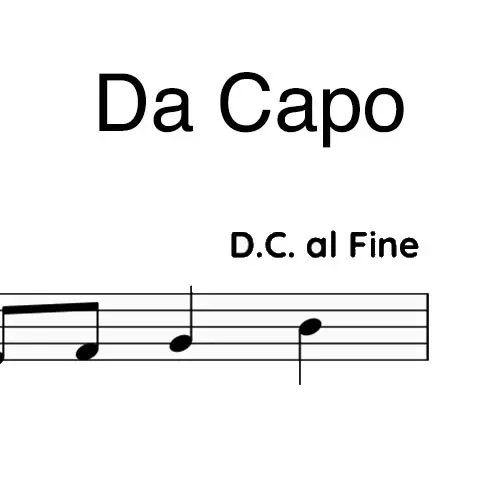
The most straightforward extension of the Da Capo directive is DC al Fine, translated as "from the head to the end."
- The Mechanism: When a performer encounters DC al Fine at the end of a middle section or movement, they immediately jump back to measure one of the piece. They continue playing forward sequentially until they encounter the Italian word Fine (meaning "the end"), which is typically embedded in the middle of a staff or at the conclusion of a specific measure. At that exact visual marker, the performance terminates instantly.
- Practical Application: This structure is frequently observed in shorter instrumental pieces, dance movements, and pedagogical studies where a compact ternary form is desired without the complexities of jumps or alternative endings.
2. DC al Segno (Da Capo al Segno)
Although it shares the Da Capo moniker, DC al Segno introduces an alternative destination point rather than a literal return to the absolute beginning of the score.
- The Mechanism: The term Segno translates directly to "the sign." When a composer writes DC al Segno, the performer must look back at the score to locate a specific navigational glyph—a stylized "S" crossed with a diagonal slash and two dots (𝄋). Rather than jumping to measure one, the musician jumps to the location of this Segno symbol. From that waypoint, they play forward until they reach a stopping instruction, such as Fine or al Fine.
- Contextual Nuance: While technically a variation involving a "Da Capo" mindset of backtracking, it bridges the gap between absolute structural returns and localized cueing.
3. DC al Coda (Da Capo al Coda)
Undoubtedly the most intricate and commonly misunderstood navigational instruction is DC al Coda ("from the head to the tail"). This directive is deployed when a composer wishes to create a dramatic, expansive concluding section that deviates from the main thematic material heard at the start of the piece.
- The Mechanism:
- The ensemble plays the piece from the beginning through to the directive DC al Coda.
- The musicians jump back to the very beginning of the score (Da Capo).
- They play forward a second time, but they remain vigilant for an exit warning—typically text reading To Coda, al Coda, or the distinct Coda symbol (a target-like glyph consisting of a circle intersected by crosshairs).
- Upon reaching this warning sign during the repeat, the performer executes an immediate physical jump, bypassing the remaining central measures of the piece to land directly on the separate concluding section known as the Coda (literally "the tail").
- Structural Purpose: The Coda acts as a grand musical resolution, summarizing thematic motifs or providing an explosive, definitive cadence to close out a movement.
Official Statements & Pedagogical Perspectives
To understand how these notations are interpreted in professional and educational environments, musicologists and master educators emphasize the psychological and communicative power of score literacy.
Ben Dunnett (LRSM), founder of the Music Theory Academy and seasoned piano pedagogue, notes in his foundational pedagogical literature:
"Musical notation is not merely a set of instructions for the fingers; it is a visual language designed to communicate the architect’s intent across time and space. Directives like Da Capo and its variants—Fine, Segno, and Coda—are the road signs of this language. Without a firm grasp of these structural waypoints, performers risk losing their narrative thread, turning a cohesive musical journey into a fragmented maze."
Furthermore, orchestral conductors frequently stress that score navigation is a primary point of synchronization during rehearsals. In high-pressure professional recording sessions, verbal cues utilizing these exact Italian terms—such as "Let’s take it back to the D.C., and this time watch for the Coda jump at measure 42"—allow conductors and ensemble members to communicate complex navigational shifts with absolute clarity and zero ambiguity.
Future Outlook: Score Navigation in the Digital Age of Notation
As the musical landscape undergoes a profound technological shift—moving rapidly from traditional paper manuscripts and physical sheet music to dynamic digital tablets, interactive PDFs, and dynamic notation software like Sibelius, Finale, and Dorico—the future of the Da Capo directive is evolving.
Digital Automation vs. Traditional Cognition
In modern scoring software, playback engines must accurately interpret navigational commands such as DC al Fine and DC al Coda to produce realistic audio realizations during the composition process. If a software program misinterprets a Coda jump or ignores a Fine marker, the resulting digital playback collapses into structural chaos. Consequently, software developers continuously refine algorithms to recognize these historical Italian markers with absolute precision.
Simultaneously, tablet-based music reading apps (such as forScore or MobileSheets) have introduced innovative features for live performers. Digital scores can now be programmed with automated page-turning links or visual teleports. When a performer reaches a DC al Coda marker on a digital screen, the software can instantaneously flash or jump the visual display to the beginning of the score, and subsequently leap to the Coda page upon encountering the exit sign, effectively eliminating manual page-turning panics during complex movements.
Preserving the Human Element
Despite these technological advancements, the fundamental human interpretation of Da Capo remains untouched. Technology can automate the jump, but it cannot dictate the artistic nuance required when executing a repeat.
Whether an opera singer stepping up to decorate the repeated A section of a Handel aria with breathtaking Baroque ornamentation, or a symphony orchestra executing a seamless transition into a triumphant Coda, the directives born centuries ago in Italian composer studios remain vital. They are timeless testaments to the elegance, economy, and structural brilliance of Western musical composition—ensuring that whenever a musician encounters "from the head," they embark on a journey that honors the past while driving dynamically toward the future.