
Executive Overview
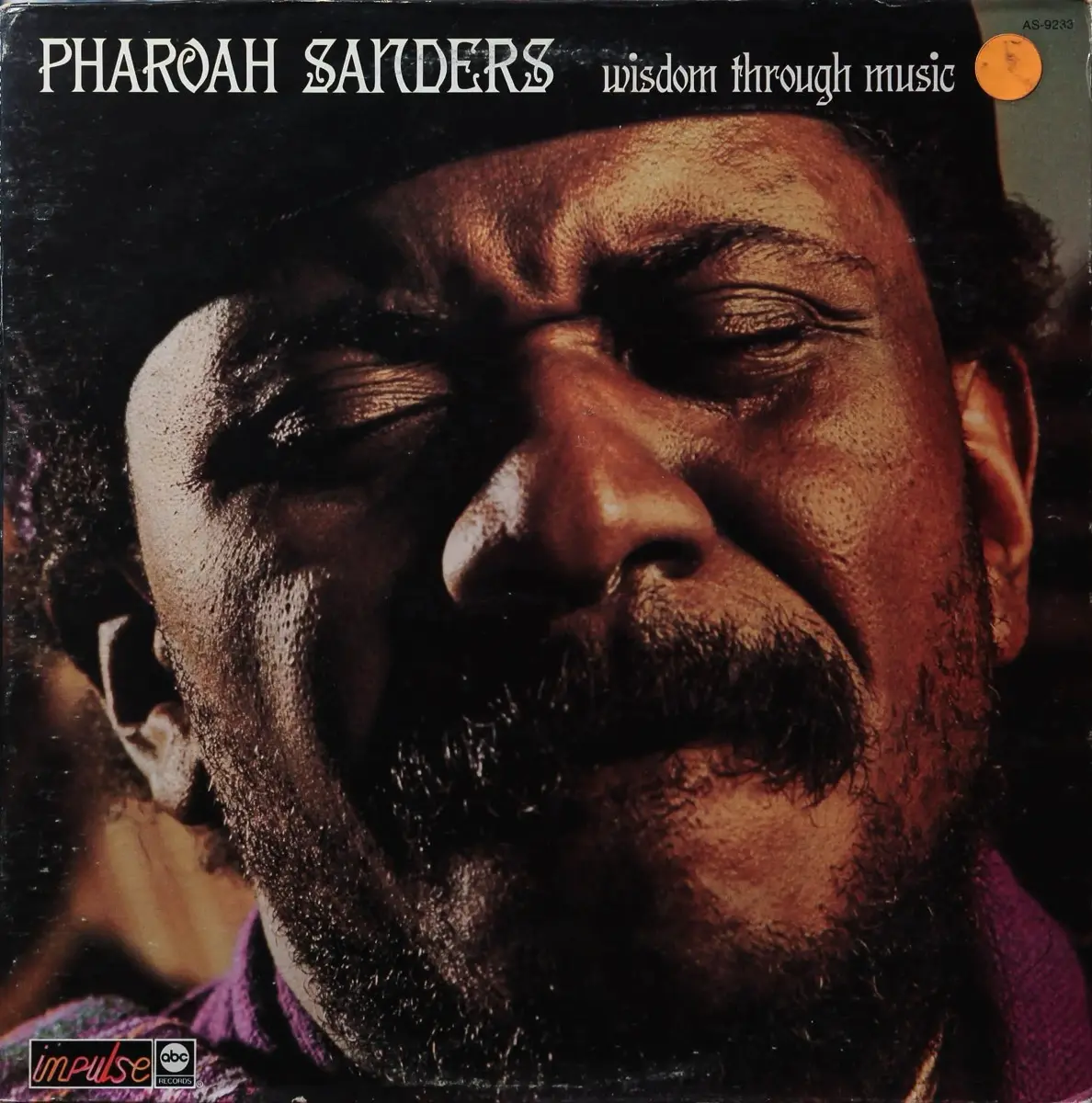
Half a century has passed since the legendary jazz critic Barry McRae penned his incisive, highly controversial critique of Pharoah Sanders’ 1972 release, Wisdom Through Music, for the pages of Jazz Journal. First published in August 1976, McRae’s review captured a pivotal moment of artistic transition—and friction—within the vanguard of avant-garde and spiritual jazz. At a time when genre boundaries were dissolving under the influence of global mysticism, funk rhythms, and vocal experimentation, Sanders was aggressively pushing his sound into uncharted, often polarizing territory.
McRae’s original assessment characterized the album as an "advance backwards"—a poignant critique of an artist whose formidable instrumental powers were seemingly stifled by conceptual overreach, repetitive vocal incantations, and a retreat from the searing, visceral energy that had defined his early career alongside John Coltrane.
This retrospective examines the cultural and musicological weight of Wisdom Through Music from the vantage point of the twenty-first century. By re-evaluating McRae’s contemporary insights against the broader landscape of Sanders’ illustrious career, we explore how this critically divisive recording reflects the broader tensions of the 1970s jazz scene: the uneasy alliance between uncompromising avant-garde improvisation and the burgeoning accessibility of spiritual communalism. Through a comprehensive chronology, detailed track breakdowns, personnel analysis, and an exploration of its legacy, this feature unpacks a fascinating chapter in the evolution of modern improvised music.
Detailed Chronology: The Trajectory to Wisdom Through Music
To fully understand the artistic motivations and critical reception of Wisdom Through Music, one must trace the rapid, kaleidoscopic evolution of Pharoah Sanders’ output from the mid-1960s to the early 1970s.
The Coltrane Crucible (1965–1967)
Pharoah Sanders (born Farrell Sanders) emerged as a seismic force in the jazz world during his tenure in John Coltrane’s late-period ensemble. Recordings such as Live in Seattle (1965) and Ascension (1965) established Sanders as a master of overblown harmonics, multiphonics, and a piercing, cathartic tone that mirrored the socio-political turmoil of the era. This was music of intense urgency, characterized by extended improvisations, a lack of conventional harmonic safety nets, and an overwhelming emotional weight.
The Impulse! Years and Cosmic Exploration (1966–1971)
Following Coltrane’s passing in 1967, Sanders stepped into a leadership role on the Impulse! Records roster. His early solo and co-led albums—such as Tauhid (1967), Karma (1969), and Deus X-Machina—laid the groundwork for the spiritual jazz movement. These albums successfully blended African polyrhythms, modal vamps, and eastern instrumentation with the fiery free-jazz vocabulary of the Coltrane legacy. Tracks like "The Creator Has a Master Plan" became anthems of the counterculture, marrying accessibility with radical sonic exploration.
The Shift Toward Vocal Mysticism (1972)
By the time Sanders entered the studio to record Wisdom Through Music (released in 1972 by Impulse!), his musical philosophy had begun to pivot. The fierce, confrontational free jazz of the 1960s was giving way to a more tranquil, participatory, and folk-infused aesthetic. Sanders increasingly integrated group chanting, vocal incantations, and a relaxed, pastoral approach to composition.
However, as Barry McRae noted in his August 1976 Jazz Journal critique, this stylistic shift did not sit well with all critics or long-time fans. The album’s heavy reliance on vocal chanting—meant to evoke universal peace, unity, and higher consciousness—was frequently experienced by listeners not as a revelation, but as an impediment to the instrumental wizardry that Sanders’ ensemble was fundamentally capable of delivering.
Supporting Context & Metrics: Anatomy of an Underwhelming Release
Album Specifications and Personnel
Wisdom Through Music is remarkably concise by the standards of 1970s jazz LPs, spanning a total runtime that could easily fit onto a single side of a ten-inch record.
- Original Label: Impulse! Records (IMPL 8023)
- Original Retail Price: £2.99 (UK release)
- Total Track Listing & Runtime:
- High Life; Love Is Everywhere; Wisdom Through Music (Side One – approx. 15½ min)
- The Golden Lamp; Selflessness (Side Two – approx. 15½ min)
The Ensemble:
- Pharoah Sanders: Tenor saxophone, soprano saxophone, flute
- James Branch: Flute
- Joseph Bonner (Banner): Piano
- Cecil McBee (McPhee): Bass
- Lawrence Killian, James Mtume, Babadal Roy: Percussion
- Norman Connors: Drums
Critical Breakdown of the Material
McRae’s 1976 critique targeted specific structural weaknesses within the compositions, pointing out that the album’s brevity did not excuse its lack of substantive musical development.
- "Love Is Everywhere": Dismissed by McRae as "spuriously frenetic" and ultimately a "bore." The track attempts to capture an ecstatic energy, but according to contemporary reviews, it suffers from a lack of genuine momentum. Listeners are left waiting in vain for soloists like pianist Joseph Bonner and Sanders himself to break through the repetitive arrangements.
- The Title Track ("Wisdom Through Music"): Serving as the centerpiece of the album’s thematic aspirations, the title track showcases the formidable talent of bassist Cecil McBee, whose arco (bowed) solo is praised as "otherwise fine." However, McRae noted that this standout moment is severely compromised, "over-powered by the cluttered surroundings."
- The Vocal Dichotomy: The core of McRae’s critique rests on the album’s use of vocal incantations. While intended as the record’s raison d’être—its spiritual and conceptual justification—they frequently act as a stumbling block. Rather than carrying an undeniable conviction, the chants often interrupt the harmonic and melodic momentum just as Bonner’s piano or Sanders’ tenor saxophone threatens to soar.
Official Perspectives and Historical Reception
The friction between Sanders’ spiritual intentions and the critical evaluation of his recorded output highlights a persistent dichotomy in jazz criticism during the 1970s.
The Avant-Garde Dilemma
During the post-Coltrane era, critics and audiences alike struggled to categorize the output of artists who abandoned traditional bebop structures in favor of communal, meditative experiences. While some listeners embraced Sanders’ transition as a natural evolution toward healing music and global consciousness, traditionalists viewed it as a dilution of the rigorous technical standards established a decade prior.
In his Jazz Journal appraisal, McRae encapsulated this sentiment:
"Sanders’ music has been moving in this direction for some time, but it is all a long way from the superb Live In Seattle album with Coltrane in 1965. This must be rated as an advance backwards."
The Artist’s Vision vs. Critical Expectations
From Sanders’ perspective, the inclusion of vocal incantations and percussion-heavy arrangements was not a regression, but a broadening of the music’s spiritual utility. For Sanders, music was a vehicle for transcendence, healing, and community bonding rather than a vehicle for academic or critical validation. The chants, while structurally intrusive to critics craving linear improvisation, were designed to create an immersive, ritualistic environment that bypassed intellectual analysis entirely.
Future Outlook: Re-evaluating Sanders’ Legacy in Modern Jazz
Fifty years after Barry McRae’s review first graced the pages of Jazz Journal, how should modern listeners approach Wisdom Through Music?
A Reappraisal in the Age of Spiritual Jazz Revival
In recent years, the contemporary jazz landscape has experienced a massive resurgence of interest in 1970s spiritual jazz, spearheaded by labels like Impulse!, International Anthem, and Talkin’ Loud, as well as artists such as Kamasi Washington, Shabaka Hutchings, and Floating Points. In this modern context, albums once dismissed as overly meandering or conceptually heavy-handed are frequently reassessed as visionary precursors to ambient jazz, global fusion, and ritualistic sound-healing.
While McRae’s technical criticisms—the cluttered arrangements, the abrupt interruption of promising solos by vocal interludes, and the brevity of the recorded material—remain valid musicological observations, they do not necessarily negate the emotional or atmospheric value of the recording. Wisdom Through Music may not possess the scorching intensity of Live in Seattle, nor the tightly wound anthemic grandeur of Karma, but it stands as a fascinating, honest document of an artist navigating the delicate balance between radical improvisation and meditative simplicity.
Conclusion
Barry McRae’s review serves as a crucial historical touchstone, reminding us that artistic evolution is rarely a linear upward trajectory. It involves bold experiments, misfires, and stylistic shifts that challenge both the artist and the audience. Today, Wisdom Through Music is viewed not merely as an "advance backwards," but as a brave, if imperfect, step in Pharoah Sanders’ lifelong quest to unite sound, spirit, and humanity—a legacy that continues to resonate powerfully across generations of musicians and listeners alike.