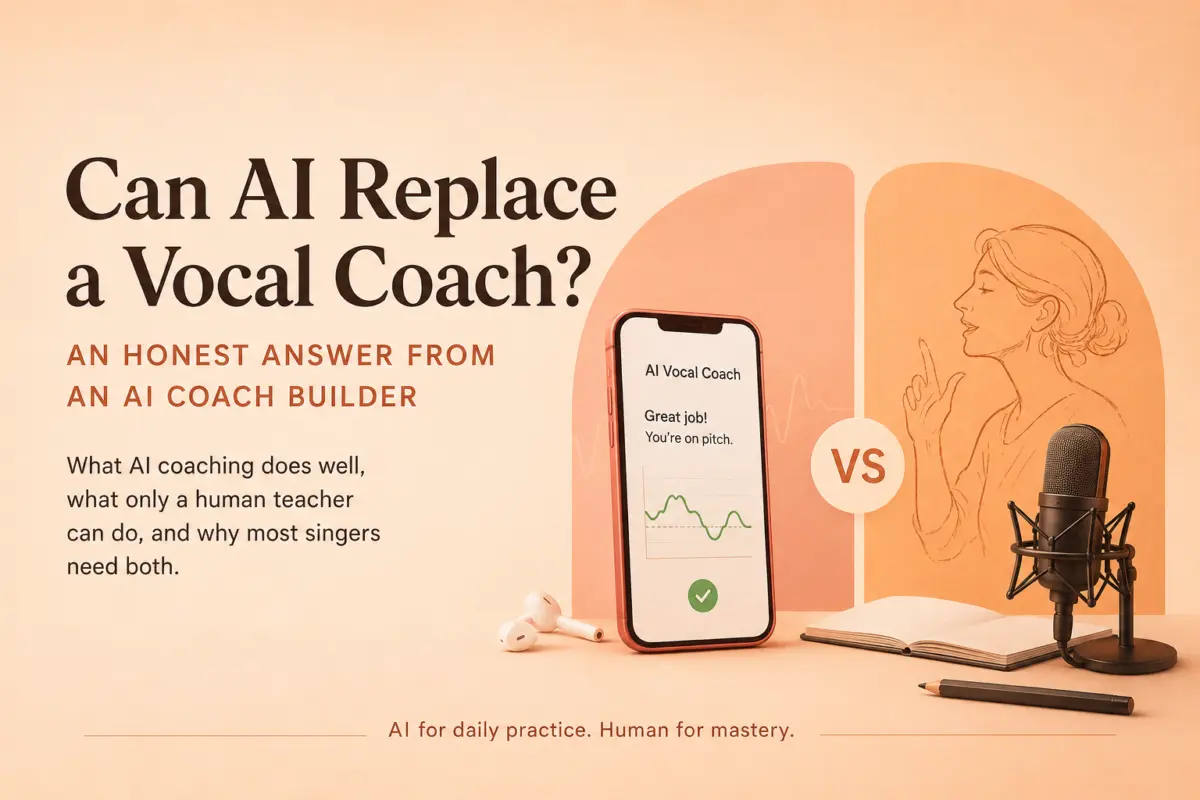

Executive Overview
The rapid integration of artificial intelligence into creative disciplines has sparked intense debate among artists, educators, and technologists. In the realm of vocal pedagogy, the emergence of AI-driven vocal coaching applications has raised critical questions: Can an algorithm truly teach a human how to sing? Is the traditional, one-on-one voice lesson facing obsolescence?
This investigative analysis explores the intersection of human vocal pedagogy and machine learning, utilizing recent performance data from Singing Carrots, an industry pioneer in AI vocal training. The evidence suggests that while AI vocal coaches cannot replicate the holistic sensory evaluation, anatomical intuition, and artistic guidance of a human instructor, they serve an entirely different and vital market.
For the vast majority of aspiring singers, the economic and psychological barriers to entry make traditional lessons inaccessible. In these cases, the choice is not between a human teacher and an algorithm; it is between an algorithm and nothing. By acting as a highly accessible, real-time feedback mechanism for daily practice, AI is not displacing human voice teachers. Instead, it is establishing a symbiotic, blended learning ecosystem that accelerates student progress, democratizes musical education, and prepares a new wave of confident singers for advanced human instruction.
Detailed Chronology of Vocal Training: From Pitch Pipes to Real-Time Algorithmic Feedback
To understand the current state of AI-assisted vocal training, one must trace the evolution of pedagogical tools designed to assist the human voice. Unlike instrumentalists, who can visually inspect their fingers on a fretboard or keyboard, singers operate an invisible, internal instrument. This unique anatomical reality has historically made vocal training highly dependent on external feedback.
[Traditional Era]           [Digital Transition]         [Modern AI Era]
Pitch Pipes & Piano  --->  Audio Recorders & Tuners  ---> Real-Time DSP & Comfort-Zone Algorithms
(Subjective, Delayed)      (Delayed Feedback Loop)        (Instantaneous, Adaptive Practice)
The Traditional Era: Subjective and Delayed Feedback
For centuries, vocal pedagogy relied strictly on the "master-apprentice" model. Teachers utilized keyboard instruments and pitch pipes to establish reference tones. Students sang scales, relying on the teacher’s verbal corrections to adjust their intonation, registration, and resonance.
The primary limitation of this model was the delay in the auditory feedback loop. Because sound waves travel through the skull via bone conduction, singers do not hear their own voices the way an external audience does. Consequently, students struggled to self-correct outside the lesson room, often practicing mistakes and reinforcing poor muscle memory throughout the week.
The Digital Transition: Recording Devices and Visualizers
The mid-to-late 20th century introduced consumer-grade audio recording devices, allowing singers to record their lessons and play them back. While beneficial, this still presented a delayed feedback mechanism.
In the late 1990s and early 2000s, software developers introduced basic digital tuners and spectrograms to academic vocal labs. However, these tools were highly academic, expensive, and difficult for amateur singers to interpret without professional supervision.
The Modern AI Era: Real-Time Digital Signal Processing (DSP)
The launch of modern platforms like Singing Carrots represents a paradigm shift. Today’s AI vocal coaches utilize sophisticated pitch-detection algorithms capable of analyzing audio input down to the cent (one-hundredth of a semitone) in real time.
By converting acoustic waveforms into instantaneous visual coordinates on a screen, these platforms close the auditory feedback loop immediately. This allows singers to visually perceive their pitch deviations as they occur, transforming abstract vocal exercises into tangible, self-correcting physical adjustments.
What Only a Human Teacher Can Do: The Anatomical and Artistic Limits of AI
Despite the mathematical precision of digital signal processing, vocal pedagogy is fundamentally an embodied, empathetic art form. There are distinct physiological, artistic, and safety thresholds that current-generation algorithms cannot cross.
                  ┌─────────────────────────────────────────┐
                  │       HUMAN VOCAL TEACHER DOMAIN        │
                  ├─────────────────────────────────────────┤
                  │  • Intercepts physical tension (jaw/neck)│
                  │  • Diagnoses vocal fatigue & pathology  │
                  │  • Teaches style, emotion, & phrasing   │
                  │  • Establishes personal accountability  │
                  └────────────────────┬────────────────────┘
                                       │
                                 [The Threshold]
                                       │
                  ┌────────────────────▼────────────────────┐
                  │          AI VOCAL COACH DOMAIN          │
                  ├─────────────────────────────────────────┤
                  │  • Calibrates real-time pitch accuracy  │
                  │  • Conducts systematic, daily drills    │
                  │  • Lowers economic barrier ($60-$150/hr)│
                  │  • Eliminates fear of public judgment   │
                  └─────────────────────────────────────────┘
1. The Blind Spot of Acoustic Signal Processing
An AI algorithm analyzes the frequency spectrum of a sound wave; it does not perceive the physical origin of that sound. A note can be mathematically centered on pitch while being produced through severe laryngeal constriction, tongue retraction, or jaw tension.
A human voice teacher possesses visual and auditory intuition developed through years of diagnostic experience. They can observe a raised shoulder, a clenched masseter muscle, or clavicular breathing—all physical impediments that degrade vocal health and tone quality long before they manifest as identifiable pitch errors in an app.
2. Vocal Health and Pathology Prevention
The human voice is a delicate biological instrument comprised of mucosal tissue, muscles, and cartilages. Improper use can lead to vocal nodules, polyps, or muscle tension dysphonia (MTD).
An experienced human teacher acts as a primary care provider for the voice, identifying the subtle signs of vocal fatigue, strain, or air escape. If a student exhibits symptoms of vocal distress, a human teacher can immediately adjust the pedagogy or refer the student to a laryngologist. An algorithm cannot responsibly navigate the complexities of vocal rehabilitation.
3. The Transmission of Artistry and Interpretation
Singing is more than the accurate execution of pitches and rhythms; it is an act of emotional communication. The nuance of a vocal slide, the deliberate use of breathiness for emotional effect, stylistic phrasing in jazz or opera, and the development of stage presence are taught through human-to-human relationship, demonstration, and emotional resonance. These elements cannot be quantified or taught by a machine learning model designed to optimize pitch accuracy.
Supporting Context & Metrics: Analyzing the Efficacy of AI-Driven Practice
To measure the actual impact of algorithmic vocal training, Singing Carrots conducted a comprehensive seven-month user study tracking pitch development, practice habits, and skill acquisition across various demographics. The empirical data reveals a stark contrast in how different skill levels interact with and benefit from AI feedback.
Key Performance Metrics: Pitch Accuracy Improvement Over 4 Weeks
The study monitored pitch deviation over a continuous four-week period of structured daily practice. The results demonstrate that while experienced singers achieved marginal gains, beginners experienced a dramatic transformation in their intonation.
| Metric / Demographic | Overall User Base | Absolute Beginners | Intermediate/Advanced |
|---|---|---|---|
| Pitch Accuracy Improvement | +5.9% | +16.5% | +1.2% |
| Average Daily Session Length | 14.5 minutes | 12.0 minutes | 18.5 minutes |
| Exercise Safety Compliance | 91.5% | 94.2% | 88.8% |
| Primary Goal of Training | Consistency | Pitch/Range Building | Style & Agility |
The "Comfort-Zone" Algorithm: Preventing Strain
One of the primary safety criticisms of self-directed app practice is the risk of users pushing their voices into extreme, damaging registers. To mitigate this, the Singing Carrots AI utilizes a dynamic adaptation engine.
The algorithm analyzes the user’s initial vocal range assessment and structures exercises so that 91.5% of all daily drills remain strictly within the user’s demonstrated comfortable tessitura. As the user’s vocal muscles strengthen and range naturally expands, the system incrementally introduces higher and lower pitches, mimicking the cautious progression of a human instructor.
The Economic and Psychological Realities: Bridging the "Silence Gap"
The debate surrounding AI in music education often overlooks the stark economic realities of private instruction. A competent, university-trained human voice teacher typically charges between $60 and $150 per hour. For working-class families, students, or hobbyists in developing economies, this cost is prohibitive.
Furthermore, vocal training carries a heavy psychological burden. Unlike learning the guitar or piano, where the instrument is external, the voice is deeply tied to personal identity. Many beginners harbor intense vulnerability or "vocal shame"—often stemming from childhood criticism.
For these individuals, booking a $100 lesson with a professional singer is not a realistic starting point; the fear of judgment is too high.
[Traditional Pathway]  ---> High Cost ($100/hr) + High Social Anxiety  ---> Avoidance / Silence

[Algorithmic Bridge]  ---> Low Cost (App Subscription) + Zero Judgment  ---> Active Daily Practice
The data shows that the primary alternative to an AI vocal coach is not a highly trained human pedagogue; it is unstructured singing in isolation (such as in the car or shower) or absolute silence. By offering a low-cost, private, and objective sandbox, the AI vocal coach acts as an essential entry point, helping beginners build the basic pitch coordination and confidence required to eventually seek out professional human instruction.
Comparative Matrix: Human Pedagogy vs. Algorithmic Coaching
| Feature / Dimension | Human Vocal Teacher | AI Vocal Coach |
|---|---|---|
| Primary Strength | Diagnosis of physical tension, artistic interpretation, vocal health monitoring, personalized accountability. | High-frequency deliberate practice, instantaneous objective pitch feedback, unlimited availability. |
| Ideal Training Cadence | Weekly, bi-weekly, or monthly check-ins. | Daily 10-to-20 minute structured practice sessions. |
| Nature of Feedback | Holistic, qualitative, somatic, and emotionally resonant. | Quantifiable, instant, visual, and note-by-note. |
| Target Audience | Intermediate to advanced performers, singers experiencing vocal pain, or those preparing for live performance. | Absolute beginners struggling with pitch matching, and singers looking for structured practice tools. |
| Core Limitations | High cost ($60–$150/hour), scheduling constraints, and inability to monitor daily practice between lessons. | Inability to analyze physical posture, identify vocal strain, or interpret stylistic nuances. |
Official Statements and Industry Perspectives: The Symbiotic Coexistence
Rather than viewing artificial intelligence as an existential threat to their livelihoods, progressive voice teachers are increasingly adopting a "blended learning" model, comparing the AI vocal coach to a modern, interactive metronome.
The Developer’s Perspective: Singing Carrots Leadership
"We did not build this technology to replace the vocal studio; we built it to fill the empty room where no teacher was ever going to be. The data from our seven-month study proves that the fastest progress occurs when singers combine both worlds. Our AI is designed to handle the repetitive, objective mechanical drilling—freeing up the human teacher to focus on the high-level artistry, somatic alignment, and emotional connection that no machine can replicate."
The Pedagogical Perspective: Academic Vocal Instructors
Several voice teachers have begun incorporating structured app-based practice into their studio curricula. This approach solves a historical pedagogical challenge: the lack of student accountability and correct practice habits between weekly lessons.
"When my students use an AI pitch-tracker at home, they stop practicing their mistakes. They come to their weekly lessons with their basic pitch and rhythm work already polished. This allows us to spend our expensive hour together working on resonance, artistic phrasing, and performance anxiety, rather than spending 40 minutes simply trying to get them to sing in tune."
Future Outlook: The Evolution of Hybrid Vocal Education
As machine learning models and hardware capabilities advance, the boundary between physical and digital instruction will continue to evolve. Several key developments are poised to reshape the landscape of hybrid vocal pedagogy over the next decade:
[Computer Vision Integration]  ---> Real-time tracking of posture, jaw tension, and shoulder alignment.
[Advanced Audio Diagnostics]   ---> Spectral analysis to detect glottal fry, breathiness, and vocal fatigue.
[LMS Platform Integration]     ---> Automated practice logs sent directly to the student's human teacher.
1. Computer Vision and Somatic Tracking
Future iterations of AI vocal coaches will likely leverage the high-resolution cameras on modern smartphones to perform basic somatic analysis. By utilizing real-time computer vision models, apps may soon be able to detect obvious physical barriers to singing—such as forward head posture, locked jaws, or shallow chest breathing—and prompt the user to perform physical release exercises before continuing.
2. Spectral Analysis for Vocal Strain Detection
While current systems focus heavily on fundamental frequency (pitch), future developments in spectral analysis will allow algorithms to monitor the harmonic profile of a singer’s voice. This could enable the AI to detect the acoustic markers of vocal fatigue, pressed phonation, or hyper-adduction, automatically halting a practice session and advising rest to protect the user’s vocal health.
3. Integrated Teacher-Student Dashboards
The future of vocal education lies in seamless connectivity. Developers are working toward integrated learning management systems (LMS) where a student’s daily practice data from the AI coach is securely shared with their human teacher.
Before a student even walks into their weekly lesson, the teacher can review a dashboard detailing their practice frequency, pitch accuracy trends, and range boundaries. This data-driven approach ensures that face-to-face instruction is highly targeted, efficient, and personalized.
Actionable Recommendations for Singers
For Absolute Beginners on a Budget
- Path: Start with a structured AI vocal coach.
- Focus: Use the real-time pitch feedback to build basic neuromuscular coordination, expand your range within safe parameters, and establish a daily 15-minute practice habit.
- Transition: Once you have built basic confidence and consistency, seek out a human teacher for periodic check-ins to ensure you are not developing hidden physical tensions.
For Singers Currently Taking Private Lessons
- Path: Maintain your lessons; integrate the AI coach as your daily practice companion.
- Focus: Use the app during the six days between your lessons to structure your warm-ups and drill difficult passages.
- Collaboration: Share your practice metrics with your teacher to help guide your in-person sessions.
For Intermediate and Advanced Performers
- Path: Prioritize your relationship with an experienced human vocal coach.
- Focus: Dedicate your energy to artistry, emotional delivery, and stylistic refinement. Use the AI coach simply as a highly efficient digital tuner and warm-up tool in the dressing room or on tour.
For Anyone Experiencing Vocal Pain or Discomfort
- Path: Stop singing immediately and consult a human professional—ideally a laryngologist or a speech-language pathologist specializing in voice.
- Rule: No app, algorithm, or software platform should ever be used to navigate, diagnose, or treat vocal strain, hoarseness, or physical pain.