
Executive Overview
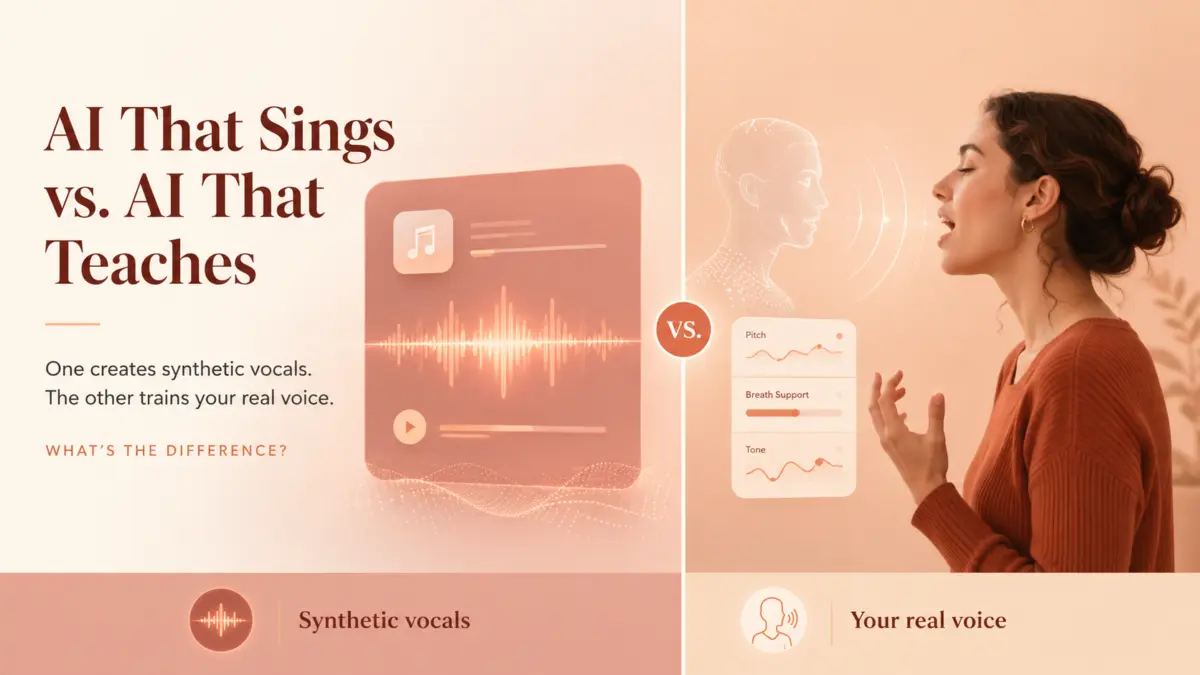
The rapid integration of artificial intelligence into the creative arts has precipitated a profound linguistic and conceptual schism within music technology. Today, the term "AI singing" refers to two entirely divergent technological paradigms. On one side of this divide stands generative artificial intelligence—represented by platforms such as Suno, Udio, and various voice-cloning networks—which synthesizes complete, studio-quality vocal tracks from textual and melodic prompts. On the opposing side stands interactive, pedagogical artificial intelligence—such as AI-driven vocal coaches—which analyzes real-time human vocal performance to diagnose pitch inaccuracies, prescribe technical exercises, and cultivate biological talent.
This division represents more than a mere semantic misunderstanding; it reflects a fundamental philosophical split regarding the future of human agency in creative expression. Generative AI seeks to automate the vocal performance, bypassing the human instrument entirely to deliver a polished, commercial end-product. Conversely, pedagogical AI aims to augment the human instrument, leveraging machine learning to democratize elite-level vocal coaching and help individuals master their physical voices.
As venture capital pours into both sectors and copyright litigation reshapes the legal landscape of synthetic media, understanding the operational, economic, and ethical distinctions between these two technologies is critical. This investigative report explores the evolution, underlying mechanics, societal impacts, and future trajectories of both facets of the "AI singing" ecosystem.
Detailed Chronology: The Parallel Evolution of Music AI
The convergence of artificial intelligence and vocal music did not happen overnight. It is the result of two distinct technical lineages—Digital Signal Processing (DSP) and Neural Audio Synthesis—which developed independently over decades before arriving at their current state of maturity.
[1997] Antares Auto-Tune Released (Beginning of digital pitch correction)
  │
  ├──► [Pedagogical Path]
  │     ├── [2000s-2010s] Real-time pitch tracking & visual feedback (SingStar, early apps)
  │     └── [2020s] Interactive AI Vocal Coaches (Singing Carrots, real-time ML diagnostics)
  │
  └──► [Generative Path]
        ├── [2010s] Vocaloid & concatenative synthesis (rule-based, robotic)
        └── [2023-Present] Diffusion & Transformer Models (Suno, Udio, RVC voice cloning)
Phase 1: The Era of Pitch Correction and Early DSP (1997–2010s)
The journey began in 1997 with the release of Antares Auto-Tune, which used digital signal processing to detect and correct pitch deviations in recorded vocals. While not "AI" in the modern sense, it established the precedent that computers could manipulate human vocal frequencies.
During the mid-2000s, consumer software began utilizing basic pitch-detection algorithms for gamified entertainment and foundational training. Video games like SingStar and Guitar Hero: Aerosmith utilized autocorrelation algorithms to track a player’s fundamental frequency ($f_0$) in real-time, mapping it against a MIDI reference track. However, these early systems lacked diagnostic capabilities; they could identify that a singer was out of tune, but they could not explain why or offer corrective pedagogical exercises.
Phase 2: The Emergence of Interactive ML Training (2015–2022)
As machine learning models became more efficient, developers began building software capable of sophisticated acoustic analysis. Rather than simply tracking pitch, new algorithms could analyze vocal registers, detect breath support issues, measure vibrato rate, and assess formant frequencies (which dictate vocal resonance and vowel clarity).
Platforms like Singing Carrots emerged during this era, shifting the paradigm from basic pitch-tracking to active, personalized vocal pedagogy. By feeding user audio through trained machine learning models, these applications could instantly customize training regimens based on a singer’s unique physiological boundaries.
Phase 3: The Generative AI Explosion (2023–Present)
The landscape changed permanently in late 2022 and early 2023 with the breakthrough of generative audio models. Utilizing transformer architectures and diffusion models similar to those powering large language models (LLMs) and image generators, platforms like Suno and Udio democratized high-fidelity audio synthesis.
Simultaneously, open-source retrieval-based voice conversion (RVC) models proliferated, allowing users to clone the voices of famous artists—such as Drake, The Weeknd, and Taylor Swift—with astonishing fidelity. Almost overnight, "AI singing" transformed in the public consciousness from an educational aid into a disruptive force capable of generating complete, commercially viable musical tracks from a single text prompt.
Supporting Context & Metrics: How the Technologies Work
To fully grasp the implications of these competing technologies, one must examine their underlying technical architectures, performance metrics, and target demographics.
Technical Architectures
Generative AI Voice Generators
These systems rely on deep neural networks trained on massive datasets of copyrighted and public-domain audio.
- Text-to-Audio Transformers: Convert natural language prompts (e.g., "a soulful female jazz vocal, 120 BPM, melancholic atmosphere") into symbolic representations of music.
- Neural Audio Codecs: Compress raw audio into discrete tokens, allowing the model to predict subsequent audio frames.
- Diffusion Models / Vocoders: Reconstruct these tokens back into high-fidelity, continuous waveforms, synthesizing both the instrumental backing and the vocal performance simultaneously.
AI Vocal Coaches
These systems utilize real-time analytical machine learning models designed for low latency and high diagnostic accuracy.
- Pitch Detection Algorithms (YIN/mYIN): Extract the fundamental frequency ($f_0$) of the user’s voice from a microphone input, filtering out background noise and room reflections.
- Acoustic Feature Extraction: Analyze the harmonic-to-noise ratio (HNR) to evaluate vocal clarity, and monitor spectral tilt to evaluate vocal tension.
- Adaptive Curricular Engines: Use decision trees and reinforcement learning to dynamically alter the difficulty of exercises based on the singer’s real-time accuracy and historic progress.
+------------------------+------------------------------------------+------------------------------------------+
| Feature                | AI Voice Generators                      | AI Vocal Coaches                         |
+------------------------+------------------------------------------+------------------------------------------+
| Primary Objective      | Synthesis of artificial vocal audio      | Optimization of biological vocal chords  |
+------------------------+------------------------------------------+------------------------------------------+
| Core Technologies      | Diffusion models, Transformers, Codecs   | DSP, YIN pitch detection, Expert engines |
+------------------------+------------------------------------------+------------------------------------------+
| User Input             | Text prompts, MIDI, or reference audio   | Live, unedited acoustic vocalizations    |
+------------------------+------------------------------------------+------------------------------------------+
| Primary Output         | WAV/MP3 audio files                      | Real-time visual feedback & lesson plans |
+------------------------+------------------------------------------+------------------------------------------+
| Human Effort Required  | Minimal (Prompt engineering)             | High (Physical practice and repetition)  |
+------------------------+------------------------------------------+------------------------------------------+
| Market Segment         | Content creators, producers, advertisers | Aspiring singers, hobbyists, vocalists   |
+------------------------+------------------------------------------+------------------------------------------+
Empirical Efficacy of AI Vocal Coaching
While generative AI metrics are typically measured in terms of generation speed, sample rate (e.g., 44.1 kHz), and user retention, the efficacy of AI vocal coaches is measured by human behavioral improvement.
In a comprehensive, seven-month study tracking beginner vocalists utilizing an AI-driven vocal coaching application, researchers observed rapid, measurable improvements in fundamental singing mechanics.
Beginner Pitch Accuracy Improvement (4-Week Study)
==================================================
Initial Accuracy:   ████████████████ 42.0%
After 4 Weeks:      ██████████████████████ 58.5%  [+16.5% Net Increase]
According to the published data, beginners who practiced consistently with the AI coach for four weeks demonstrated a net increase of 16.5 percentage points in pitch accuracy (climbing from an average baseline of 42.0% accuracy to 58.5%).
Crucially, the study revealed that the steepest trajectory of improvement occurred among users with the lowest initial baselines. Individuals who historically struggled to match basic pitches saw their accuracy rates nearly double within the first month. This suggests that real-time, objective visual feedback loops—wherein a user can see their pitch deviation on a screen as they sing—accelerate the neuromuscular coordination required for accurate singing far faster than traditional self-guided audio practice.
Official Statements and Ethical/Legal Battlegrounds
The divergence between these two technologies has created vastly different legal and ethical realities for their respective developers. While AI vocal coaches operate with minimal friction, generative AI voice platforms are currently embroiled in high-stakes legal battles that could redefine copyright law.
The Legal War Over Generative Voices
In June 2024, the Recording Industry Association of America (RIAA), representing major labels such as Universal Music Group (UMG), Sony Music Entertainment, and Warner Music Group, filed landmark copyright infringement lawsuits against Suno and Udio. The lawsuits allege that these platforms copied copyrighted sound recordings on a massive scale to train their generative models.

In an official statement, Mitch Glazier, Chairman and CEO of the RIAA, stated:
"The music community has embraced AI, and we are already partnering and collaborating with responsible developers to build sustainable AI tools centered on human creativity. But unlicensed services like Suno and Udio, which claim it’s ‘fair’ to copy an artist’s life’s work and exploit it for their own profit without consent or pay, set back the promise of genuinely collaborative AI for us all."
Suno’s CEO, Mikey Shulman, countered with a defense of fair use, arguing that their technology is designed to create entirely new, original works rather than replicate existing ones:
"Our technology is transformative; it is designed to create completely new outputs, not to copy and paste pre-existing content. We do not allow users to prompt for specific artists, and we are committed to building a tool that expands the creative pie for everyone."
The Artist’s Perspective on Voice Cloning
The rise of unauthorized voice cloning has also prompted legislative action. Artists have expressed deep concern over the unauthorized commodification of their vocal identities.
Testifying before the U.S. Senate Judiciary Committee on the threat of generative AI, British singer-songwriter FKA twigs emphasized the deeply personal nature of the human voice:
"My vocal identity is the culmination of years of physical training, emotional vulnerability, and creative exploration. It is not a dataset to be scraped, synthesized, and redistributed without my consent. We must establish federal protections that recognize our voices as extension of our physical selves."
In response to these concerns, states like Tennessee have enacted the ELVIS Act (Ensuring Likeness Voice and Image Security Act), which explicitly protects an individual’s voice from unauthorized AI duplication. On the federal level, lawmakers are debating the NO FAKES Act, which aims to establish a federal property right over one’s voice and likeness.
The Contrast of Pedagogical AI
In stark contrast, developers of AI vocal coaching applications face none of these legal existential crises. Because their tools do not scrape copyrighted audio to generate synthetic replacements, but instead use signal processing and machine learning to analyze the user’s own voice, they are widely embraced by the musical and educational communities.
"Our goal is not to replace the human singer, but to demystify the physical act of singing," says a representative from Singing Carrots. "We are not training models to sing for you; we are building tools that help you understand your own anatomy, breath control, and pitch accuracy. The AI generates instruction and guidance, but the singing remains entirely yours."
Future Outlook: The Convergence of Training and Synthesis
As both generative and pedagogical AI technologies mature, the line between them may begin to blur, leading to novel, hybrid applications that could revolutionize how humans learn to sing.
1. The "Ideal Self" Feedback Loop
One of the most promising future developments lies in the intersection of voice cloning and vocal pedagogy. Future AI vocal coaches could clone a student’s voice, correct the pitch and tonal imperfections using generative models, and play back a "perfected" version of the student’s own voice singing the exercise.
This would provide singers with an acoustic blueprint of their own physiological potential, showing them exactly what they would sound like with proper technique, breath support, and resonance. Studies in neuro-muscular feedback suggest that mimicking one’s own optimized voice can dramatically accelerate vocal development compared to mimicking a different singer.
2. Conversational, Role-Playing AI Mentors
With the integration of advanced LLMs, AI vocal coaches are transitioning from simple pitch-trackers into fully conversational mentors. Developers are already building interfaces where users can ask their AI coach to adopt specific pedagogical styles or historic personas.
[User Voice Input] ────► [Pitch & Resonance Analysis] ────► [Pedagogical Engine]
                                                                   │
                                                                   ▼
[Conversational LLM] ◄─── [Context-Aware Coaching Dialogue] ◄──────┘
(e.g., "Bel Canto" or
 "Freddie Mercury" Persona)
A student practicing rock vocals, for instance, might instruct the AI to "coach me using the stylistic philosophy of Freddie Mercury." The AI does not generate Mercury’s voice to sing the song for them; instead, it analyzes the student’s vocal output and delivers feedback, stylistic tips, and encouragement in a conversational style modeled after Mercury’s historical interviews and vocal habits.
3. Ethical Generative Collabs
On the generative front, we are likely to see the rise of licensed, ethical voice marketplaces. Companies like Hooky and Grimes’ Elf.Tech are pioneering models where vocalists lease their synthetic voices to producers in exchange for royalty splits secured by smart contracts. In this future, a songwriter might use an AI vocal coach to train their real voice, record a demo, and then legally apply a licensed, high-profile artist’s vocal skin over their performance—marrying biological skill with synthetic star-power.
Conclusion
Ultimately, the dual meanings of "AI singing" highlight a permanent division in the creative landscape. Generative voice technology serves those who view music as a product to be consumed or a utility to be integrated into media. Interactive vocal coaching serves those who view music as a deeply satisfying human process—an embodied, physical skill that brings joy through personal mastery.
Generative AI will undoubtedly continue to disrupt the commercial production of background tracks, jingles, and synthetic pop hits. Yet, it cannot satisfy the intrinsic human desire to sing. As long as humans wish to experience the physical thrill of performing at a local karaoke bar, singing in a community choir, or performing on a live stage, the AI vocal coach will remain an essential, empowering partner, proving that the most valuable role for technology in the arts is not always to replace us, but to help us become better versions of ourselves.