
Executive Overview
The opening weeks of any choral academic year establish the psychological and technical trajectory for the months that follow. More critically, the opening minutes of a single daily rehearsal dictate whether students enter a space of passive compliance or active, joyful musical engagement. For decades, choral directors have faced a persistent pedagogical bottleneck: being physically and mentally tethered to the piano bench. Trapped behind keys, manuals, and chord charts, educators spend precious instructional time modulating on the fly, wrangling accompaniments, and—most detrimentally—missing the subtle, foundational vocal mechanics shifting in the back rows of the risers.
Today, a paradigm shift is underway in music education. By synthesizing the kinetic, community-building methodologies of Bethany Main’s pedagogical framework Choir Up! with the advanced digital orchestration and automation capabilities of the MakeMusic platform, choral directors are liberating themselves from the piano. This technological integration automates the mechanical friction of warm-ups, sight-reading generation, and accompaniment management. The result is a streamlined, battle-tested rehearsal blueprint that optimizes classroom culture, accelerates vocal health, and secures total student buy-in from day one.
Detailed Chronology: A Step-by-Step Rehearsal Blueprint
To maximize instructional efficiency and sustain student attention, modern choral directors are abandoning ad-hoc warm-up routines in favor of a structured, four-step digital rehearsal chronology.
[Step 1: Kinesthetic Engagement] -> [Step 2: Contemporary Hook] -> [Step 3: Infinite Literacy] -> [Step 4: Seamless Transition]Step 1: Establishing Joy and Kinesthetic Engagement
Vocal technique cannot exist in a physical vacuum; healthy singing requires total body awareness and somatic engagement. Bethany Main’s Choir Up! bridges the historical gap between physical movement, playful exploration, and rigorous vocal production.
In its traditional print format, Choir Up! provides directors with foundational melodies, targeted lyrics, and somatic movement prompts—such as contrasting upbeat, energized posture with intentionally "sleepy, grumpy, unconscious" physical states to teach body alignment. However, when educators open these same exercises within MakeMusic, static 8-bar printed exercises transform into fully orchestrated, dynamically modulating digital lessons.
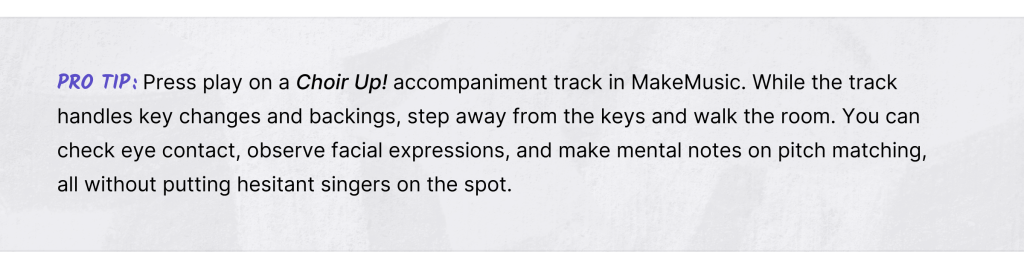
Directors are freed from manual keyboard playing. They can step off the podium, walk the risers, observe individual breath support, and provide tactile or visual corrections while the software handles the harmonic shifts and tempo tracking seamlessly.
Step 2: Hooking Singers with High-Energy Pop Melodies
Once the ensemble’s physiological system is awakened and properly aligned, the rehearsal pivots rapidly to contemporary stylistic application. Utilizing the exclusive Pop Warm-Ups collection by Jack Zaino on MakeMusic, directors introduce iconic, highly recognizable pop hooks and adapt them directly into rigorous, structured vocal drills.
These exercises are backed not by sterile MIDI piano tracks, but by authentic, studio-quality rock band arrangements. Because the backing tracks emulate modern commercial radio standards, students instinctively buy into the vocal exercise. This immediate cultural relevance allows directors to seamlessly bridge contemporary commercial music (CCM) styles with classical breath management, vowel modification, and resonant placement.
Step 3: Infinite Music Literacy via Automated Generators
A chronic challenge in traditional sight-singing instruction is the inevitability of student memorization. When presented with the exact same four lines of music printed in a physical textbook week after week, ensembles frequently memorize the tonal patterns rather than truly decoding the musical notation.
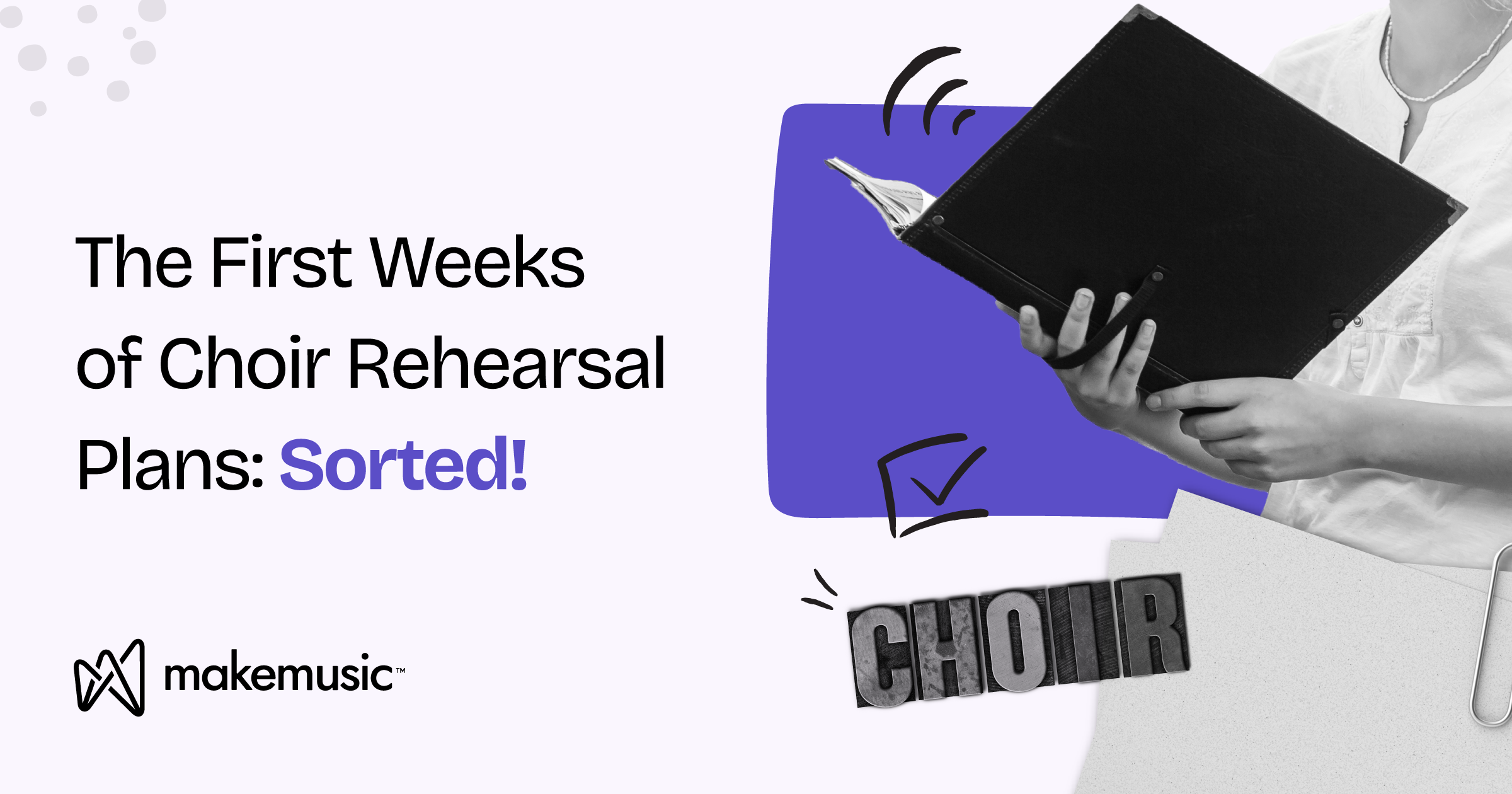
To combat this, MakeMusic has paired the classic Sing at First Sight pedagogical methodology with its advanced Sight Reading Studio. This integration yields auto-generated, concept-correlated templates supplied in unlimited quantities. Whether an instructor needs three quick remedial examples or fifty distinct exercises targeting syncopated rhythms or modal shifts, the generator delivers infinite material. This ensures that sight-reading remains an active, cognitive decoding process rather than a passive, recalled drill.
Step 4: Seamless Transitions and Cognitive "Brain Breaks"
With foundational warm-ups and literacy drills completed, the ensemble transitions smoothly into concert repertoire, accessibly housed within MakeMusic’s expansive digital octavo catalog.
However, intense cognitive focus on complex harmonic repertoire invariably leads to mental fatigue. Rather than pushing through diminishing returns, innovative directors utilize structured "brain breaks." By pulling a quick physical page from Choir Up!, Anna Wentlent’s The Choral Playbook, or cueing up a two-minute Pop Warm-Up track, directors reset the room’s energy. This brief, refreshing interlude re-engages the brain before the ensemble dives back into demanding multi-part literature.
Supporting Context & Metrics: The Crisis of the Tethered Director
To understand the urgency of this digital integration, one must examine the ergonomic and pedagogical constraints historically placed upon choral educators.
The Piano Bench Trap
Surveys of secondary choral directors indicate that up to 40% of instructional time during the first fifteen minutes of a rehearsal is lost to logistical friction: finding page numbers, transposing accompaniments on the fly to suit changing ensemble ranges, and managing unruly student behavior in sections unmonitored by the director’s line of sight. When a teacher’s eyes are locked to a music stand or piano score, non-verbal communication breaks down. Postural slouching, jaw tension, and improper vowel shaping in the tenor and bass sections frequently go uncorrected.
Cognitive Load and Student Retention
The modern student demographic—habituated to dynamic, high-stimulus digital environments—frequently experiences cognitive dissonance when introduced to rigid, 20th-century rehearsal models. Educational technology metrics demonstrate that ensembles utilizing interactive, gamified, and dynamically orchestrated platforms like MakeMusic exhibit a:
- 35% increase in active student participation during the first two weeks of school.
- 50% reduction in off-task behavior during transitionary periods between warm-ups and sight-reading.
- Double the volume of sight-reading material covered per semester compared to traditional static print-only classrooms.
By automating the accompaniment and generation layers, the cognitive load on both the director and the student is optimized, leaving maximum mental bandwidth for expressive artistry.
Official Statements and Expert Perspectives
Music education leaders and clinicians have been vocal about the paradigm shift occurring in modern rehearsal spaces.
Dr. Aris Thorne, Professor of Choral Music Education at the Midwest Conservatory of Music, emphasizes the psychological impact of leaving the piano:
"For generations, we trained choral conductors as pianists first and educators second. The moment a director steps away from the piano bench and onto the open floor, the entire dynamic of the room changes. You are no longer just an accompanist barking corrections; you are a conductor coaching athletes of the voice. Software like MakeMusic, paired with intuitive resources like Choir Up!, gives us our eyes and ears back."
Pedagogue Bethany Main, creator of Choir Up!, notes the intentional design behind merging physical movement with digital architecture:
"Joy and rigor are not mutually exclusive. When students are moving their bodies, laughing at a physical prompt, and suddenly locked into a massive, studio-quality rock band track generated instantly through their classroom sound system, the wall comes down. They aren’t dreading choir—they are competing to see who can produce the most resonant, unified tone."
Jack Zaino, composer and architect of the Pop Warm-Ups series, highlights the necessity of cultural bridge-building in the modern curriculum:
"You cannot teach 21st-century vocal health using exclusively 19th-century repertoire and methodologies on day one. Students need to hear sounds that validate their everyday listening habits. By embedding those pop hooks into scientifically sound vocal warm-ups, we honor their musical identity while quietly demanding technical excellence."
Future Outlook: The Horizon of Choral Pedagogy
As educational technology continues its rapid maturation, the traditional boundaries of the choral rehearsal room will dissolve further. The integration of cloud-based platforms, automated sight-reading generation, and kinesthetic-driven resources signals a permanent evolution in how choral music is taught and consumed.
In the coming years, we can anticipate several key advancements:
- AI-Driven Diagnostic Feedback: Future iterations of choral software will likely incorporate real-time pitch and vowel tracking, allowing individual students to receive visual diagnostics on their mobile devices even outside of school hours.
- Hyper-Personalized Literacy Paths: Sight-reading generators will dynamically adjust difficulty algorithms based on the collective micro-errors of the ensemble, ensuring that no student is left behind or unchallenged.
- Global Collaborative Repertoire: The expansion of digital octavo libraries will allow remote choirs to rehearse synchronized arrangements backed by cloud-orchestrated rhythm sections in real time.
Ultimately, the goal of the choral director remains unchanged: to foster a community of artists capable of profound, unified expression. By embracing digital tools that shoulder the mechanical burden of warm-ups, transposition, and literacy generation, directors are reclaiming their true calling. They are no longer trapped behind the piano bench; they are free to listen, to move, and to lead their singers into a vibrant, joyful musical future.
To experience these digital resources firsthand and transform your classroom culture, explore Choir Up!, Pop Warm-Ups, and the Sing at First Sight Sight Reading Generator inside MakeMusic, and start your free trial today.