
Executive Overview
The human voice is often perceived as an effortless extension of identity—a natural mechanism that allows us to speak, emote, and sing without conscious physical calculation. Yet, for millions, the vocal apparatus is a fragile instrument susceptible to mechanical breakdown, structural damage, and chronic fatigue. When pathology strikes the vocal cords, the repercussions extend far beyond physical discomfort; they erode confidence, disrupt professional ambitions, and silence lifelong passions.
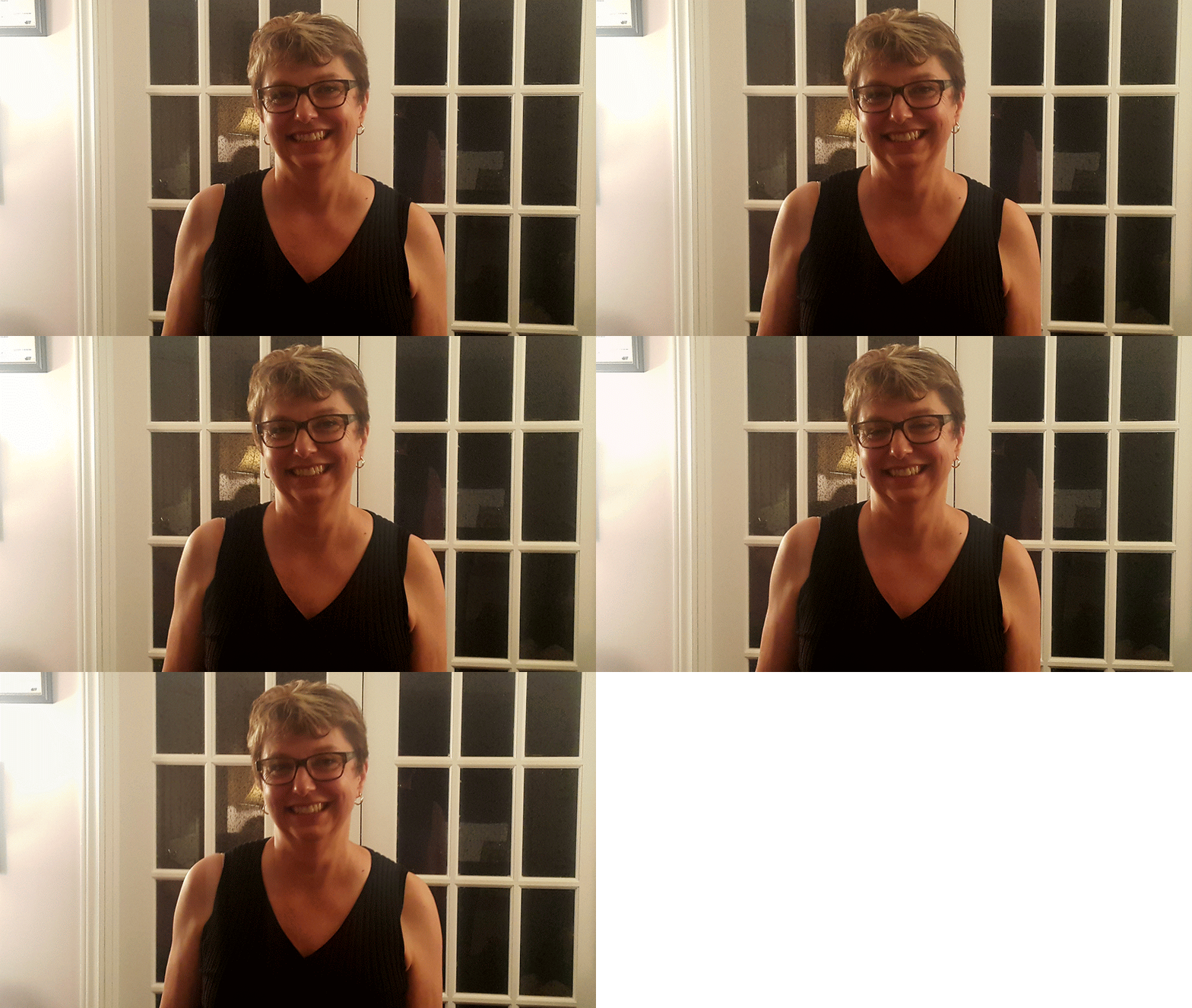
This journalistic case study examines the profound journey of Mary Ellen Stoll, a retired professional with a background in the biological sciences hailing from the Ottawa and Kingston regions of Ontario, Canada. Over three decades ago, Stoll underwent surgical intervention to remove benign nodules from her vocal cords—a common yet debilitating condition frequently caused by vocal strain, misuse, or chronic trauma. For over thirty years, this historical injury cast a long shadow over her life. Constrained by demanding career obligations and family responsibilities, Stoll largely abandoned her passion for singing. Her vocal instrument remained perpetually compromised: easily fatigued, notoriously unreliable, and prone to recurring episodes of complete laryngitis multiple times a year.
Upon entering retirement, Stoll sought to reclaim her creative voice by auditioning for a local ladies’ barbershop chorus. However, her aspirations hit an immediate wall. The chorus director expressed grave concerns regarding potential re-injury, and Stoll herself experienced immediate physical warning signs—notably, sharp vocal cord soreness following standard two-hour rehearsals.
Faced with what felt like a dead end in conventional vocal pedagogy, Stoll turned to Diana Yekinny (known professionally as Diana) and the proprietary Vocal Science™ methodology. Over an intensive 20-hour immersion program, Stoll underwent a radical physiological and mechanical recalibration of her speaking and singing voice. This report explores the nuances of Stoll’s rehabilitation, examining the intersection of biomechanics, holistic therapies, rigorous training, and the transformative potential of specialized vocal care.
Detailed Chronology: From Surgical Intervention to Vocal Renaissance
The Genesis of Injury: The Three-Decade Silence
To understand the magnitude of Stoll’s rehabilitation, one must examine the baseline pathology that initiated her struggles. Over thirty years ago, Stoll was diagnosed with vocal cord nodules—localized growths or calluses that develop on the vocal folds as a result of continuous acoustic trauma and hyper-functional phonation. When the vocal cords strike together aggressively over prolonged periods, tissue changes occur, leading to hoarseness, breathiness, and a loss of vocal range.
For Stoll, the medical solution of the era was surgical excision. While surgery successfully removed the physical nodules, it did little to address the root mechanical habits that caused them in the first place. Without a systemic retraining of how she projected her voice, Stoll was left with a structurally altered and vulnerable instrument.
"Since then I have not really gone back to singing as family plus heavy work obligations kept me very busy and my vocal cords were always a problem," Stoll reflects in her reference letter to prospective clients.
For decades, her vocal endurance remained compromised. The biological mechanisms responsible for sound production—the lungs, vocal folds, resonating cavities, and articulators—operated under a state of chronic compensation. Simple daily communication left her vocal cords fatigued, and environmental stressors or mild colds reliably triggered total bouts of laryngitis.
The Retirement Catalyst and the Barbershop Ambition
Retirement often serves as a crucible for personal reinvention. For Stoll, leaving the workforce opened a window to revisit long-abandoned artistic pursuits. She set her sights on joining a regional ladies’ barbershop chorus—a demanding vocal environment characterized by tight four-part a cappella harmonies, precise intonation, and significant projection requirements.
However, reality quickly intervened. The chorus director, attuned to the physical vulnerabilities of aging and previously injured voices, voiced legitimate anxieties about Stoll risking permanent vocal damage. These fears were validated during rehearsals. Following standard two-hour group practices, Stoll experienced unmistakable somatic feedback: acute soreness in her vocal cords.
The physiological message was clear: her old neuromuscular habits were incompatible with the rigorous demands of choral singing. Without intervention, her return to music would be short-lived and potentially hazardous to her long-term laryngeal health.
The Intervention: Entering the Vocal Science™ Ecosystem
Recognizing that traditional voice lessons or speech therapy approaches were insufficient for her complex history, Stoll initiated an exhaustive search for alternative methodologies. This search led her to Diana Yekinny and the Vocal Science™ studio—a practice renowned for treating stubborn, chronic, and seemingly intractable vocal pathologies.
Stoll enrolled in an intensive 20-hour program spread across several weeks. This was not a casual weekly lesson format; it was an immersive boot camp designed to dismantle decades of ingrained, destructive muscle memory.
According to Stoll, the methodology requires a fundamental shift in perception regarding how sound is produced. Rather than relying on throat tension and laryngeal squeezing—common traps for individuals with historical vocal injuries—the Vocal Science™ technique shifts the workload away from the delicate vocal folds and distributes it across the broader musculature of the face, head, and core.
"I can tell you after several hours with her my vocal cords do not hurt or aren’t tired—just my cheek muscles!" Stoll notes. "You can feel the difference in how you produce sound and volume."
The Breakthrough: The First Note
The culmination of the intensive training arrived at the conclusion of her initial sessions. For the first time in over thirty years, Stoll was cleared to sing freely utilizing her newly acquired mechanics. The result was nothing short of paradigm-shifting.
"At the end of my first sessions with Diana I finally got to sing for the first time and I was TOTALLY amazed," Stoll recalls. "I could not believe that I could produce that sound, that volume and clarity and length to hold a note without any change in pitch."
This milestone marked the psychological and physical turning point of her journey. The fear of re-injury was replaced by empirical proof of functional recovery.
Supporting Context & Metrics: The Anatomy of Vocal Rehabilitation
To appreciate the significance of Stoll’s recovery, it is necessary to examine the physiological parameters of vocal health, the economics of specialized rehabilitation, and the integration of alternative modalities in modern voice care.
Biomechanical Realignment vs. Traditional Pedagogy
Traditional vocal training often focuses on aesthetic output: tone quality, vowel modification, and musical interpretation. While valuable for healthy voices, this approach frequently fails individuals with compromised laryngeal tissue. When a patient has undergone nodule removal, the vocal folds may exhibit localized scarring, stiffness, or asymmetry in vibration.
The Vocal Science™ approach functions more like neuromuscular physical therapy fused with vocal coaching. Key components of this methodology include:
- Isolation of Effort: Shifting resonance from the intrinsic laryngeal muscles to the facial resonators (maxillary sinuses, hard palate, and zygomatic/cheek muscles). As Stoll observed, fatigue should register in the supportive facial framework rather than the delicate mucosal tissues of the vocal folds.
- Postural and Core Integration: Sound production begins with breath support. Realigning posture ensures that subglottic pressure is managed by the abdominal and intercostal muscles rather than being forced through a constricted throat.
- Hyper-Vigilant Monitoring: As Stoll points out, the training requires an instructor with exceptional sensory acuity. Diana’s ability to observe micro-tensions in the body in real-time allows for immediate course corrections before compensatory habits can take root.
The Role of Holistic and Herbal Interventions
As a professional with a lifetime career rooted in the biological sciences, Stoll admits to a natural inclination toward skepticism regarding alternative therapies. However, her experience with the herbal treatments recommended during her program challenged her initial assumptions.
In vocal rehabilitation, inflammation is the primary enemy. Edema (swelling) of the vocal folds dampens their ability to vibrate efficiently, leading to hoarseness and vocal fatigue. While pharmaceutical anti-inflammatories are sometimes prescribed, they can carry systemic side effects or cause drying of the mucosal lining—an anathema to vocal health. Targeted herbal formulations, often possessing demulcent, anti-inflammatory, or mucilaginous properties, can soothe laryngeal tissues topically and systemically without desiccating the vocal folds. Stoll’s empirical observation of these treatments working in real-time bridged the gap between her scientific background and holistic vocal care.
Investment, ROI, and Opportunity Cost
Specialized, intensive vocal rehabilitation is a significant financial commitment. Programs that demand personalized, one-on-one immersion over dozens of hours do not come cheaply. Stoll candidly addresses this reality:
"As for the cost—it is not insignificant. You WILL get results and I would do it all again with Diana. I wish I had looked for and found her about 20 years ago. It would have saved me years of frustration with my voice."
When analyzing the return on investment (ROI) of such programs, one must look beyond monetary metrics. The cost of untreated vocal dysfunction includes:
- Psychological Toll: The anxiety of public speaking, social withdrawal, and the grief of losing one’s artistic outlet.
- Medical Expenses: Repeated visits to otolaryngologists (ENTs), speech-language pathologists, and treatments for chronic laryngitis.
- Time Lost: Decades of deferred dreams, as Stoll experienced.
Viewed through this lens, upfront investment in specialized mechanical retraining proves to be a cost-effective measure against a lifetime of chronic frustration and recurrent medical intervention.
Official Statements and Testimonial Analysis
Mary Ellen Stoll’s reference letter serves as a primary source document offering a transparent, unvarnished window into the realities of advanced vocal repair. Below is an analytical breakdown of key excerpts from her correspondence with future clients:
On the Nature of the Training
"I am not saying its easy—it requires effort and dedication on your part and patience on Diana’s part. She has an amazing eye and ear and is observing you the whole time, and quick to tell you when something is wrong with your voice or your body."
Analysis: This statement highlights the collaborative yet demanding nature of corrective vocal work. True rehabilitation cannot be achieved through passive reception; it requires active neuromuscular reprogramming. The instructor acts as an exacting diagnostic mirror, reflecting postural flaws, breath inefficiencies, and laryngeal tension that the student is often entirely unaware of.
On Authenticity and Expectations
"From what I have experienced I would say all the testimonials you read on the Vocal Science and Repair Your Voice website are accurate. Diana has spent over 30 years of her life creating and fine tuning her techniques and it shows."
Analysis: In an industry occasionally populated by dubious quick-fix claims, validation from a medically and scientifically literate client carries substantial weight. Stoll’s verification of the authenticity of her peers’ testimonials reinforces the empirical validity of the Vocal Science™ framework.
Future Outlook: Implications for Vocal Health and Aging Artists
Stoll’s successful rehabilitation offers a broader blueprint for aging populations, professional speakers, and vocal artists navigating historical injuries. As life expectancy increases and active retirement becomes the societal norm, older adults are increasingly unwilling to accept physical decline as an inevitable consequence of aging.
The Growing Need for Preventive and Corrective Voice Care
The medical community has long recognized the importance of vocal hygiene, yet specialized training for post-surgical or chronically strained voices remains underrepresented in standard health care pathways. Often, once acute pathology (such as nodules or polyps) is surgically removed, patients are discharged with minimal guidance on how to alter the vocal behaviors that caused the pathology initially.
This gap in the continuum of care creates a vast population of individuals—much like Stoll prior to her work with Diana—who wander through decades of vocal frustration, self-limiting their social, artistic, and professional lives.
Paradigm Shifts in Interdisciplinary Voice Therapy
The future of vocal rehabilitation lies in the synthesis of traditional otolaryngology, rigorous vocal pedagogy, and holistic body mechanics. As demonstrated by Stoll’s journey:
- Cross-Disciplinary Openness: Individuals trained in hard sciences can successfully integrate holistic and non-traditional interventions when supported by empirical, observable results.
- Lifelong Vocal Plasticity: The adult nervous system retains a remarkable capacity for neuroplasticity. Even after thirty years of ingrained compensatory habits, targeted mechanical intervention can rewrite neuromuscular pathways, proving that it is never too late to reclaim one’s voice.
Conclusion
Mary Ellen Stoll’s journey from post-surgical vocal disability and chronic laryngitis to empowered choral singer stands as a testament to the resilience of the human spirit and the efficacy of specialized vocal engineering. By confronting her limitations head-on, committing to an intensive 20-hour immersion program, and embracing unorthodox modalities under expert tutelage, Stoll transformed her retirement years.
For future clients standing at the crossroads of vocal frustration and recovery, her message is unequivocal: while the journey demands physical effort, financial investment, and unwavering dedication, the reward is nothing less than the reclamation of one’s authentic voice.