
Executive Overview
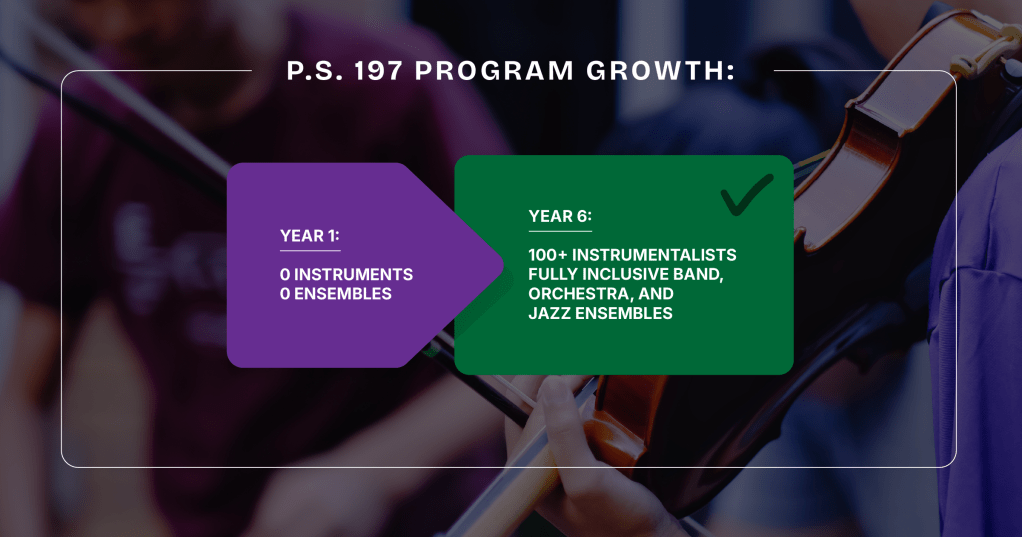
When Kimberly Rosenbaum stepped through the doors of P.S. 197, The King’s Highway Academy, in central Brooklyn six years ago, she faced a daunting challenge that would cause many educators to hesitate. School administrators presented her with a blank slate and an ambitious directive: build a comprehensive instrumental music program entirely from scratch. At the time, the school possessed no band, no orchestra, and zero instrumental inventory. There was no institutional foundation to build upon, no legacy equipment lockers, and no established student pipeline.
Today, that narrative of scarcity has been thoroughly rewritten. P.S. 197 boasts a thriving musical ecosystem comprising a vibrant fourth-grade band, a fifth-grade band, an after-school string orchestra, a specialized jazz band, and an inclusive policy that welcomes students receiving special education services who want to participate in music-making. Managing a booming school population of 1,200 students spanning grades 3K through fifth grade is an extraordinary operational feat. Yet, Rosenbaum manages roughly 15 general music sections while carving out time for small-group instruction during compressed 20-minute lunch and recess windows.
To achieve this level of scale without sacrificing instructional quality, Rosenbaum turned to digital innovation. By integrating the interactive practice platform MakeMusic into her daily routine, she transformed a logistical nightmare into a streamlined, highly effective teaching environment. This case study explores how Rosenbaum leveraged pedagogical strategy, software automation, administrative loopholes, and an unwavering commitment to equity to turn an empty room into a symphony of more than 100 instrumentalists.
Detailed Chronology: The Evolution of P.S. 197’s Music Program
The transformation of P.S. 197 did not happen overnight. It required a methodical, multi-year rollout that carefully balanced institutional growth with pedagogical resource management.
Phase One: Laying the Foundation (Years 1–2)
During the initial years, the primary hurdle was inventory and infrastructure. With no instruments in the building, Rosenbaum focused on securing grants, community donations, and basic school funding to purchase starter band and string instruments—flutes, clarinets, trumpets, violins, and cellos. Concurrently, she introduced introductory general music and recorder units to gauge student interest, establish classroom management norms, and identify students displaying early aptitudes for specific instrument families.

Phase Two: Establishing Ensembles and Scaling Up (Years 3–4)
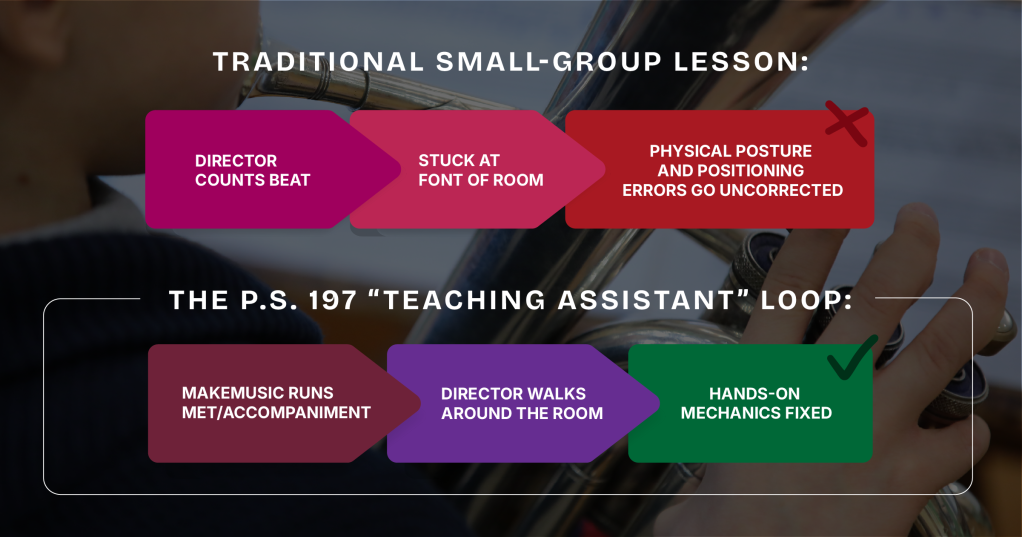
As student interest surged, P.S. 197 quickly outgrew traditional teaching methods. With a school population expanding toward 1,200 children, the sheer volume of students eager to play created severe scheduling bottlenecks. Rosenbaum was forced to conduct small-group lessons during compressed 20-minute lunch and recess periods. Teaching a cluster of ten beginner alto saxophones or brass players in a narrow window of time presented severe instructional challenges. If the director remained stuck at the front of the room waving a baton or counting aloud, individual physical corrections became nearly impossible. It was during this critical juncture that MakeMusic was introduced to act as an automated digital conductor, freeing Rosenbaum to move around the room and provide targeted, hands-on guidance.
Phase Three: Full Integration and Inclusivity (Years 5–6)
By years five and six, the program evolved into a multifaceted cultural hub within central Brooklyn. The daily operations expanded to include distinct fourth- and fifth-grade bands, an after-school string orchestra, and a dedicated jazz ensemble. Crucially, the program achieved true inclusivity, fully integrating students receiving special education services and English Language Learners (ELL). Through localized digital adaptations—such as deploying Spanish-translated editions of Alfred Music’s Sound Innovations directly within the platform—Rosenbaum ensured that language barriers never stood in the way of musical expression. Today, the program serves well over 100 dedicated instrumentalists, standing as a testament to what is possible when vision meets the right technological tools.
Supporting Context & Metrics: Navigating Scale and Logistics
Running a comprehensive instrumental program within a bustling New York City public school involves mastering complex operational frameworks. The numbers behind P.S. 197’s success highlight the sheer scale of Rosenbaum’s daily routine:
- Total School Population: 1,200 students spanning grades 3K through 5th.
- Instructional Load: Approximately 15 general music sections taught weekly.
- Ensemble Inventory: Fourth-grade band, fifth-grade band, after-school string orchestra, and a specialized jazz band.
- Active Instrumentalists: Over 100 students engaged in regular instrumental performance.
- Lesson Constraints: Small-group instrumental pull-outs compressed into 20-minute lunch and recess windows.
The In-Class "Teaching Assistant"
In a high-density, low-time instructional environment, traditional pedagogical approaches often break down. When teaching a cluster of beginning wind players, an educator cannot simultaneously maintain a steady tempo, read the score, and check the embouchure, hand position, and posture of every child in the room.
By utilizing MakeMusic as an automated conductor, Rosenbaum bypassed this bottleneck. The software handles the mechanical aspects of practice—providing accurate visual and auditory count-offs, playback accompaniments, and interactive pacing.
"MakeMusic allows me to take a step away from being a conductor and lets me really focus on just being a teacher," Rosenbaum explains. "They know the count-off is coming, the program takes them through, and I can go student-by-student down the line to fix hand position, embouchures, and instrumental positions while they play."
Unlocking NYCDOE Procurement: The "Sole Source" Shortcut
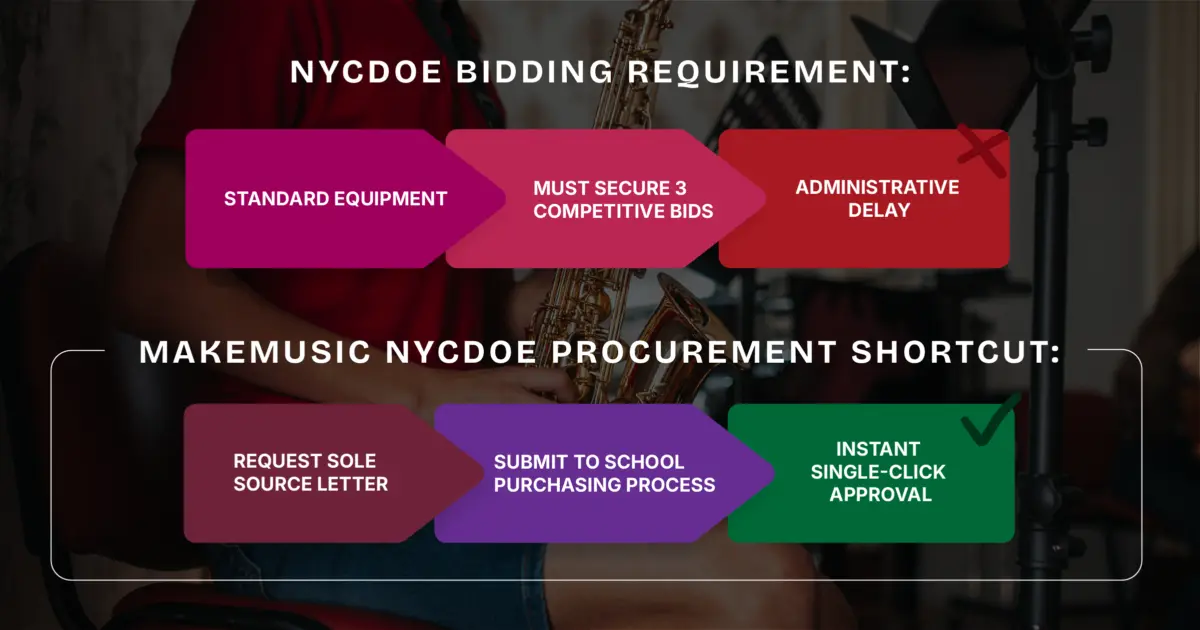
For many educators working within the New York City Department of Education (NYCDOE), navigating bureaucratic purchasing portals such as FAMIS and ShopDOE can feel like navigating a labyrinth. Standard district procurement rules often mandate securing three competitive bids from different vendors for software acquisitions—a lengthy bureaucratic hurdle that can stall digital rollouts for months.
Rosenbaum discovered a streamlined procurement shortcut that is replicable by music educators across the district: the Sole Source Vendor Letter.
"MakeMusic provides a sole-source letter stating you can’t buy this tool anywhere else," notes Rosenbaum. "You give that letter to your purchasing secretary, and they don’t have to ask for three bids because there’s only one source. It’s one of my easiest purchases of the entire year." This administrative maneuver effectively removed the red tape, allowing technological resources to reach students without unnecessary delay.
Universal Access and Equity
Central Brooklyn is celebrated for its rich cultural diversity, which is directly reflected in the hallways and classrooms of P.S. 197. A significant percentage of the student body comes from multi-lingual households or enters the school system as English Language Learners (ELL).
To prevent these linguistic and cultural factors from becoming obstacles to musical participation, Rosenbaum utilized the flexibility of digital platforms. By layering core method books with supplemental digital materials, she integrated Spanish-translated editions of Alfred Music’s Sound Innovations directly into the student interface. Furthermore, the platform’s visual red-and-green note feedback engine provides young musicians with an intuitive, non-verbal practice partner at home. Students do not need to master complex English instructional texts to understand whether they played the correct pitch at the correct time; the software provides immediate, color-coded visual validation.
Official Statements and Educator Insights
The philosophy driving P.S. 197’s music program is rooted in student empowerment, equity, and the democratization of the arts. Rather than viewing software as a replacement for human instruction, Rosenbaum views it as a force multiplier that extends the reach of a single educator working within a large urban school district.
"MakeMusic isn’t a rigid curriculum; it’s a flexible tool. You’re giving students access to resources they wouldn’t otherwise have. When you give a kid an instrument and the right tools to practice, they just take off with it. Why wouldn’t you give them that opportunity?" — Kimberly Rosenbaum, Music Educator, P.S. 197
Industry analysts and arts education advocates frequently point to P.S. 197 as a prime model for urban music advocacy. In an era where arts funding faces constant scrutiny and class sizes continue to climb, innovative programmatic design combined with targeted ed-tech solutions offers a sustainable roadmap for survival and growth. By decentralizing the practice room and empowering students to self-correct during independent and small-group sessions, educators can cultivate high-functioning ensembles even when working under tight budgetary and scheduling constraints.
Future Outlook: The Blueprint for Urban Music Programs
As P.S. 197 looks toward the future, the primary objective is sustainability and expansion. Having successfully broken the barrier of zero instruments to establish a robust community of over 100 instrumentalists, the next frontier involves deepening community engagement and exploring advanced repertoire for the school’s growing jazz and orchestral wings.
Rosenbaum’s journey offers a replicable blueprint for public school music educators nationwide who find themselves tasked with building programs under challenging circumstances. The core lessons of the P.S. 197 case study are clear:
- Embrace Technological Leverage: Utilize digital tools not to replace the teacher, but to act as an in-class assistant that manages pacing and allows for individualized physical coaching.
- Master Administrative Pathways: Learn the procurement policies of your district. Utilizing mechanisms like sole-source letters can bypass months of bureaucratic delays.
- Prioritize Universal Access: Meet students where they are linguistically and culturally by leveraging translated texts, visual feedback systems, and inclusive ensemble policies.
- Focus on Empowerment: View students as capable musicians who, when provided with the proper tools and instruments, will naturally take ownership of their artistic development.
For educators on the fence about incorporating digital practice software with elementary or urban ensembles, Rosenbaum’s experience provides a compelling answer. By tearing down structural, administrative, and linguistic barriers, schools can transform silent, empty rooms into vibrant spaces where young musicians can find their voice and take flight.