
Executive Overview
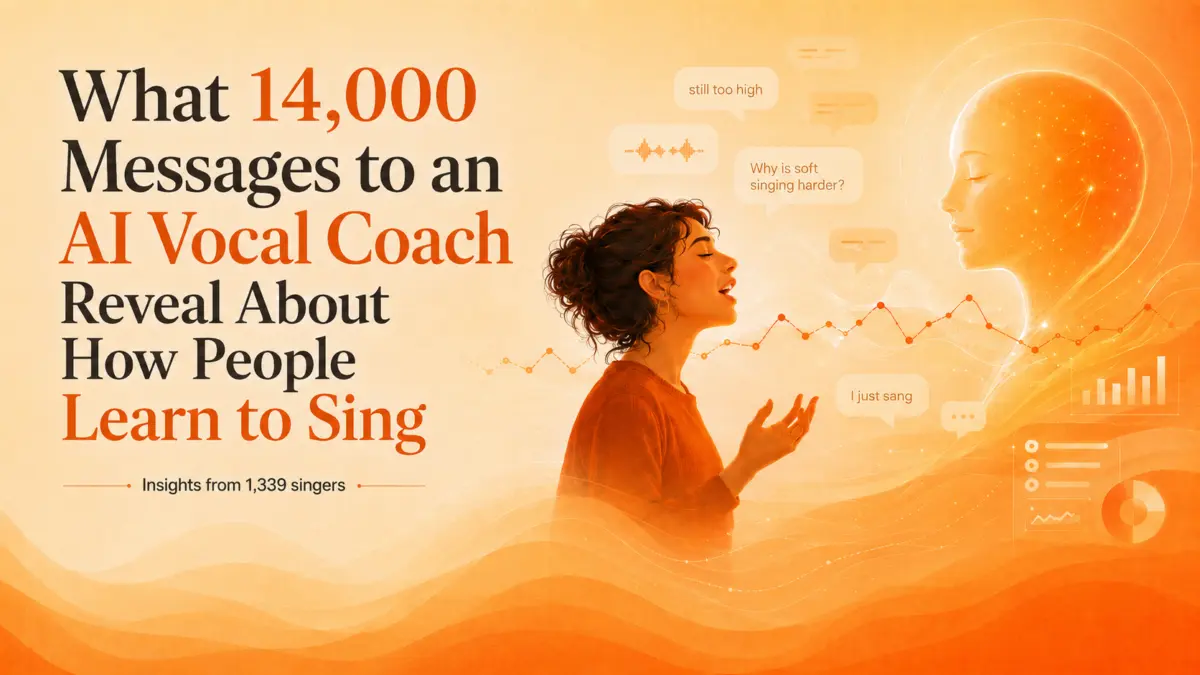
In the field of music education, the barrier between student and master has traditionally been defined by the high cost of private instruction, geographical limitations, and the acute performance anxiety that accompanies vocal training. However, data from a groundbreaking study of user interactions with artificial intelligence suggests that a quiet revolution is underway.
Since the launch of Singing Carrots’ AI Vocal Coach in November 2025, the platform has logged 14,091 messages from 1,339 distinct users across the globe, representing a subset of more than 2,000 singers who have initiated over 13,000 coaching sessions.
An aggregate, anonymized analysis of these interactions offers an unprecedented, unfiltered look at the reality of vocal practice in 2026. Rather than treating the AI as a static, automated search engine, users are engaging in dynamic, highly personalized dialogues. They negotiate the terms of their practice, push back against algorithmic suggestions, and use the privacy of the digital interface to confront deep-seated performance anxieties.
The findings challenge long-held assumptions about how amateur musicians learn. The data reveals that modern singers are not passive recipients of instruction; instead, they are active co-creators of their learning environments. By utilizing the AI to bypass the psychological friction of human judgment, these learners are integrating rigorous vocal practice into the margins of their daily lives—transforming bedrooms, cars, and kitchens into high-tech music studios.
Detailed Chronology: From Algorithmic Launch to Agentive Partnership
The evolution of the AI Vocal Coach from a novel utility to an interactive learning partner occurred rapidly over an eight-month period between late 2025 and mid-2026.
[November 2025: AI Vocal Coach Launched]
       │
       ├─► [December 2025: Transition to Active Dialogue]
       │   Singers move beyond basic setup queries; begin negotiating lesson terms.
       │
       ├─► [March 2026: The Rise of "Prompt Engineering"]
       │   Power users bypass standard UI to input custom system prompts and sheet music.
       │
       └─► [July 2026: 14,000+ Messages Logged]
           Analysis reveals a global, 24/7 practice network integrated into daily life.
Phase I: The Novelty of Automated Feedback (November–December 2025)
When the AI Vocal Coach was introduced in November 2025, initial interactions were characterized by standard technical queries and navigational troubleshooting. Users sought to understand the parameters of the software, asking how to calibrate their microphones or select basic warm-up routines. However, within weeks, a distinct shift occurred. The vocabulary of the messages began to mirror that of a traditional voice studio. Users stopped asking how to use the software and started asking why their voices were behaving in specific ways.
Phase II: The Emergence of the "Power User" (Early to Mid-2026)
By the spring of 2026, a significant cohort of users had begun to bypass the pre-programmed pathways of the application. Rather than simply following the prompts of the AI, these singers began treating the system with the agency reserved for advanced LLM (Large Language Model) interfaces.
They initiated "prompt engineering" sessions, pasting complex, custom instructions directly into the chat interface. Singers demanded highly specific pedagogical approaches, instructing the AI to act as a "strict, real-time vocal trainer" or pasting digital sheet music notation to request precise structural breakdowns. This period marked the transition from passive consumerism to active pedagogical design.
Phase III: The Maturity of the Dataset (July 2026)
By July 15, 2026, the dataset had swelled to over 14,000 messages. The geographic and temporal distribution of these messages confirmed that vocal practice had decoupled from traditional time zones and schedules. The volume of practice remained remarkably consistent across all seven days of the week, proving that access to an on-demand digital coach had successfully integrated vocal training into the daily, domestic routines of its users.
Supporting Context & Metrics: Deconstructing the Anatomy of Vocal Struggle
The quantitative data harvested from the Singing Carrots database exposes a stark alignment between what amateur singers feel they are struggling with and what acoustic analysis proves they are actually doing wrong.
                  COMMON VOCAL STRUGGLES REPORTED BY USERS

  Pitch Accuracy   ████████████████████████████████ 256 Singers

  Vocal Range      ██████████████████████████████ 245 Singers

  Register Shifts  █████████████████ 139 Singers

  Active Negotiators ████████████████ 136 Singers
The Triumvirate of Vocal Obstacles
Among the 1,339 singers analyzed, three primary technical challenges dominated the corpus:
- Pitch Accuracy (256 Singers): Staying in tune remains the preeminent hurdle for amateur vocalists. One in five users explicitly sought assistance with pitch correction, questioning whether they were singing flat or sharp.
- Vocal Range and High Notes (245 Singers): Nearly equal to pitch concerns was the desire to expand vocal range. Within this group, 182 singers specifically focused on the mechanics of singing higher notes, expressing a desire to expand their upper register.
- Register Navigation (139 Singers): The physical transition between chest voice, head voice, falsetto, and the elusive "mixed voice" represents a significant source of confusion. Users frequently expressed frustration over their inability to identify or feel these physiological shifts.
The Correlation with Acoustic Reality
What makes the self-reported data compelling is how precisely it correlates with objective acoustic performance. In a parallel, large-scale quantitative analysis conducted by Singing Carrots—which examined 632,000 individual missed notes—it was revealed that 65.7% of all vocal errors committed by amateur singers are flat notes, concentrated heavily in their upper registers.
This demonstrates that amateur singers possess a high degree of intuitive self-awareness; they are not deluded about the shortcomings of their voices. Instead, they lack the immediate, actionable feedback loops required to correct the physiological errors they are already aware of making.
The Power of Active Dialogue
Perhaps the most surprising metric to emerge from the study is that only 19% of the 14,091 messages sent to the AI were questions. The remaining 81% of the corpus consisted of active dialogue, negotiation, and behavioral pushback.
- Pedagogical Negotiation: At least 136 singers actively argued with or modified the difficulty settings of their sessions. When a routine was too taxing, they commanded the AI to "slow it down by 60%" or protested that the key was "still too high." Conversely, when unchallenged, users demanded more rigorous material, with one user noting, "This is way too easy and quite boring to be honest."
- The Correlation with Improvement: This negotiation is not merely conversational noise. Singing Carrots’ seven-month outcomes data reveals a direct, positive correlation between conversational engagement and vocal improvement. Singers who frequently communicated with, questioned, and challenged the AI practiced more consistently and demonstrated greater measurable progress in pitch stability and range expansion than those who interacted with the platform passively.
Official Statements & Anthropological Analysis: Voices from the Studio
The qualitative data embedded in the message logs provides an intimate, often humorous, and deeply human look at the psychology of practice. Stripped of the performative polish required for social media or live audiences, these messages reveal the vulnerability of the learning process.
"The Freddie Mercury Clause" and the Psychology of the Safe Space
A recurring phenomenon in the dataset is what researchers have termed "The Freddie Mercury Clause." Users frequently asked the AI to engage in roleplay scenarios designed to test their loftiest musical ambitions:
"Okay, let’s pretend I was Freddie Mercury and was singing Bohemian Rhapsody to you—what would you comment on it?"
Another user inquired:
"What would you tell me of my voice if I was Adele?"
These queries point to a critical psychological truth: learning to sing is an act of extreme vulnerability. In front of a human instructor, admitting to such grand ambitions can feel foolish or embarrassing.
The AI, by virtue of its non-judgmental, purely functional nature, provides a psychological safe space. In this private digital environment, users are free to audition their "fantasy selves," build confidence, and then return to the mundane, repetitive work of vocal scales.
Humility, Humor, and Domestic Reality
The raw transcripts also highlight the domestic environments in which digital learning occurs. Practice sessions are frequently interrupted by the realities of shared spaces and family life:
"Stop for today, my cat wants to sleep."
Other users relied on self-deprecating humor to describe their technical struggles:
"It’s so hard for me, the higher ones close to C5—I sound like a dying cat."
Yet, amidst the humor, there are moments of profound artistic breakthrough. One user, reflecting on their struggle to hit a specific note without tensing their vocal cords, wrote:
"The first time, I let myself be confused by a fear of overshooting the fa. The last time, I just sang."
This single observation captures the primary goal of vocal pedagogy: moving a student past cognitive interference and physical tension into a state of intuitive, uninhibited physical expression.
Future Outlook: The Rise of Hybrid Pedagogy
The data gathered from Singing Carrots’ AI Vocal Coach suggests that the future of music education will not be defined by a zero-sum competition between human instructors and artificial intelligence. Instead, we are entering an era of hybrid pedagogy, where digital tools support and extend traditional learning frameworks.
                      THE HYBRID PEDAGOGY ECOSYSTEM

    ┌────────────────────────┐          ┌────────────────────────┐
    │  Human Vocal Coach     │          │  AI Vocal Coach        │
    ├────────────────────────┤          ├────────────────────────┤
    │ • Deep artistic mentorship│       │ • 24/7 availability    │
    │ • Complex physiological│  ◄────►  │ • High-volume practice │
    │   adjustments          │          │ • Judgment-free space  │
    │ • Emotional connection │          │ • Real-time pitch data │
    └────────────────────────┘          └────────────────────────┘
                ▲                                    ▲
                │                                    │
                └───────────────┬────────────────────┘
                                │
                                ▼
                    ┌────────────────────────┐
                    │     Modern Singer      │
                    └────────────────────────┘
Democratization and Integration
The AI coach is not replacing the human teacher; rather, it is filling the vacant space of daily practice. Traditional voice lessons are expensive and typically occur once a week. In the intervening six days, students are left to practice alone, often reinforcing bad habits or avoiding practice altogether out of fear of making mistakes.
The AI coach solves this problem by providing real-time, low-stakes feedback exactly when the student needs it—whether that is at 11:00 PM on a Tuesday in a parked car, or 50 minutes before a community choir rehearsal.
Empowering the Amateur Musician
Ultimately, the ambitions of the singers in this dataset are modest and community-focused. They are not seeking global fame or record deals; they are preparing to sing in their local church praise bands, community choirs, school musicals, or local karaoke nights.
By lowering the financial and psychological barriers to entry, AI vocal coaching is democratizing the joy of singing. It allows ordinary people to quietly build their skills in private so they can step forward and share their voices in public. As technology continues to evolve, the line between taking a lesson and designing one will continue to blur, placing the tools of vocal mastery directly into the hands of the singers themselves.