
Executive Overview
For over half a century, the history of American musical theater was inextricably linked to a small, unassuming theater off-Broadway, where a whimsical, poetic fable about young love quietly racked up a record-breaking 17,162 performances. Yet, remarkably, Tom Jones and Harvey Schmidt’s iconic masterpiece, The Fantasticks, had never received a proper Broadway production—until now.
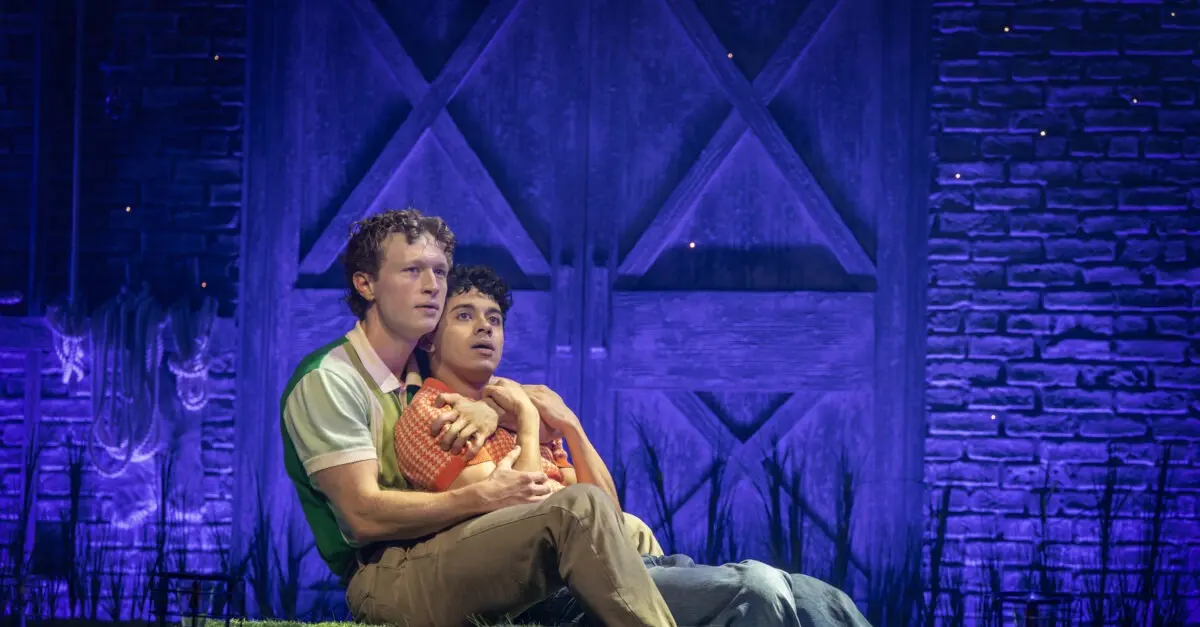
On November 16, Second Stage Theater officially brought a revolutionary, long-awaited reimagining of the world’s longest-running musical to the Hayes Theatre, following previews that began on October 22. This landmark staging shatters decades of theatrical tradition by reframing its central romantic allegory through a queer lens. Directed and choreographed by Tony Award winner Christopher Gattelli (Schmigadoon!, Death Becomes Her, Newsies), this production transforms the original musical’s starry-eyed boy-and-girl protagonists, Matt and Luisa, into Matt and Lewis—two young men navigating the perilous, beautiful terrain of first love. Simultaneously, the interfering fathers who orchestrate their children’s clandestine affair have been reconceived as mothers, radically shifting the familial and societal dynamics of the narrative.
As the curtain fell on opening night, the critical establishment responded with a flurry of reviews, capturing the theatrical community’s complex, fascinating reactions to this historic revival. Boasting a stellar cast featuring Maxim Chlumecky, Nathan Levy, and Zane Phillips alongside Broadway heavyweights like Leslie Rodriguez Kritzer and Ruthie Ann Miles, The Fantasticks has firmly planted itself at the center of contemporary cultural conversations. This comprehensive report explores the journey of this groundbreaking production, detailing its evolution from regional development to the Great White Way, breaking down its creative architecture, reviewing the critical consensus, and evaluating what this queer evolution means for the enduring legacy of a theatrical institution.
Detailed Chronology: From Flint to Broadway
The path of this gender-bent, queer-centric The Fantasticks to the Hayes Theatre was neither swift nor accidental; it represents a carefully stewarded journey of artistic development that spans half a decade and multiple regional stages.
The Genesis and Regional Incubators (2022–2024)
The roots of this modern transformation trace back to 2022 at the Flint Repertory Theatre in Flint, Michigan. Working in close collaboration with then-Flint Repertory Producing Artistic Director Michael Lluberes, the creative team set out to fulfill a long-held desire of original co-creator Tom Jones, who had privately and publicly mused about seeing a gender-swapped, queer iteration of his classic work.
Far from being treated as a cheap gimmick, the material was carefully stress-tested to see if its timeless themes of illusion, disillusionment, and the painful passage into maturity could withstand a same-sex framework. The experiment yielded powerful emotional results. Recognizing the production’s potential to spark a national conversation, the creative team took the show on a developmental tour, workshopping and refining the text and staging at the historic Provincetown Playhouse in Provincetown, Massachusetts, and subsequently at Coachella Valley Repertory in Cathedral City, California. These regional runs allowed Gattelli and his collaborators to iron out tonal shifts, deepen character motivations, and ensure that the musical’s signature whimsy remained intact even as its socio-cultural context shifted dramatically.
The Uptown Migration and Previews (Fall 2026)
By the late summer of 2026, anticipation had reached a fever pitch within the theater district. Second Stage Theater announced that it would host the historic Broadway bow at the Hayes Theatre, setting an official opening date for November 16 following an October 22 preview period.
The arrival of The Fantasticks on Broadway marked a historic milestone: despite its global cultural footprint—having been performed in all 50 states and over 60 foreign countries—the title had never graced a Broadway stage during its legendary 42-year original off-Broadway run at the Sullivan Street Playhouse, nor during its subsequent revival at the Snapple Theater Center. Previews at the Hayes Theatre drew immediate attention from theater purists, cultural critics, and LGBTQ+ advocates alike, sparking intense debate across social media and theater forums about the boundaries of adaptation and the modernization of classic texts.
Opening Night and Critical Deluge (November 16, 2026)
When the official opening night arrived on November 16, the floodgates opened for a diverse spectrum of theatrical criticism. Major outlets, digital theater critics, and veteran reviewers rushed to weigh in on whether this "lavender moon" reimagining successfully revitalized a vintage chestnut or if the adjustments revealed fractures in the original structural framework.
As reviews continue to roll in from across the media landscape, Playbill and cultural chroniclers have kept a close eye on the shifting critical consensus, documenting an artistic gamble that forces audiences to reconsider what they thought they knew about "Try to Remember," moonlit walls, and the bittersweet education of the human heart.
Supporting Context & Metrics: The Creative Architecture and Production Data
To fully appreciate the scope of this Broadway revival, one must examine the meticulous engineering behind the production, from its cast and crew to its physical design metrics.
Cast and Creative Roster
Director and choreographer Christopher Gattelli has assembled an ensemble that bridges rising Broadway stars with seasoned veterans of the musical stage:
- The Boy (Matt): Maxim Chlumecky (Appropriate)
- The Boy (Lewis): Nathan Levy (& Juliet, Aladdin)
- The Narrator (El Gallo): Zane Phillips (The Comeback, MidCentury Modern, Fire Island)
- Matt’s Mother (Mildred Hucklebee): Leslie Rodriguez Kritzer (Spamalot, Beetlejuice)
- Lewis’s Mother (Bessie Mae Bellomy): Ruthie Ann Miles (Sweeney Todd, The King and I)
- The Man Who Dies (Mortimer): Kevin Del Aguila (Some Like It Hot, Frozen)
- The Old Actor (Henry): David Patrick Kelly (Once, The Warriors)
- The Mute: Ahmad Simmons (Illinoise, Hadestown)
Design and Musical Leadership
Gattelli’s vision is supported by an elite tier of Broadway designers, many of whom hold Tony and Emmy accolades:
- Scenic Design: Jason Sherwood (Emmy Award winner)
- Costume Design: Linda Cho (Tony Award winner)
- Lighting Design: Jen Schriever (Tony Award winner)
- Sound Design: Nevin Steinberg (Tony Award winner)
- Music Supervision and Orchestrations: Sam Davis
- Music Direction: Rick Hip-Flores
Critical Reception Matrix
The critical response to the production has been exceptionally varied, reflecting the deep emotional investment audiences hold in the original material. Reviewers have generally split into three distinct camps:
- The Enthusiasts: Critics from outlets such as The Wrap, TimeOut, and The Guardian praised the production for making "new magick" under a literal and figurative lavender moon, arguing that shifting the romance to a same-sex couple makes the universal themes of adolescent longing and parental scheming feel startlingly fresh and necessary.
- The Moderates: Publications like The New York Times, The New York Sun, and New York Stage Review acknowledged the cleverness of the adaptation and the strength of performances by actors like Leslie Rodriguez Kritzer and Ruthie Ann Miles, while questioning whether the whimsical, allegorical nature of Jones and Schmidt’s book entirely supports the weight of contemporary queer realism.
- The Skeptics: Some reviewers, including voices from TheaterMania and specialized drama critics, suggested that while the production offers a "gay old time," it occasionally hesitates to fully commit to the radical potential of its premise, leaving some audience members wanting a more thorough deconstruction of the original’s dated tropes.
Official Statements and Artistic Intentions
The motivation behind reshaping The Fantasticks is deeply rooted in the wishes of its original creators and the artistic philosophy of Second Stage Theater.
Tom Jones, one half of the legendary songwriting duo that penned the show in 1960, spent his later years openly contemplating how the show’s archetypal romance might translate through a gender-bent lens. Jones recognized that the core narrative—a tale of youthful romantic fantasy crashing against harsh reality, only to be salvaged by hard-won reconciliation—is fundamentally human rather than strictly heterosexual. By giving his blessing to these early developmental conversations, Jones ensured that his work would not remain a museum piece frozen in the mid-20th century, but rather a living, breathing text capable of evolving alongside societal definitions of love and family.
Director and choreographer Christopher Gattelli elaborated on this vision, noting that turning the feuding fathers into meddling mothers (Mildred Hucklebee and Bessie Mae Bellomy) and the romantic leads into Matt and Lewis does not break the show’s poetic framework; rather, it deepens it. In interviews leading up to the opening, Gattelli emphasized that the universal ache of wanting to be seen, loved, and initiated into adulthood resonates just as powerfully—if not more so—when filtered through the historical and emotional realities of queer youth.
Second Stage Theater’s decision to house this production at the Hayes Theatre underscores an institutional commitment to taking bold, calculated risks with classic American titles. By placing works of historical significance into contemporary dialogues, Second Stage continues to position itself as a vital laboratory where theatrical heritage meets modern cultural inquiry.
Future Outlook
As The Fantasticks settles into its historic run at the Hayes Theatre, the broader implications for the American musical theater landscape are profound. For decades, classic revivals have often played it safe, relying on nostalgic recreations of past productions to draw tourist-heavy box offices. Second Stage’s gamble proves that audiences and producers are increasingly hungry for intellectual re-examinations of the theatrical canon.
The success—and the healthy critical debate—surrounding this queer revival opens the door for other foundational musicals to be re-evaluated through diverse lenses. If a piece as historically rigid and stylized as The Fantasticks can successfully pivot its romantic axis without losing its poetic soul, other mid-century masterworks may soon follow suit.
For now, theatergoers in New York and visitors from around the globe have a limited window to experience a cultural milestone: a vintage fairy tale wearing a modern crown, singing songs of moonlight and illusion under a distinctly lavender sky. As Playbill and cultural critics continue to monitor ticket sales, audience reactions, and potential awards buzz, one thing is certain—the boy, the boy, and their meddling mothers have firmly established that the magic of The Fantasticks is not just in what it remembers, but in how courageously it reimagines its tomorrow.
For further information, ticketing details, and ongoing review roundups, visit 2ST.com and Playbill.com.