
Executive Overview
For contemporary opera aficionados, the announcement of a standard repertory masterpiece—such as Giuseppe Verdi’s La Traviata, Wolfgang Amadeus Mozart’s Le nozze di Figaro, or Giacomo Puccini’s Rigoletto—often evokes a deep-seated sense of apprehension. Rather than anticipating a faithful celebration of the composer’s vision, modern audiences frequently brace themselves for radical directorial "innovations." Far too often, these high-concept reimaginings result in catastrophic misfires: productions that discard librettos, introduce jarring anachronisms, and prioritize shock value over emotional resonance, leaving operatic purists alienated and the original art form unrecognizable.
It was with this familiar anxiety that local audiences and critics awaited the Teatro Municipale di Piacenza’s October production of Giacomo Puccini’s beloved La Bohème. Yet, that initial trepidation quickly dissolved upon the realization that this was no experimental, avant-garde disruption. Instead, the house presented a celebrated revival of the 2019 production conceived, directed, and stamped with the unmistakable artistic integrity of legendary baritone Leo Nucci.
With decades of international performance experience under his belt, Nucci brings a profound, insider’s understanding of the symbiotic relationship between vocal execution, physical gesture, and theatrical staging. By honoring Puccini’s score and libretto rather than ridiculing or forcibly rewriting them, Nucci’s vision proved that traditional stagings, when executed with meticulous care and theatrical intelligence, remain profoundly potent.
Staged in co-production with the Teatro di Modena, this revival offered a masterclass in tasteful, period-accurate operatic design, drawing clear visual inspiration from Franco Zeffirelli’s historic, monumental versions. While the staging occasionally craved an extra spark of raw emotional spontaneity to elevate its intellectual precision into pure transcendence, its rich attention to detail, strong female vocal leads, and a heartwarming birthday-night curtain call ensured it a cherished place in the season’s triumphs.
Detailed Chronology and Production Analysis
The Directorial Vision: Honoring the Libretto
From the rising of the curtain, it was abundantly clear that Leo Nucci’s directorial philosophy centers on fidelity to the text and deep psychological insight into the characters. Eschewing the temptation to innovate at all costs, Nucci worked exhaustively with the performers on the histrionic dimensions of their roles. Every movement, gesture, and lingering glance was meticulously calibrated to reveal the underlying relationships and emotional trajectories of the Bohemians.
This deep-rooted comprehension of the theatrical fabric translated into a seamless synthesis of stage business and musical pacing. While some critics might argue that a touch more abandon could have heightened the raw verismo passion, Nucci’s disciplined approach guaranteed that the narrative clarity never faltered. He trusted Puccini and librettists Luigi Illica and Giuseppe Giacosa to tell their own story, allowing the natural tragedy of youth, poverty, and mortality to strike home without conceptual filters.
Visual Landscapes: Sets, Lighting, and Costumes
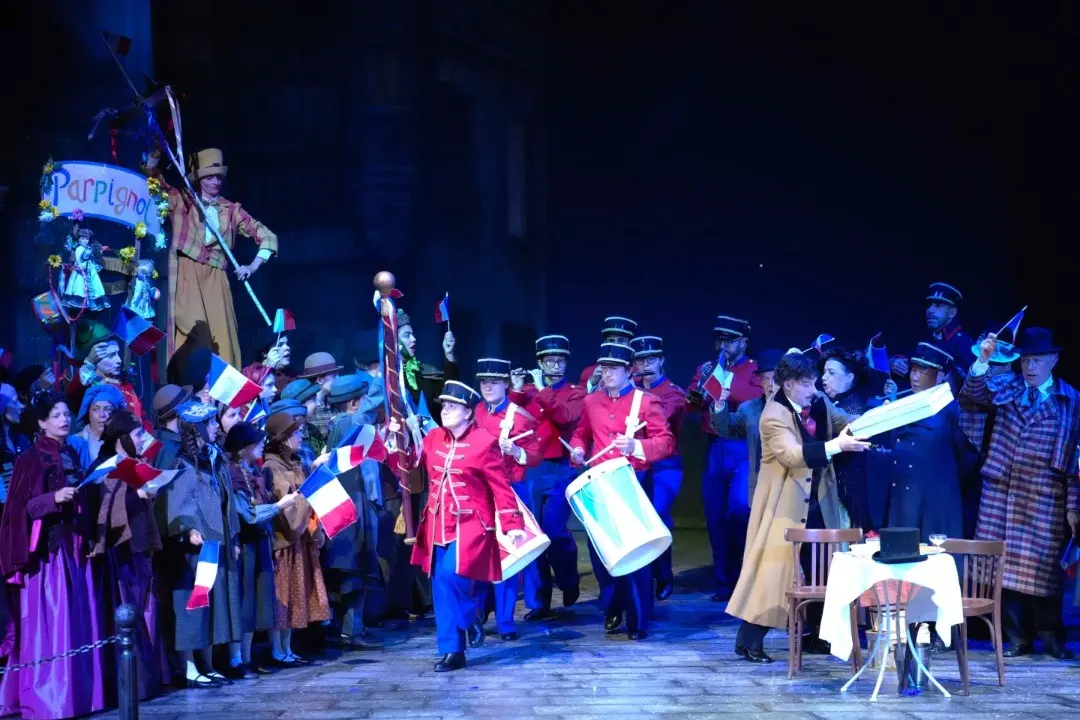
The scenic and aesthetic world of nineteenth-century Paris was brilliantly brought to life through the collaborative efforts of the creative design team. Carlo Centolavigna’s highly effective set designs provided an unmistakable evocation of a bygone French capital.
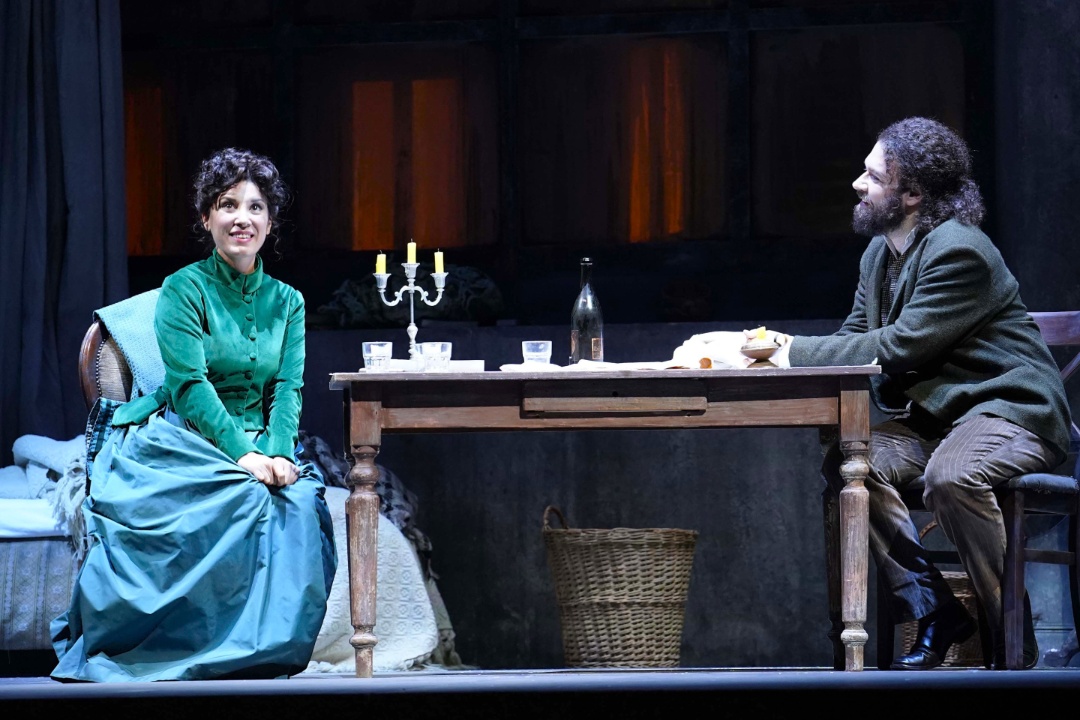
- Act I: The bohemian garret, enhanced by Michele Cremona’s carefully conceived, atmospheric lighting, emerged as a suitably gloomy, impoverished space. Yet, it was a space thrumming with the irrepressible energy and youthful enthusiasm of starving artists.
- Act II: The production smoothly transitioned into the bustling, neon-like vibrancy of the Quartiere Latino, capturing the chaotic effervescence and sensory overload of Parisian street life.
- Costumes: Artemio Cabassi’s elegant costume designs rooted the production firmly in Puccini’s desired epoch. Every coat, dress, and accessory painstakingly recreated the historical texture of the composer’s world, creating a unified visual canvas that thoroughly satisfied the eye.
Musical Execution: The Pit and the Chorus
In the orchestra pit, conductor Vincenzo Milletarí led the Orchestra Filarmonica Italiana with commendable academic rigor and vigilant attentiveness. Milletarí maintained an effective, balanced relationship between the instrumental forces on the floor and the vocalists on stage, carefully supporting the singers through their most demanding passages.
However, from a purely interpretive standpoint, the conducting occasionally leaned too heavily into technical precision at the expense of theatrical plasticity. Puccini’s verismo style demands more than academic correctness; it requires a palpable sense of tension, expressive abandon, and the aching, signature melancholy intrinsic to the score. While Milletarí demonstrated a solid command of structural architecture, his reading occasionally lacked the raw, bleeding-edge emotional intensity that defines the opera’s most devastating moments.
In the choral departments, a slight disparity was observed. The Coro del Teatro Municipale di Piacenza, prepared by chorus master Corrado Casati, exhibited occasional moments of minor cohesion issues and nearly imperceptible inaccuracies. Conversely, the children’s chorus of the Conservatorio di Piacenza, under the direction of Marcello Valentini, delivered a much crisper, highly effective performance, injecting youthful charm and precise musicality into their scenes.
Supporting Context & Metrics
Vocal Cast Breakdown
While the entire ensemble performed with admirable competence, the evening undoubtedly belonged to the female protagonists, who consistently outshone their male counterparts in both vocal brilliance and dramatic characterization.
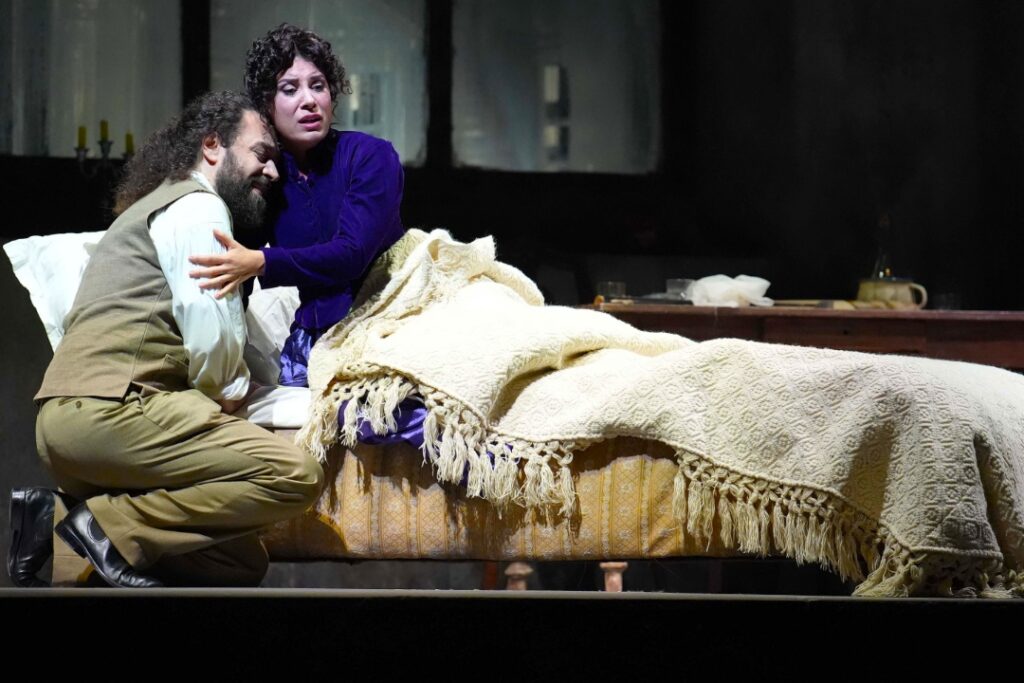
- Claudia Pavone (Mimì): Soprano Claudia Pavone offered an interpretation that grew in crescendo throughout the evening. Her initial rendition of "Sì, mi chiamano Mimì" was solid and foreshadowed a secure upper register, though it remained somewhat conventional. By Act III, however, Pavone transformed: her delivery of "Donde lieta uscí" was shattering in its emotional depth. In Act IV, she achieved vocal and dramatic transcendence. Possessing a luminous voice rich in harmonics—particularly soaring in the upper register—Pavone wielded a solid vocal instrument that effortlessly conveyed Mimì’s heartbreaking physical and emotional fragility.
- Mariam Battistelli (Musetta): Ethiopian-born soprano Mariam Battistelli was a revelation as Musetta, projecting freshness and naturalness both vocally and physically. Portraying a character who was genuine, sensual, and ultimately deeply compassionate, Battistelli displayed an enviable vocal lightness coupled with surprising power. Her fiato control and pristine vocal line made "Quando m’en vo’’" an undisputed highlight of the evening. Furthermore, her dramatic commitment in Act IV during Mimì’s final moments showcased a mature, deeply moving actress.
- Davide Giusti (Rodolfo): Tenor Davide Giusti stepped into the grueling role of Rodolfo under challenging circumstances as a last-minute emergency replacement. Despite the suddenness of his engagement, Giusti displayed a powerful instrument with notable ease in the upper register. While occasional technical difficulties in breath management (fiato) resulted in swallowed high notes and a slightly uneven vocal line, his iconic "Che gelida manina" won over the house. Moreover, in the Act III duets and quartets, and the devastating final scene of Act IV, Giusti rose to the occasion, delivering deeply affecting work.
- Fabrizio Brancaccio (Marcello): Baritone Fabrizio Brancaccio brought a luminous, even tone to the role of the painter Marcello. Although his voice was occasionally on the lighter side for the dramatic weight of the part, his contribution was undeniably successful. His Act III duet with Rodolfo, "O Mimì, tu più non torni," was handled with exquisite care, and his sparkling stage chemistry with Giusti and Battistelli earned him enthusiastic applause.
- Fernando Cisneros (Schaunard): Mexican baritone Fernando Cisneros delivered what was perhaps the most structurally complete performance among the male leads. His Schaunard featured a well-projected, powerful voice, consistently secure tuning, and clear diction, demonstrating complete mastery of the role.
- Diego Maffezzoni (Colline): Bass Diego Maffezzoni capitalized on Puccini’s ultimate gift to the bass voice, delivering "Vecchia zimarra, senti" with profound vocal and histrionic depth, anchoring the quartet’s emotional collapse in Act IV.
- Comprimario Roles: Dario Giorgelé portrayed both Benoît and Alcindoro with a sound, remarkably youthful voice that contrasted slightly with the advanced age of the characters, yet remained well-placed and dramatically effective. Carlo Bellingeri rounded out the ensemble with an appropriate and charming turn as Parpignol.
Official Statements and Curtains-Up Reflections
The production concluded with an atmosphere of profound warmth and communal celebration. As the final chords faded into silence, the Teatro Municipale di Piacenza erupted into sustained applause for the entire cast.
The emotional peak of the evening, however, arrived during the curtain calls when stage director Leo Nucci stepped forward. The audience showered the legendary baritone with an enthusiastic, prolonged ovation, acknowledging not only his work on this production but his towering contributions to the history of Italian opera. Visibly moved, Nucci embraced and personally thanked each member of the cast—a gesture that highlighted his generous spirit and cemented his reputation as an artist of immense humanity.
Following the applause, conductor Vincenzo Milletarí took to the microphone to address the audience. He publicly commended tenor Davide Giusti for his heroic eleventh-hour rescue mission, revealing to the house that Giusti "was not supposed to be here." In a delightful, unscripted moment that captured the camaraderie of the evening, Milletarí prompted the orchestra to strike up and led the entire house and cast in singing "Happy Birthday" to Giusti, who was celebrating his milestone 40th birthday on the exact night of the performance.
Future Outlook
The success of Leo Nucci’s La Bohème at the Teatro Municipale di Piacenza—subsequently shared in co-production with the Teatro di Modena—serves as a timely reminder of the enduring viability of traditional opera staging. In an era where regional houses frequently gamble on conceptually jarring, modern-dress interpretations that alienate traditional patrons, Piacenza’s production proved that respect for the composer’s original libretto and score is not a limitation, but a springboard for profound theatrical truth.
As the production continues its life across Italian stages, it sets an important benchmark for future revivals of standard repertory works. It demonstrates that when seasoned masters like Nucci apply their lifetime of stage experience to the details of character interaction, period design, and vocal sensitivity, classic operas require no forced modernization to speak powerfully to contemporary audiences. For the fortunate audiences in Piacenza, this Bohème was a triumph of heart, history, and high art—proving that Puccini, when honored on his own terms, remains utterly timeless.