
Executive Overview
The intersection of hardware engineering, consumer electronics, and music curation has long been defined by a clear division of labor. Hardware manufacturers build the vessels—hi-fi systems, premium headphones, automotive soundstages, and Bluetooth speakers—while streaming platforms, social media algorithms, and independent curators dictate what fills them. For decades, consumer electronics giant Harman, a wholly owned subsidiary of Samsung Electronics, has reigned supreme in the former category. Trusted globally for its acoustic engineering, luxury automotive audio systems, and lifestyle consumer gear, Harman has never been mistaken for a digital tastemaker or a social media network.
That paradigm is now shifting. In a move that has caught the tech and music industries off guard, Harman has officially unveiled Drops, an experimental, discovery-driven mobile application designed to fundamentally rethink how users encounter, share, and save music.
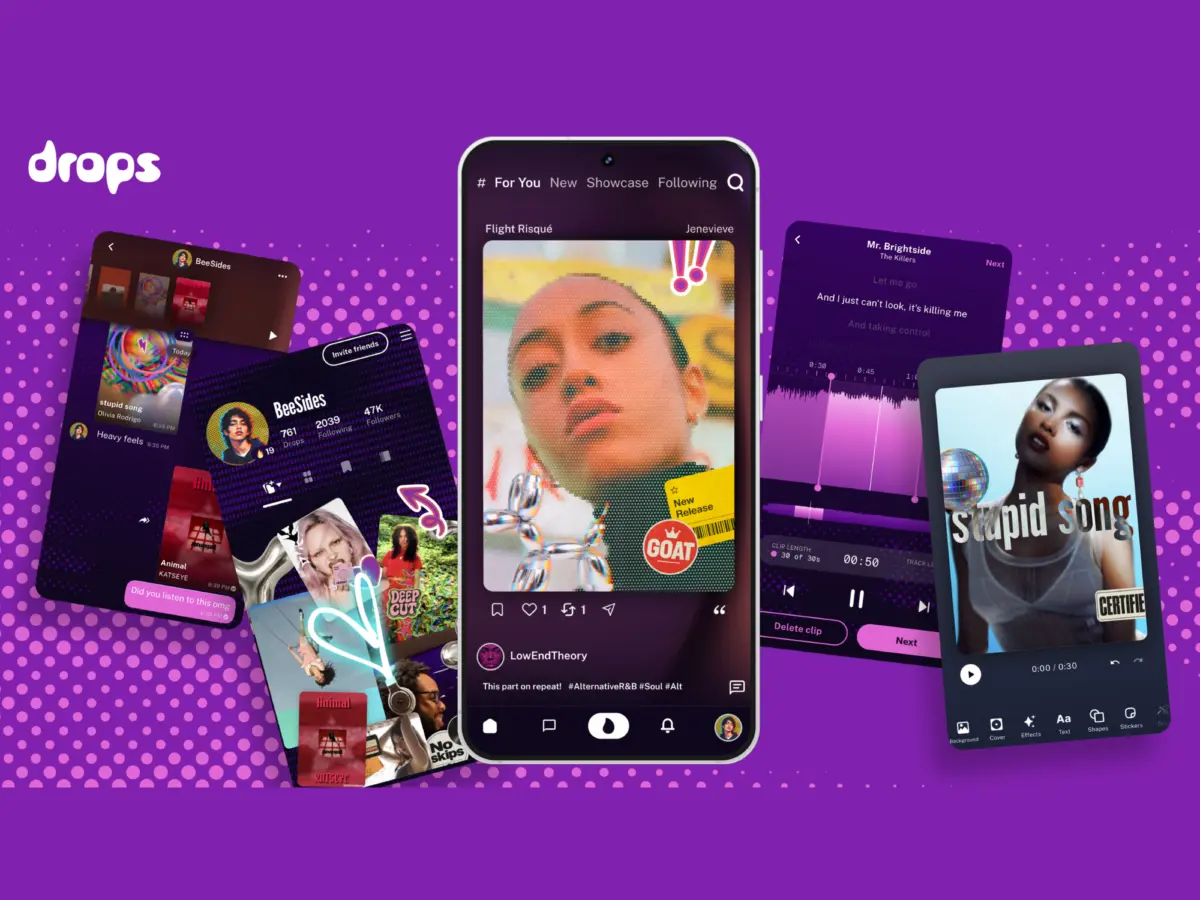
Initially rolling out via an exclusive, invitation-only model in the United States, Drops departs radically from the standard streaming interface. Instead of offering full-length tracks out of the gate, the app centers on bite-sized, highly visual 10-to-30-second audio-visual snippets. These snippets pair targeted track segments with synced lyrics, striking album artwork, artist imagery, and user-generated captions.
Far from operating as an isolated walled garden, Drops is engineered to act as a bridge. Harman has strategically positioned the app as a top-of-funnel discovery engine designed to drive full-length consumption on third-party music streaming services. At launch, the platform boasts integration with major audio services—including Apple Music, Qobuz, and Tidal—allowing users to seamlessly save newly unearthed tracks directly into personalized collections or migrate them to their primary streaming libraries.
Behind this consumer-facing interface lies significant industry backing. Drops has secured content and licensing agreements with major players, including Universal Music Group (UMG), independent powerhouse Beggars Group, and prominent distribution platforms such as Empire, Symphonic Distribution, and UnitedMasters, alongside various publishers and collecting societies. Furthermore, the app’s foundational DNA traces back to Harman’s strategic 2023 acquisition of high-end music management software firm Roon, signaling that beneath the social-first aesthetic lies serious audio pedigree.
Yet, stepping into the music discovery arena is fraught with historical failures. The graveyard of music tech is littered with apps that attempted to gamify or socialize music exploration, only to be crushed by the gravitational pull of TikTok, Instagram, and established streaming giants. As Harman takes its first steps into software-led social audio, the critical question remains: Can a hardware heavyweight leverage its deep industry roots to carve out a permanent niche in the hyper-competitive attention economy, or will Drops prove to be a fleeting experiment?
Detailed Chronology: From Roon to the Unveiling of Drops
To understand how a company renowned for amplifiers and acoustic transducers arrived at a social music discovery app, one must trace a strategic corporate evolution that began years prior to the public rollout of Drops.
The Roon Acquisition: Laying the Software Foundation
The intellectual and infrastructural roots of Drops can be directly traced back to November 2023, when Harman announced the acquisition of Roon, the acclaimed music management, research, and streaming platform prized by audiophiles. Roon was famous for its deeply interconnected library management, rich metadata, and ability to bridge local file collections with high-resolution streaming services like Qobuz and Tidal.
While Roon served a distinct niche of high-end audio enthusiasts, the acquisition signaled a broader strategic directive within Harman: the company was no longer content with merely building the hardware that delivered sound. Under Samsung’s overarching vision, Harman sought to deepen its software capabilities and capture consumer attention across the entire audio lifecycle—from discovery and curation to playback and hardware integration.
Roon provided Harman with more than just advanced metadata architecture; it instilled an organizational appetite for software development and closer alignment with music rights holders. Over the subsequent months, Roon’s engineering and product teams began cross-pollinating with Harman’s broader lifestyle division, laying the groundwork for consumer-facing products that could leverage metadata and curation on a mass scale.
The Incubation of Drops
By late 2024 and throughout 2025, internal development teams at Harman began prototyping a concept designed to solve a modern paradox of the streaming age: despite having tens of millions of tracks available at their fingertips, modern listeners suffer from chronic discovery fatigue. Algorithms on dominant platforms often trap users in sonic echo chambers, while long-form music videos have largely migrated to fragmented short-form video feeds.
Harman’s concept shifted away from passive algorithmic feeds toward human-led, bite-sized curation. The project—eventually named Drops—was built around the premise that the most impactful music discovery moments are visceral, immediate, and easily shareable. Rather than asking users to commit four minutes to an unknown track, Drops would isolate the "hook"—a 10-to-30-second slice of audio—and package it with rich contextual metadata, including real-time lyric display, high-resolution artwork, and curated artist narratives.
Securing the Industry Pillars
Recognizing that any music-based application must maintain strict compliance with copyright holders to survive, Harman embarked on an extensive business development campaign. Unlike tech startups that launch first and license later, Harman approached the music industry with the weight of a multi-billion-dollar subsidiary of Samsung.
Throughout 2025, negotiations yielded key partnerships. Universal Music Group—the world’s largest music company—signed on early, bringing its vast catalog and roster of superstar artists to the platform. They were soon joined by Beggars Group, representing the pinnacle of independent alternative music, alongside major digital distributors Empire, Symphonic Distribution, and UnitedMasters. Crucially, Harman also engaged various global publishers and collecting societies to ensure that the micro-streams and clip plays generated within the app were properly reported and monetized.
The Invitation-Only Launch
In November 2026, Harman transitioned Drops from internal testing to the public eye, initiating an invitation-only rollout in the United States. To seed the platform with high-value content and establish an aura of exclusivity, Harman recruited a handpicked roster of early "tastemakers"—influential music journalists, DJs, independent curators, and niche creators—to populate the app’s initial feeds.
By employing an invite-only strategy, Harman aimed to manufacture organic buzz, prevent server strain during early deployment, and cultivate a community of hyper-engaged music enthusiasts before opening the floodgates to the general public.
Supporting Context & Metrics: The Mechanics and Business Model of Drops
Examining the technical architecture, user experience, and financial mechanics of Drops reveals a carefully constructed ecosystem designed to navigate the treacherous waters of music tech.
Anatomy of a Drop: How the App Works
At its core, Drops is structured around micro-interactions that mirror the visual pacing of modern social media while preserving the fidelity of the underlying music.
- The 10–30 Second Snippet: Users encounter vertically scrolling content consisting of curated audio clips lasting between 10 and 30 seconds. These are not lo-fi snippets ripped from video platforms; they are high-quality masters pulled directly from official distribution pipelines.
- Dynamic Visual Context: As the audio plays, the screen displays synchronized lyrics (reminiscent of Apple Music or Spotify’s canvas features), high-resolution album artwork, artist biographies, and user-generated captions that explain why a particular track matters.
- Frictionless Saving and Collections: Users can organize discovered tracks into personalized "collections" within the app, functioning akin to digital mood boards or sonic scrapbooks.
- The Streaming Bridge: This is Harman’s masterstroke. Drops does not attempt to become a standalone on-demand streaming subscription service. Instead, it acts as the discovery funnel. Users can link their existing accounts from launch partners like Apple Music, Qobuz, and Tidal. With a single tap, a track discovered in Drops can be exported directly to the user’s primary streaming library or played in full.
Licensing, Royalties, and Rights-Holder Reporting
One of the most persistent criticisms leveled against short-form audio and video platforms has been the historical lack of transparent, reliable monetization and reporting for rights holders. Harman has taken pains to distance Drops from these criticisms.
According to reporting from TechCrunch, Drops has been architected from the ground up to ensure strict compliance with music licensing laws. The app directly compensates rights holders and reports playback data back to its label, distributor, and publisher partners. By utilizing the technological infrastructure inherited from the Roon acquisition, Drops can track user engagement down to the micro-interaction level, ensuring that artists, songwriters, and labels receive appropriate accounting for their content, even when consumed in 20-second bursts.
The Competitive Landscape
To understand the gamble Harman is taking, one must evaluate the graveyard of music discovery apps that came before it. Over the last fifteen years, countless startups have attempted to build the "Instagram for music" or the ultimate discovery engine.
- The Social Giants: TikTok and Instagram Reels currently dominate the music discovery space. Millions of users discover new music daily through short-form video content, making direct competition for attention immensely difficult.
- The Streaming Titans: Spotify and Apple Music have invested heavily in algorithmic personalization (Discover Weekly, Infinite Canvas, smart playlists) to keep users inside their respective ecosystems.
- Independent Discovery Apps: Past ventures like SoundHound, Shazam (acquired by Apple), and various niche social music networks have found varying degrees of success, but few have managed to successfully bridge the gap between social curation and high-yield conversion to paid streaming subscriptions.
Harman’s competitive advantage lies not in matching the marketing budgets of TikTok, but in its deep hardware integration, its credibility within the audiophile and music-maker communities, and its structural alignment with major labels who are eager to find alternative discovery channels that do not rely entirely on short-form video algorithms.
Official Statements and Industry Insights
While Harman has kept promotional details tightly controlled during the initial invite-only rollout, insights gathered through industry leaks, developer disclosures, and investigative coverage by outlets like TechCrunch paint a clear picture of the company’s long-term ambitions.
Industry analysts note that Harman’s parent company, Samsung, views software and services as the primary frontier for future consumer electronics growth. As the commoditization of hardware accelerates, bridging physical listening devices with proprietary software ecosystems represents a crucial defensive and offensive maneuver.
A spokesperson close to the development of Drops emphasized the app’s philosophical core during early briefings:
"Music discovery in the streaming era has become paradoxically sterile. Algorithms serve up more of what you already know, while social feeds treat music merely as a background track for viral video moments. Drops was conceived to return the focus squarely to the artistry of the song itself—distilling the most arresting seconds of a track and giving music lovers a frictionless way to collect, share, and ultimately stream the full work."
Music rights executives have similarly expressed cautious optimism regarding the platform. Representatives from partnering independent distributors noted that platforms offering direct, authenticated reporting and clear conversion paths to full-length streaming services represent a welcome departure from platforms operating in regulatory gray areas regarding copyright and compensation.
Future Outlook: Will Drops Stick or Fade?
The introduction of Drops represents a fascinating corporate pivot. For a hardware manufacturer traditionally measured by frequency response curves, THD (Total Harmonic Distortion), and premium chassis design, launching a social music discovery app is an exercise in venturing far outside its core competency.
The Hurdles Ahead
- User Acquisition and Retention: Building buzz via an invitation-only launch is an effective short-term PR strategy, but sustaining user engagement once the app opens to the general public is notoriously difficult. Consumers suffer from app fatigue; convincing a user to download a dedicated app just to discover 20-second clips—when similar content is already embedded within Instagram and TikTok—requires a compelling value proposition.
- The Conversion Paradox: Drops relies on successfully funneling users to its streaming partners (Apple Music, Qobuz, Tidal). If users consume the snippets within Drops but fail to export them to full-length streaming platforms, the economic model for rights holders and the long-term viability of the app could be called into question.
- Corporate Patience: Samsung and Harman possess deep financial reserves, but software experiments launched by hardware conglomerates face intense internal scrutiny. If user growth metrics do not hit aggressive internal benchmarks within the first 12 to 18 months, corporate leadership may pull funding.
The Potential Upside
Conversely, if Harman plays its cards right, Drops could carve out a lucrative and culturally influential space. By integrating the app directly into Harman’s broader hardware ecosystem—imagine owning a pair of JBL or Harman Kardon headphones that feature native Drops integration, allowing you to save a track you hear mentioned in the app directly to your hardware queue—Harman could create a closed-loop audio experience that no software-only startup can replicate.
Furthermore, as major labels increasingly seek diversified marketing channels that prioritize high-fidelity audio over compressed, looping video clips, Drops could establish itself as the premier destination for discerning music enthusiasts.
Ultimately, Harman’s stomach—and marketing budget—for the brutal realities of the consumer software market will dictate whether Drops becomes a permanent pillar of the modern music discovery landscape, or an innovative footnote in the company’s storied audio history.