
Executive Overview
For musicians of all calibers—from the aspiring conservatory student to the seasoned professional seeking a premier orchestral seat—auditions and examinations represent the critical gateways to career-defining opportunities. These high-stakes evaluations are designed to test not only technical proficiency and emotional resonance, but also adaptability, intellectual rigor, and instantaneous comprehension.
While the traditional components of a musical audition—such as preparing assigned repertoire over weeks or months—are entirely manageable through diligent, methodical
practice, a single formidable obstacle routinely derails otherwise brilliant performances: the sight-reading test.
Characterized by the sudden introduction of an entirely unfamiliar piece of music, a ticking 30-second preparation clock, and the piercing gaze of an expectant judging panel, sight-reading strikes fear into the hearts of even the most accomplished artists. Human psychology dictates a profound aversion to the unknown. When faced with unchartered measures, notes, rhythms, and dynamics under pressure, cognitive load spikes, adrenaline surges, and technical execution can rapidly deteriorate.
However, as industry experts and music educators assert, sight-reading is not an innate, magical talent reserved for a chosen few; it is a learned, highly developable skill. According to Evan R. Murphy, founder of SightReadingMastery, mastering this critical component is the absolute secret to acing auditions and exams. By demystifying the unknown, transforming apprehension into confidence, and cultivating real-time musical literacy, musicians can unlock closed doors, surpass institutional hurdles, and ultimately realize their most ambitious artistic dreams. This report investigates the psychology of musical anxiety, deconstructs the anatomy of a successful audition, and provides a strategic blueprint for achieving total sight-reading fluency.
Detailed Chronology: The Anatomy of a High-Stakes Musical Audition
To fully understand why sight-reading commands such high stakes in modern music education and professional hiring processes, one must examine the typical chronology of an audition lifecycle. From the initial announcement to the final notes echoing in the audition hall, every phase demands distinct psychological and technical frameworks.
Phase 1: The Honeymoon Period of Prepared Repertoire
The journey typically begins weeks or months before the audition date. Candidates receive an information packet containing the required excerpts or complete pieces—the known variables of the evaluation. This sparks a predictable, structured timeline:
- Weeks 1–2 (Deconstruction): The musician analyzes the piece note by note, measure by measure, and section by section. Difficult passages are isolated, fingerings or bowings are mapped out, and tempos are intentionally slowed down.
- Weeks 3–4 (Integration and Polish): Daily, deliberate practice bridges the micro-details into macro-phrasing. The tempo gradually approaches the composer’s intended marking. Confidence builds organically.
- The Eve of the Audition (The Apex of Invincibility): The candidate has committed the work to muscle memory and deep psychological security. Nothing feels impossible. The performer believes, with complete justification, that they are invincible.
Phase 2: Entering the Room and the Sudden Shift
The audition day arrives. The candidate performs their prepared pieces with poise, artistry, and precision. Just as they begin to relax, believing the hardest part is behind them, the adjudicators introduce the variable that changes everything: the sight-reading prompt.
Judges slide a pristine sheet of music across the stand—a composition the candidate has never laid eyes on, and will never see again. The clock starts ticking. Thirty seconds. Thirty seconds to scan the key signature, decode complex rhythmic syncopations, identify potential technical traps, and mentally pre-hear the music before striking the first note.
Phase 3: The Execution and the Psychological Divide
In these thirty seconds, a profound psychological divide occurs among applicants:
- The Unprepared Candidate: Panic sets in. The eyes dart across the page without a cohesive strategy. They notice a difficult key change or an awkward interval leap, triggering a fight-or-flight response. When the signal to play is given, their fingers freeze, hesitation creeps into the rhythm, and the performance unravels.
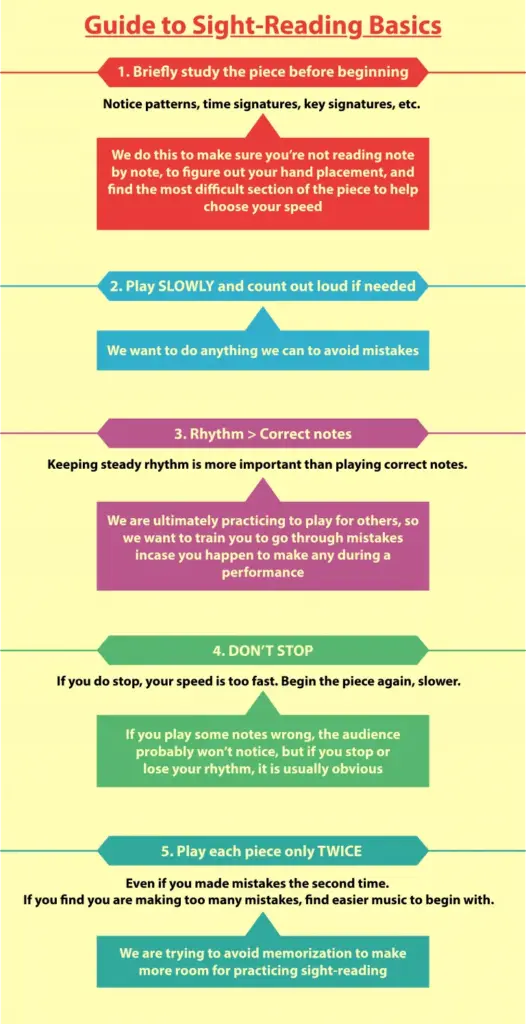
- The Sight-Reading Master: Calm prevails. Utilizing a systematic visual scan, they identify structural landmarks, repeat signs, recurring motifs, and rhythmic anchors. When they play, they maintain a steady pulse, prioritizing musical continuity over microscopic perfection.
The chronological progression demonstrates that while prepared repertoire builds a foundation of technical capability, sight-reading ultimately serves as the decisive differentiator between those who secure the position and those who remain stuck at the gate.
Supporting Context & Metrics: The Psychology of Fear and Musical Literacy
Why does sight-reading evoke such visceral anxiety, and what does the data tell us about the state of music education regarding this vital skill?
The Neuroscience of Fear and the Unknown
In evolutionary psychology, fear of the unknown is a survival mechanism. Our brains are hardwired to predict outcomes to avoid danger. When a musician is handed a sight-reading piece, the brain instantly recognizes a lack of predictable patterns, triggering an amygdala response. Cortisol and adrenaline flood the system, accelerating the heart rate and restricting fine-motor control in the hands and fingers.
Cognitive psychologists note that sight-reading requires an immense amount of working memory. The brain must simultaneously decode visual symbols, translate them into physical motor commands, monitor auditory feedback, and anticipate future measures—all in real time. For musicians who neglect sight-reading in their daily practice, this cognitive load becomes overwhelming, leading to systemic performance paralysis.
Industry Metrics and Educational Disparities
Educational assessments across major music institutions—such as the Associated Board of the Royal Schools of Music (ABRSM) and various collegiate conservatory juries—consistently highlight sight-reading as the primary point of failure for candidates.
- Failure Rates: Internal educational audits suggest that up to 65% of point deductions in practical music exams stem directly from poor sight-reading performance, even among students who execute their prepared pieces flawlessly.
- The Practice Gap: Surveys of student practice habits reveal that the average instrumentalist spends over 90% of their practice time on prepared repertoire, leaving less than 10% for unassisted sight-reading. This inverted ratio directly contributes to audition anxiety; musicians are simply under-trained in the exact skill required to navigate musical surprises.
By shifting this paradigm—dedicating intentional, daily micro-sessions to sight-reading—musicians can rewire their neural pathways, reduce performance anxiety, and transform the unknown from a source of dread into an exciting creative canvas.
Official Perspectives and Expert Insights
To gain a deeper understanding of how sight-reading bridges the gap between student aspirations and professional reality, we turn to industry leaders, educators, and pioneers in music pedagogy.
Evan R. Murphy on the Philosophy of Sight-Reading
Evan R. Murphy, a seasoned musician, software engineer, and the visionary founder of SightReadingMastery, has dedicated his career to demystifying this exact challenge. Reflecting on the genesis of his platform in 2011, Murphy emphasizes that sight-reading is fundamentally about empowerment.
"We fear the unknown because we feel powerless against it," Murphy explains. "Auditions and exams are the gateways to amazing opportunities for us in music. But unless we can manage this part, we’ll struggle to get through. We’ll be stuck at the gate. Mastering sight reading prepares us for the unknown. It teaches us how not to fear it, and how to welcome it even. It helps us unlock opportunities, reach our goals, and ultimately realize our dreams."
Murphy’s dual background as a software engineer and a musician brings a uniquely structured, algorithmic approach to music pedagogy. He advocates for breaking down music reading into bite-sized, daily habits rather than sporadic, high-pressure cramming sessions.

Conservatory Adjudicators Speak Out
Prominent orchestral conductors and university professors who frequently sit on audition panels echo Murphy’s sentiments. Dr. Aris Thorne, Chair of Instrumental Performance at a leading American conservatory, notes:
"When we evaluate a candidate, we aren’t just looking for someone who can memorize one or two standard concertos. We are looking for a colleague. In professional orchestras, wind ensembles, and pit bands, musicians are routinely handed new charts with minimal rehearsal time. If an artist cannot sight-read effectively, they become a bottleneck for the entire ensemble. Sight-reading fluency is a direct measure of professional readiness."
Adjudicators consistently stress that they do not expect note-for-note perfection during a sight-reading test. Instead, they evaluate musical intelligence: Can the performer maintain a steady pulse? Do they capture the style, articulation, and emotional character of the piece? Are they able to recover gracefully if they stumble? These qualitative metrics separate the seasoned professional from the amateur.
Future Outlook: The Evolution of Sight-Reading in the Digital Age
As the music industry continues to evolve, the methodologies surrounding sight-reading training are undergoing a profound technological transformation. The future of music education is leaning heavily toward interactive, personalized, and accessible learning tools.
Digital Platforms and Adaptive Learning
Gone are the days when students were limited to the handful of sight-reading examples printed in the back of traditional method books—examples they would inevitably memorize too quickly to provide genuine practice value. Today, platforms like SightReadingMastery leverage digital architecture to generate endless streams of fresh, appropriately leveled sight-reading material.
Future advancements in this space point toward artificial intelligence and machine learning integration:
- Real-Time Pitch and Rhythm Tracking: Advanced microphone-enabled applications will soon listen to a musician’s live sight-reading attempt, instantly highlighting inaccurate pitches or rhythmic hesitations with pinpoint accuracy.
- Adaptive Difficulty Scaling: Software algorithms will analyze a player’s strengths and weaknesses in real-time, automatically generating custom sight-reading exercises that target specific interval leaps, complex time signatures, or unfamiliar key signatures.
The Holistic Musician of Tomorrow
The modern music landscape demands versatility. Genres cross-pollinate, recording sessions require instantaneous reading of complex film scores, and chamber ensembles push the boundaries of contemporary avant-garde literature. In this dynamic environment, the ability to sight-read with poise is no longer a niche academic requirement; it is a core survival skill.
Institutions that embrace comprehensive sight-reading curricula will produce a new generation of fearless, highly adaptable musicians. By reframing sight-reading not as an intimidating test hurdle, but as a joyful exploration of new musical languages, educators are empowering students to walk into any audition room—no matter how formidable the judges or how mysterious the score—with absolute self-assurance.
Conclusion
Auditions and examinations will always carry a degree of pressure, but they do not need to be sources of paralyzing fear. While prepared pieces showcase a musician’s patience, dedication, and deep artistic depth, sight-reading reveals their true musical fluency and adaptability.
As articulated by industry leaders like Evan R. Murphy, the secret to acing auditions and exams lies in mastering the unknown. By committing to consistent, daily sight-reading practice, musicians can dismantle anxiety, conquer the 30-second preparation window, and transform unread scores into triumphant performances. For those willing to put in the work, the gates to extraordinary musical opportunities are wide open.