For decades, the name Saregama has been synonymous with the golden era of Indian cinema. To music lovers, film historians, and casual listeners alike, the label was universally perceived as the ultimate custodian of India’s musical heritage—a vast, comforting archive housing the definitive soundtracks of Hindi films released between the 1940s and the 1970s. For generations, Saregama was where one went to unearth the timeless melodies of legendary playback singers like Lata Mangeshkar, Mohammed Rafi, and Kishore Kumar, and the cinematic masterpieces of iconic composers such as Shankar-Jaikishan, S.D. Burman, and O.P. Nayyar.
However, a profound strategic and financial evolution has been quietly reshaping the core identity of this historical institution. Far from being merely a museum of 20th-century nostalgia, Saregama has successfully engineered a high-growth, modern intellectual property (IP) business model.
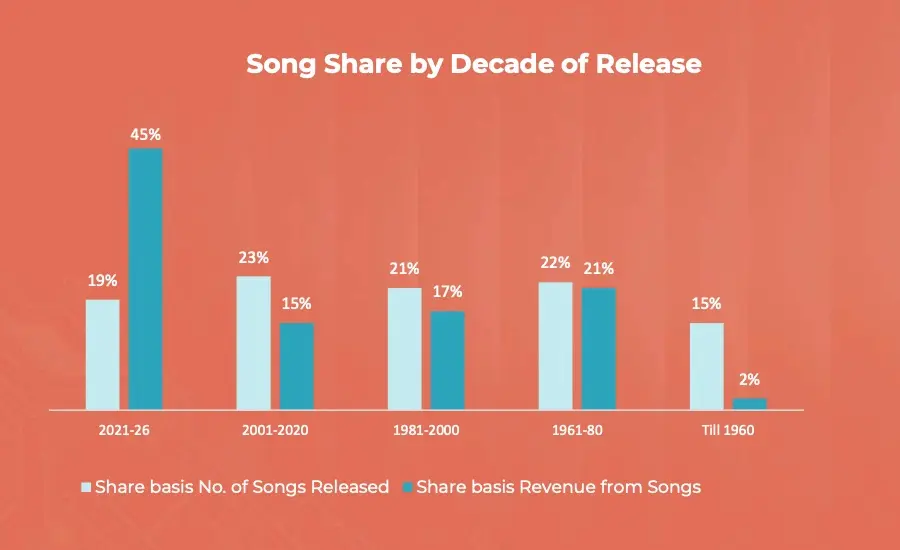
Fresh financial results from FY2026 and the subsequent Q1 FY2027 performance shatter the long-standing misconception that the company relies exclusively on its vintage catalogue. In a striking revelation, the majority of Saregama’s revenue—a commanding 60%—now stems from music released after the year 2000. Even more remarkably, 45% of that modern revenue stream is generated by contemporary blockbusters and recent chart-toppers launched after 2021, including smash hits from the original sound tracks (OSTs) of high-profile cinematic releases such as Dhurandhar (2025), Stree 2 (2024), and Rocky Aur Rani Kii Prem Kahaani (2023).
This shift does not mean that Saregama has abandoned its roots; rather, it highlights a dual-engine financial model. While tracks recorded before 2001 still comprise the bedrock of its expansive library—accounting for roughly 58% of its total catalogue—they generated 40% of the company’s revenue in the most recent full financial year.
Driven by aggressive investments in multi-language regional repertoires, diversified live entertainment extensions like Carvaan Live, and strategic synchronization licensing across feature films and streaming web series, Saregama is proving that legacy brands can successfully reinvent themselves. By marrying the timeless stability of heritage catalogues with the explosive, high-margin monetization of contemporary music IP, Saregama has established a blueprint for modern music publishing in the digital age.
Detailed Chronology and Financial Trajectory
To understand how Saregama reached this pivotal juncture, one must examine the systematic evolution of its operational strategy over the past several fiscal cycles. Historically operating as The Gramophone Company of India (an offshoot of EMI), Saregama inherited the monumental legacy of India’s recorded music industry. For much of the late 20th century, physical sales—and later, basic licensing to television and early digital aggregators—defined its business model.
However, the advent of streaming in the 2010s forced legacy labels to radically rethink their approach. While competitors scrambled to acquire contemporary catalogues, Saregama adopted a two-pronged approach: it locked down its heritage catalogue through aggressive digital rights management while simultaneously rebuilding its frontline music acquisition pipeline across multiple Indian languages.
The FY2026 Turning Point
By the close of FY2026, the fruits of this dual-track strategy became undeniably clear on the company’s balance sheets. For years, industry analysts assumed that Saregama’s valuation was tethered entirely to the nostalgia economy—driven heavily by the older demographic that famously embraced the Carvaan digital audio player.
Yet, the FY2026 performance metrics revealed a dramatic demographic and catalogic pivot:
The Modern Majority: 60% of total music revenue was generated by tracks produced and released in the 21st century.
The Recent Surge: 45% of that modern slice came exclusively from hits released after 2021. Modern cultural touchstones like Rocky Aur Rani Kii Prem Kahaani (2023) and Stree 2 (2024) proved that Saregama could compete effectively in the modern, algorithm-driven streaming marketplace against pure-play contemporary digital labels.
The Heritage Anchor: Songs from the pre-2001 era still punch significantly above their weight. While they make up 58% of the company’s raw catalogue volume, they continue to deliver a rock-solid 40% of overall revenue, proving that classic Bollywood possesses unmatched, long-tail monetization power.
The Q1 FY2027 Leap: Growth Across All Verticals
This momentum carried aggressively into the first quarter of FY2027. Saregama reported a remarkable 27% year-on-year increase in operational revenue, reaching Rs263.6 crore (approximately $27.6 million). More impressively, profitability surged alongside top-line growth; the company’s profit after tax (PAT) rose by 42% to Rs52 crore (approximately $5.4 million).
This financial leap was not driven by streaming alone. A closer inspection of the Q1 FY2027 results reveals a diversified growth engine firing on multiple cylinders:
Frontline Music Production: The label aggressively scaled its new music output, releasing over 750 new tracks during the single quarter. This output spanned a vast linguistic footprint, covering Hindi, Bhojpuri, Punjabi, Tamil, Telugu, Malayalam, Kannada, Haryanvi, Marathi, and Bengali.
Sync Licensing and Screen Placements: Tracks from Saregama’s monumental 180,000-song library found new life on screens, being integrated into over 15 feature films (such as the romantic drama Cocktail 2) and more than 10 streaming web series (including the gritty crime thriller Raakh).
The Live Events Explosion: Live entertainment emerged as a massive breakout category, registering an astonishing 214% jump in revenue. This extraordinary growth was fueled by curated devotional music concerts featuring spiritual artists like Jaya Kishori and Manoj Muntashir, stand-up comedy specials by spoken-word performers such as Manhar Seth, and the commercial rollout of a brand-new experiential IP: Carvaan Live.
Supporting Context and Metrics: Decoding the Numbers
The quantitative reality of Saregama’s business model offers a fascinating case study in modern catalogue management. In the music industry, labels are frequently forced to choose between the high-risk, high-reward game of signing new, expensive frontline talent and the steady, low-risk cash flow of legacy archives. Saregama has successfully bridged this divide.
60 to 80 years of active primary and secondary commercial life ahead.
Immediate high-velocity streaming monetization transitioning into long-term catalog staples.
The Carvaan Ecosystem and Experiential Expansion
No discussion of Saregama’s financial fortitude is complete without examining the Carvaan phenomenon. Initially launched as a hardware play—a portable digital audio player pre-loaded with thousands of evergreen retro songs targeted at older consumers and families—Carvaan became a cultural and commercial masterstroke. It monetized a demographic that had largely migrated away from digital streaming apps.
Building on the immense brand equity of this hardware line, Saregama has successfully engineered a bridge from passive in-home listening to active, live experiential consumption through Carvaan Live. During Q1 FY2027 alone, the company staged 23 dedicated live shows.
These events are meticulously targeted at middle-aged and older audiences who cherish the playback singers and music directors of yesteryear. By organizing tribute concerts dedicated to icons like Kishore Kumar and legendary composers like Pritam, Saregama has transformed a passive listener base into an active, high-yielding live-event community. This synergy between hardware, digital memory, and physical concert ticketing represents a masterclass in 360-degree brand monetization.
Official Statements and Strategic Vision
The leadership team at Saregama is acutely aware of this structural transformation. During the earnings call discussing the Q1 FY2027 financial results, Managing Director Vikram articulated the company’s identity shift with striking clarity:
"At Saregama, we proudly steward the musical heritage of India, we take care of it, we cherish it, we try to monetise it," Vikram stated during the earnings call.
"But the fact is that we are now a new age IP company with a large part of our revenue coming from brand-new IP, which has 60 to 80 years of life left in front of it."
This statement cuts to the heart of Saregama’s modern corporate philosophy. While the company honors its role as the museum curator of Indian cinematic history, its financial engine is deliberately forward-looking. By acquiring and generating brand-new intellectual property across ten distinct regional languages, Saregama is building a massive war chest of assets that will continue to yield royalties, sync fees, and streaming revenues for the next six to eight decades.
This dual focus—protecting the 20th-century bedrock while aggressively funding 21st-century hits—ensures that the label is insulated against the shifting tastes of younger generations while capitalizing on the massive, hyper-growth digital expansion currently underway across India’s Tier-2, Tier-3, and rural media markets.
Future Outlook: The Next Frontier for Saregama
As Saregama looks toward the remainder of FY2027 and beyond, its trajectory points toward continued, diversified expansion. The traditional boundaries separating record labels, film studios, and live-event promoters are dissolving rapidly, and Saregama is positioning itself at the intersection of all three.
1. Hyper-Localization and Regional Dominance
India is not a monolithic music market; it is a federation of distinct linguistic and cultural ecosystems. Saregama’s aggressive push into regional music production—evidenced by its simultaneous rolling out of tracks in Bhojpuri, Punjabi, Tamil, Telugu, Malayalam, Kannada, Haryanvi, Marathi, and Bengali—signals a deliberate strategy to capture non-Hindi streaming growth. As digital penetration deepens across southern and eastern India, these regional catalogues will serve as powerful growth levers.
2. Amplifying the Sync Economy
The integration of legacy tracks into modern visual media (such as Cocktail 2 and Raakh) demonstrates a sophisticated understanding of syncretic marketing. When older songs are reintroduced to younger audiences via contemporary web series and films, it triggers an immediate resurgence in streaming loops on digital service providers (DSPs) like Spotify, JioSaavn, and Wynk. Saregama’s extensive IP library acts as a ready-made mood board for modern filmmakers looking to evoke specific emotional resonances.
3. Scaling Experiential and Niche Live IPs
The phenomenal 214% growth in live event revenues proves that consumer appetite for physical, community-based music experiences is roaring back post-pandemic. By expanding Carvaan Live, scaling devotional music tours with prominent spiritual voices, and branching into spoken-word comedy and literary performances, Saregama is de-risking its revenue model. It is no longer solely dependent on digital streaming royalty payouts from third-party platforms; it is directly owning the consumer relationship at the ticket counter.
Conclusion
Saregama’s evolution offers a vital lesson for heritage media companies worldwide. By refusing to rest on the laurels of its monumental 20th-century archive, the company has successfully transformed into a dynamic, multi-lingual, multi-format IP powerhouse.
With 60% of its revenue now anchored in the modern era, a rapidly expanding live events division, and a staggering 180,000-song library feeding both modern streaming algorithms and cinematic screens, Saregama has proven that honoring the past is the best way to secure the future.