
Executive Overview
In an era defined by rapid technological advancements in sanctuary audio, visual design, and immersive worship production, a profound accessibility gap persists across thousands of religious facilities nationwide. While modern line-array speaker systems, digital mixing consoles, and high-definition projection mapping deliver staggering acoustic power and visual fidelity to the majority of a seated congregation, a significant demographic often remains structurally isolated. For millions of individuals grappling with age-related hearing loss, tinnitus, or medically diagnosed auditory impairments, the weekly worship experience can transform from a communal gathering of spiritual connection into an exercise in profound frustration and alienation.
The spoken word—whether delivered through an impassioned homily, scripture readings, or spoken prayer—is the foundational bedrock of many religious traditions. When congregants cannot comfortably and clearly decipher this communication, participation plummets, engagement wanes, and individuals quietly drift away from the community. Addressing this challenge requires more than simply turning up the master volume on the soundboard. Excess volume often exacerbates acoustic distortion, compounding issues for those with hearing aids who struggle with reverberation, background noise, and echoes inherent in traditional sanctuaries characterized by high ceilings, hard flooring, and expansive architectural footprints.
Enter the Assistive Listening System (ALS)—a specialized suite of audio technologies designed to transmit sound directly from the sound source (the pulpit, microphones, or live instruments) to the ears of the listener, bypassing the ambient acoustics of the room entirely. However, the procurement, deployment, and operational success of an ALS require meticulous planning, strategic budgeting, comprehensive staff training, and proactive community engagement.
This comprehensive report provides an authoritative, four-pillar roadmap for houses of worship seeking to bridge the acoustic divide. Drawing upon industry insights from audio-visual integration experts such as CCI Solutions and technology manufacturers like Listen Technologies, this analysis explores how religious institutions can systematically evaluate their congregation’s unique auditory needs, navigate the complex landscape of hardware options, empower their operational teams, and foster an inclusive culture that ensures no member of the flock is left unheard.
Detailed Chronology: A Four-Phase Implementation Framework
Successfully integrating an Assistive Listening System into the structural and operational workflow of a church or house of worship cannot be treated as an afterthought or a quick weekend fix. It demands a deliberate, chronological strategy that spans initial discovery, financial planning, operational readiness, and public promotion.
[Phase 1: Needs Assessment] ──► [Phase 2: Budgeting & Solutions] ──► [Phase 3: Operational Training] ──► [Phase 4: Promotion & Awareness]Phase 1: Understand Your Needs (The Diagnostic Foundation)
The foundational misstep made by many administrative boards and audio-visual committees is assuming they already know what their congregation needs without collecting empirical data. Acoustic challenges are often invisible; congregants frequently mask their hearing difficulties out of embarrassment, social stigma, or resignation. Consequently, leadership must initiate a proactive, data-driven diagnostic process long before browsing hardware catalogs.
- The Congregational Needs Survey: The single most effective tool for determining the scale and technical parameters of an ALS is a comprehensive survey distributed to the congregation. This survey should be made available in multiple formats—both physical printed copies placed in weekend bulletins and digital iterations sent via email newsletters or church mobile apps.
- Key Data Points to Collect:
- Subjective Service Experience: How would you rate your ability to clearly understand the spoken word during standard weekend services? Are there specific dead zones in the sanctuary where intelligibility drops significantly?
- Hearing Aid Utilization: Do you currently wear a medically prescribed hearing aid or cochlear implant?
- T-Coil Compatibility: If you utilize a hearing aid, is your device equipped with an active telecoil (t-coil) receiver? (This data point is vital for determining whether an audio induction loop system is viable, or whether radio frequency (RF) or Wi-Fi-based systems are required).
- Environmental Triggers: Does ambient noise (hvac hum, side conversations, children stirring, or excessive reverberation) impede your comprehension?
By aggregating these responses, church leadership transitions from guessing at accessibility metrics to designing an infrastructure tailored precisely to the demographic realities of their community.
Phase 2: Fully Understand Your Options (Financial Strategy & Sourcing)
Once the demographic assessment is complete, the institution must evaluate the technological and financial landscape. The market offers several distinct types of Assistive Listening Systems, each with unique cost implications, installation footprints, and user-experience profiles:
- Radio Frequency (RF) Systems: Transmit audio via radio waves from a base transmitter to portable belt-pack receivers worn by users, who then plug in standard headphones or ear buds. Highly versatile and cost-effective for large spaces, though receivers must be managed and maintained by the church.
- Infrared (IR) Systems: Utilize invisible light waves to transmit audio within a contained line-of-sight space. Excellent for privacy and security, but less practical in sunlit sanctuaries or sprawling architectural layouts.
- Audio Induction Loop Systems: Create an electromagnetic field within the physical perimeter of the room that transmits sound directly into hearing aids equipped with t-coils. Offers the ultimate user experience because listeners use their own customized hearing devices without needing external receivers, though installation costs can be substantial depending on the size of the room.
- Wi-Fi / IP-Based Systems: Stream audio packets over a secure local wireless network directly to personal smartphones or smart devices via a dedicated app. Highly scalable and appealing to tech-savvy demographics, though it requires users to possess a smartphone and headphones.
Navigating this matrix of options requires rigorous budgeting and cost estimation. Organizations do not need to navigate this alone; integration specialists such as CCI Solutions offer expert assistance and complimentary initial consultations to help leadership teams align their technical desires with fiscal realities. Furthermore, churches can explore creative funding mechanisms—such as designated memorial funds, accessibility grants, targeted capital campaigns, or special giving drives—to completely or partially offset the procurement costs of the chosen system.
Phase 3: Prepare for Success (Operational Readiness & Staff Training)
Investing in state-of-the-art listening hardware is meaningless if the equipment remains trapped in a supply closet, uncharged, uncalibrated, or misunderstood by the personnel tasked with distributing it. The operational human element is the ultimate arbiter of an ALS’s success.
- Designating "Assisted Listening Ambassadors": Staff members, ushers, greeters, and welcome-desk volunteers must be thoroughly trained not merely in the mechanics of checking out receivers, but in the mission behind them. They are the frontline ambassadors of accessibility.
- Structured Hands-On Training: Volunteers must practice powering on devices, adjusting volume controls, sanitizing earpieces, pairing neckloops, and troubleshooting common user errors.
- Standardized Instructional Support: At the distribution desk, efficiency and clarity are paramount. Greeters should take a moment to walk first-time users through the basic functions of the device with patience and empathy. To eliminate staff hesitation and ensure consistency, administrative teams should create a laminated Quick-Reference Guide containing answers to Frequently Asked Questions (FAQs) placed directly at the distribution station.
Phase 4: Create Awareness (Community Outreach & Internal Marketing)
Building it does not automatically mean they will come. An invisible technology requires visible communication. Launching an ALS demands a multi-channel marketing and educational campaign directed both inward at the active congregation and outward into the wider geographical community.
- Sanctuary and Facility Signage: Install clear, internationally recognized ADA-compliant signage at every major entrance, welcome desk, and sanctuary doorway indicating that Assisted Listening Devices are available, along with directional indicators pointing to where they can be acquired.
- Multi-Media & Print Integration: Keep the presence of the system visible. Insert brief, welcoming reminders into every weekly printed bulletin, digital slide announcement pre-service, and website accessibility page. Example phrasing: "Struggling to catch every word? Complimentary Assistive Listening Devices are available at our Welcome Center—just ask an usher!"
- Live Training & Demonstrations: Consider hosting a dedicated post-service demonstration or an open house where congregants can test the technology in a low-pressure environment, familiarizing themselves with the receivers before a service begins.
- Community-Wide Advertising: Do not confine the messaging to existing members. Local senior living facilities, retirement communities, and regional audiologists should be informed of your church’s new accessibility infrastructure. Many individuals have abandoned communal worship entirely simply because they assumed religious facilities could not accommodate their sensory needs. Hearing about a dedicated ALS can serve as a powerful catalyst for their return.
Supporting Context & Metrics: The Human and Economic Impact
The imperative to install Assistive Listening Systems extends far beyond compliance with legal frameworks such as the Americans with Disabilities Act (ADA). While federal and state regulations mandate accessibility standards for public accommodations—including houses of worship depending on their structural classification and public event hosting—the true driving force is pastoral theology and demographic inevitability.
The Auditory Demographics of Modern Congregations
According to demographic data compiled by public health agencies and audiological associations:

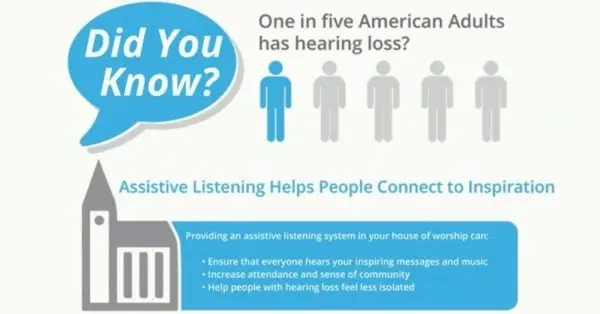
- Approximately 48 million Americans (roughly 15% of the population) experience some degree of hearing loss.
- Hearing loss is the third most common chronic physical condition in the United States, with prevalence doubling for adults aged 65 and older.
- Despite these staggering figures, studies indicate that adoption rates for hearing aids hover around 25% to 30% among individuals who could clinically benefit from them, frequently due to cost, aesthetic stigma, or frustration with background noise in public venues.
When applied to a church setting, these statistics reveal that a substantial percentage of any given congregation is actively struggling to decode sermons, hymns, and responsive readings. Without assistive technology, these individuals experience listening fatigue—a state of mental exhaustion caused by the brain working overtime to fill in missing acoustic blanks. Over time, individuals suffering from listening fatigue simply stop attending services, feeling that their spiritual home no longer accommodates their physical reality.
Acoustic Realities of Sacred Spaces
Architecturally, houses of worship present some of the most challenging acoustic environments in modern design. Historically constructed to project acoustic pipe organs and soaring choral voices across large stone and hardwood cavities, sanctuaries rely on natural reverberation. However, what sounds majestic and resonant for music is toxic for speech intelligibility.
Reverberation times (RT60) in traditional sanctuaries often exceed 2.0 to 3.0 seconds, meaning sound waves bounce continuously off hard reflective surfaces, muddying consonants and causing words to blur together. For a person with normal hearing, the brain can filter out much of this acoustic clutter; for a person with sensorineural hearing loss or a hearing aid, the background noise is amplified right alongside the speech, rendering the message incomprehensible. An ALS cuts straight through this acoustic chaos by delivering a pristine, direct feed from the microphone to the ear.
Official Statements & Industry Insights
Industry leaders and integration professionals emphasize that modern accessibility is a core component of authentic hospitality.
"Reaching out to those who feel disconnected from your community due to hearing loss is central to sharing the message of inclusion. Genuinely compassionate service involves being aware of and caring for the needs of everyone, especially those dealing with impairments. Make sure they are able to hear the beauty and emotion of the spoken word in your church by providing them with the equipment they need to stay connected."
— Audio-Visual Integration Advisory, CCI Solutions
From a ministry standpoint, leadership teams frequently report a profound cultural shift once listening systems are properly deployed and promoted. When an elderly or hearing-impaired member experiences a service with absolute acoustic clarity for the first time in years, the emotional reaction is often overwhelming. It communicates a powerful, non-verbal message: You matter, your presence is valued, and we have prepared a place specifically for you to engage fully.
Furthermore, major technology manufacturers have streamlined the implementation process through comprehensive, standardized resources. For example, organizations seeking granular documentation can download the Listen Technologies Church Assistive Listening Toolkit, which provides actionable templates, sample congregational surveys, standardized signage graphics, and pre-written bulletin announcements designed to accelerate deployment.
Future Outlook: The Next Generation of Sanctuary Inclusion
As we look toward the future of worship production and facility management, the intersection of accessibility and digital technology will only deepen. Several emerging trends are poised to redefine how houses of worship approach auditory inclusion over the next decade:
- Personalized Audio via Mobile Applications: The ubiquity of smartphones means the future of assistive listening is increasingly software-driven. Wi-Fi streaming systems allow users to download a church-branded app and adjust volume, tone profiles, and EQ settings directly on their personal mobile devices, matching their exact clinical audiogram profile without requiring physical hardware checkouts.
- Integration with Artificial Intelligence (AI) and Live Captioning: Beyond audio delivery, forward-thinking churches are pairing listening systems with real-time AI speech-to-text transcription displayed on sanctuary confidence monitors or transmitted to mobile devices. This multi-sensory approach benefits not only those with severe hearing loss but also neurodivergent individuals, non-native language speakers, and visual learners.
- Mainstreaming of Auracast™ Broadcast Audio: The advent of Bluetooth Low Energy (LE) Audio and Auracast™ technology promises to revolutionize public space audio broadcasting. In the near future, congregants will be able to connect their hearing aids or wireless earbuds directly to a sanctuary’s broadcast stream with a single tap on their phone, completely eliminating the need for specialized venue receivers or proprietary loops.
Conclusion and Next Steps
The mission of any thriving house of worship is to proclaim a message of hope, community, and unconditional inclusion. Yet, when physical barriers prevent a segment of the congregation from hearing that message clearly, an invisible wall is erected.
Implementing an Assistive Listening System is not merely an engineering upgrade or a regulatory checkbox; it is an act of profound pastoral care. By methodically assessing your congregation’s needs, budgeting for the appropriate technological solution, training your staff to be enthusiastic ambassadors, and aggressively promoting the new infrastructure, your facility can tear down the acoustic divide.
For detailed information on selecting the right Assistive Listening System, accessing sample diagnostic surveys, obtaining compliance signage, and utilizing ready-made communication templates, download the Listen Technologies Church Assistive Listening Toolkit.
Does your worship facility currently meet the auditory needs of every member of your community? Contact integration specialists today to evaluate how your ministry can benefit from advanced assistive listening technology.