
Executive Overview
In an era defined by rapid technological innovation, modern houses of worship strive to create immersive, spiritually uplifting environments through cutting-edge architectural acoustics, line-array speaker systems, and state-of-the-art digital mixing consoles. Yet, despite these multi-thousand-dollar audio investments, a significant demographic within congregations continues to experience profound isolation during services. For millions of individuals living with hearing loss, standard amplified sound simply does not equate to speech intelligibility. Reverberation, background noise, and distance from the sound source combine to turn sermons, prayers, and hymns into an indistinguishable wall of sound.
The implementation of an Assistive Listening System (ALS) is no longer a peripheral accessibility accommodation; it is a fundamental imperative for radical hospitality and inclusive ministry. When a church integrates an effective ALS, it directly confronts the physical barriers that separate hearing-impaired members from the lifeblood of the community: the spoken Word and shared fellowship.
However, purchasing and installing hardware is merely the first step in a much larger journey. True technological integration requires strategic foresight, deep community engagement, rigorous staff training, and proactive awareness campaigns. This report provides an authoritative, step-by-step framework for religious organizations seeking to evaluate, select, deploy, and promote assistive listening solutions. Drawing on industry insights from AV integration leaders and audio-visual resource toolkits, this guide explores how houses of worship can transform their acoustic environments into spaces of absolute clarity and inclusion.
Detailed Chronology: A Four-Phase Strategic Roadmap for Implementation
Deploying an Assistive Listening System requires a deliberate, phased approach to ensure financial stewardship, technical compatibility, and high user adoption rates. Rushing the procurement process often results in mismatched technologies, underutilized equipment, and frustrated congregants. The following four-phase chronological roadmap outlines the lifecycle of a successful ALS implementation project.
[Phase 1: Needs Assessment] ──> [Phase 2: Technical & Budgetary Planning] ──> [Phase 3: Operational Preparation] ──> [Phase 4: Awareness & Community Outreach]Phase 1: Understanding Congregation Needs and Acoustic Realities
The foundational error many facility managers make is assuming they know what kind of assistive technology their congregation requires. Before requesting vendor quotes or browsing equipment catalogs, leadership must conduct a comprehensive assessment of the demographic and technical realities within their pews.
- Conducting the Congregation Survey: The most effective method for evaluating need is a direct survey of the membership. This questionnaire should go beyond simply asking, "Do you have trouble hearing?" It must dive into specifics: How do members experience current worship services? Do they use hearing aids? Crucially, do those hearing aids feature telecoil (t-coil) technology? Understanding the prevalence of t-coil equipped devices dictates whether an inductive loop system, an FM system, an infrared system, or a Wi-Fi-based streaming solution will yield the highest satisfaction.
- Acoustic Mapping and Environment Audit: Alongside demographic surveys, facility teams should evaluate the physical acoustic profile of the sanctuary. High ceilings, hard reflective surfaces (like marble, glass, and untreated drywall), and expansive footprints exacerbate reverberation time, destroying speech intelligibility. Identifying dead zones where audio intelligibility drops off sharply helps determine coverage requirements for the chosen listening system.
Phase 2: Evaluating Technical Options and Financial Logistics
Once congregational needs and architectural constraints are clearly defined, the leadership team must evaluate available hardware configurations and financial pathways.
- Balancing Technology Types: Houses of worship generally choose between four primary assistive listening technologies:
- Audio Frequency Induction Loop Systems (AFILS): Broadcasts audio directly to t-coil equipped hearing aids and cochlear implants without the need for separate receivers.
- FM Radio Frequency Systems: Transmits audio via radio waves to dedicated bodypack receivers worn by users. Highly reliable and flexible, ideal for large rooms.
- Infrared (IR) Systems: Uses light waves to transmit audio within a contained line-of-sight space. Excellent for privacy and high-security needs, but vulnerable to sunlight interference.
- Wi-Fi Streaming Systems: Broadcasts audio over a local wireless network directly to users’ smartphones via a downloadable app. Highly cost-effective for tech-savvy congregations, though it introduces latency and operational hurdles for non-smartphone users.
- Budgeting and Financial Planning: Estimating the total cost of ownership involves looking past the initial hardware price tag to include cabling, transmitters, receivers, neckloops, charging stations, and signage. Professional AV integration partners—such as CCI Solutions—offer invaluable assistance in navigating these variables through free consultations, ensuring that churches do not overspend on redundant features or underspend on critical performance metrics. Furthermore, houses of worship can leverage targeted fundraising campaigns, memorial gifts, or accessibility grant programs to offset capital expenditures.
Phase 3: Preparing Staff, Volunteers, and Operational Infrastructure
The finest audio hardware in the world will fail if the human element of distribution and maintenance is neglected. Operational readiness requires transforming support staff and ushers into knowledgeable advocates for accessibility.
- Training "Assisted Listening Ambassadors": Staff members and hospitality volunteers must receive thorough, hands-on training regarding the operation, troubleshooting, and distribution of the assistive listening devices. These individuals serve as the frontline ambassadors for the new technology. When a congregant checks out a receiver, the ambassador should take the time to demonstrate its functions, adjust the volume, and ensure a comfortable fit.
- Establishing Fail-Safe Operational Protocols: To eliminate friction at the distribution desk, leadership should create a standardized checkout process. Essential troubleshooting steps and answers to frequently asked questions (FAQs) should be printed in large, legible font and laminated for placement directly at the distribution counter. Regular battery checks, sanitization protocols for earpieces and neckloops, and secure storage solutions must be embedded into the weekly facilities checklist.
Phase 4: Creating Awareness and Driving Adoption
An invisible system is easily ignored. Even the most advanced assistive listening installation will fall flat if the community does not know it exists. Launching an ALS requires a multi-channel awareness campaign that reaches both current congregants and prospective visitors.
- Strategic Signage Placement: Clear, universally recognized international symbols for accessibility must be displayed prominently at building entrances, welcome kiosks, and the main auditorium doors. These signs should explicitly state that Assisted Listening Devices (ALDs) are available and direct visitors to the exact location where they can be acquired.
- Multi-Channel Communications: Awareness must be reinforced continually. Weekly bulletins, digital slide presentations before services, social media channels, and the church website should feature gentle reminders that listening assistance is available.
- Host Live Technology Workshops: For older demographics who may feel intimidated by new technology, consider hosting a dedicated live training session or a "coffee and tech" seminar. Allowing congregants to test the equipment in a relaxed, low-stakes environment builds confidence and demystifies the hardware.
- Community Outreach: Advertising the availability of an ALS to the surrounding neighborhood communicates a powerful message of radical inclusion. Many individuals with hearing loss quietly stop attending religious services because they feel alienated by poor acoustic environments. When local care facilities, senior centers, and community groups learn that a church has invested in accessibility, it serves as a powerful beacon of welcome.
Supporting Context & Metrics: The Hidden Crisis of Hearing Loss in Worship
To fully appreciate the urgency of deploying Assistive Listening Systems, one must examine the broader socio-acoustic context of hearing impairment within modern society and religious gatherings.
The Scale of Age-Related and Induced Hearing Loss
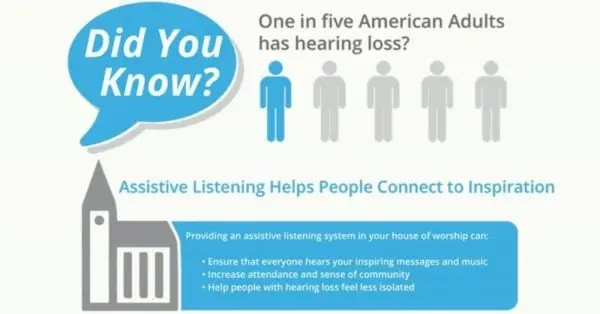
According to data compiled by the World Health Organization (WHO) and the Centers for Disease Control and Prevention (CDC), hearing loss is one of the most common chronic physical conditions affecting adults. In the United States alone, approximately 15% of American adults (roughly 37.5 million people) report some trouble hearing. The prevalence of hearing loss increases dramatically with age:
- Ages 45 to 54: ~2% experience disabling hearing loss.
- Ages 55 to 64: ~8.5% experience disabling hearing loss.
- Ages 65 to 74: ~25% experience disabling hearing loss.
- Ages 75 and older: ~50% experience disabling hearing loss.
Because traditional church demographics frequently skew toward older adult populations, the concentration of hearing-impaired individuals inside a typical Sunday morning service is often significantly higher than the national average. Without dedicated acoustic support, a church with an attendance of 500 people may inadvertently be leaving dozens of members struggling to comprehend the spoken message.
The Psychological Toll of Acoustic Isolation
The consequences of untreated hearing loss extend far beyond mere inconvenience; they exact a heavy psychological and social toll. Studies published in geriatric psychiatry journals consistently link unmanaged hearing loss to:
- Social Isolation: Individuals who cannot follow group conversations or sermons gradually withdraw from communal life, avoiding fellowship halls and sanctuary pews alike.
- Cognitive Decline: The brain’s constant struggle to decode degraded audio signals diverts cognitive resources away from memory and executive function, accelerating cognitive fatigue.
- Depression and Anxiety: The frustration of missing critical spoken cues often leads to feelings of inadequacy, embarrassment, and loneliness.
By providing high-fidelity Assistive Listening Systems, houses of worship do more than amplify sound—they actively combat the isolation and depression associated with sensory impairment, restoring dignity and full communal participation to vulnerable members.
Official Statements and Industry Insights
Industry leaders, accessibility advocates, and audio engineers emphasize that the transition toward universal design in religious facilities represents a cultural shift in how faith communities view disability.

"Reaching out to those who feel disconnected from your community due to hearing loss is central to sharing the message of inclusion. Genuinely compassionate service involves being aware of and caring for the needs of everyone, especially those dealing with impairments. Make sure they are able to hear the beauty and emotion of the spoken word in your church by providing them with the equipment they need to stay connected."
— Audio-Visual Accessibility Working Group & Industry Insights
AV integration specialists frequently point out that accessibility is an ongoing ministry rather than a one-time line item. Speaking on the integration of assistive technologies, senior systems designers note:
"Investing in assistive listening is a profound statement of pastoral care. When a church tells an aging or hearing-impaired member, ‘We built this system specifically so you wouldn’t miss a single word of God’s grace,’ it transforms the technological experience into a deeply spiritual encounter."
— Technical Consultation Desk, CCI Solutions
Furthermore, legal compliance frameworks—such as the Americans with Disabilities Act (ADA) in the United States—mandate the provision of assistive listening systems in places of assembly with fixed seating and amplified sound. Beyond legal minimums, proactive houses of worship view ADA compliance as a baseline rather than an ultimate goal, striving to exceed standards to ensure genuine usability and comfort.
Future Outlook: The Next Generation of Acoustic Inclusion
As audio technology continues to evolve at a blistering pace, the future of assistive listening in houses of worship promises even greater integration, discretion, and fidelity. Several emerging trends are reshaping the landscape of accessible ministry:
1. The Rise of Auracast™ and Bluetooth LE Audio
Traditional FM and infrared systems are rapidly being challenged by next-generation Bluetooth audio standards, specifically Auracast™ broadcast audio. This revolutionary technology allows an audio source—such as a church’s soundboard—to broadcast crystal-clear, high-quality audio simultaneously to an unlimited number of compatible Bluetooth receivers, hearing aids, and earbuds. Congregants will no longer need to check out bulky dedicated receivers from a hospitality desk; instead, they will be able to connect directly to the church’s broadcast stream using their own personal smartphones, smartwatches, or Bluetooth-enabled hearing aids with a simple tap on a screen.
2. Artificial Intelligence and Dynamic Noise Suppression
Future assistive listening systems will increasingly incorporate AI-driven noise suppression and room calibration algorithms. These smart processors will dynamically filter out HVAC hums, shuffling feet, and side-conversations in real-time, delivering an optimized, pristine vocal mix tailored precisely to the unique auditory profile of the individual user.
3. Comprehensive Accessibility Toolkits
To empower churches of all sizes—from rural congregations to multi-site mega-churches—industry manufacturers and non-profit accessibility advocates are releasing comprehensive digital resource packages. Organizations seeking to audit their facilities can now download specialized toolkits containing sample surveys, printable signage templates, staff training modules, and bulletin announcement drafts. For example, comprehensive guides such as the Listen Technologies Church Assistive Listening Toolkit provide turnkey resources designed to eliminate the guesswork from compliance and implementation.
Conclusion
The mission of a house of worship is rooted in radical welcome, community, and the unhindered proclamation of the Gospel. Yet, architectural acoustics and natural physical limitations can inadvertently build invisible walls around those struggling with hearing loss.
By following a structured implementation path—carefully assessing congregation needs, evaluating technical options with expert guidance, training dedicated staff to be welcoming ambassadors, and maintaining vibrant awareness campaigns—churches can tear down these acoustic barriers. Investing in an Assistive Listening System is an investment in human connection, ensuring that every soul in the sanctuary can partake fully in the beauty, emotion, and transformative power of the spoken word.
For more detailed information on choosing the right Assistive Listening System and tools to ensure your success—including sample surveys, signage vectors, and bulletin announcements—please download a copy of the Listen Technologies Church Assistive Listening Toolkit.
Does your worship facility currently utilize assistive listening, or are you exploring ways to upgrade your audio accessibility infrastructure? Reach out to our team of integration specialists to share your story and discover how your ministry can benefit from modern acoustic solutions.