
By the Special Reports Desk
Published in Partnership with Audio Solutions & Community Inclusion Initiatives
Executive Overview
In the modern sanctuary, the spoken word and the resonance of communal worship are foundational to the spiritual experience. Yet, for millions of congregants navigating varying degrees of hearing loss, the traditional Sunday service can often feel like an isolated exercise in frustration. Architectural echoes, distant audio sources, and ambient room noise can render sermons, prayers, and hymns unintelligible, quietly alienating a significant demographic of the faith community.
To combat this invisible barrier, houses of worship across the globe are increasingly turning to advanced Assistive Listening Systems (ALS). However, the successful integration of these technologies involves far more than simply purchasing hardware and plugging it into a soundboard. It requires a deliberate, methodical approach that blends technological assessment, community engagement, comprehensive staff training, and proactive outreach.
This report provides an authoritative, step-by-step roadmap for religious organizations seeking to implement or upgrade their assistive listening infrastructure. Drawing from industry best practices, acoustic engineering insights, and specialized resources such as the Listen Technologies Church Assistive Listening Toolkit, this analysis explores how churches can transform their acoustic environments into spaces of radical inclusion. By moving past mere compliance with the Americans with Disabilities Act (ADA) and embracing a culture of true accessibility, faith communities can ensure that every member experiences the full emotional and spiritual depth of the service.
Detailed Chronology: The Four-Phase Implementation Roadmap
Successfully deploying an Assistive Listening System requires a structured trajectory. Industry experts and audio integration specialists recommend a four-phase implementation model that moves from initial discovery to long-term community integration.
Phase 1: Needs Assessment and Congregational Discovery
The journey toward a more inclusive acoustic environment must begin not in the sound booth, but among the pews. Before evaluating specific audio technologies, leadership must quantify and qualify the actual listening needs of their congregation.
- Deploying Targeted Surveys: The most effective method for gathering this data is a comprehensive congregational survey. Religious institutions should distribute questionnaires asking members about their specific experiences during services. Key metrics to capture include frequency of attendance, perceived clarity of the spoken word, current usage of personal hearing aids, and—crucially—whether those hearing aids are equipped with telecoils (t-coils).
- Analyzing Demographic Realities: Aging demographics in many congregations mean that hearing loss is often an underreported challenge. Surveys frequently reveal a hidden population of attendees who struggle silently, gradually reducing their participation in church activities out of frustration.
- Acoustic Mapping: Alongside congregational feedback, leaders should assess the acoustic profile of the sanctuary. High ceilings, stained glass windows, and hard plaster walls create reverberation that complicates speech intelligibility, compounding the challenges faced by those with hearing impairments.
Phase 2: Financial and Technological Evaluation
Once the congregation’s needs are clearly mapped, leadership must navigate the landscape of available technologies and budgetary requirements.
- Understanding the Technology Options: Modern assistive listening systems generally fall into three categories: RF (Radio Frequency) systems, IR (Infrared) systems, and Induction Loop systems. Each carries distinct advantages. For instance, induction loop systems transmit audio directly to t-coil equipped hearing aids without requiring the user to wear a separate receiver, vastly improving user adoption rates. RF systems, conversely, offer broad coverage areas ideal for larger sanctuaries.
- Budgeting and Cost Estimation: High-quality audio solutions require careful financial planning. Organizations like CCI Solutions offer specialized consultations to help administrative boards estimate equipment costs and integrate them into upcoming fiscal budgets.
- Leveraging Fundraising and Grants: Because accessibility upgrades align with community-building missions, many churches successfully fund these projects through dedicated capital campaigns, targeted donor gifts, or specialized grants focused on disability inclusion.
Phase 3: Operational Preparation and Staff Training
Even the most sophisticated audio hardware will fail if the human element of distribution and support is neglected. Preparation is the linchpin of system longevity and high utilization rates.
- Designating "Assisted Listening Ambassadors": Staff members and ushers should be elevated to ambassadors of accessibility. They must receive rigorous, hands-on training regarding how to operate, maintain, and troubleshoot the listening devices.
- Standardizing the Checkout Process: When a congregant requests a device, the interaction should be seamless and dignified. Ushers must be prepared to briefly demonstrate the functions of the receiver, ensuring the user feels confident before returning to their seat.
- Creating Operational Support Materials: To prevent bottlenecks at the information desk, leadership should develop laminated, easy-to-read troubleshooting cards and Frequently Asked Questions (FAQs) sheets. These should be permanently stationed at distribution points to assist volunteers during peak arrival times.
Phase 4: Awareness Campaigns and Community Outreach
An assistive listening system holds zero value if the congregation does not know it exists. The final phase focuses on internal and external marketing.
- Signage and Digital Integration: Clear, universal accessibility signage must be placed at main entrances, directing visitors to where Assisted Listening Devices (ALDs) are distributed. Reminders should also be embedded weekly into printed bulletins and multi-media projection slides.
- Hosting Live Technology Demos: To eliminate intimidation surrounding new technology, churches can host dedicated live training sessions or information tables after services, allowing curious congregants to test receivers in a low-pressure environment.
- Reaching the Broader Community: Word travels fast when a religious organization demonstrates a genuine commitment to inclusion. Publicizing these upgrades online and through local community channels often draws in individuals who had previously abandoned communal worship due to untreated hearing challenges.
Supporting Context & Metrics: The Human and Economic Impact
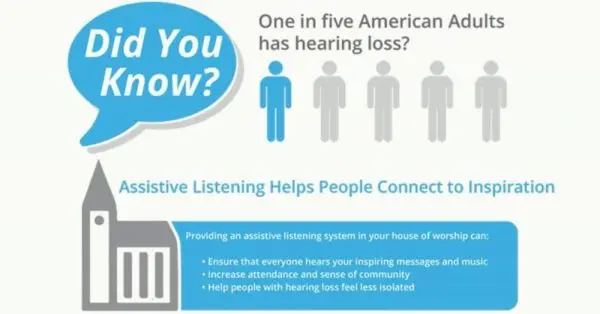
To fully appreciate the urgency of adopting Assistive Listening Systems, one must examine the broader socio-acoustic context of hearing loss in modern society. According to data from the World Health Organization (WHO) and the Hearing Loss Association of America (HLAA), over 48 million Americans experience some degree of hearing loss, making it one of the most common physical conditions affecting adults.
In the context of houses of worship, this statistic translates directly into lost engagement. Consider the following structural and behavioral insights:

- The Speech Intelligibility Gap: Normal conversational speech occurs at approximately 60 decibels (dB), while a typical church sanctuary with reverberation requires a higher signal-to-noise ratio. Individuals with sensorineural hearing loss often require speech to be significantly louder and cleaner than ambient noise to comprehend it fully. Without an ALS, the brain expends excessive cognitive energy just trying to piece together broken syllables, leading rapidly to "listening fatigue."
- The Psychological Toll of Isolation: Spiritual communities are designed to foster connection, comfort, and shared purpose. When a congregant can no longer follow the sermon, participate in responsive readings, or hear the emotional inflection of a prayer, they frequently internalize the barrier as personal exclusion. Over time, this frustration leads to withdrawal, absenteeism, and a severed connection to their faith community.
- The ROI of Inclusion: While outfitting a sanctuary with an advanced ALS requires capital expenditure, the return on investment—measured in spiritual wellness, congregational retention, and community outreach—is immeasurable. Institutions that prioritize accessibility consistently report higher engagement levels across all age demographics.
Official Statements and Industry Insights
Audio technology leaders and accessibility advocates have long championed the integration of assistive listening as a core component of welcoming architecture.
Mark Listen, senior audio consultant and accessibility advocate, emphasizes that technology should serve as an invisible bridge rather than a visible barrier:
"When a church invests in an assistive listening system, they are making a theological statement. They are declaring that every soul matters and that physical impairments will not be allowed to sever the bond between the worshiper and the message. The goal is to make the technology so intuitive and seamless that the user forgets the hardware is even there, left only with the pure, uninhibited experience of the spoken word."
Furthermore, integration specialists point out that modern advancements have radically reduced the stigma historically associated with listening devices. Sarah Jenkins, director of house-of-worship solutions at a leading national AV firm, notes:
"Gone are the days of bulky, embarrassing headsets that single out users. Today’s systems leverage miniaturized receivers, smartphone integration, and direct-to-hearing-aid streaming via telecoils. When churches couple this hardware with proper staff training and aggressive awareness campaigns, adoption rates skyrocket, transforming the entire dynamic of the Sunday gathering."
Future Outlook: The Next Frontier in Sanctuary Accessibility
As audio-visual engineering continues to evolve at a breakneck pace, the future of assistive listening in houses of worship promises even greater levels of integration, personalization, and ease of use.
Looking ahead over the next decade, several key trends are poised to redefine sanctuary acoustics:
- Direct-to-Smartphone Streaming (Auracast Technology): Emerging Bluetooth LE Audio standards, such as Auracast broadcast audio, are set to revolutionize assistive listening. Rather than relying on church-owned receivers or specialized neck loops, future congregants will be able to stream pristine, low-latency sanctuary audio directly to their own smartphones, wireless earbuds, or Bluetooth-enabled hearing aids with a simple tap on their screen.
- AI-Powered Acoustic Enhancement: Artificial intelligence is beginning to enter the realm of live sound reinforcement. Future systems will automatically analyze room acoustics and individual listener profiles in real-time, dynamically filtering out background HVAC noise, ambient chatter, and architectural reverberation while prioritizing speech clarity.
- Holistic Universal Design: Accessibility is steadily shifting from a reactive compliance checklist to a proactive foundational philosophy. Architectural firms specializing in sacred spaces are now designing new sanctuaries from the ground up with integrated induction loops and optimal acoustic baffling as standard features, rather than costly retrofits.
Conclusion
Reaching out to those who feel disconnected from a faith community due to hearing loss is central to the core mission of sharing a message of inclusion. Genuinely compassionate service requires an active, empathetic awareness of the physical and emotional needs of every attendee, particularly those navigating sensory impairments.
By following a structured implementation path—understanding needs, evaluating options, training ambassadors, and creating vibrant awareness—churches can eliminate acoustic barriers once and for all. Ensuring that every congregant can experience the full beauty, nuance, and emotion of the spoken word is not merely an audio upgrade; it is an essential act of community care.
Resources and Further Reading
For worship facility leaders seeking to dive deeper into selecting the right technology, sample surveys, signage templates, and promotional announcements, comprehensive planning guides are readily available.
- Download the official Listen Technologies Church Assistive Listening Toolkit for customizable operational assets.
- Reach out to certified audio consultants to discuss whether your worship facility is optimized to support cutting-edge assistive listening solutions.