
Executive Overview
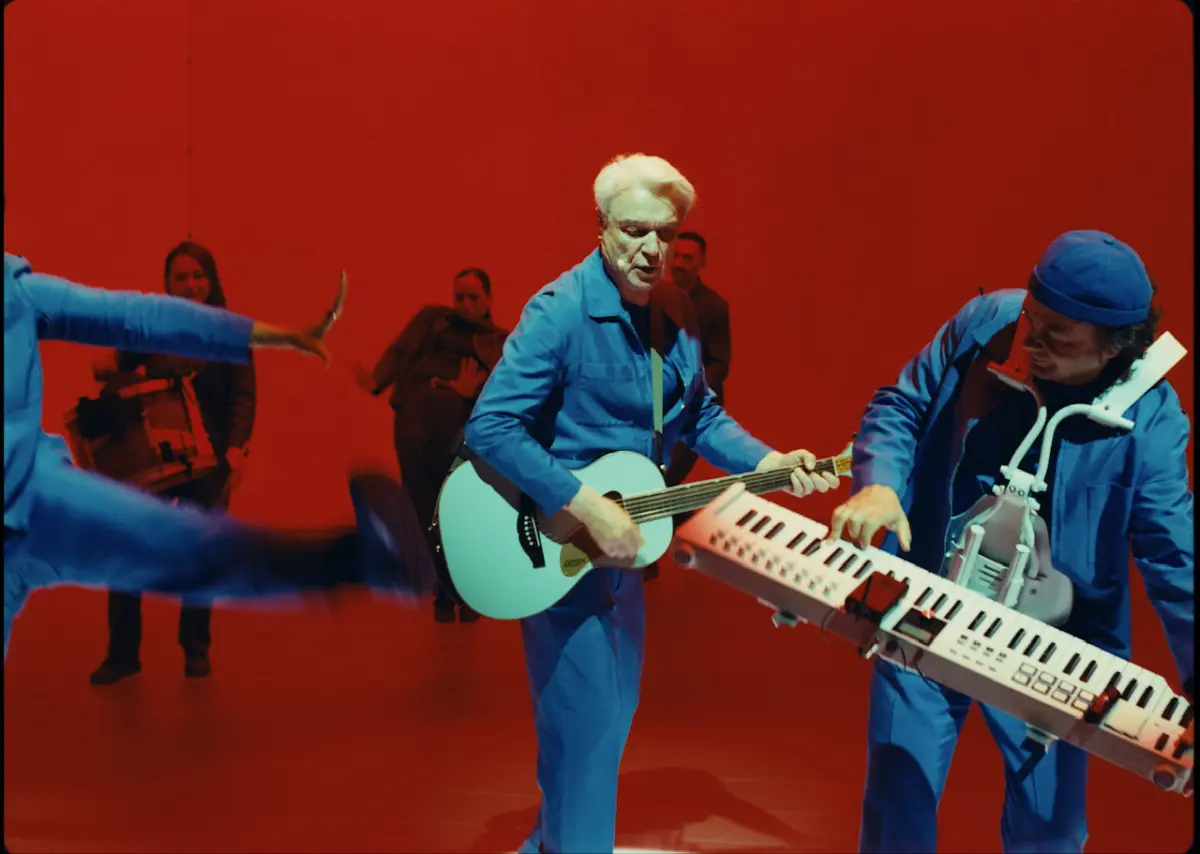
In an era dominated by digital streaming, compressed audio formats, and smartphone-shot concert clips, legendary musician and performance artist David Byrne is taking a decidedly old-school, high-art approach to preserving his latest live triumph. Byrne has partnered with acclaimed filmmaker Brady Corbet—fresh off his visionary work on the architectural epic The Brutalist—to create a landmark concert film. Captured over multiple nights at the historic Hippodrome Theatre in Byrne’s hometown of Baltimore, Maryland, the project immortalizes a definitive chapter of a massive global tour that has spanned more than 150 shows across four continents.
What sets this cinematic endeavor apart from standard concert documentaries is its medium: pristine 70mm film. Eschewing the ubiquitous digital cameras that have become the industry standard, Byrne and Corbet utilized both 8-perf and 15-perf 70mm formats to capture the scale, intimacy, and visceral energy of the live performance. The result is a fusion of avant-garde filmmaking and world-class musicianship, produced by The Deep End Films and Pre-Code (Corbet’s production company, co-run with Mona Fastvold), and presented by River Road Entertainment.
This comprehensive report examines the genesis of this unique collaboration, details the technical hurdles and artistic triumphs of shooting on large-format film, contextualizes Byrne’s ongoing reinvention of the live concert experience in support of his 2025 album Who Is The Sky?, and explores what this ambitious project signals for the future of cinematic music distribution.
Detailed Chronology: From the Stage to the Silver Screen
The journey toward this unprecedented cinematic document began long before the cameras rolled at the Hippodrome. To understand the gravity of the Baltimore residency, one must trace the trajectory of Byrne’s recent creative output and the grueling, exhilarating schedule of his international touring machine.
The Genesis of Who Is The Sky? and the Global Trek
Following a string of critically lauded theatrical and musical projects—most notably his explosive Broadway hit American Utopia—David Byrne returned to the studio to craft his 2025 album, Who Is The Sky?. The record, which embraces themes of interconnectedness, environmental wonder, and cosmic perspective, demanded a live realization that was both expansive and deeply human.
To bring the record to life, Byrne assembled a powerhouse touring ensemble, hitting the road for a relentless schedule that ultimately surpassed 150 shows. Traversing North America, Europe, Asia, and South America, the tour became renowned for its theatricality, seamless choreography, and the infectious, communal joy that Byrne has made a hallmark of his solo career. Yet, as the tour wound its way across continents, the looming question for management and production teams was how to capture a lightning-in-a-bottle experience that changed subtly night after night.
The Baltimore Residency and the Vision of Brady Corbet
Rather than opting for a generic tour-stop recording, Byrne chose his native Baltimore as the spiritual and physical anchor for the film project. The historic Hippodrome Theatre provided an ornate, atmospheric backdrop that contrasted brilliantly with the sleek, modern staging of the concert.
Enter Brady Corbet. Known for his uncompromising visual style and meticulous command of historical and spatial scale in narrative filmmaking—culminating in the sweeping vistas of The Brutalist—Corbet was an unconventional choice for a concert film director. However, it was precisely his eye for grand framing and textural authenticity that caught Byrne’s attention.
Over multiple nights at the Hippodrome, Corbet and his cinematographers deployed massive 70mm camera rigs. Operating in both 8-perf and 15-perf (IMAX-style) configurations, the crew faced immense technical hurdles. Unlike digital sensors that thrive in low-light stage environments and allow for infinite takes without media changes, shooting on genuine 70mm stock required absolute precision, massive lighting adjustments to accommodate the film’s exposure requirements, and a choreography between camera operators and performers that left no room for error.
Despite the logistical nightmares of handling vintage-style large-format film stock inside a crowded theater, the gamble paid off. When Byrne first viewed test frames sent by Corbet, his skepticism evaporated, replaced by awe at how the medium captured the physical dimensions of the stage show in a way standard high-definition video never could.
Supporting Context & Metrics: The Anatomy of a 70mm Concert Film
To truly appreciate the magnitude of this collaboration, one must analyze the technological, artistic, and logistical metrics that define the project.
The 70mm Difference: Technical Specifications
In modern filmmaking, "70mm" has become an almost mythical buzzword, usually reserved for prestige period dramas or Christopher Nolan blockbusters. Its application to a live music performance is exceptionally rare.
- The Format: The production utilized dual configurations of 70mm film—8-perf and 15-perf.
- Resolution and Detail: While digital cinema packages (DCPs) are often measured in 4K or 8K digital pixels, true 70mm film possesses an analog resolution equivalent that far surpasses digital standards, offering infinite continuous gradation of color, immense dynamic range, and a three-dimensional depth of field.
- The Physical Scope: The 15-perf format (running horizontally through the gate, identical to IMAX) provides an image area nearly ten times larger than standard 35mm film, capturing peripheral details of the Hippodrome’s architecture, the sweat on the musicians’ brows, and the intricate staging with breathtaking clarity.
Touring Footprint and Cultural Impact
The film serves as a historical archive for a monumental touring cycle:
- Scale: Over 150 shows played globally in support of Who Is The Sky?.
- Geographic Reach: Spanning four distinct continents, uniting diverse audiences under a shared umbrella of communal performance.
- The Venue: The Hippodrome Theatre in Baltimore, chosen not just for its acoustic and visual properties, but as a tribute to Byrne’s formative roots in Maryland.
The Production Powerhouse
The film’s pedigree is bolstered by an elite coalition of indie and prestige film production companies:
- Pre-Code: Brady Corbet and Mona Fastvold’s production banner, known for backing auteur-driven, formally daring cinema.
- The Deep End Films: Headed by Jason Fine and Amit Dey, bringing industry-leading expertise in translating complex cultural moments to the screen.
- River Road Entertainment: Serving as presenter, adding major-studio-tier backing to an uncompromisingly artistic indie production.
Official Statements and Industry Perspectives
The announcement of the project has sent ripples through both the music and film communities. The principal creators offered profound insights into the philosophy driving the collaboration.
Reflecting on the unexpected visual power of the medium, David Byrne shared his initial reservations and subsequent conversion:
"When Brady told me he wanted to shoot our show in 70 millimeter (70 millimeter!) I didn’t realize what a difference it would make until I saw some frames he sent me. He was right, it really does capture the wide screen visual scope of the show. I’ve never seen anything like it."
For Brady Corbet, the project was as much an homage to a legendary musician as it was a love letter to an overlooked American city. Corbet remarked:
"I am so grateful to David Byrne and his entire team for entrusting us to capture his hometown show on 8-perf and 15-perf 70mm. The band’s performance is an inclusive celebration of community, and of Baltimore in particular—one of America’s most underappreciated historic cities."
Meanwhile, Jason Fine and Amit Dey of The Deep End Films emphasized the cultural urgency of the film in a fractured media landscape:
"We are thrilled to help bring David Byrne’s incredible, joyous tour to the screen in a way that can be shared for all time. This film will capture one of our greatest artists at the peak of his craft, in a moment that brings people together when we need it most, and that will elevate the concert film experience to a new level."
Future Outlook: Setting a New Standard for Concert Cinematography
As post-production on the 70mm footage ramps up, industry analysts and cinephiles are already speculating on the distribution model and long-term cultural legacy of the film.
In an entertainment landscape increasingly saturated with disposable, algorithmically generated content designed for vertical phone screens, Byrne and Corbet’s uncompromising analog approach acts as a radical counter-statement. By forcing audiences to slow down and appreciate the rich grain, tactile depth, and expansive vistas of 70mm film, the project elevates the concert movie from a promotional byproduct of a music tour into a standalone masterwork of cinematic art.
What Lies Ahead:
- Theatrical Roadshow: Given the rarity of 70mm projection equipment in modern commercial cinemas, industry insiders anticipate a specialized "roadshow" release, hitting select historic picture palaces and IMAX-equipped venues capable of handling the physical film prints.
- Archival Permanence: Unlike digital files that risk obsolescence or compression artifacts, a properly stored 70mm preservation print can last for generations, ensuring that Byrne’s 2025 artistic peak will remain pristine for decades to come.
- A New Blueprint for Artists: The success of this collaboration may inspire other legacy and contemporary acts to rethink how they document their live shows, proving that fans will show up for premium, high-art cinematic experiences that respect both their intelligence and their aesthetic sensibilities.
Ultimately, by wedding the ecstatic, community-driven ethos of David Byrne’s live music with the uncompromising structural rigor of Brady Corbet’s cinematic vision, this upcoming release promises to redefine what a concert film can—and should—be.