Executive Overview
The intersection of modern environmental degradation, corporate hegemony, and the creative psyche forms the crucible from which contemporary art often draws its most visceral power. In his latest sonic and conceptual undertaking, A Ban On Plastic Bag Bans, artist Andrew confronts the suffocating realities of corporate impunity in Middle America. Driven by a harrowing personal relocation to Kalamazoo, Michigan—a city where economic reliance on industry occasionally supersedes public health—Andrew has crafted an album that serves as both a scathing indictment of systemic environmental negligence and a deeply personal excavation of psychological trauma.
Triggered by toxic hydrogen sulfide emissions that forced local authorities to issue emergency stay-indoors directives, the project expands outward into a broader commentary on how systemic pollution becomes normalized. The album’s provocative title is drawn directly from a contentious Michigan legislative reality: a state law explicitly prohibiting local municipalities from banning single-use plastic bags. This legislative constraint serves as a metaphor for corporate dominance over everyday life, where environmental safety is systematically subordinated to commercial convenience.
Written and recorded across continents—spanning the United States and Andrew’s current home in Australia—the album marks a vital creative reunion with avant-garde jazz drummer Laurence Pike and multi-instrumentalist Cameron Deyell. Lead single "Ice Pick, Kalamazoo" offers the first window into this turbulent auditory landscape, blending experimental arrangements with raw lyrical urgency. As A Ban On Plastic Bag Bans prepares for its release, complete with a sprawling eleven-track tracklist, it stands as a testament to the enduring friction between human well-being, unchecked corporate power, and the invisible toxins that permeate both our air and our minds.
Detailed Chronology: From Relocation to Resistance
The genesis of A Ban On Plastic Bag Bans traces back to a specific domestic timeline, one that shifted rapidly from the mundane excitement of relocation to acute environmental anxiety.
Phase One: The Arrival in Kalamazoo
When Andrew, alongside his wife and daughter, relocated to Kalamazoo, Michigan, they anticipated the quiet charms and communal rhythms typical of Middle American towns. However, domestic peace was abruptly shattered shortly after unpacking. Settling into their new neighborhood, the family began noticing a persistent, deeply unsettling odor permeating the air around their home. What initially registered as an inexplicable domestic nuisance quickly escalated into a public health crisis.
Phase Two: The Hydrogen Sulfide Hazard
Investigation into the foul smell revealed a alarming source: a local packaging factory operating in close proximity to residential areas. The facility was emitting toxic hydrogen sulfide ($textH_2textS$) gas at concentrations so dangerously high that the Michigan state health department intervened. Authorities issued urgent warnings, explicitly advising local residents to "stay indoors" to avoid acute respiratory and neurological risks associated with the chemical exposure.
For Andrew, this moment marked a definitive psychological shift. The realization that his family’s health—and the health of the entire community—was being compromised by industrial emissions sparked an intense desire for accountability. Yet, navigating the bureaucratic and corporate structures designed to protect the facility proved an uphill battle, highlighting the stark imbalance of power between everyday citizens and industrial conglomerates.
Phase Three: Transcontinental Creation
Seeking distance from the toxic environment while processing the lingering psychological fallout, Andrew eventually relocated to Australia. However, the emotional imprint of Kalamazoo remained indelible. Collaborating remotely and across studio sessions between the United States and Australia, Andrew reconnected with avant-garde jazz drummer Laurence Pike and multi-instrumentalist Cameron Deyell.
Channeling the disorientation, frustration, and sensory overload of his Michigan experience, the trio forged the sonic architecture of A Ban On Plastic Bag Bans. The creative process became an act of catharsis, transforming toxic air and bureaucratic inertia into complex, avant-garde compositions that capture both external chaos and internal turmoil.
Supporting Context & Metrics: The Anatomy of Environmental Normalization
To fully understand the gravity of A Ban On Plastic Bag Bans, one must examine the socio-legal and environmental landscape that inspired it. The album’s title references a specific legislative framework in Michigan that strips local governments of their autonomy regarding environmental protection.
The Legislative Landscape: Preemption Laws
In Michigan, as in several other states across the U.S., state-level preemption laws forbid municipalities from implementing bans or fees on single-use plastic bags and containers. Proponents of these laws argue for uniformity in commerce, but critics—including grassroots environmental activists and local government leaders—view them as a direct assault on local democracy.
For Andrew, this specific statute became emblematic of a broader cultural conditioning. It demonstrated how corporate lobbyists can successfully institutionalize practices that degrade the environment, effectively tying the hands of communities attempting to protect their local ecosystems.

The Psychology of Invisible Pollution
Central to the thematic core of the album is the concept of normalization. Industrial pollution rarely arrives as an overnight catastrophe; instead, it frequently seeps into daily routines until it becomes an invisible, accepted backdrop of modern existence.
"You become so used to something, you lose your sense of it," Andrew observes, reflecting on his time in Michigan. "It’s got more to do with the perception of things than modern pollution—how these things that can be a constant in your life become sort of ingrained and invisible."
This insidious integration of toxicity affects more than just physical ecology. The psychological toll of living under a constant, low-grade environmental threat is profound. As Andrew succinctly notes regarding the dual nature of his experience: "It wasn’t just the environment that was polluted… It was also my mind." This duality forms the conceptual bedrock of the album, bridging external industrial neglect with internal psychological distress.
Official Statements and Artistic Vision
The collaborative synergy behind A Ban On Plastic Bag Bans elevates the project from a localized protest record into a sophisticated work of avant-garde art. The reunion of Andrew with Laurence Pike and Cameron Deyell brings a high level of improvisational mastery and textural depth to the instrumentation.
Pike, renowned for his work in the avant-garde and experimental jazz scenes, infuses the tracks with polyrhythmic urgency, mirroring the erratic and nerve-wracking nature of environmental anxiety. Deyell’s multi-instrumentalist dexterity bridges acoustic and electronic soundscapes, creating an atmospheric density that reflects the suffocating sensation of hydrogen sulfide-laden air.
While traditional protest music relies on explicit lyrical messaging, A Ban On Plastic Bag Bans leans heavily into abstraction, texture, and mood. The lead single, "Ice Pick, Kalamazoo," sets a sharp, piercing tone for the record, cutting through the complacency of suburban industrial towns with jagged rhythms and unsettling sonic interludes.
Complete Tracklist Overview
The album unfolds across eleven distinct movements, guiding the listener through an emotional arc of realization, conflict, internal strain, and eventual resolution:
- "Happy Or Not"
- "Ice Pick, Kalamazoo"
- "Laced Plume"
- "Urgent As Always"
- "Deep Deeper"
- "Disaster Tropes"
- "Beat Creep Some Eyes"
- "Real Time Trespasser"
- "SHAME!"
- "Retention Arc"
- "Out Of Order"
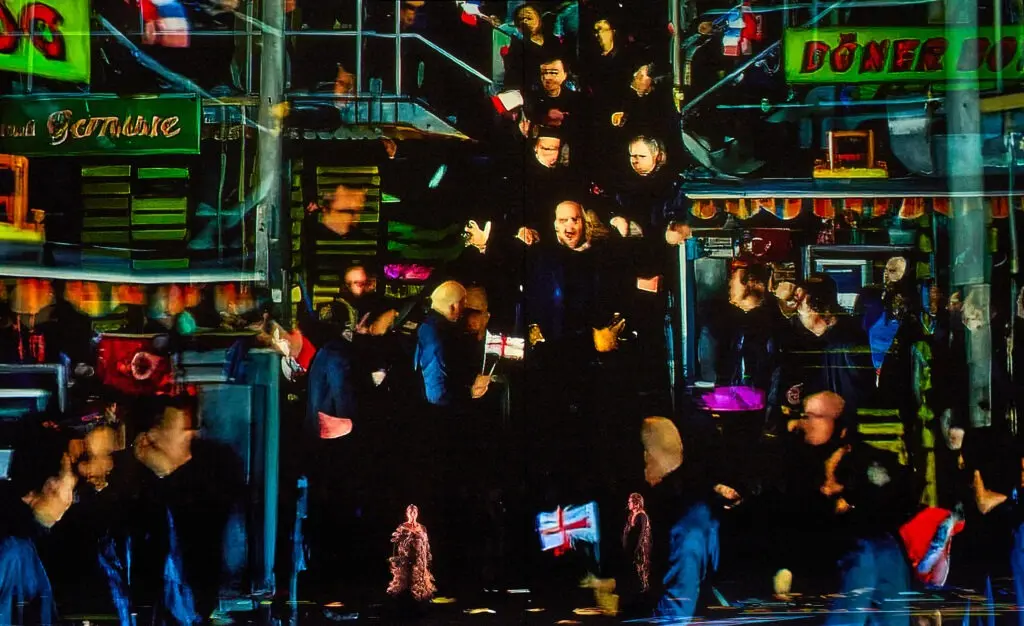
Each title hints at themes of systemic malfunction, psychological intrusion, and the friction between human dignity and industrial expansion. The striking visual artwork accompanying the release further reinforces this aesthetic, capturing the bleak yet hypnotic convergence of industrial landscapes and human habitation.
Future Outlook: Art as a Catalyst for Awareness
As A Ban On Plastic Bag Bans prepares to reach international audiences, its resonance extends far beyond the confines of indie music critique. In an era marked by escalating climate anxiety, regulatory rollbacks, and corporate greenwashing, the album offers a timely meditation on the cost of complacency.
By turning his lens toward the invisible poisons that populate Middle America, Andrew has created a work that challenges listeners to reevaluate their own environments. The album asks uncomfortable questions: What are we conditioned to ignore? Which corporate compromises have we accepted as immutable facts of life? And at what point does the pollution of our surroundings finally break the barriers of our minds?
Through its transcontinental craftsmanship, fearless thematic exploration, and uncompromising artistic vision, A Ban On Plastic Bag Bans establishes itself as a defining artistic statement of our environmentally precarious moment. It proves that while local governments may be legally barred from banning plastic bags, art remains entirely unfettered—capable of exposing toxic realities and demanding accountability long after the smoke clears.