
Executive Overview
The landscape of vocal pedagogy, otolaryngology, and voice science has undergone a monumental transformation over the past half-century, evolving from disparate artistic traditions into an empirically rigorous, multidisciplinary science. At the epicentre of this evolution stands The Voice Foundation, an international institution that has consistently bridged the gap between the art of singing and the science of medicine.
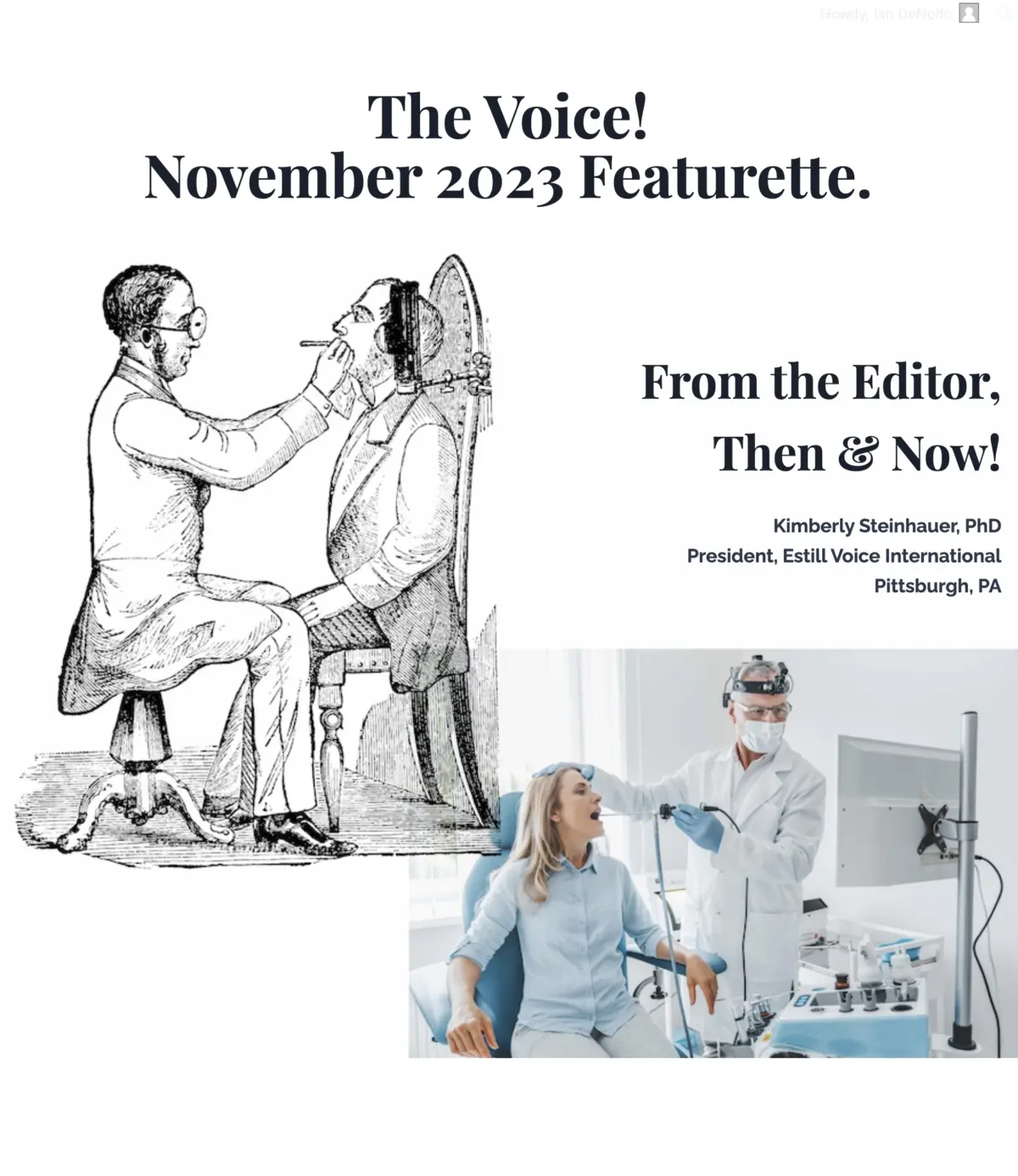
In the November 2023 special investigative edition of The Voice, guest editor and Estill Voice International President Dr. Kimberly Steinhauer introduced a reflective motif that resonated deeply with the global vocal community: "Then & Now." Borrowing a page from contemporary cultural vernacular, the issue moved past simple nostalgia to examine the core drivers—the personal motivations, scientific devotions, and unyielding drives—that animate the organization’s principal leaders.
Propelled by the intellectual momentum of the 2023 Symposium’s G. Paul Moore Lecture, delivered by Margaret Baroody, M.M., Dr. Steinhauer launched a probing survey titled "Ten Questions for our Leaders." This comprehensive inquiry captured the institutional memory and strategic visions of the Foundation’s key executives: Executive Director Ian DeNolfo, Advisory Board Chairman Dr. Michael Johns III, and Board Chairman Dr. Robert T. Sataloff.
This expanded report explores the foundational philosophies, historical milestones, and future horizons of The Voice Foundation’s leadership. By synthesizing personal developmental trajectories with systemic organizational goals, we uncover how past aspirations have translated into modern innovations, safeguarding the human voice for generations of performers, clinicians, and scientists to come.
Detailed Chronology: From Academic Aspirations to Institutional Pillars
To truly understand the contemporary operational philosophy of The Voice Foundation, one must examine the personal and professional timelines of its leaders. The trajectory from early artistic curiosity to elite scientific administration mirrors the very evolution of voice science itself—a journey characterized by the convergence of music, anatomy, acoustics, and clinical medicine.
The Genesis of a Multidisciplinary Passion: Dr. Kimberly Steinhauer
For Dr. Kimberly Steinhauer, the journey into voice science began at the intersection of three distinct passions: music, science, and education. Reflecting on her early academic choices then, she harbored a singular ambition: to synthesize a lifelong love of singing with a rigorous curiosity about how the human body functions acoustically and physiologically.
Unlike many musicians of her generation who treated voice training as an intuitive, purely empirical art form, Dr. Steinhauer sought objective answers. Her undergraduate and graduate studies were deliberately curated to bridge the liberal arts with empirical science. Now, as the President of Estill Voice International and a seasoned researcher, educator, and singer, she sees those early ambitions fully realized.
Her editorial work for The Voice Foundation represents a full-circle moment. Having aspired to be an active, contributing member of The Voice Foundation community decades ago, she now shapes its public discourse as a newsletter editor. In characteristic self-awareness, she notes with a touch of humor that while her current professional output is thoroughly modern, her editorial author photo carries a nostalgic "then" quality—a fitting metaphor for a discipline that constantly builds upon its historical foundations while hurtling toward the future.
The Baroody Catalyst: Unearthing Institutional Knowledge
The intellectual framework for the November 2023 issue was forged during the 2023 annual symposium, specifically through the G. Paul Moore Lecture delivered by Margaret Baroody, M.M. A respected figure in vocal arts, Baroody’s address was not merely a retrospective; it was a masterclass in institutional memory. She dissected the historical milestones of vocal pedagogy and otolaryngology, challenging the contemporary community to recognize the decades of painstaking research and advocacy that built the modern field of voice care.
Baroody’s lecture served as the intellectual catalyst for Dr. Steinhauer’s survey, "Ten Questions for our Leaders." Recognizing that institutional longevity is sustained by the individuals at the helm, Steinhauer sought to document the personal motivations of the figures steering The Voice Foundation. The resulting symposium and subsequent publication transformed abstract organizational achievements into deeply human stories of dedication, trial, and triumph.
Supporting Context & Metrics: The Anatomy of Modern Voice Science
The leadership examined in The Voice does not operate in a vacuum; they steer an organization that sits at the nexus of a massive, globally impactful scientific and clinical enterprise. To appreciate the magnitude of The Voice Foundation’s influence, one must examine the broader context of voice disorders, pedagogical advancements, and interdisciplinary research metrics.

The Economic and Clinical Burden of Voice Disorders
Epidemiological data underscores the critical importance of the work championed by The Voice Foundation’s leadership. Voice disorders affect approximately 3% to 9% of the general population at any given time, with lifetime prevalence rates soaring much higher among occupational voice users—such as teachers, singers, actors, attorneys, and sales professionals.
- Occupational Vulnerability: Studies consistently show that educators face a risk of voice disorders up to three times higher than non-vocal professionals. This creates a multi-million-dollar economic burden in lost productivity, medical expenditures, and early retirements.
- Clinical Intersections: The synergy between laryngologists, speech-language pathologists, and singing voice specialists—a triad championed aggressively by The Voice Foundation since its inception—has revolutionized treatment outcomes. Conditions that once threatened the careers of elite vocalists, such as vocal fold nodules, hemangiomas, and neurological dystonias, are now managed with precision surgical techniques and targeted voice therapy.
The Interdisciplinary Model
The Voice Foundation’s annual symposiums and publications have historically broken down traditional academic silos. Historically, singing teachers operated independently of ear, nose, and throat (ENT) specialists, and scientists worked far removed from the performance hall.
Under the guidance of leaders like Dr. Robert T. Sataloff and Dr. Michael Johns III, the Foundation has fostered an ecosystem where data-driven laryngology informs pedagogical technique, and real-world artistic challenges inspire laboratory research. This cross-pollination has established international standards for laryngeal electromyography, strobovideolaryngoscopy, and acoustic analysis.
Official Statements & Leadership Insights: The "Then & Now" Survey
At the core of Dr. Steinhauer’s investigative feature are the responses to the "Ten Questions for our Leaders" survey. While Executive Director Ian DeNolfo, Advisory Board Chairman Dr. Michael Johns III, and Board Chairman Dr. Robert T. Sataloff are the public-facing architects of the Foundation’s modern era, their reflections consistently pivot toward humility, collective effort, and a shared vision for the future.
The Collective Ecosystem Behind the Scenes
A recurring theme across all leadership responses is the acknowledgment of the vast, decentralized network of volunteers, researchers, clinicians, and artists who power the Foundation. While executive leadership sets strategic direction, the day-to-day vitality of The Voice Foundation relies on an army of dedicated professionals.
- Dr. Robert T. Sataloff (Chairman of the Board): A titan in the field of otolaryngology and performing arts medicine, Dr. Sataloff’s historical contributions have shaped modern laryngology. His perspective bridges the formative years of voice science—when establishing the physiological reality of vocal fold vibration was an uphill battle—with the current era of artificial intelligence, high-speed digital imaging, and molecular biology in voice care.
- Dr. Michael Johns III (Advisory Board Chairman): Bringing deep clinical expertise and strategic foresight, Dr. Johns represents the continuation of rigorous medical governance within the Foundation. His leadership focuses on expanding the reach of evidence-based voice care to broader medical communities and ensuring that the Advisory Board remains responsive to emerging clinical and technological trends.
- Ian DeNolfo (Executive Director): Managing the operational heartbeat of the organization, DeNolfo translates the visionary goals of the board and researchers into sustainable administrative realities. His focus remains on organizational growth, expanding global access to educational resources, and ensuring the financial health of the Foundation’s outreach initiatives.
Despite their individual accolades, each leader was quick to deflect personal praise, emphasizing that the true strength of The Voice Foundation lies in the collaborative spirit of its community. As Steinhauer noted, seeing the core leadership team laid bare through the "Then & Now" lens provides members and followers with a reassuring sense of continuity and shared purpose.
Future Outlook: The Next Horizon of Voice Science and Education
As The Voice Foundation looks beyond the milestones celebrated in the November 2023 issue, the organization stands at the precipice of a new technological and pedagogical era. The convergence of artificial intelligence, telemedicine, and advanced regenerative medicine promises to redefine what is possible in vocal health and performance.
1. Artificial Intelligence and Machine Learning in Voice Diagnostics
The next decade will see AI integration move from experimental research to clinical mainstreaming. Machine learning algorithms are currently being trained on vast acoustic databases—many of which have been informed by decades of Voice Foundation research—to detect early pathological changes in the human voice long before they are visible to the naked eye or audible to the human ear. Leaders like Dr. Sataloff and Dr. Johns are actively guiding the ethical and clinical implementation of these tools to ensure diagnostic accuracy and patient privacy.
2. Regenerative Medicine and Vocal Fold Tissue Engineering
One of the most exciting frontiers in laryngology is the quest to regenerate scarred or damaged vocal fold lamina propria using stem cell therapies and bio-engineered scaffolds. The foundational anatomical and physiological knowledge cultivated through decades of Voice Foundation symposia provides the essential baseline data required for these advanced bio-medical breakthroughs.
3. Globalized Education and Digital Equity
Under the administrative leadership of Ian DeNolfo and the pedagogical watch of educators like Dr. Steinhauer, the Foundation is poised to expand its digital footprint. By leveraging web-based symposia, global certification programs, and open-access research dissemination, geographical barriers to elite voice education are rapidly dissolving. Young singers and clinicians in remote or developing regions can now access the same institutional knowledge once restricted to major metropolitan academic medical centers.
Conclusion
The Voice Foundation’s enduring success is a testament to the power of interdisciplinary collaboration, relentless inquiry, and profound personal devotion. Through the investigative lens of Dr. Kimberly Steinhauer’s "Then & Now" feature, we are reminded that institutions are ultimately built by people—individuals who dared to ask difficult questions, combined their passions for art and science, and dedicated their lives to preserving the most fundamental instrument of human expression. As leaders past and present continue to guide the Foundation into uncharted technological and clinical waters, the future of the human voice remains in exceptionally capable hands.