
Executive Overview
In an era where modern houses of worship strive to offer deeply immersive, spiritually uplifting, and technologically advanced environments, one critical demographic is frequently overlooked: individuals experiencing hearing loss. For many congregants, attending a traditional worship service is not a sanctuary of peace, but rather an exercise in frustration. The acoustics of vaulted sanctuaries, competing ambient noises, complex sound reinforcement setups, and the natural reverberation of architectural spaces can render spoken sermons, Scripture readings, and congregational prayers entirely unintelligible.
Addressing this barrier requires more than simply turning up the main sanctuary speakers; it demands a deliberate, technologically integrated approach through the deployment of an Assistive Listening System (ALS).
Implementing an ALS transforms the worship experience from an isolating ordeal into a fully inclusive community event. However, procuring and installing the equipment is only half the battle. True accessibility requires a strategic, multi-step framework that encompasses congregation assessment, budget forecasting, staff and volunteer education, and aggressive community outreach.
This report provides an in-depth analysis of how houses of worship can successfully evaluate, acquire, and integrate assistive listening technology. Drawing from industry best practices—including expert insights from integration specialists like CCI Solutions and manufacturers such as Listen Technologies—this article outlines a definitive roadmap for fostering a truly inclusive worship environment. By systematically addressing congregation needs, evaluating financial options, empowering operational ambassadors, and driving awareness, religious institutions can bridge the acoustic divide and ensure that every message is heard clearly and felt deeply.
Detailed Chronology of Implementation
Successfully introducing an Assistive Listening System into a worship facility is a systematic journey. To avoid common pitfalls—such as purchasing underpowered equipment or leaving expensive devices sitting unused in a drawer—churches must follow a structured, phased methodology. The implementation timeline is best broken down into four foundational stages, moving from initial discovery to active community engagement.
[Phase 1: Needs Assessment] ---> [Phase 2: Technical & Financial Evaluation] ---> [Phase 3: Operational Preparation] ---> [Phase 4: Awareness & Outreach]Phase 1: Understanding Your Congregation’s Unique Needs
The implementation process must always begin with data collection rather than hardware selection. Every house of worship has a distinct demographic profile, acoustic footprint, and spatial layout. Consequently, assuming what a congregation needs based on generalized assumptions is a recipe for costly inefficiency.
The most effective strategy for the initial discovery phase is deploying a comprehensive congregational survey. Church leadership, pastoral care teams, or accessibility committees should distribute a questionnaire designed to capture the qualitative and quantitative realities of hearing loss within the body.
- Key metrics to capture in the survey include:
- Service Experience: How would congregants rate their current ability to understand the spoken word during various parts of the service (e.g., sermons, announcements, musical performances)?
- Hearing Aid Usage: What percentage of attendees actively wear hearing aids?
- T-Coil Integration: Crucially, do those hearing aids feature telecoil (t-coil) technology? This distinction is paramount, as t-coil compatibility allows users to stream audio directly from an induction loop system straight into their hearing aids, eliminating the need for bulky external receivers.
- Technological Comfort: What is the demographic breakdown of those struggling with hearing, and what types of listening receivers (e.g., neck loops, lightweight ear speakers, or direct-to-hearing-aid streaming) would they feel most comfortable utilizing?
By collecting this data, church leadership transitions from guessing about accessibility requirements to formulating an evidence-based acquisition strategy.
Phase 2: Evaluating Options and Financial Engineering
Once the baseline needs of the congregation are established, the focus shifts to technical specification and budget allocation. The market offers a wide spectrum of assistive listening technologies, primarily categorized into Radio Frequency (RF) systems, Infrared (IR) systems, and Audio Induction Loop (hearing loop) systems. Each technology carries its own set of cost parameters, installation complexities, and user experiences.
Because these variables can quickly overwhelm a non-technical board or finance committee, churches should leverage professional consultations. Integration partners such as CCI Solutions offer specialized assistance in this arena, providing free consultations designed to help facilities navigate equipment tiers, map out audio topologies, and develop realistic budgetary forecasts.
- Financial Strategies for Acquisition:
- Capital Improvement Budgeting: Integrating the ALS into the church’s annual operating budget or capital improvement fund.
- Targeted Fundraising: Launching a dedicated accessibility campaign, allowing members who are passionate about inclusion to sponsor specific receivers or transmission zones.
- Grants and Foundations: Exploring regional and national grant programs dedicated to disability access and community outreach initiatives in public assembly spaces.
Phase 3: Preparing for Operational Success
Hardware procurement is essentially useless if the staff and volunteers tasked with managing the equipment are unprepared. The operational rollout is arguably the most vulnerable point in the implementation timeline; if a visitor approaches the welcome desk and encounters a volunteer who does not know how to operate or troubleshoot an assistive listening device, the positive momentum of inclusion stalls instantly.
To prevent this, churches must cultivate an internal culture of advocacy. Staff and hospitality volunteers should be conceptualized and trained as "Assisted Listening Ambassadors."
- Best practices for operational preparation include:
- Hands-On Training: Conduct mandatory training sessions for all ushers, greeters, and audio-visual (AV) technicians. Volunteers must practice handing out, powering on, pairing, and sanitizing the devices.
- Instructional Directives: When checking out a device to a user, volunteers should take an extra sixty seconds to explain its core functions, volume controls, and accessory compatibility.
- Visual Job Aids: Keep a laminated, highly visible copy of frequently asked questions (FAQs) and step-by-step troubleshooting guides directly at the counter or welcome desk where receivers are distributed. This eliminates guesswork for volunteers during the hectic minutes before a service begins.
Phase 4: Creating Awareness and Driving Community Engagement
The final phase of the chronology focuses on communication. An advanced, state-of-the-art ALS provides zero value if the target audience does not know it exists. Developing a robust marketing and awareness campaign ensures that both current congregants and prospective visitors are fully informed of the new accessibility features.
- Tactics for Maximizing Visibility:
- Signage: Install clear, internationally recognized ADA-compliant signage at building entrances, welcome desks, and sanctuary doors indicating that Assisted Listening Devices are available and directing patrons to their location.
- Print & Digital Reminders: Insert brief, welcoming notices regarding the availability of the ALS in weekly worship bulletins, digital newsletters, and pre-service multi-media projection slides.
- Live Demonstrations: Host a dedicated Sunday school class or post-service live training session where congregants can try out the technology, alleviating any intimidation associated with unfamiliar gadgets.
- Community Outreach: Market the new accessibility capabilities to the surrounding geographical area. Local retirement communities, senior centers, and advocacy groups often look specifically for houses of worship that accommodate hearing impairments. Publicizing these efforts frequently draws new visitors looking for an inclusive spiritual home.
Supporting Context & Metrics: The Scale of Hearing Loss in Worship
To fully appreciate the necessity of investing in an Assistive Listening System, one must examine the broader socio-medical context of hearing impairment, particularly within aging demographic groups that traditionally form the core of many church congregations.
Hearing loss is one of the most prevalent chronic conditions affecting adults globally. According to statistical data from public health organizations:
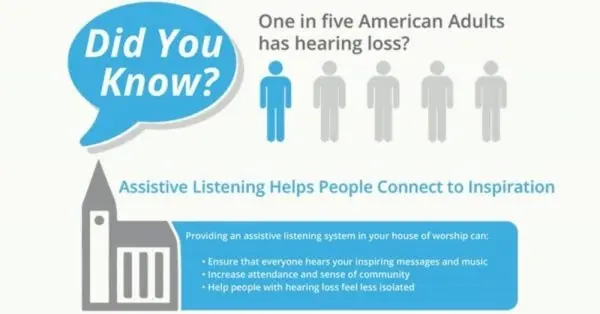
- Approximately 15% of American adults (37.5 million people aged 18 and older) report some degree of trouble hearing.
- The incidence of hearing loss increases dramatically with age. Among adults aged 60 to 69, roughly 18.9% experience disabling hearing loss; that figure skyrockets to nearly 43.2% for those aged 70 and older.
- Despite these high numbers, studies indicate that only a fraction of individuals who could benefit from hearing aids actually use them consistently, and standard hearing aids alone are often insufficient in large, reverberant spaces like traditional church sanctuaries.
The Acoustic Challenge of Houses of Worship
Sanctuary architecture historically prioritizes aesthetic grandeur and acoustic resonance to amplify acoustic music, choirs, and unamplified human voices. However, modern worship services often feature amplified contemporary bands, multi-track backing tracks, and spoken-word presentations through complex PA systems.

When high reverberation times (RT60) combine with high ambient noise floors—such as air conditioning units, whispering children, and shuffling papers—the speech transmission index (STI) plummets. For a person with normal hearing, the brain can subconsciously fill in missing acoustic cues. For an individual with sensorineural hearing loss or age-related presbycusis, the incoming audio signal becomes an unintelligible wash of sound.
The Psychological Cost of Exclusion
The impact of unaddressed hearing loss in a communal setting extends far beyond mere frustration; it exacts a heavy psychological toll. When individuals cannot comprehend the sermon, scripture, or communal prayers, they frequently experience:
- Social Isolation: Feeling disconnected from the spiritual body and conversations during fellowship time.
- Embarrassment and Fatigue: Constantly straining to hear leads to extreme cognitive fatigue, often causing attendees to withdraw entirely from public worship.
- Spiritual Attrition: Over time, individuals who feel alienated by inaccessible services may stop attending church altogether, severing vital pastoral relationships during times in their lives when they need community support the most.
Installing an Assistive Listening System directly combats these negative outcomes. By restoring clarity to the spoken word, churches validate the dignity of every congregant, reinforcing the theological imperative that every individual is an essential part of the body of believers.
Official Statements and Industry Insights
Industry leaders, accessibility advocates, and integration experts consistently emphasize that assistive listening is no longer an optional "add-on" for progressive churches, but a fundamental component of hospitality and legal compliance.
"Reaching out to those who feel disconnected from your community due to hearing loss is central to sharing the message of inclusion. Genuinely compassionate service involves being aware of and caring for the needs of everyone, especially those dealing with impairments. Make sure they are able to hear the beauty and emotion of the spoken word in your church by providing them with the equipment they need to stay connected."
— Accessibility Integration Guidelines, CCI Solutions
From a regulatory standpoint, houses of worship are increasingly viewed under the broader umbrella of public accommodation. While religious entities have historically enjoyed certain exemptions under specific clauses of the Americans with Disabilities Act (ADA) regarding structural changes, the moral, ethical, and practical imperatives far outweigh legal technicalities. Providing equal access to the spoken word is an expression of radical hospitality.
Manufacturers have responded to these demands by creating comprehensive deployment assets. For example, Listen Technologies has published specialized implementation resources designed to streamline the adoption process for faith communities. Their flagship publication, the Listen Technologies Church Assistive Listening Toolkit, provides churches with downloadable sample surveys, printable signage templates, operational checklists, and bulletin announcement drafts.
Industry experts stress that technology manufacturers and system integrators must work collaboratively with church boards. By taking advantage of free educational toolkits and professional site evaluations, churches can bypass the steep learning curve traditionally associated with acoustic engineering and accessibility compliance.
Future Outlook: The Evolution of Worship Accessibility
As audio-visual technology continues to advance at a rapid pace, the landscape of assistive listening within houses of worship is undergoing a profound transformation. Looking toward the future, several emerging trends and technological shifts are set to redefine how churches deliver inclusive audio experiences.
1. The Shift Toward Personal Device Streaming (Wi-Fi Audio)
While traditional RF and infrared systems remain widely deployed, the future of assistive listening is leaning heavily toward Wi-Fi-based audio streaming solutions. These systems allow users to download a dedicated app onto their own smartphones or smart devices, connecting directly to the church’s wireless network to stream crystal-clear, zero-latency audio straight to their personal earbuds, headphones, or Bluetooth-enabled hearing aids.
- Advantages of Wi-Fi Streaming:
- Reduced Hardware Overhead: Churches no longer need to maintain, sanitize, and store dozens of dedicated physical receivers.
- User Familiarity: Congregants use devices they already own and understand intimately (their smartphones).
- Discreet Inclusion: Users experience zero social stigma, as wearing smartphone earbuds is completely normalized in modern public spaces.
2. Integration with Auracast™ and Bluetooth Low Energy (LE) Audio
The next major frontier in hearing accessibility is Bluetooth Auracast™. This emerging broadcast audio standard allows an audio source—such as a church’s soundboard—to broadcast a public audio stream directly to an unlimited number of compatible Bluetooth receivers, hearing aids, and cochlear implants simultaneously.
As hearing aid manufacturers rapidly adopt Auracast™ technology, houses of worship will soon be able to broadcast ultra-high-quality audio directly into congregants’ hearing aids without requiring intermediate bodypack receivers, neck loops, or venue-specific apps. Churches that upgrade their AV infrastructure today with flexible, forward-looking IP and digital audio distribution systems will be uniquely positioned to adopt Auracast™ protocols as they become the universal standard.
3. Holistic Accessibility as a Core Metric of Church Health
In the years to come, the definition of a "welcoming church" will expand to encompass comprehensive digital, physical, and sensory accessibility. Facilities that embrace Assistive Listening Systems today are establishing a culture of proactive empathy.
Ultimately, the future of worship technology is not merely about achieving higher decibel levels, pristine frequency response, or dazzling visual displays. It is about human connection. By investing in the tools that ensure every word of grace, comfort, and truth reaches the ears and hearts of those who struggle to hear, houses of worship fulfill their highest calling: ensuring that no one is left standing in silence.
Actionable Next Steps & Resources
For church leadership, AV teams, and facility committees ready to take action, comprehensive tools are readily available to guide your next moves:
- Download the Toolkit: Access the official Listen Technologies Church Assistive Listening Toolkit for sample congregation surveys, ADA signage templates, and ready-to-use bulletin announcements.
- Schedule a Consultation: Reach out to integration partners like CCI Solutions to request a professional, no-obligation evaluation of your sanctuary’s acoustic environment and budgeting options.
- Assess Your Body: Print and distribute the preliminary accessibility survey to your congregation this Sunday to evaluate the true scope of hearing needs within your community.
Let your house of worship stand as a beacon of complete inclusion—where every spoken word is shared, and every member stays fully connected.