
Executive Overview
In an era where modern houses of worship constantly seek innovative ways to engage their congregations, digital projection, acoustic optimization, and dynamic lighting often steal the spotlight. Yet, one of the most critical elements of a truly welcoming and accessible worship environment remains deeply personal and frequently overlooked: the auditory experience. For millions of individuals navigating hearing loss, attending a weekly service can often feel isolating rather than uplifting. The inability to clearly understand the spoken word, scripture readings, or musical lyrics creates an unintended barrier, disconnecting eager participants from the spiritual heart of the community.
To bridge this profound gap, forward-thinking faith communities are increasingly turning to Assistive Listening Systems (ALS). However, the successful integration of these technologies requires far more than merely purchasing and plugging in audio hardware. It demands a strategic, compassionate, and well-executed deployment plan that accounts for congregational demographics, budgetary constraints, staff training, and continuous community outreach.
This comprehensive guide explores the multi-faceted approach required to successfully implement an Assistive Listening System within a house of worship. Drawing on industry best practices and insights from audio-visual integration experts, this report outlines a definitive roadmap for church leadership—spanning initial assessment, financial planning, operational readiness, and long-term community engagement. By prioritizing auditory accessibility, ministries can fulfill their core mission of radical inclusion, ensuring that every member of the congregation can fully absorb the beauty, emotion, and power of the spoken word.
Detailed Chronology: The Four-Phase Implementation Roadmap
Implementing an Assistive Listening System requires a methodical, step-by-step approach. Rushing the process or failing to consult key stakeholders can result in underutilized equipment and continued frustration among congregants. To maximize return on investment and ensure optimal user adoption, churches should follow a structured four-phase chronology.
Phase 1: Understanding Your Congregation’s Unique Needs
The foundational step in any successful audio accessibility project is gathering accurate, actionable data regarding the congregation’s specific hearing challenges. Assumptions about who can or cannot hear clearly during services can lead to misguided technology purchases. Therefore, church leadership must initiate a comprehensive discovery phase.
The most effective mechanism for this assessment is a targeted survey distributed to the congregation. This survey should be designed to capture quantitative and qualitative insights, asking pointed questions about:
- Individual experiences during standard worship services (e.g., distinguishing speech from background music or reverberation).
- The prevalence of hearing aid usage among members.
- Whether current hearing aids are equipped with telecoils (t-coils), a critical feature that directly interfaces with modern induction loop systems.
By collecting this data, audio technicians and church administrators can accurately determine the scale of the required deployment. For instance, a congregation with a high percentage of t-coil-compatible hearing aid users may benefit immensely from a hearing loop, whereas a community with diverse, non-hearing-aid-wearing demographics might require a combination of FM or Wi-Fi-based receivers and lightweight headphones.
Phase 2: Evaluating Options and Financial Planning
Once the congregation’s needs are clearly mapped, the next critical phase involves evaluating technological options and establishing a realistic budget. The marketplace offers a variety of Assistive Listening Systems—including FM systems, Infrared (IR) systems, Wi-Fi-based streaming solutions, and Audio Frequency Induction Loops (AFILs)—each with distinct cost structures, installation requirements, and coverage capabilities.
Navigating these options can be daunting for church boards and facility managers. Fortunately, specialized integration partners, such as CCI Solutions, provide invaluable assistance during this phase, offering expert guidance and free consultations tailored to specific budgetary frameworks.
Because capital expenditures for church technology are often tightly managed, faith communities must also explore creative funding mechanisms. Many successful installations are made possible through targeted fundraising campaigns, memorial gifts, or dedicated grants focused on accessibility and disability inclusion. Framing the purchase of an assistive listening system not as a technical upgrade, but as a vital ministry of hospitality, can significantly boost donor enthusiasm and financial support.
Phase 3: Preparing Staff and Volunteers for Operational Success
Hardware is only as effective as the people operating it. Even the most advanced Assistive Listening System will fail if staff members and volunteers are uncertain about how to distribute, maintain, or troubleshoot the devices. Preparing for success requires transforming key personnel into knowledgeable "Assisted Listening Ambassadors."
Training should encompass more than a brief tutorial; it must instill confidence. Volunteers stationed at welcome desks or audio-visual booths must be thoroughly trained on the precise mechanics of every device. When a congregant checks out a receiver, the ambassador should take a moment to gently and respectfully guide the user through its basic functions, volume controls, and sanitary ear-piece options.
To ensure consistency and eliminate friction during high-traffic Sunday mornings, facilities should maintain a laminated, easy-to-read sheet of Frequently Asked Questions (FAQs) directly at the distribution counter. This quick-reference guide should address common user inquiries, battery replacement procedures, and basic troubleshooting steps, empowering volunteers to resolve minor issues swiftly and professionally.
Phase 4: Creating Awareness and Driving Community Engagement
An exceptional Assistive Listening System achieves little if the target audience remains unaware of its existence. The final phase of implementation focuses on robust, multi-channel communication designed to inform both current congregants and the wider geographical community.
First, houses of worship must deploy clear, universally recognized signage indicating that Assisted Listening Devices are available, along with directional cues pointing to the distribution desk. Second, continuous reminders should be integrated into weekly printed bulletins, digital slide presentations prior to the service, and verbal announcements from the stage.
To help hesitant users overcome any apprehension regarding new technology, churches can host a dedicated live training session or workshop. This allows congregants to test the equipment in a relaxed, low-pressure environment before the pressures of a live service begin. Furthermore, extending this outreach to the surrounding community—through local advertising, senior center partnerships, and digital media—can attract individuals who previously abandoned church attendance due to hearing barriers, effectively welcoming them back into a supportive spiritual home.
Supporting Context & Metrics: The Hidden Impact of Hearing Loss
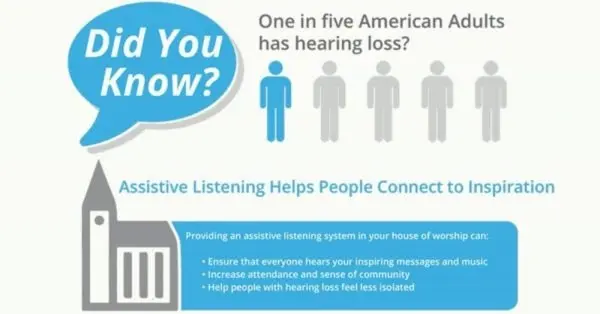
To fully appreciate the urgency of implementing an Assistive Listening System, leadership teams must examine the broader socio-demographic and psychological data surrounding hearing impairment. Hearing loss is one of the most prevalent chronic physical conditions affecting adults globally, yet it remains profoundly misunderstood and under-accommodated in public spaces.

According to demographic health data, millions of adults experience varying degrees of hearing loss, with incidence rates climbing steadily alongside aging populations. In the context of a typical faith community, a significant percentage of regular attendees over the age of sixty experience age-related hearing decline (presbycusis). However, hearing loss is not restricted to seniors; congenital conditions, noise-induced damage, and illnesses affect individuals across all age brackets.
When individuals with hearing impairments attend traditional worship services, they face unique acoustic challenges. Modern sanctuaries are often architecturally expansive, featuring hard reflective surfaces like stone, glass, and wood that create reverberation and echo. While aesthetically pleasing, these architectural choices degrade speech intelligibility. Sound reinforcement systems (PA systems) amplify volume, but they also amplify background noise and reverberation, which does little to help a struggling listener distinguish individual words.
The psychological fallout of unmanaged hearing loss in social and religious settings is well-documented by sociologists and audiologists. Individuals frequently experience:
- Social Isolation: Struggling to catch conversational nuances during fellowship time or missing sermon points leads many to withdraw entirely from community life.
- Exhaustion: The intense cognitive effort required to lip-read or strain to hear over ambient noise results in "listening fatigue," leaving attendees drained rather than spiritually renewed.
- Diminished Participation: Feeling disconnected from the spoken word undermines the core communal experience of shared worship.
By installing an Assistive Listening System, churches directly counteract these negative outcomes. Metrics from accessibility advocates indicate that houses of worship offering reliable assistive listening technologies report higher retention rates among senior members, increased engagement in small-group ministries, and a notable influx of new visitors who finally feel accommodated and valued.
Official Statements and Expert Perspectives
Industry leaders and accessibility advocates consistently emphasize that audio accommodation is a fundamental component of modern pastoral care. The integration of assistive listening technology is viewed less as a regulatory compliance checkbox and more as an extension of radical Christian hospitality.
"Reaching out to those who feel disconnected from your community due to hearing loss is central to sharing the message of inclusion," notes an advocacy brief from Listen Technologies. "Genuinely compassionate service involves being aware of and caring for the needs of everyone, especially those dealing with impairments. Make sure they are able to hear the beauty and emotion of the spoken word in your church by providing them with the equipment they need to stay connected."
Audio-visual integration specialists reinforce this sentiment, stressing that the acoustic environment of a church should actively serve every occupant.
"Too often, sound design in houses of worship focuses solely on musical performance and raw volume," explains a senior AV consultant specializing in sacred spaces. "True acoustic excellence, however, is measured by intelligibility. Can the elderly parishioner in the back row hear the whispered nuance of a pastoral prayer just as clearly as the lead vocalist? If the answer is no, the system is incomplete. Assistive Listening Systems are the ultimate equalizer in achieving absolute clarity."
Furthermore, legal and ethical standards increasingly underscore the importance of public accessibility. While religious institutions may sometimes have specific exemptions under regional civil rights legislation regarding public accommodations, the moral imperative to welcome all individuals regardless of physical ability remains paramount for spiritual leadership.
Future Outlook: The Evolution of Accessible Worship
Looking toward the horizon, the landscape of assistive listening and church audio technology is poised for rapid evolution. As digital connectivity deepens and personal smart devices become ubiquitous, the barriers between dedicated church hardware and personal consumer electronics are beginning to blur.
The Rise of Bring-Your-Own-Device (BYOD) Solutions
Traditional assistive listening models relied exclusively on dedicated, church-owned receivers and cumbersome headphones or ear-loops. While these devices remain essential for individuals who do not own smartphones, modern Wi-Fi-based assistive listening systems allow users to stream high-definition, zero-latency audio directly to their own smartphones or Bluetooth-enabled hearing aids via custom mobile apps. This shift not only reduces the administrative burden of cleaning, charging, and maintaining physical receivers for church volunteers but also removes the subtle social stigma some individuals feel when asking for specialized assistive equipment at a welcome desk.
Integration with Advanced Acoustic Modeling
Future church renovations and new builds will increasingly incorporate sophisticated acoustic modeling software alongside integrated assistive listening loops from the ground up. Rather than treating hearing loops or FM transmitters as retrofitted band-aids, acousticians are designing sanctuary spaces where room geometry, speaker dispersion patterns, and induction loop wiring work in seamless synergy to eliminate dead zones and provide pristine audio coverage across every square foot of seating.
Comprehensive Accessibility Toolkits
To assist religious organizations in navigating these technological leaps, industry leaders are continuously refining educational resources. Comprehensive toolkits—such as the Listen Technologies Church Assistive Listening Toolkit—provide invaluable templates, sample surveys, signage layouts, and bulletin announcements. These resources empower non-technical church administrators to execute professional-grade accessibility rollouts without needing advanced degrees in acoustic engineering.
Conclusion: A Call to Action for Ministry Leaders
The ultimate measure of a thriving church community is not merely its seating capacity, musical polish, or architectural grandeur, but the depth of its compassion and its unwavering commitment to leaving no one behind. Hearing loss is an invisible barrier that silently alienates members of the flock from the profound comfort and inspiration of communal worship.
By systematically understanding congregational needs, carefully budgeting for technological solutions, rigorously training support staff, and proactively promoting new accessibility initiatives, churches can tear down these acoustic walls. Investing in an Assistive Listening System is an investment in human connection, ensuring that every soul within the sanctuary can clearly hear, absorb, and celebrate the message of grace.
For more detailed information on choosing the right Assistive Listening System and tools to ensure your success—including sample surveys, signage, and announcements—please download a copy of the Listen Technologies Church Assistive Listening Toolkit.
Does your worship facility currently meet the auditory needs of every member of your community? Let church leadership and AV integration specialists help you evaluate how an assistive listening system can transform your ministry today.