
Executive Overview
In the modern landscape of religious and spiritual assembly, inclusivity extends far beyond the physical accessibility of ramps and automatic doors. While architectural modifications have rightfully taken center stage in ADA compliance over the past several decades, a critical sensory barrier frequently remains unaddressed within the sanctuary: hearing loss. For millions of congregants globally, the Sunday sermon, the communal prayers, and the emotional resonance of spoken liturgy are obscured by acoustic challenges, poor room design, or unmanaged hearing impairments.
Houses of worship face a profound moral and operational imperative to bridge this gap. Implementing an Assistive Listening System (ALS) is no longer merely an optional enhancement for a select few; it is a fundamental component of radical hospitality and spiritual inclusion. However, deploying such technology successfully requires moving beyond a simple hardware purchase. It demands a strategic, multi-phased approach that encompasses congregation assessment, financial planning, rigorous staff and volunteer training, and proactive community outreach.
This report provides an authoritative, in-depth guide for church leadership, technical directors, and administrative boards seeking to integrate or upgrade assistive listening infrastructure. Drawing on industry best practices, expert consultations, and deployment toolkits from leading acoustic innovators like Listen Technologies and integration partners such as CCI Solutions, this blueprint outlines the systematic journey from initial needs analysis to long-term community engagement. By treating assistive listening as a vital ministry rather than an afterthought, worship facilities can ensure that every message is heard, every heart is reached, and no member of the congregation is left isolated by hearing loss.
Detailed Chronology: The Four-Phase Implementation Roadmap
The successful integration of an Assistive Listening System into a worship environment is a methodical process. Rushing through procurement without a clear foundational strategy often leads to underutilized equipment, frustrated users, and wasted capital. To maximize return on investment—both spiritually and financially—leadership teams should follow a structured, four-phase implementation chronology.
Phase 1: Needs Assessment and Congregational Discovery
The foundational step in any infrastructure upgrade is data collection. Before evaluating radio frequency (RF), infrared (IR), or Wi-Fi-based listening systems, church leadership must accurately diagnose the specific demographic and acoustic realities of their congregation.
- Conducting the Comprehensive Survey: The most effective mechanism for gauging demand is a well-structured survey distributed across both physical bulletins and digital platforms. This survey should ask targeted questions regarding the individual’s subjective experience during standard services. Do they struggle to understand the speaker over ambient reverberation? Do they already wear hearing aids? Crucially, administrators must inquire whether those hearing aids are equipped with telecoils (t-coils), as this dictates whether a neck-loop infrastructure or a simpler receiver-based model will provide the optimal user experience.
- Analyzing the Acoustic Environment: Beyond the congregation’s self-reported needs, facilities managers must evaluate the physical space. High ceilings, large open sanctuaries, and hard reflective surfaces—while aesthetically pleasing—create significant acoustic challenges. Understanding how sound travels in the room allows technical teams to match the appropriate ALS technology (such as induction loop systems versus wide-band RF systems) to the architectural layout of the building.
Phase 2: Financial Planning and Strategic Procurement
Once the scope of the congregational need is established, the focus shifts to budgeting, equipment selection, and cost mitigation. Audio technology can represent a significant capital expenditure, but strategic planning can alleviate financial pressure.
- Consultation and Cost Estimation: Estimating the exact cost of transmitters, receivers, charging stations, and interface cables requires specialized knowledge. Organizations such as CCI Solutions offer specialized assistance and complimentary consultations to help church boards align equipment specifications with real-world operating budgets.
- Creative Funding and Fundraising: For many congregations, capital improvement budgets are tightly constrained. Successful implementations often rely on targeted fundraising campaigns, memorial gifts, or dedicated grants from accessibility foundations. Framing the purchase of an ALS not as an administrative expense, but as a direct investment in evangelism and community care, routinely inspires generous giving from the broader membership.
Phase 3: Operational Readiness and Staff Training
The finest audio hardware in the world is rendered useless if staff and volunteers do not know how to operate, maintain, and distribute it. Phase 3 focuses on operational execution and building a culture of service.
- Designating "Assisted Listening Ambassadors": Ushers, greeters, and AV technicians are the frontline of accessibility. These individuals must receive comprehensive, hands-on training regarding the deployment of assistive listening devices. They should not merely hand a device across a counter; they should act as empathetic ambassadors who understand how the technology works and can troubleshoot basic issues on the spot.
- Standardizing User Instruction: When checking out a receiver to a congregant, staff should take a moment to walk the user through the volume controls, ear-piece fit, and proper placement. To ensure consistency—especially when volunteers rotate on a weekly basis—facilities should maintain a laminated, easy-to-read sheet of Frequently Asked Questions (FAQs) at the distribution desk. This simple administrative control eliminates friction and builds confidence among elderly or technically hesitant users.
Phase 4: Cultivating Awareness and Community Outreach
An investment in accessibility is only successful if the target audience knows the resource exists and feels welcomed to use it. Phase 4 transforms a technical installation into a vibrant ministry of inclusion.
- Visual Signage and Ongoing Reminders: Proper, high-contrast international symbols for accessibility should be prominently displayed at every entrance, informing visitors that Assisted Listening Devices are available and directing them precisely where to acquire them. Furthermore, weekly bulletins, digital slide decks, and website announcements should serve as gentle, continuous reminders of this service.
- Live Training and Community Advertising: To demystify the technology, some progressive churches host dedicated live training sessions or open houses where members can test the equipment in an empty sanctuary before a service. Beyond the existing walls of the church, marketing these accessibility features to the surrounding secular community can yield remarkable results. Many individuals with age-related or congenital hearing loss have stopped attending public gatherings simply because they feel disconnected; hearing that a church has invested in their ability to participate can be the catalyst that brings them through the doors.
Supporting Context & Metrics: The Hidden Reality of Hearing Loss
To fully appreciate the necessity of implementing an Assistive Listening System, leadership teams must examine the demographic data and psychological impacts surrounding hearing impairment in modern society.

+-----------------------------------------------------------------+
                 DEMOGRAPHIC & AUDIOLOGICAL CONTEXT
+-----------------------------------------------------------------+
 |  • Millions of adults experience disabling hearing loss        |
 |  • Age-related hearing decline impacts a vast percentage        |
 |    of traditional church demographics                          |
 |  • Untreated hearing loss strongly correlates with:            |
 |      - Social isolation and withdrawal                         |
 |      - Increased risk of cognitive decline                     |
 |      - Disconnection from spiritual communities                |
+-----------------------------------------------------------------+
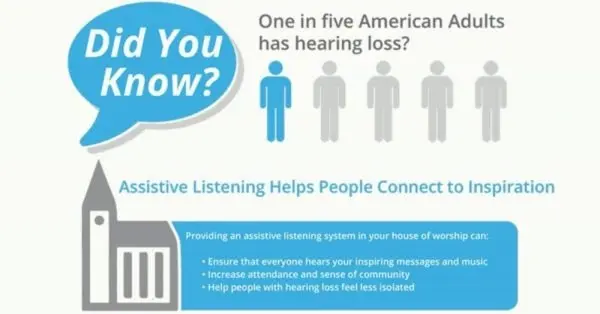
According to public health data, millions of adults globally experience disabling hearing loss, with prevalence increasing sharply with age. Because a significant portion of active churchgoers skew toward older demographics, the statistical probability that a non-trivial percentage of any given congregation is struggling to comprehend spoken dialogue is virtually 100%.
However, the implications extend far beyond simple acoustics. Audiological research consistently demonstrates that unmanaged hearing loss is not merely an inconvenience; it is a profound driver of social isolation. When individuals can no longer follow a sermon, engage in fellowship hour discussions, or participate in responsive readings without severe cognitive strain, they frequently choose withdrawal over embarrassment. They stop attending services.
By failing to provide assistive listening infrastructure, a church inadvertently creates a barrier to fellowship. Conversely, when a worship center proactively installs systems that comply with or exceed accessibility guidelines, it sends an unmistakable message of radical welcome. It acknowledges that every individual—regardless of their physical sensory capacities—is an valued, integral member of the body of believers.
Official Statements and Industry Insights
Industry experts and accessibility advocates emphasize that technology is fundamentally a tool for pastoral care. The integration of assistive listening is viewed by leaders in acoustic engineering not as an engineering challenge to be solved, but as a human imperative to be fulfilled.
"Reaching out to those who feel disconnected from your community due to hearing loss is central to sharing the message of inclusion. Genuinely compassionate service involves being aware of and caring for the needs of everyone, especially those dealing with impairments."
— Industry Accessibility Consensus
Technical specialists point out that the evolution of assistive listening technology—spanning from archaic loop systems to sophisticated digital radio frequency and Wi-Fi streaming platforms—has made crystal-clear audio more accessible and affordable than ever before.
Furthermore, organizations like Listen Technologies have developed comprehensive resources, such as the House of Worship Assistive Listening Toolkit, designed to remove the guesswork from deployment. These toolkits provide institutional leadership with the exact compliance documents, sample congregation surveys, standardized signage templates, and bulletin announcements required to execute a seamless rollout. Experts maintain that leveraging these pre-packaged resources allows church administrators to bypass trial-and-error phases and focus their energy where it matters most: ministering to their people.
Future Outlook: The Next Horizon in Sanctuary Accessibility
As audio-visual technology continues to advance at a breakneck pace, the future of assistive listening in houses of worship points toward convergence, personalization, and seamless wireless integration.
- The Shift Toward Personal Device Integration: Traditional models relied exclusively on the church purchasing and maintaining a fleet of dedicated receivers and hygienic earpieces. While these will remain vital for guests who do not carry smart devices, the next frontier relies on streaming audio directly to congregants’ personal smartphones or Bluetooth-enabled hearing aids via low-latency Wi-Fi protocols. This minimizes hardware management for church staff while maximizing user comfort and discretion.
- Artificial Intelligence and Dynamic Acoustic Compensation: Future sanctuary audio systems will increasingly incorporate AI-driven digital signal processors (DSP) that automatically adjust for room reverberation, background noise, and individual hearing loss profiles in real-time. As these technologies mature, the line between general sanctuary sound reinforcement and personal assistive listening will continue to blur, creating a universally accessible acoustic environment.
In conclusion, the integration of an Assistive Listening System is far more than an AV upgrade; it is a profound theological statement. It declares that the spoken word, the shared prayer, and the communal bond are treasures meant to be shared without exception. By understanding congregational needs, planning strategically, training operational staff, and cultivating community awareness, houses of worship can ensure that their message resonates clearly in every ear and heart.