
Executive Overview
In an era where modern houses of worship heavily invest in architectural grandeur, state-of-the-art line array audio systems, and immersive visual projection technologies, a significant portion of the congregation often remains acoustically isolated. Hearing loss is one of the most pervasive yet frequently overlooked disabilities affecting modern communities. For millions of individuals, Sunday services, midweek studies, and celebratory gatherings are marred by a frustrating barrier: the inability to clearly comprehend the spoken word and the nuances of live musical worship.
The implementation of an Assistive Listening System (ALS) is no longer merely an ADA compliance checkbox or an optional ministry amenity; it is a vital expression of radical hospitality and spiritual inclusion. When a church fails to accommodate those with hearing impairments, it inadvertently locks them out of the communal dialogue, discipleship, and shared worship experience.
However, deploying an ALS effectively requires strategic foresight, careful budgetary planning, dedicated staff training, and robust internal communication. Too often, churches purchase expensive assistive listening hardware, place it in a drawer, and wonder why utilization rates remain negligible. Bridging this gap requires an intentional, multi-step framework that transforms technology into ministry.
This comprehensive report examines the strategic imperatives of deploying an Assistive Listening System within a faith-based setting. Drawing upon industry standards, acoustic engineering insights, and operational best practices, this guide outlines a four-step blueprint for success: assessing congregational needs, evaluating technological options, empowering staff through training, and driving awareness across both the congregation and the wider local community. By following this structured approach, leadership teams can ensure that every member of their community experiences the full beauty and emotional resonance of the spoken and sung word.
Detailed Chronology: The Four-Phase Implementation Roadmap
Successfully introducing an Assistive Listening System into a worship environment is a journey that demands methodical execution. To move from a vague desire to accommodate the hard of hearing to a fully operational, highly utilized ministry program, church leadership must navigate four distinct, sequential phases.
Phase 1: Deep Diagnostic Assessment of Congregational Needs
The foundational error many facility managers and audio engineers make is purchasing an ALS based solely on architectural specifications or vendor recommendations without consulting the end-users. The first and most critical step in the implementation timeline is conducting a comprehensive, data-driven assessment of your congregation’s actual hearing-assistance needs.
To accomplish this effectively, churches must deploy a targeted survey across their community. This diagnostic tool should go beyond a simple "Do you have trouble hearing?" inquiry. It must delve into specific behavioral patterns and medical realities:
- Service Experience Analysis: Ask respondents to rate their current comprehension levels during various parts of the service, including spoken prayer, pastoral preaching, acoustic music, and high-decibel contemporary worship sets.
- Device Utilization: Inquire whether congregants currently wear hearing aids or cochlear implants, and specifically whether those devices are equipped with telecoils (t-coils).
- Acoustic Environment Feedback: Gather qualitative data regarding specific trouble spots in the auditorium—such as under balcony overhangs, near HVAC return vents, or in peripheral seating sections where phase cancellation and reverberation are most acute.
By aggregating this data, the administrative and AV teams can build an accurate demographic profile of the demographic that will benefit most from the investment, ensuring that the chosen technology directly matches the physical realities of the room and the audience.
Phase 2: Comprehensive Technological and Financial Evaluation
Once the diagnostic phase has established the scope of the need, leadership must conduct a thorough market and budgetary evaluation. The audio technology landscape offers multiple solutions—including Infrared (IR), Radio Frequency (RF), Wi-Fi-based streaming audio, and Audio Frequency Induction Loops (hearing loops)—each carrying distinct cost profiles, installation requirements, and user experiences.
Estimated costs must be weighed against the church’s capital improvement budget. Fortunately, organizations do not have to navigate this labyrinth alone. Industry leaders and specialized AV integration firms, such as CCI Solutions, offer expert assistance in evaluating spatial acoustics, estimating hardware expenses, and designing scalable systems that fit within tight budgetary constraints.
Furthermore, churches should explore dedicated fundraising campaigns, specialized grants, or memorial gifts to offset capital expenditures. Positioning an ALS installation as a "compelling ministry campaign" rather than a mundane "facility maintenance expense" often unlocks unprecedented generosity among donors who recognize the deeply personal impact of hearing accessibility.
Phase 3: Operational Readiness and Staff Training
Purchasing cutting-edge technology is insufficient if the people responsible for its daily distribution are unprepared. The operational success of an ALS hinges entirely on the front-line staff and volunteers—the ushers, welcome team members, and audio-visual technicians who interact directly with attendees.
Think of these individuals not merely as hospitality personnel, but as Assisted Listening Ambassadors. Their posture, knowledge, and confidence will dictate whether an elderly or hearing-impaired visitor feels welcomed or stigmatized.
- Comprehensive Onboarding: All weekend volunteers must receive hands-on training regarding how to turn on, sanitize, troubleshoot, and distribute the listening receivers or neck loops.
- Personalized Instruction: When a device is checked out to a congregant, the ambassador must take an extra minute to demonstrate its functions, adjust the volume levels, and ensure a comfortable fit. Never simply hand a device across a counter in silence.
- Visual Reference Aids: To alleviate cognitive load and reduce human error during high-traffic Sunday morning rushes, facilities should maintain a laminated, step-by-step FAQ sheet and troubleshooting guide directly at the distribution desk or reception counter.
Phase 4: Strategic Marketing and Community Awareness
Even the most advanced Assistive Listening System is useless if nobody knows it exists. Transitioning to Phase 4 involves a sustained, multi-channel awareness campaign designed to destigmatize hearing loss and aggressively promote the availability of the new technology.
- Clear Signage: Install professional, ADA-compliant signage at every primary entrance, welcome center, and seating section, clearly indicating that Assisted Listening Devices (ADDs) are available and showing precisely where to acquire them.
- Print and Digital Reminders: Embed brief, inviting notices in every weekly bulletin, digital newsletter, and pre-service multi-media slide presentation.
- Live Educational Demonstrations: Consider hosting a dedicated orientation or live training session during a midweek gathering, allowing congregants to test the technology in a low-stress environment and familiarize themselves with the equipment.
- External Community Outreach: Broaden the marketing scope beyond the existing membership. Local senior centers, retirement communities, and regional audiologists should be notified that your facility is fully accessible. Many individuals who have dropped out of church attendance due to progressive hearing loss will return—or visit for the first time—when they realize your facility actively cares about their sensory inclusion.
Supporting Context & Metrics: The Hidden Epidemic of Acoustic Isolation
To fully grasp the urgency of deploying an Assistive Listening System, leadership teams must examine the broader socioeconomic and physiological landscape of hearing loss in modern society.

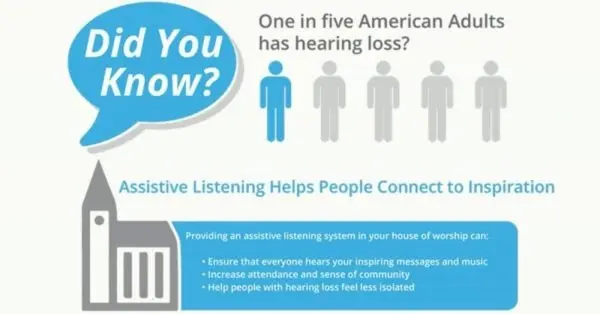
According to data compiled by the World Health Organization (WHO) and the Hearing Loss Association of America (HLAA), over 48 million Americans experience some degree of hearing loss. While this condition is statistically more prevalent among older adults—affecting roughly one in three individuals over the age of 65—it increasingly impacts younger demographics due to occupational noise exposure and the ubiquitous use of personal earbuds.
The Psychological Toll of Acoustic Exclusion
When an individual sits in a cavernous worship auditorium with poor acoustic treatment or a muddy sound mix, they face a severe cognitive burden. Listening in a reverberant space requires intense lip-reading, context-guessing, and cognitive processing. Over the course of a 75-minute service, this manifests as "listening fatigue," leaving the attendee mentally exhausted, frustrated, and ultimately detached.
Sociological studies consistently link untreated hearing loss to:
- Social Isolation: Individuals withdraw from communal gatherings to avoid the embarrassment of misunderstanding conversations or missing spoken cues.
- Depression and Anxiety: The inability to participate fully in shared spiritual and emotional experiences accelerates feelings of irrelevance and loneliness.
- Spiritual Drift: When people cannot hear the sermon illustrations, scripture readings, or pastoral prayers, the sanctuary ceases to be a place of connection and becomes an alienating environment.
Technological Overview: Matching Hardware to Congregation
Modern assistive listening systems operate via several primary technological modalities, each with distinct advantages:
- Audio Frequency Induction Loops (Hearing Loops): These systems transmit audio signals electromagnetically directly to a telecoil (t-coil) inside the user’s personal hearing aid or cochlear implant. Advantage: Users do not need to wear awkward, conspicuous external receivers; the sound goes directly into their custom-calibrated hearing devices.
- Radio Frequency (RF) Systems: These systems broadcast audio over FM radio frequencies from a transmitter to pocket-sized receivers equipped with headphones or neck loops. Advantage: Highly reliable, excellent range, and cost-effective for large spaces.
- Wi-Fi Streaming Systems: Utilizing local wireless networks, these systems stream ultra-low-latency audio directly to congregants’ smartphones via a downloadable app, where they can listen using their own earbuds or Bluetooth-enabled hearing aids. Advantage: Appeals to tech-savvy users and minimizes hardware maintenance overhead for the church.
Official Statements and Expert Guidance
Industry leaders, accessibility advocates, and architectural acousticians universally emphasize that accessibility must be baked into the foundational philosophy of ministry design, rather than treated as an afterthought.
"Reaching out to those who feel disconnected from your community due to hearing loss is central to sharing the message of inclusion. Genuinely compassionate service involves being aware of and caring for the needs of everyone, especially those dealing with impairments. Make sure they are able to hear the beauty and emotion of the spoken word in your church by providing them with the equipment they need to stay connected."
— Ministry Technology & Accessibility Coalition
Furthermore, organizations specializing in house of worship audio engineering stress that compliance with federal regulations, such as the Americans with Disabilities Act (ADA), establishes only a minimum legal floor, not a ceiling for excellence. The ADA mandates that assembly areas with fixed audio systems must have assistive listening systems available for a designated percentage of total capacity. However, legal compliance should never be the primary motivator for a church; the true driving force must be pastoral care and spiritual stewardship.
To empower facility teams, industry resources such as the Listen Technologies Church Assistive Listening Toolkit provide exhaustive, turnkey implementation assets. These toolkits furnish administrators with downloadable sample surveys, printable signage templates, slide graphics, and step-by-step liturgical announcements designed to streamline the rollout process.
Future Outlook: The Horizon of Inclusive Worship Technology
Looking ahead, the intersection of assistive technology and house of worship audio engineering is poised for radical transformation. As artificial intelligence, machine learning, and advanced wireless protocols continue to mature, the future of hearing accessibility in sacred spaces will become increasingly seamless, personalized, and invisible.
1. AI-Driven Real-Time Transcription and Captioning
While traditional ALS hardware amplifies and clarifies acoustic signals, emerging systems are incorporating automated speech recognition (ASR) driven by artificial intelligence. In the near future, mid-sized and large churches will routinely integrate real-time captioning feeds onto sanctuary projection screens or personal mobile devices. This technology translates spoken sermons into readable text with near-instantaneous speed, providing an invaluable secondary layer of comprehension for the hard of hearing, non-native language speakers, and those processing neurodivergent learning styles.
2. Next-Generation LE Audio and Bluetooth Auracast
The commercial rollout of Bluetooth Low Energy (LE) Audio and Auracast broadcast technology represents a generational leap forward in assistive listening. Auracast allows an audio source—such as a church soundboard—to broadcast multiple high-quality audio streams directly to an unlimited number of nearby Bluetooth-enabled hearing aids, earbuds, or smartphones simultaneously. This eliminates the need for specialized, costly venue receivers altogether, drastically lowering the financial barrier to entry for smaller churches while offering unprecedented audio fidelity to the end-user.
3. Holistic Architectural and Acoustic Integration
Forward-thinking churches are moving away from treating acoustics and accessibility as post-construction fixes. Architectural design firms are increasingly collaborating with acoustic consultants during the initial blueprint phase to engineer spaces with optimal speech transmission indices (STI), minimal slap-back echo, and integrated induction loop wiring embedded directly into the subfloor concrete.
Conclusion
The ultimate measure of a thriving church community is not merely its seating capacity, musical polish, or digital footprint, but its unwavering commitment to leaving the ninety-nine to care for the one. Hearing loss is an invisible barrier that quietly disenfranchises millions of devoted believers. By methodically assessing congregational needs, investing in the appropriate assistive listening technology, training staff to act as compassionate ambassadors, and aggressively raising awareness, churches can dismantle these acoustic barriers once and for all.
Investing in an Assistive Listening System is an investment in human dignity, spiritual connection, and the uncompromising proclamation of the Gospel to every single ear within reach.